

Most B2B teams think their competitive advantage comes from content, ads, or brand awareness. But the real advantage is sitting in their CRM, and the companies that understand this are building massive momentum in 2026, especially when you consider that AI search visitors convert 4.4x better than traditional organic visitors and spend up to 3x longer engaging with content.
Key Takeaways
|
Question |
Key Insight |
|---|---|
|
Why is CRM data important for AI marketing? |
CRM systems contain the most reliable first‑party customer signals, including buyer intent, deal progression, and engagement history. |
|
How do AI agents use CRM signals? |
AI agents analyze CRM activities to trigger campaigns, personalize messaging, and identify high‑value accounts. |
|
What makes CRM better than external data sources? |
CRM records reflect real customer behavior and sales outcomes, making them stronger indicators than third‑party data. |
|
What systems unify CRM intelligence? |
Platforms such as Omnibound’s Marketing Context Engine combine CRM signals with market intelligence. |
|
How does CRM influence AI‑driven marketing strategy? |
CRM signals guide content priorities, campaign triggers, and messaging decisions across marketing teams. |
|
Where can teams apply CRM intelligence today? |
Demand generation, product marketing, and content production can all leverage CRM data insights. |
The Shift from Search Engines to AI Decision Engines
The marketing stack changed quietly. Discovery now happens inside AI systems that analyze signals, context, and behavior before recommending vendors.
This means visibility no longer depends only on published content. AI systems surface companies based on structured intelligence about customers and markets.
Your CRM already contains that intelligence.
Account engagement, deal momentum, and conversation history are signals AI systems use to determine which companies deserve attention.
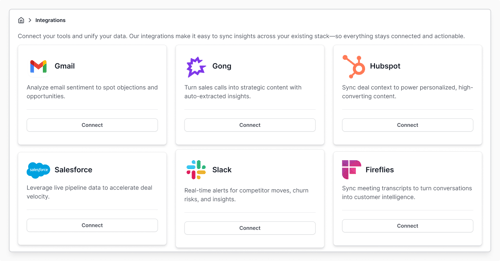

What AI Systems Actually Need to Work
AI agents do not run on prompts. They run on structured context.
Modern agentic systems operate around five components that determine how decisions are made.
- Role – what the AI system is responsible for
- Knowledge – data sources feeding the system
- Actions – tasks the system can execute
- Guardrails – rules controlling decisions
- Channels – where actions occur
The CRM becomes the knowledge layer that gives these systems real customer understanding.
Why CRM is the Highest Quality Data Source in Marketing
Marketing teams chase third‑party data while ignoring the strongest signal source they already own.
The CRM captures the entire buyer journey.
- Firmographic and company intelligence
- Deal stages and opportunity progression
- Email engagement and meeting history
- Demo requests and product interest
- Closed‑won and closed‑lost outcomes
This dataset tells AI systems exactly which customers convert and why.
That is why platforms like Intelligent Research continuously analyze CRM signals, sales calls, and support tickets to keep customer insights current.
The Hidden AI Power Inside CRM Data
When CRM signals feed AI agents, marketing stops guessing. Decisions become data driven.
Several autonomous workflows become possible immediately.
- Lead intelligence agents analyze engagement patterns to identify high‑value accounts.
- Personalization agents adjust messaging based on CRM history.
- Pipeline prediction agents estimate deal probability using past outcomes.
- Campaign optimization agents redirect budget toward segments that convert.
These systems operate continuously, analyzing signals that humans rarely notice.
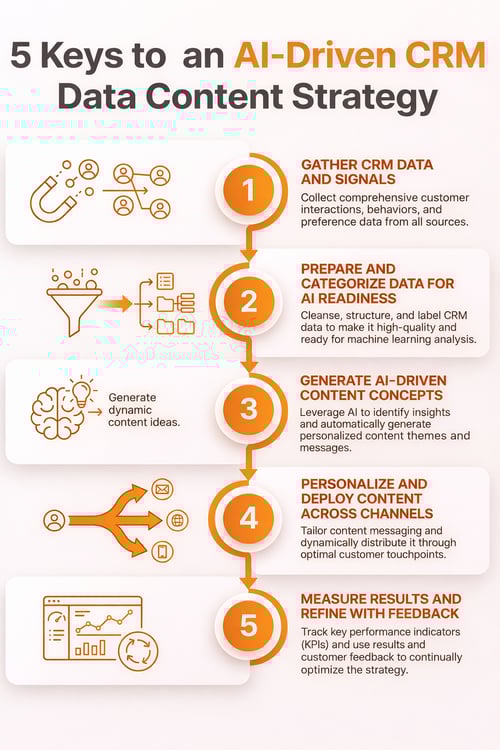
This infographic highlights the five key pillars of an AI-driven CRM data content strategy. Use it to align data quality, governance, and personalized customer content across teams.
Did You Know?
Companies that effectively combine first-party CRM data with AI-powered systems experience 20% faster sales cycles and higher deal conversion rates.
Why Most Companies Fail to Use CRM Data Properly
Most companies treat CRM as reporting software. That mindset kills its strategic value.
Instead of building signal intelligence, teams simply store records.
Four issues appear in nearly every organization:
- CRM used only for sales forecasting
- Customer data fragmented across tools
- Incomplete or inconsistent records
- No system for activating signals
AI cannot generate strategic insight without structured context.
How Leading B2B Teams Turn CRM Into an AI Growth Engine
High performing marketing teams do not treat CRM as storage. They treat it as intelligence infrastructure.
They follow a structured process.
- Clean the CRM signal layer with standardized industries, roles, and lifecycle stages.
- Connect marketing signals including product usage, campaigns, and engagement.
- Deploy AI agents that monitor signals and trigger actions.
- Feed insights into strategy for campaigns and messaging.
When executed properly, CRM becomes the central data layer powering marketing execution.
CRM Signals That Should Drive Your Content Strategy
Content should not be driven by guesswork. It should come directly from customer signals.
CRM data exposes which problems buyers care about, and which messaging drives deals forward.
- Sales call objections
- Frequently asked demo questions
- Industries with fastest deal velocity
- Messages correlated with closed deals
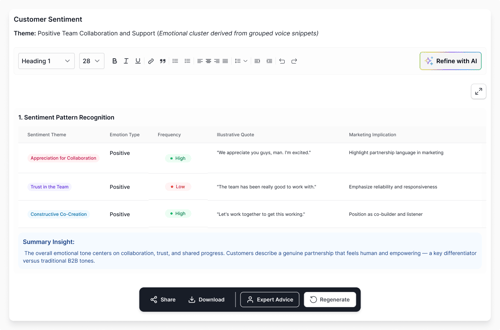
These insights feed systems like AI content marketing solutions that generate assets aligned with real buyer conversations.
Product Marketing Becomes Signal‑Driven
Product marketing teams traditionally rely on surveys and interviews. CRM signals provide something better, real buyer behavior.
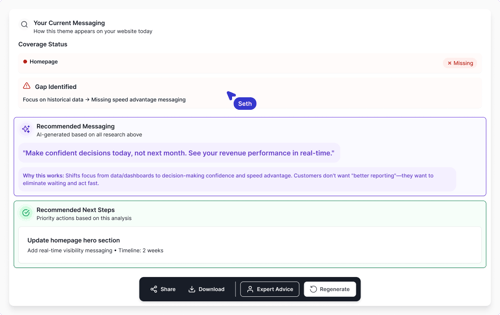
Win and loss patterns inside deals reveal positioning gaps instantly.
Solutions like Omnibound product marketing intelligence unify CRM activity, competitor signals, and customer conversations.
The result is positioning grounded in evidence rather than opinion.
Did You Know?
76% of organizations admit that less than half of their CRM data is accurate and complete, creating a foundation of sand for AI implementation.
Security and Governance for CRM‑Powered AI
AI systems that access CRM signals must follow strict governance. Without strong controls, organizations risk exposing sensitive customer information.
Enterprise platforms integrate encryption, identity management, and monitoring into every layer.
Organizations deploying AI systems grounded in CRM data rely on practices outlined in security‑by‑design frameworks.
The Future of B2B Marketing: CRM as the Brain of AI
The next generation of marketing stacks will look simple.
CRM collects signals. AI agents interpret those signals. Marketing systems execute actions.
Instead of manually managing campaigns, teams define objectives while AI systems run the workflows.
Privacy and governance frameworks like customer data protection policies ensure these systems remain trustworthy.
Conclusion
Most B2B companies believe their advantage in AI marketing comes from better tools or faster automation. That assumption is wrong.
The companies winning in 2026 focus on better data.
Your CRM already contains the most valuable signals in your organization. It captures buyer intent, deal progression, and the language customers use when making decisions.
When AI systems gain access to that signal layer, marketing stops producing generic content and starts operating on real market intelligence. Teams that treat CRM as an AI signal engine will build a lasting competitive advantage in the next generation of B2B marketing.
.png?height=245&name=Why%20B2B%20AI%20Search%20Requires%20More%20Than%20a%20CMS%20(And%20What%20Modern%20Marketing%20Stacks%20Must%20Do%20Instead).png)