


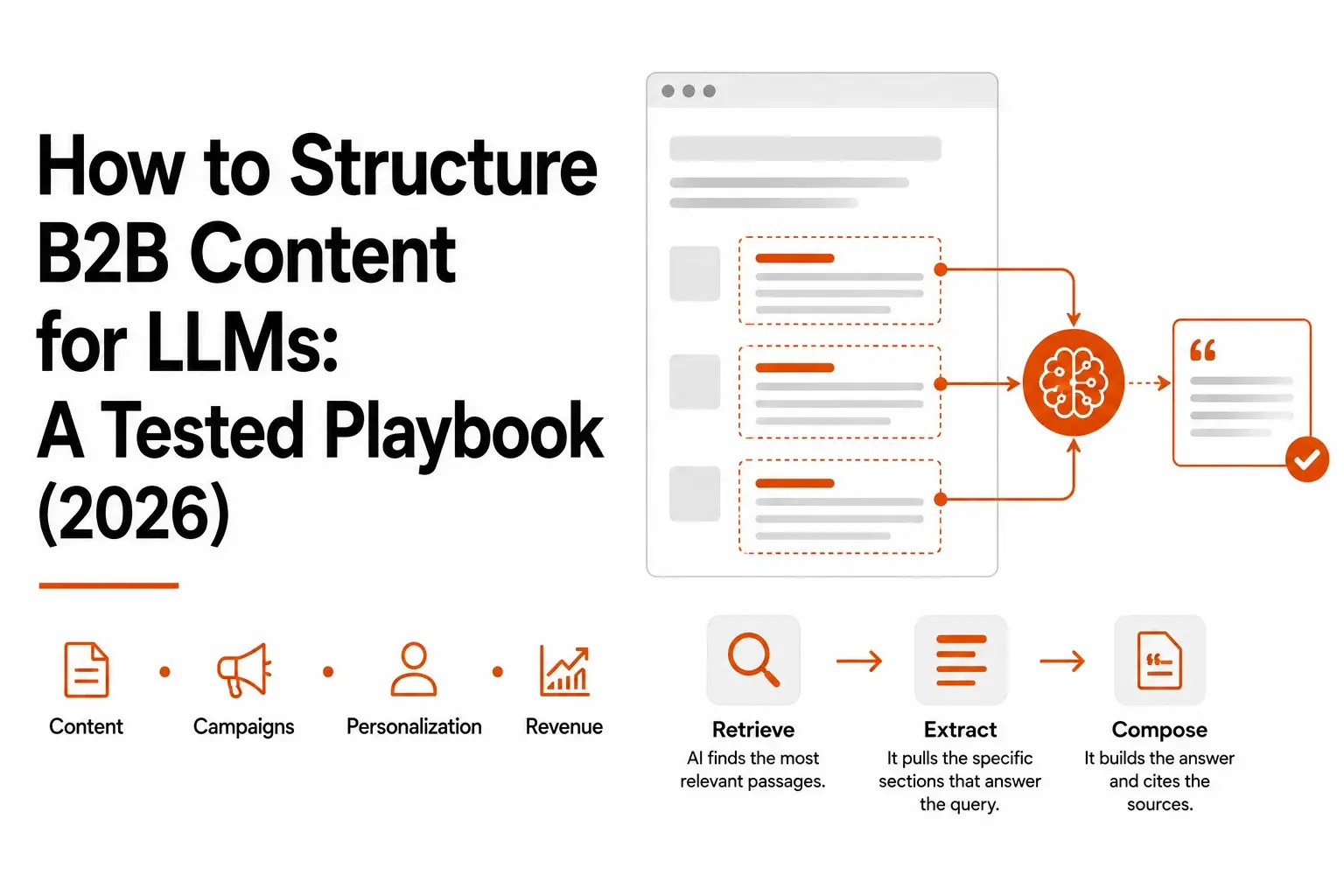


Most B2B teams write a page for a person reading top to bottom. An AI engine does not read that way. It breaks your page into pieces, finds the one piece that answers the question in front of it, and lifts that piece out to build its answer. If that piece only makes sense in the context of the whole page, it does not get used. If it stands on its own, it can be quoted and cited.
That single difference is what "structuring content for LLMs" is really about. It is not a new writing style or a set of tricks; it is making sure the parts of your page can survive being pulled out and read alone. This playbook covers why AI reads that way, the specific structural practices that make content extractable, how they differ from classic SEO formatting, and, because a practice is only worth keeping if it works, how to test whether a rewrite actually earned the citation. For the broader definition of what a citation is, see what AI citations are.
Why an AI reads your page in pieces
When an AI engine answers a question, it rarely ingests your whole page and reasons over all of it. It retrieves at the passage level, pulling the specific section most relevant to the query, and composes its answer from those retrieved passages. The mechanics of that retrieval step are covered in how AI search works; the consequence for your writing is what matters here.
If retrieval works on pieces, then the piece is the unit of optimization, not the page. A brilliant page whose key answer is buried in the middle of a long paragraph, dependent on three paragraphs above it for context, is hard to retrieve cleanly. A page whose sections each answer one question completely, in language that holds up alone, is easy. The goal is not a longer or shorter page; it is a page made of self-contained, liftable blocks.
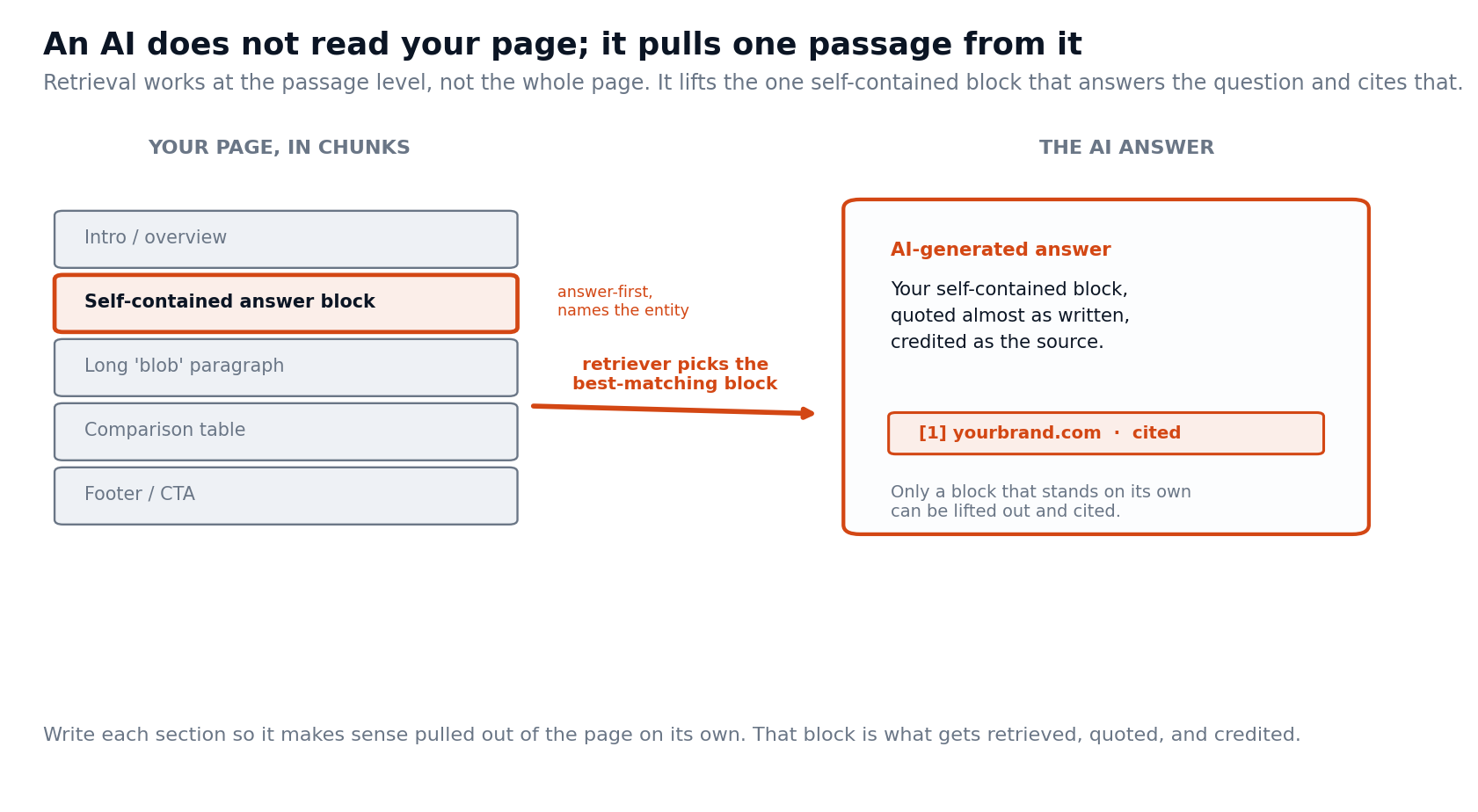
Retrieval works at the passage level. The block that stands on its own is the one that gets pulled, quoted, and credited.
This is why some pages that rank well are never cited: they are written as one continuous argument, not as a set of retrievable answers. It is also why a modest page can get cited above a bigger competitor, because its answer to that exact question is cleaner to lift. This is the concrete work behind the "extractable" requirement in the signals that make a page citable.
The one rule: every block should stand on its own
If you remember one thing, make it this: write each section so it makes complete sense when read on its own, with nothing above or below it. Everything else in this playbook is a way of doing that. The practices below turn that rule into specific edits.
Lead each section with the answer
Put the direct answer to the section's question in its first line or two, then explain, expand, and qualify underneath. Retrieval and AI answers both favor the front of a section, so an answer that arrives after three sentences of preamble is an answer that may never be reached. This is the same "answer-first" discipline that wins featured snippets, covered in featured snippets and position zero; the difference is that here you are doing it in every section, not just the one you hope becomes the snippet.
A short summary at the very top of the page helps too. A few sentences that state the page's core answers up front give an engine a clean, front-loaded block to pull when the query matches the page's main topic.
Write in small, single-idea blocks
Break content into short blocks of two to four sentences, each carrying one idea. One idea per block is what makes a block liftable, because the retriever can take it whole and it still means one clear thing. A single long paragraph that covers pricing, then integrations, then support, is three answers tangled together, and none of them extracts cleanly. Split it into three blocks and each becomes retrievable for its own question.
This is the opposite of the dense "blob" paragraph that reads fine to a person skimming but scores poorly for any specific query, because it is about several things at once and none of them completely.
Use question-shaped headings
Phrase headings as the actual questions your buyers ask, then answer each one immediately beneath. "How much does it cost" beats "Pricing," and "Does it integrate with Salesforce" beats "Integrations." Question headings do two jobs: they map directly to how buyers phrase queries, and they mark the start of a self-contained answer block, which helps an engine find and bound the passage it needs.
Name entities explicitly; kill vague pronouns
Inside a block that might be lifted out, never rely on "it," "this," or "the platform" to carry meaning, because once the block is pulled from the page, there is nothing for those words to point back to. Name the product, the company, the feature, and the category directly, every time it matters. A block that says "Omnibound tracks citations across engines" survives extraction; a block that says "it tracks them across engines" becomes meaningless the moment it is quoted alone. This is the single most common structural fix, and the easiest to skip.
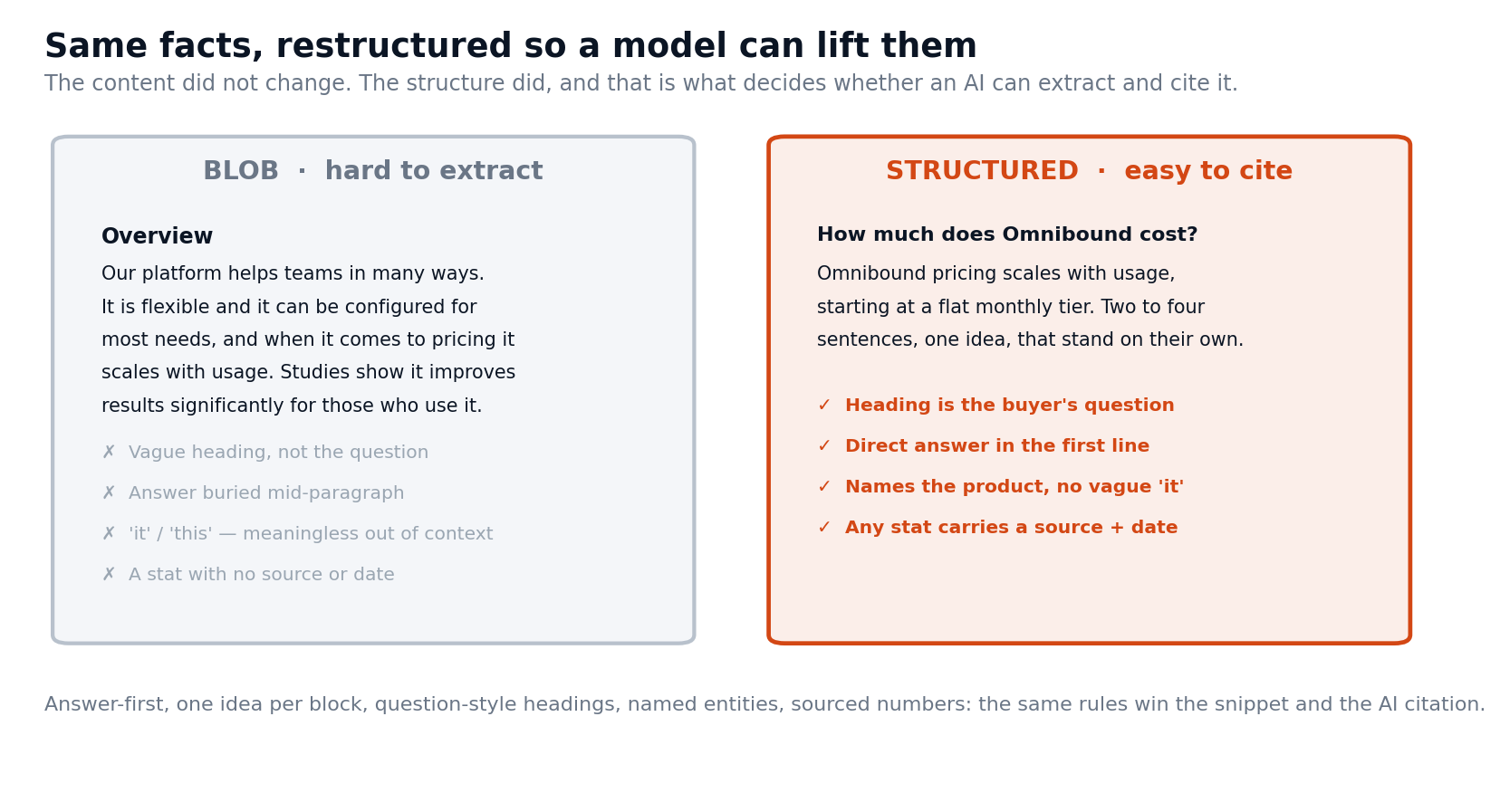
The content did not change. The structure did, and that is what decides whether an AI can extract and cite it.
Make facts and comparisons quotable
Two formats do a disproportionate amount of citation work for B2B.
Lists earn citations for anything sequential or enumerable: steps, requirements, options, criteria. Use a real ordered or unordered list, with each item a complete statement rather than a fragment, so an engine can lift the list or a single item cleanly.
Tables earn citations for anything comparative or specification-based, which is much of B2B buying content. Pricing tiers, feature comparisons, and "X versus Y" breakdowns package information the way a model wants to retrieve it: structured, labeled, and unambiguous. A comparison written as prose is far harder to extract than the same comparison in a table with clear column headers and specific values.
When you include a statistic, attach its source and date in the same block. A number with a named source and a year is quotable and verifiable, which makes an engine more willing to repeat it and attribute it to you. A bare number with no provenance is a number an engine has little reason to trust or cite.
Do not hide your answers
Structure can make content extractable; presentation can hide it again. Answers tucked inside accordion or tab components that only load on click can be invisible to the systems that read your page, so an FAQ whose answers are collapsed by default may never be seen. Render the answer in the page, and add FAQ or how-to structured data so the question-and-answer pairs are explicit. Structured data does not guarantee a citation, but it removes ambiguity about what your content is, which helps the extractable, self-contained blocks you built get read as intended.
A short before-and-after
Take a paragraph a lot of B2B pages actually ship, and restructure it without changing a single fact.
The blob version reads: "Our platform is built to help revenue teams work smarter. It brings everything together in one place, and because it is flexible, it can be configured to fit how your team already works. When it comes to reporting, it gives you the visibility you need, and pricing is designed to grow with you." A person skims past that. A retriever finds nothing it can lift, because no sentence answers a specific question on its own, and "it" carries every claim.
The restructured version splits that into blocks under real questions. Under "What does Omnibound do?": "Omnibound tracks and improves a B2B brand's visibility in AI search. It monitors where AI engines cite you across your buyer questions and shows where to improve." Under "How does Omnibound pricing work?": "Omnibound pricing scales with usage, starting at a flat monthly tier." Same information, now in two self-contained blocks, each led by its answer, each naming the product, each retrievable for the question it answers. Nothing was invented; the facts were just made liftable.
How this differs from classic SEO formatting
Some of this looks like good SEO, and the overlap is real, but the target is different, and a few habits that helped rankings now work against you.
Classic SEO rewarded comprehensive pages that kept a reader engaged and covered a keyword thoroughly, which encouraged long, flowing sections and a single deep page per topic. Extraction rewards the opposite at the paragraph level: short, self-contained blocks that a machine can remove without losing meaning. You still want a thorough page; you just want it built from liftable parts rather than one continuous narrative.
Keyword density and exact-match phrasing mattered more for classic ranking than they do for extraction, where clarity and self-containment matter more than repetition. And the introduction that warms up before getting to the point, a normal editorial habit, is a liability when the point is what needs to be retrieved. Structure for the machine that reads in passages, and you tend to serve the human skimmer better too.
A pre-publish structure checklist
Before a page goes live, run it against a short list. Each item is a way of asking whether the blocks stand on their own.
- Does each section lead with its answer? The first line or two should answer the section's question directly, before any setup.
- Is there a short summary near the top? A few sentences stating the page's core answers give an engine a clean block to pull for the main topic.
- Is each block one idea, in two to four sentences? If a paragraph covers three things, split it into three blocks.
- Are headings phrased as buyer questions? "How much does it cost" over "Pricing," and an answer immediately beneath.
- Does every key claim name its entity? No "it," "this," or "the platform" carrying meaning that breaks when the block is lifted out.
- Are comparisons and specs in tables, and sequences in lists? Prose comparisons are hard to extract; labeled tables are not.
- Does every statistic carry a source and a date? A number with provenance is quotable; a bare number is not.
- Are FAQ answers rendered, not hidden in accordions? And marked up with FAQ or how-to structured data.
If a page clears all eight, its blocks can survive being pulled out and read alone, which is the whole objective.
Test whether it worked
Structure is a hypothesis until you check it, so treat every rewrite as something to verify rather than assume. This is what keeps the playbook honest. Start from the questions, not the pages. For each priority buyer question, check whether AI engines currently cite you, and note the ones where they do not. Those are your candidates. Restructure the relevant page or section using the practices above, answer-first, single-idea blocks, question headings, named entities, quotable facts, then re-check the same questions over the following weeks.
Check repeatedly, not once, because AI answers vary from run to run, a behavior worth understanding on its own in why AI search results fluctuate. A single look after a change tells you almost nothing; a citation rate measured across repeated checks tells you whether the restructure actually moved you from uncited to cited. Doing this across a full question set by hand does not scale, which is why frequent automated checks are the practical way to run the test.
The result is a tight loop: restructure, measure, keep what earns citations, and apply it to the next page.
Where B2B teams get structure wrong
- Optimizing the page, not the passage. A strong page with buried answers still loses to a modest page whose blocks stand alone. Fix the blocks.
- Leaving vague pronouns in key claims. "It integrates with your CRM" is worthless once lifted from the page. Name the product and the CRM.
- Burying the answer under an intro. If the answer to the heading's question is in the fourth sentence, it is effectively hidden from retrieval.
- Writing comparisons as prose. Pricing and feature comparisons belong in tables with clear labels and values, not paragraphs.
- Hiding FAQs in accordions. Answers that only appear on click may never be read. Render them, and mark them up.
- Changing structure and never checking. Without measuring citations before and after, you cannot tell which changes worked. Test the rewrite.
Frequently asked questions
How do I structure content so an LLM will cite it?
Write each section so it stands on its own: lead with the direct answer, keep blocks to two to four sentences on a single idea, use question-shaped headings, name entities explicitly instead of using "it" or "this," and put comparisons in tables and facts with their sources. Those self-contained blocks are what an engine can lift and credit.
Why does structure matter more than length for AI?
Because engines retrieve at the passage level, not the whole page. A self-contained block that answers the question cleanly gets pulled and cited; a long, tangled page whose answer is buried does not, regardless of total word count.
Is structuring for LLMs the same as SEO?
It overlaps but is not identical. Both reward clear, well-organized content, but extraction specifically rewards short, self-contained blocks and penalizes the long, flowing paragraphs and slow introductions that classic SEO tolerated.
Do I need schema or structured data?
It helps by making your content's meaning explicit, especially for FAQs and how-to content, and it removes ambiguity about what a block is. It is not a substitute for writing self-contained, answer-first blocks, but it reinforces them.
How do I know if my new structure is working?
Measure it. Check whether AI engines cite you for the target questions before the change, restructure, then re-check over the following weeks with repeated checks rather than a single look, since answers vary. A rising citation rate on those questions is the signal that the structure worked.
Structure for the reader that quotes you
The shift is small to describe and large in effect. You are no longer writing only for a person who reads your page in order; you are also writing for a system that will take one piece of it and hand that piece to a buyer as the answer. Both readers are served by the same thing: clear, self-contained blocks that lead with the answer, name what they are talking about, and back their claims. Build your pages out of those, and you give the machine something clean to lift and the person something easy to read.
Then check your work. To see which of your pages and questions AI engines already cite, and which self-contained blocks are missing, run a free scan with the AI Search Visibility Checker, or track your citation rate as you restructure with AI Search Intelligence.