


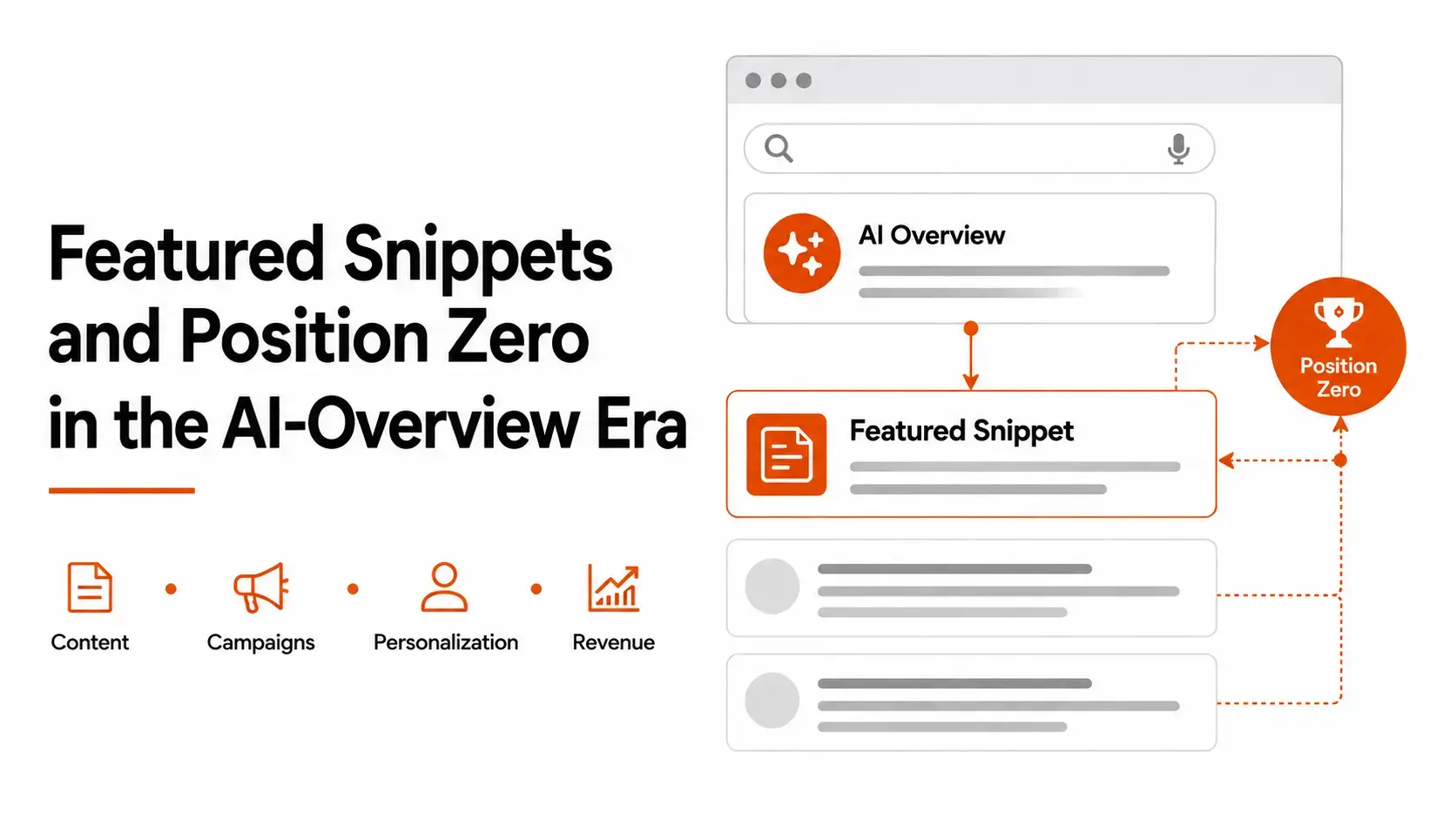


For a decade, position zero was the prize. Win the featured snippet and Google lifted your answer into a box above the ranked links, where it got read first and clicked more. Then Google put an AI Overview above even that, and other engines started answering questions outright, and a reasonable question followed: is the featured snippet dead, and was position zero a skill worth keeping?
The short answer is that the box did not disappear so much as grow up. Position zero was the first version of a machine reading the web and handing back one direct answer instead of a list of links. AI Overviews and the AI engines are that same move at a much larger scale. So the snippet-winning skill did not become useless; it became the on-ramp to something bigger. This piece is about what changed, what still holds, and how a B2B team should optimize for both the snippet and the AI answer at once.
What position zero taught us about answer-first search
A featured snippet is the boxed answer Google shows at the top of some results, pulled from a single page it judged to answer the query most directly, with a link back to that page. Position zero is the nickname, because it sits above the number-one organic result. It came in a few shapes: a short paragraph answering a question, a numbered or bulleted list for steps and rankings, and a table for structured data.
The reason it mattered was not just the extra visibility. It was the lesson underneath it. To win the box, you could not just rank; you had to give a clean, self-contained answer a machine could lift out of your page and trust on its own. That skill, writing the answer so a system can extract it without the surrounding page, is exactly the skill the AI era runs on. Position zero was the training ground.
How AI Overviews absorbed the answer box
AI Overviews took the answer box and changed two things about it. First, instead of lifting one passage from one page, the AI synthesizes an answer from several sources at once. Second, it cites those sources rather than simply linking one winner. The single-source box became a multi-source, cited answer. How that assembly actually works, an engine retrieving pages and composing an answer from them, is the subject of how AI search works; the shift that matters here is from one source to several.
Position zero was one source above the links. The AI answer is the same idea, synthesizing a response and citing several sources.
This is why featured snippet visibility has been shifting. As AI Overviews expand to more queries, the classic snippet box appears on fewer of them, because the AI answer often takes that space instead. On the queries where the AI answer shows up, the game is no longer to be the one boxed source; it is to be one of the cited sources the answer is built on. The queries where a plain featured snippet still shows are a smaller, more specific set.
Naming that shift plainly matters more than chasing a single number, because the exact share moves month to month and varies by query and industry, and AI answers themselves change from run to run, a behavior worth understanding on its own in why AI search results fluctuate.
Do featured snippets still matter? Yes, but the job changed
Featured snippets are not gone, and they are not a waste of effort. Their role narrowed and their purpose widened at the same time.
They still appear, and still earn clicks, on the query types AI Overviews are slower to take over. Procedural how-to questions, direct definitional lookups, comparison queries, and many commercial-intent searches still surface a snippet, and on those, the box remains real estate worth owning. Informational questions with broad, general answers are where the AI Overview has moved in most, so a snippet there is both rarer and less valuable than it used to be.
The bigger reason to keep the skill is that winning a snippet and earning an AI citation are now the same underlying work. A page structured cleanly enough for Google to lift into a snippet is a page structured cleanly enough for an AI answer to quote and cite. When you optimize a page to answer a question directly and extractably, you are making it a candidate for the snippet on the queries that still show one and a candidate for citation in the AI answer on the queries that show that instead. You are not choosing between the two; you are earning both from one effort.
 The same extractable structure that wins the featured snippet is what earns a citation in an AI answer.
Which snippet formats survive the shift
The three classic snippet formats are not equally exposed to AI Overviews, and knowing which is which tells you where the box is still worth chasing on its own.
Paragraph snippets, the short prose answer to a definitional or "what is" question, are the most exposed. Broad definitional questions are exactly what AI Overviews answer well, so this is where the plain snippet is disappearing fastest and where you should expect the AI answer to take the space. The work still pays off, but through the citation rather than the box.
List snippets, the numbered or bulleted answer to a "how to," "steps to," or "best" question, are more durable. Procedural and ranking questions still surface lists often, and a clean ordered list is both what wins that snippet and what an AI answer tends to quote wholesale. For B2B, how-to and process questions are a strong place to keep earning the box.
Table snippets, the structured answer to a comparison or specification question, are the most durable of the three and the most valuable for B2B. Comparison and "X vs Y" questions, pricing-model and specification lookups, and feature matrices still trigger tables, and these sit close to real buying decisions. A well-built comparison table on your page is a candidate for the snippet and a clean object for an AI answer to lift.
The pattern is consistent: the closer a query sits to a specific, structured, decision-stage question, the more likely a classic snippet still shows and the more it is worth owning outright. The broader and more informational the query, the more the value has moved to being cited in the AI answer instead.
The structure that wins both
Because the snippet and the AI citation reward the same thing, the optimization checklist is largely shared. A few practices do most of the work.
Answer the question directly, high on the page. Lead the relevant section with a clean, self-contained answer in the first line or two, phrased so it makes sense lifted out of context. This is what a snippet extracts and what an AI answer quotes. The deeper mechanics of what makes a page quotable are covered in the signals that make a page citable.
Match the format to the query. Use a short paragraph for definitions, a numbered list for steps or rankings, and a table for structured comparisons. Both Google's snippet logic and AI answers prefer the format that fits the question, so a steps question wants a real ordered list, not a wall of prose.
Use question-style headings. Phrasing a heading as the actual question a buyer asks, then answering it immediately beneath, gives both systems a clean unit to pull. Keep it current and factual. Snippets and AI answers both favor pages that read as accurate and up to date. A page with an old date, a wrong figure, or a vague claim is a weaker candidate for either. Earn the authority behind the page.
Neither the snippet nor the AI citation goes to a clean answer from a source nothing trusts. The off-page reputation that makes you a credible source matters as much as the on-page structure, a balance covered in first-party versus third-party citations. None of this is new SEO exotica. It is the same answer-first discipline position zero always rewarded, now pointed at a bigger target.
What changes for B2B
The mechanics carry over; the goal and the scorecard change. The goal moves from a click to a citation. A featured snippet was valued largely for the traffic it sent. In the AI era, being the cited source in an answer is worth something even when it does not produce an immediate click: you are the source a buyer's assistant is standing on when it describes your category, which shapes the shortlist before a rep is ever involved. Chasing only the click undervalues the citation.
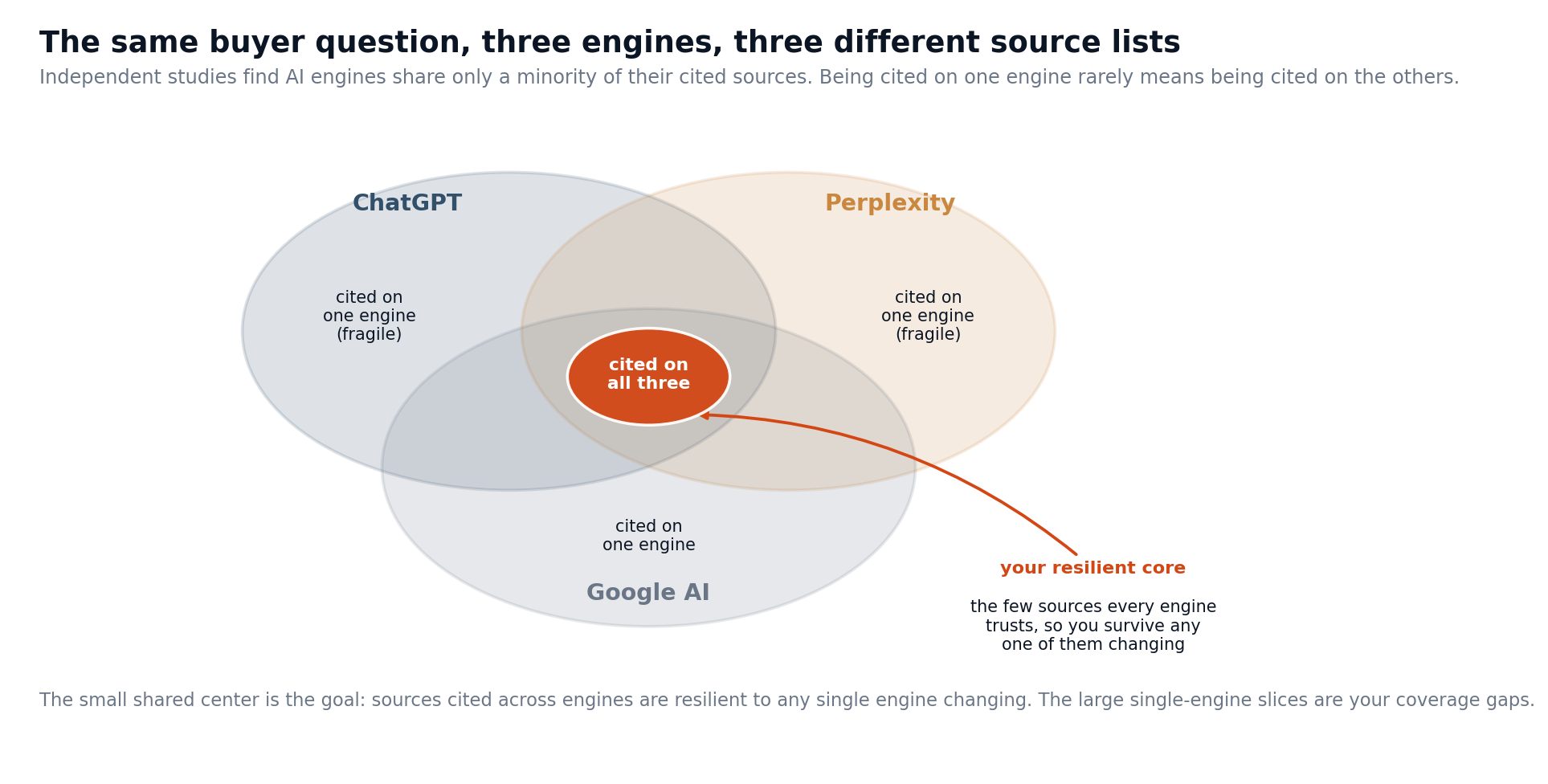
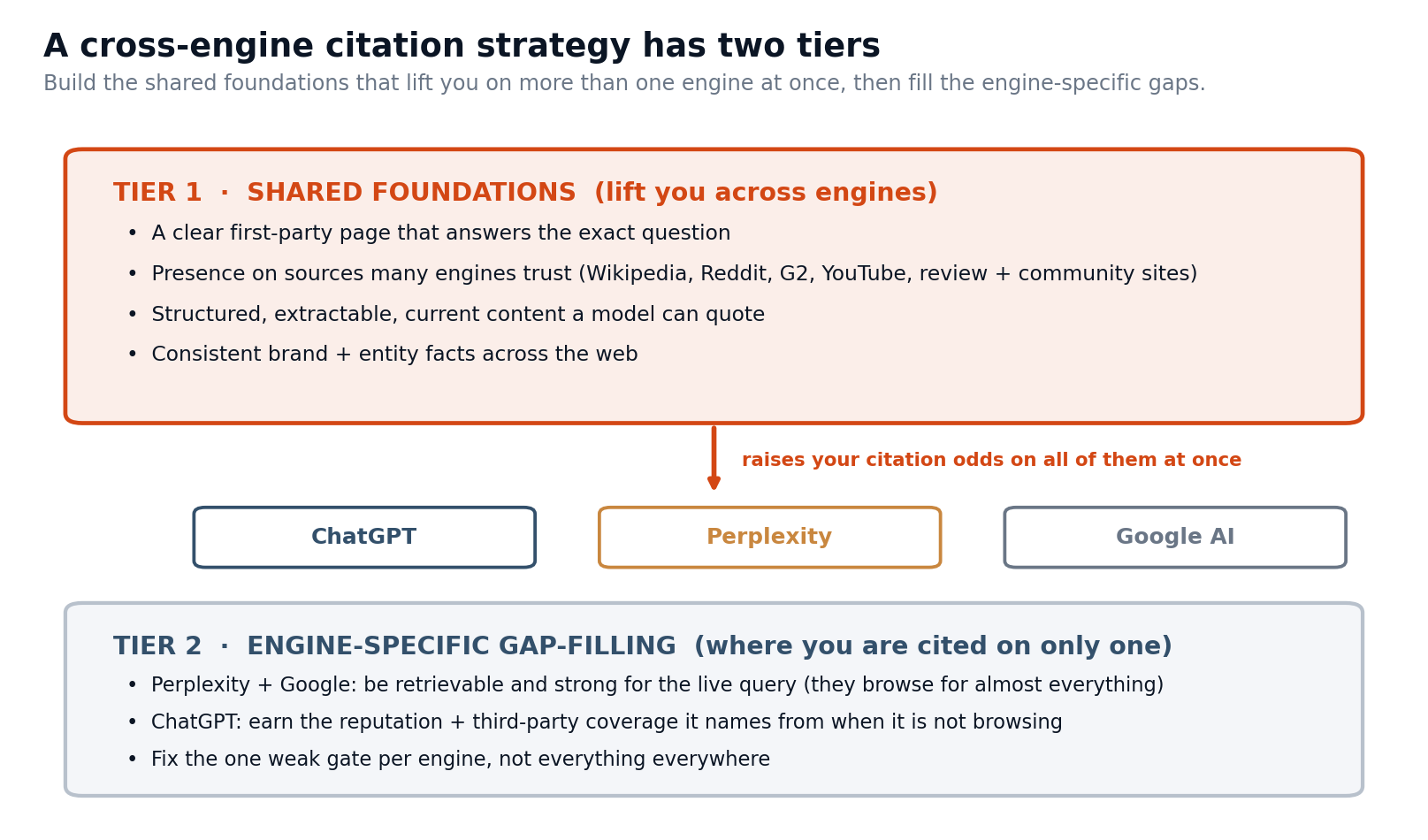
The target moves from one box to many answers. Position zero was a single slot on a single results page. Now the same question gets answered by ChatGPT, Perplexity, Google's AI, and others, each citing its own sources, and those sources overlap surprisingly little across engines. Winning one answer box is no longer the finish line; coverage across engines is, a strategy covered in getting cited across AI engines.
The metric moves from a ranking to a rate. You used to track whether you held the snippet for a keyword. Now the useful measure is how often you are the cited source across your priority questions and across engines, watched over repeated checks rather than a single look, because the answers vary. That is a citation rate, not a position, and tracking it across a full question set is why frequent automated checks matter more than a one-off snippet audit.
How to work this now
Start by segmenting your priority queries. For each one, look at what the results actually show: a plain featured snippet, an AI Overview, both, or neither. That tells you what you are optimizing for on that query, and stops you chasing a snippet on a question the AI answer has already taken over.
Then reformat before you write new content. Many pages that already rank on page one are one structural pass away from being snippet-and-citation ready: a direct answer moved to the top, a heading rephrased as the question, a list turned into a real list. This is usually the highest-return work, because the authority is already there and only the extractability is missing.
Then measure across engines, not just in Google. Check where you are the cited source for each priority question across the AI engines your buyers use, track it over time, and treat the questions where you are cited nowhere, but that matter to pipeline, as your build list.
A worked example: one buyer question
Take a B2B query like "how to measure AI search visibility." Before optimizing anything, look at what the results actually show. Suppose you find an AI Overview at the top synthesizing an answer from three sources, no classic paragraph snippet beneath it, and your page ranking sixth in the organic results but cited nowhere in the AI answer.
That single check tells you the job.
The AI Overview has taken the answer space, so chasing a plain paragraph snippet here is chasing a box that is not shown. Your page ranks, so the authority and relevance are largely there; what is missing is that the AI answer is not building on it. The fix is a structural pass, not new content: lead the relevant section with a direct, self-contained answer to that exact question, rephrase the heading as the question itself, and add a short list or table if the answer has steps or parts, so the page becomes an easy thing for the AI answer to quote and credit.
Then measure the right thing. Instead of asking whether you hold a snippet in Google, ask whether you are now cited for that question across the AI engines your buyers use, checked several times over a couple of weeks because the answers vary. Run that same loop, see what the query shows, reformat for extraction, measure citation across engines, across your priority questions, and you get a ranked list of exactly where the answer-first work will move the needle.
Where teams get this wrong
- Declaring the snippet dead. It narrowed, it did not vanish. On procedural, definitional, comparison, and many commercial queries the box still shows and still earns clicks.
- Chasing snippets on informational queries. Broad informational questions are where AI Overviews took over most. Optimizing hard for a snippet there is optimizing for a box that increasingly is not shown.
- Treating snippets and AI answers as separate projects. They reward the same extractable structure. Splitting them into two workstreams doubles the effort for no reason.
- Optimizing for the box, not the citation. The click is nice; being the cited source is the durable win. Structure for extraction and authority, not just for the keyword.
- Measuring in Google only. A snippet audit in one search engine misses whether ChatGPT and Perplexity cite you for the same question. The scorecard is cross-engine now.
Frequently asked questions
Are AI Overviews the same as featured snippets?
They are related but not identical. A featured snippet lifts one direct answer from a single page and links to it. An AI Overview synthesizes an answer from several pages and cites multiple sources. The Overview is the answer box scaled up from one source to many, which is why the skill of writing an extractable answer carries over to both.
Do featured snippets still matter in 2026?
Yes, with a narrower role. They still appear and earn clicks on procedural, definitional, comparison, and many commercial queries, and the work that wins them is the same work that earns AI citations. They matter less on broad informational queries, where AI Overviews now dominate.
Is position zero still worth optimizing for?
It is, because the optimization is no longer single-purpose. Structuring a page to win position zero also makes it a candidate for citation in AI answers across engines, so the effort pays off on more than one surface even when the classic snippet is not shown.
How do I optimize for both featured snippets and AI Overviews?
Answer the question directly and high on the page, match the format to the query (paragraph, list, or table), use question-style headings, keep the content current and factual, and back it with real authority. That single structure is what both the snippet logic and AI answers reward.
Should B2B teams still track featured snippets?
Track them, but do not stop there. The more useful measure now is your citation rate across the AI engines your buyers use, watched over repeated checks, since a snippet in Google alone no longer tells you whether you are the source AI answers are built on.
Winning the answer, not the box
Position zero trained everyone to do one thing well: give a clean answer a machine can trust and hand to a person. That skill did not expire when the AI Overview arrived; it got more valuable, because now that same clean answer can win the snippet on the queries that still show one and earn a citation in the AI answer on the queries that show that instead. The box you are competing for got bigger and started citing several sources, and it moved from one search engine to many.
So keep the discipline and widen the target. To see where your pages already earn the answer, in Google's snippets and in AI answers across engines, and where the gaps are, run a free scan with the AI Search Visibility Checker, or track your citation rate over time with AI Search Intelligence.