

Table Of Contents
When an AI engine answers a question about your category, it does not only quote your website. It quotes review sites, Reddit threads, industry publications, and Wikipedia, and it often trusts those more than anything on your own domain. For B2B teams that have spent years building their own content, this is the uncomfortable part of AI search: a large share of what gets said about you, and cited, is written by other people.
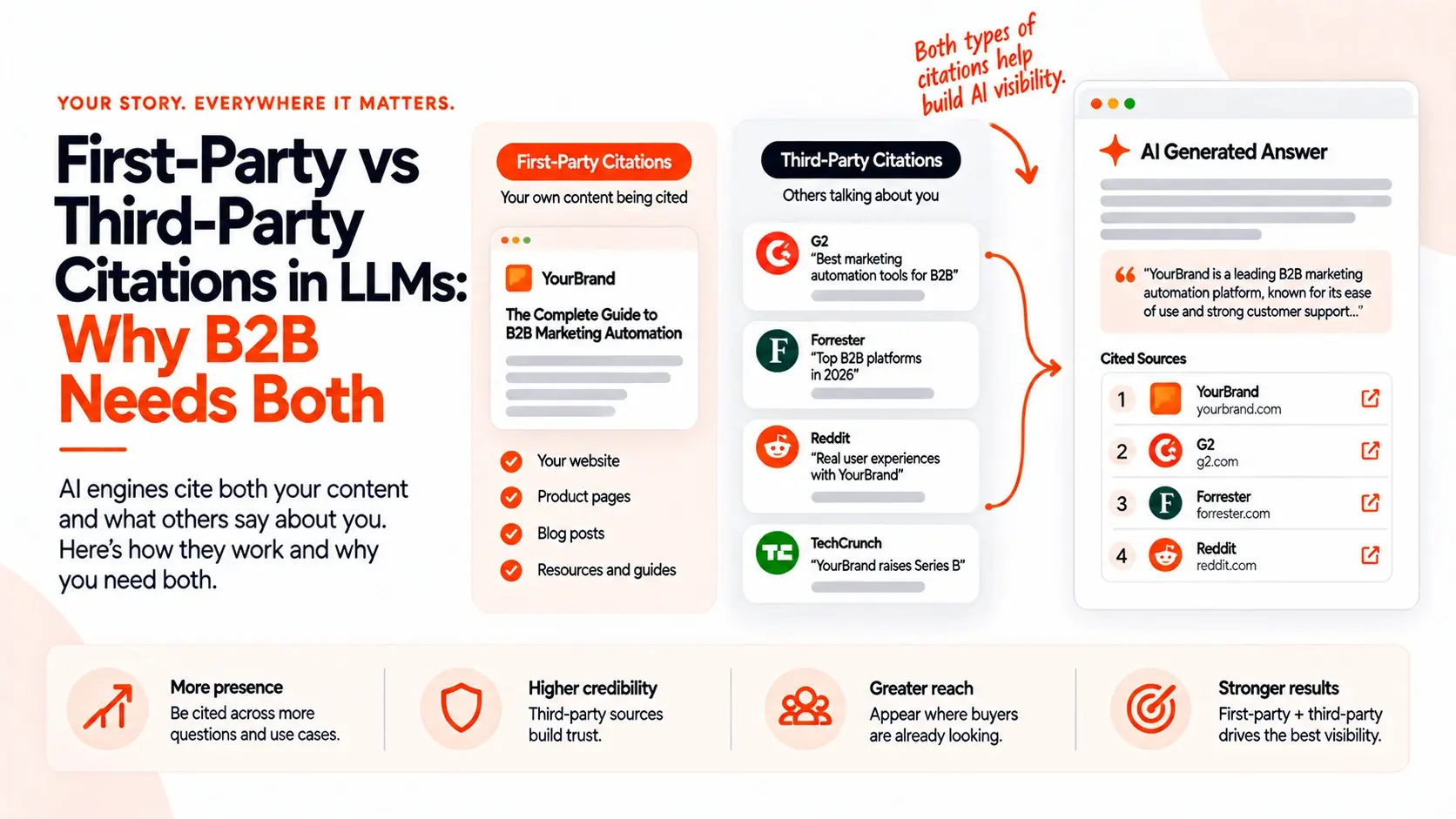
Those are two different kinds of citation. A first-party citation is your own page being used as a source. A third-party citation is a page someone else published being used as the source about you. Both put your brand into the answer, they are earned in completely different ways, and winning AI search means having both. This piece explains the difference, why third-party sources carry so much weight for B2B buying questions, and how to build the half most B2B teams neglect.
The two sources, defined
The distinction is about who owns the page the engine cites, not about the link format.
A first-party citation is a page on your own domain, your product pages, blog, documentation, or original research, being credited as a source in the answer. You write it, you control it, and you can change it whenever you want.
A third-party citation is a page you do not own, a G2 listing, a Reddit thread, a Capterra comparison, an analyst note, a news article, a Wikipedia entry, being credited as the source for something about you. You cannot edit it directly, and often you did not create it at all. It exists because other people wrote about your category, your product, or your competitors.
This is a different cut than the difference between a citation and a mention, which is about whether you are linked. First-party versus third-party is about where the cited page lives: on your domain, or on someone else's.
Why engines lean on third-party sources for B2B
For a large share of B2B questions, especially the ones near a buying decision, engines reach for third-party sources first. The reason is trust, and it is worth understanding rather than resenting.
Your own pages have a built-in credibility problem: they speak for themselves. Your product page says you are the best option for mid-market teams, but so does every competitor's product page, so a model treats that as a claim, not evidence. A G2 page with hundreds of independent reviews, a Reddit thread where practitioners compare tools, or an analyst report answers the same question with independent evidence. Engines weight that independence heavily, because a claim corroborated by sources with no stake in it is safer to repeat than a brand describing itself.
Corroboration compounds the effect. When the same point about you appears across several unaffiliated sources, an engine reads it as established rather than asserted, and is more willing to state it and cite it. This is the trust dimension of the signals that make a page citable, seen from the outside: much of your trust is built on pages you do not own. Independent studies of AI answers have consistently found that third-party and earned sources make up the majority of citations for commercial and vendor questions, which matches what anyone sees testing their own category: ask an engine to compare or recommend tools and the sources are mostly not the vendors' own sites.
Where first-party still wins
None of that makes your own pages irrelevant. They win a specific and important set of questions: the ones about you, in your own terms.
When a buyer asks what your category is, how your product works, what you do, or the detail behind a feature, your own pages are the natural, authoritative source, and engines do cite them. First-party pages are also where you set the language, the framing, and the facts that third-party sources and the engines themselves draw on later. If your own explanation of your category is clear and well-structured, it shapes how you are described everywhere else. First-party content is the foundation; it is just not sufficient on its own for the evaluation questions where deals are decided.
Which third-party sources matter most for B2B
Not all third-party sources carry equal weight, and the mix that matters is specific to B2B. A few types come up again and again in AI answers about vendors.
Review platforms. G2, Capterra, TrustRadius and their peers are among the most-cited sources for B2B vendor questions, because they aggregate independent, verified user evidence, exactly what an engine wants for a "is X any good" or "best X" query. A thin or outdated profile here is a standing, fixable gap.
Communities. Reddit and specialist forums are cited heavily because they carry firsthand practitioner experience a vendor page cannot replicate. When buyers ask what real users think, engines reach for these, and being genuinely discussed there matters.
Encyclopedic and reference pages. Wikipedia and established reference sources lend an engine confidence about who you are and what category you sit in. They are hard to earn and influential when you have them.
Industry media and roundups. Trade publications, analyst notes, and "best tools" roundups from credible outlets are the sources engines pull for comparison and shortlist questions. Being included in the ones an engine already cites is high-return.
Analyst and expert coverage. For considered B2B purchases, analyst mentions and named-expert commentary carry weight out of proportion to their volume, because they are treated as authoritative.
Engines also differ in which third-party sources they favor. Some lean heavily on Reddit and encyclopedic references, others on review platforms and professional networks, and Google's AI surfaces pull from its own ecosystem of sources. The specific mix shifts over time and by category, so the reliable move is not to memorize a ranking but to check the engines your buyers actually use and see which third-party sources they pull for your category right now. The point is not to chase all of them at once. Find which of these your engines already cite, and strengthen those first.
A vendor question, and who actually gets cited
Picture the question that decides a deal: a buyer asks an engine, "what's the best AI search visibility platform for a mid-market B2B team." Watch what it cites. Typically it pulls a G2 category page, a Reddit thread where marketers compare tools, and a "best tools" roundup from an industry site, then names a few vendors drawn from those. The vendors' own product pages are often nowhere in the cited sources, even the vendor who has the best-written site.
If you are that vendor and your third-party presence is thin, a strong G2 profile you neglected, no presence in the roundup, no community discussion, you are simply absent from the answer that mattered most, while a competitor with a fuller earned footprint is recommended. Nothing in your analytics flags it. That is the first-party-only trap in one question, and it is why the earned half is not optional.
The B2B blind spot
Put the two together and the common B2B mistake is clear. Teams pour budget into owned content, the blog, the pillar pages, the product site, and treat third-party presence as PR's problem or ignore it entirely. Then they wonder why they are absent from the "best tools for X" and "X vs Y" answers that sit closest to a purchase. They built the box they control and left the box the engine trusts empty.
The evaluation questions on the right side of the diagram are exactly where B2B pipeline forms, and those are won disproportionately by third-party sources. A brand strong only in first-party content shows up well when a buyer asks about it by name and vanishes when the same buyer asks the engine to compare the field. That gap is invisible in most reporting, because nothing shows up as a lost visit, which is why it persists.
How to earn third-party citations
You cannot edit a third-party page, but you can influence what exists and how you appear on the sources engines already trust. The work is real relationship and content work, not a technical fix, and it has to be done honestly.
Start by finding where engines already cite for your category. Ask the engines the vendor and comparison questions that matter and note which third-party sources they pull, G2, a particular subreddit, a specific publication, an analyst. Those are the sources to prioritize, because they are already in the answer; you just are not in them strongly enough. Watching who is cited beside you turns this into competitive intelligence.
Then build presence on them, starting with the highest-return sources. Get your review-site profiles complete and actively gather real reviews, since G2, Capterra, and their peers are cited heavily for vendor questions. Make sure you are included in the third-party roundups and comparisons engines already cite, by pitching to be added where it is genuinely warranted. Earn editorial and analyst coverage that describes your category and your place in it. And engage authentic communities like Reddit as a real participant, not with planted posts; astroturfing is both against platform rules and easy for engines and people to discount, and it backfires. The honest version, being genuinely present and genuinely reviewed, is what compounds.
One thing not to do: try to buy your way in. Paid placements and advertorials are cited far less than genuinely earned coverage, because engines and readers can often tell the difference, and a sponsored mention carries little of the independent-trust signal that makes third-party sources valuable in the first place. Spend on earning real reviews and real coverage, not on paying for the appearance of it. Getting placed in the third-party sources engines trust is the honest version of this work, and the point of AI authority building.
Feed the third-party layer from your first-party one. The clearest facts, definitions, and data on your own site are what reviewers, journalists, and community members reach for when they write about you, so strong owned content makes strong earned content more likely and more accurate. The two halves reinforce each other, which is the whole point of building both: clear owned content earns better third-party coverage, and strong third-party coverage sends more buyers back to your owned pages to confirm what they read. Neglect either and the loop stalls.
How to measure both halves
Because the two sources are earned differently, measure them separately. Track not just whether you are cited, but whether the citation is your own page or a third-party one, and which third-party sources recur. That split tells you where to invest: heavy first-party citation but thin third-party presence means you are winning the "about us" questions and losing the evaluation ones; the reverse means your own pages are not pulling their weight. Watch the pattern over time and against competitors, using the visibility metrics that tie to pipeline, so you can see which half is moving and which needs work. This matters more because citations shift on their own; the volatility of AI answers means a single check will not tell you whether your first-party or third-party presence is genuinely improving.
Where B2B teams go wrong
- Building only owned content. A strong site with no third-party presence wins the questions about you and loses the ones that compare you.
- Assuming your product page will be believed. Self-description is treated as a claim; engines want independent corroboration for evaluation questions.
- Ignoring review sites. G2 and its peers are among the most-cited sources for B2B vendor questions, and an incomplete profile is a standing gap.
- Astroturfing communities. Planted Reddit posts and fake reviews are against the rules, easy to discount, and a reputational risk. Earn presence honestly.
- Measuring citations as one number. If you do not separate first-party from third-party, you cannot see which half is failing.
Build the half you have been ignoring
AI search rewards brands that are both well-documented on their own site and well-regarded across the web. First-party pages give you the questions about you in your own words; third-party sources give you the evaluation questions where buyers actually choose, and for B2B that second half is usually the weaker one. The fix is not more blog posts. It is earning presence on the independent sources engines already trust, while keeping your own pages clear enough to feed them.
Start by seeing the split. Check the buyer questions that matter, note where you are cited from your own domain and where a third-party source stands in for you or names a competitor instead, and you will see exactly which half to build. To see where your brand is cited today, first-party and third-party, across the AI engines, run a free scan with the AI Search Visibility Checker, or track how both halves move over time with AI Search Intelligence.
Frequently asked questions
What is the difference between a first-party and a third-party AI citation?
A first-party citation is a page on your own domain being used as the source. A third-party citation is a page someone else owns, a review site, Reddit, a publication, being used as the source about you. Both put you in the answer; you control the first and earn the second.
Why does AI cite other websites instead of mine?
Because for evaluation and comparison questions, engines treat independent sources as more trustworthy than a brand describing itself. A review site or community thread offers corroborated, third-party evidence that your own product page, by definition, cannot.
Are third-party citations more important than first-party ones?
They dominate the vendor and comparison questions closest to a purchase, so for pipeline they are often decisive. But first-party pages win the questions about your category and product in your own terms, and they feed the accuracy of everything third-party. You need both.
How do I get cited on sites like G2 or Reddit?
Complete and maintain your review-site profiles and gather genuine reviews; get included in the roundups engines already cite; earn editorial and analyst coverage; and participate authentically in relevant communities. Do not plant posts or fake reviews, which are against the rules and easy to discount.
How do I know if AI is citing my site or third-party sources?
Check the sources behind the AI answers for your priority questions and record whether each cited page is on your domain or someone else's. Tracking that split over time shows which half of your presence is working and which needs investment.
Turn Your Content Into AI-Search Winners
Get cited across ChatGPT, Claude & Perplexity — not just ranked on Google.
- Increase AI citations
- Improve answer visibility
- Track brand mentions in LLMs