


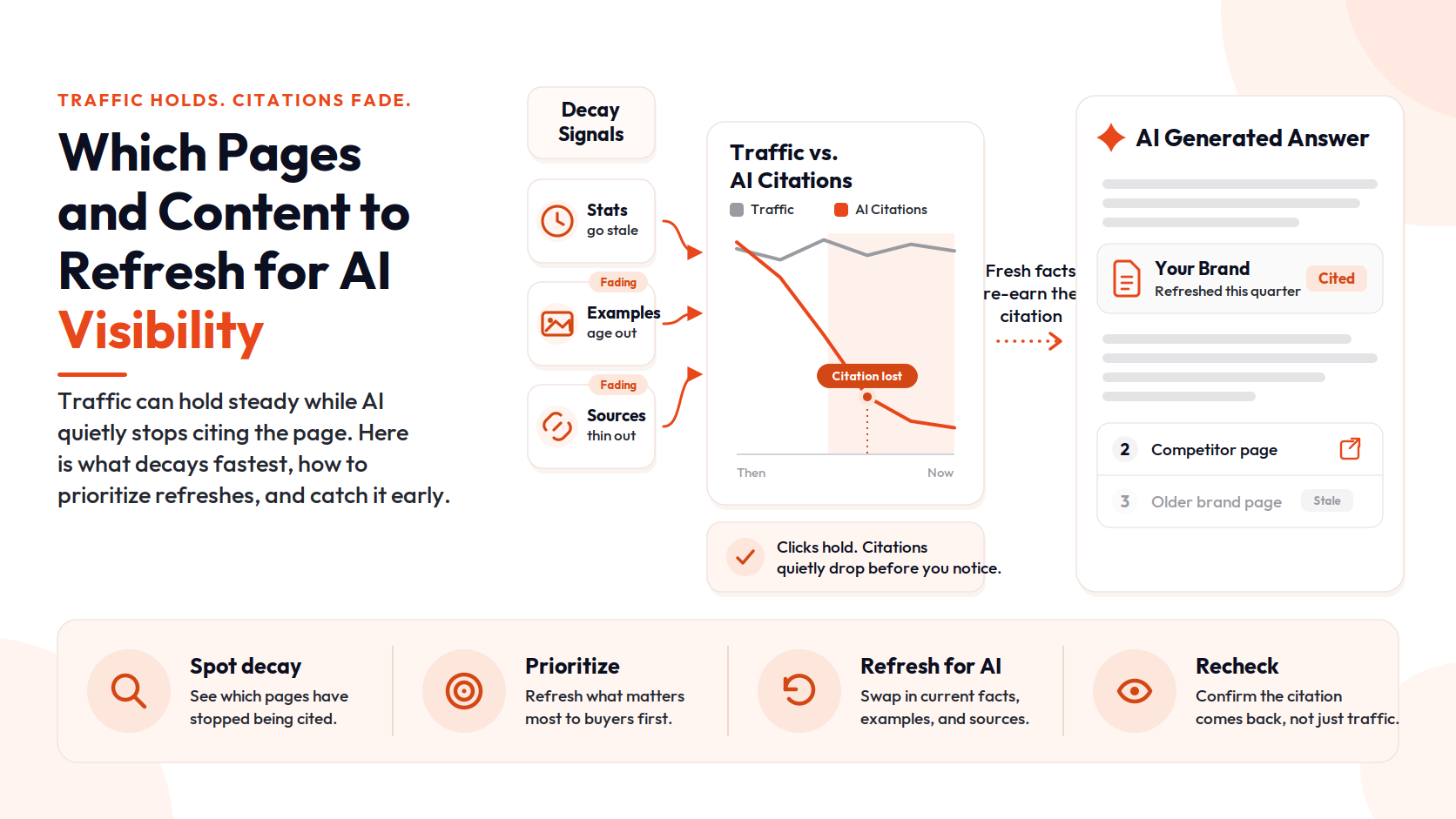


There is a failure mode that classic SEO never warned B2B teams about: a page keeps its traffic but quietly stops being cited. In search you noticed decay when rankings and clicks slipped. In AI search, an engine can keep sending you the same trickle of visitors while it silently drops your page as a source, because your facts went stale or a competitor became the fresher answer. You lose the citation before you lose the click, and your traffic dashboard will not warn you in time.
That changes how you run a refresh program. The question is no longer only "which pages are losing traffic," but "which pages have stopped being current enough for AI to cite, and which ones matter most." This piece covers which page types decay fastest, how to prioritize what to refresh, what a refresh should actually change for AI, and how to catch the decay before it costs you the citation. It is the update side of content maintenance; for what to cut, merge, or remove, see content pruning and the AEO editing pass.
Why content decays differently in AI search
Freshness carries more weight in AI answers than most B2B teams expect. Engines lean toward sources that look current, often append the current year to a query on their own, and reach for the most up-to-date page that answers a question. A page that was the cited source a year ago can be passed over simply because its numbers, dates, and examples now read as old, even if nothing about it technically broke.
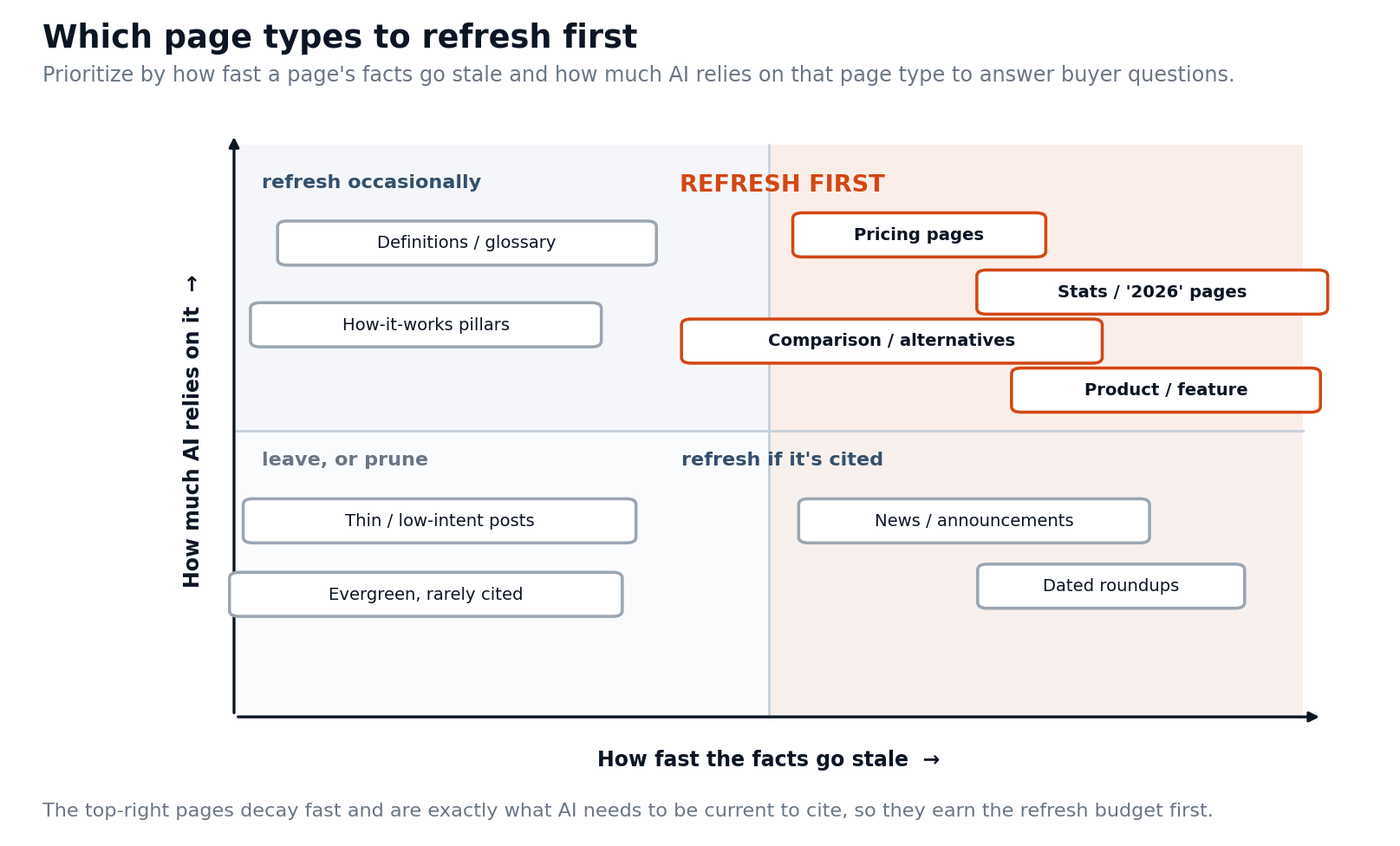
In AI search the citation decays before the traffic does, so the usual "watch for a traffic drop" trigger fires too late.
There is a second, sharper risk. A stale page that does still get cited can get you misquoted: an engine repeats your old pricing model, a deprecated feature, or a superseded statistic as if it were current, because that is what your page says. So refreshing is not only about staying cited; it is about keeping what AI says about you accurate. Both problems point to the same fix, keeping the pages that matter current, but they mean the trigger to act is staleness and lost citations, not just a dip in sessions.
Which page types decay fastest, and matter most
Not every page ages at the same rate or carries the same weight in AI answers, so the first move is to sort your page types by two things: how fast their facts go stale, and how much AI leans on that type to answer buyer questions. The pages that score high on both are where refresh budget earns the most.
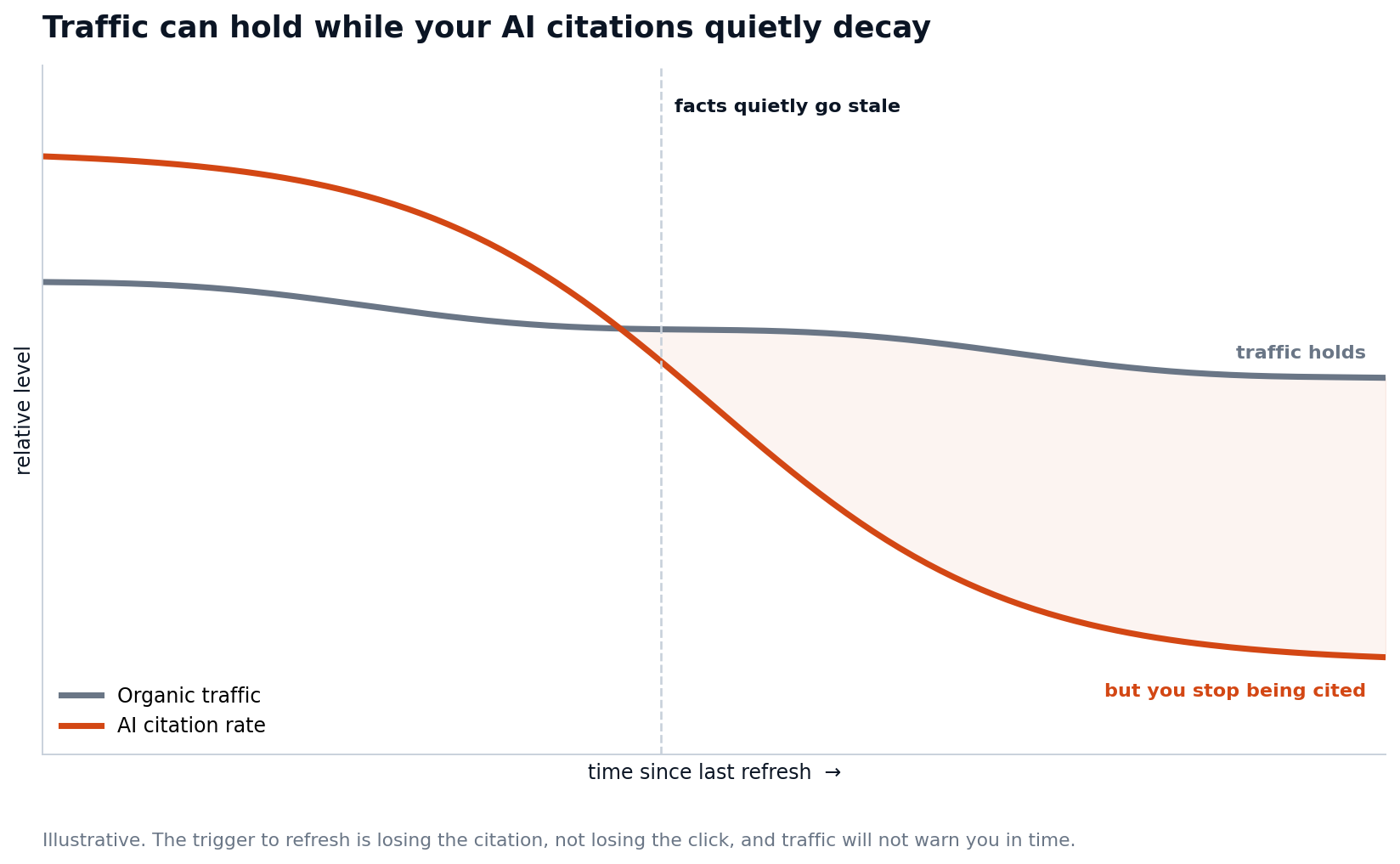
Sort page types by decay speed and citation value. The top-right quadrant earns the refresh budget first.
Refresh first the pages that go stale fast and that AI relies on heavily. For B2B that means pricing pages, pages built on statistics or a year in the title, comparison and alternatives pages, and product or feature pages. These change often, and they are exactly the pages an engine needs to be current to cite for a buyer who is evaluating. A comparison page that lists a competitor's old feature set, or a pricing page a version behind, is both uncited and actively misleading.
Refresh occasionally the pages that matter to AI but age slowly. Definitional and glossary pages and how-it-works pillars carry citation weight but change less, so they need attention on a longer cycle, mostly to keep examples and links current. Refresh only if cited the pages that age fast but carry less lasting value, like news, announcements, and dated roundups. If an engine is still citing one for a live question, keep it current; otherwise let it age.
Leave or prune the pages that neither age into a problem nor earn citations, like thin low-intent posts. These are not refresh candidates; they are pruning candidates, which the editing pass covers. Deciding which page types earn citations in the first place is a separate question from keeping the earners fresh, and it is worth answering before you spend refresh budget on a page type AI rarely cites at all.
How to prioritize which pages to refresh
Page type sets the general priority; within it, rank individual pages by citation value against decay risk. Two reads decide the order.
Citation value: does this page answer a question that matters to pipeline, and is it a page AI already cites or clearly should. Pages you are already cited on for high-intent buyer questions are worth protecting first, because losing those citations costs the most. Pages you should be cited on but are not are the build-and-refresh opportunities.
Decay risk: how much of this page depends on facts that change. A page whose core is a price, a statistic, a feature list, or a "current best" claim decays the moment reality moves; a page of durable principles does not. The higher the share of time-sensitive facts, the shorter its safe shelf life.
Rank by both and the order is clear: high-value, high-decay pages first, especially any you were cited on and have since lost. This is the same discipline as measuring a citation rate rather than a traffic number, covered in why AI search results fluctuate: you are managing whether you are still the answer, not whether a page still gets sessions.
Refresh, rewrite, or start over?
Not every aging page wants the same treatment, and spending a full rewrite on a page that needs a data update wastes effort. Match the fix to the problem. Refresh when the page is fundamentally right but the facts have aged: correct numbers, current examples, an added sub-question. This is the common case for a page you are cited on or should be, and it is the fastest path back to being current.
Rewrite when the page targets the right question but the answer or structure no longer holds: the framing is dated, the content is a tangled block, or the page reads as thin against what engines now cite. Here you keep the URL and the topic but rebuild the content.
Start over with a new page when the buyer question has split into several, or when no existing page cleanly owns a question that now matters. Refreshing a page to cover three questions at once usually produces the blob that AI cannot cite.
Prune, rather than refresh, when a page has no unique question to own and no citations to protect. Pouring refresh effort into a page that should be merged or removed is the most common misallocation, and the editing pass is where that decision belongs. Refresh is for the earners; pruning is for the dead weight.
What a refresh should actually change
A real refresh is a substantive update, not a new date in the byline. Changing the timestamp without changing the content does not make you current, and engines are not fooled by it. Focus the edit on what makes the page citable again.
Update the facts first: the prices, statistics, dates, feature lists, and named tools that a buyer or an engine would check. Any statistic should carry its source and a current date in the same sentence, so it reads as verifiable rather than aging.
Re-answer the current version of the question. Buyer questions drift, and a page written for last year's version of the question can be accurate and still off-target. Check that the question the page answers is the one people ask now, and adjust the framing if it moved.
Close the gaps competitors have opened. If the pages an engine now cites for your question cover a sub-question you do not, add it. Refresh is partly catching up to what the current cited sources include. Then re-tighten for extraction. While you are in the page, apply the structural basics that make a passage liftable, a direct answer up top, self-contained blocks, named entities, covered in how to structure content for LLMs and reinforced by the signals that make a page citable. A refresh is a good moment to fix structure you could not justify touching otherwise.
How to spot AI content decay early
Because traffic lags, you need a signal closer to the citation itself. Watch, per priority question, whether AI engines still cite you, and treat a drop from cited to uncited as the alarm, the same way you once watched for a ranking slip. Pair that with a simple content-age view: pages heavy in time-sensitive facts that have not been touched in a while are decay-in-waiting, whether or not the citation has fallen yet.
Neither check is a one-time audit. AI answers vary from run to run, so a single look can mislead, and decay is gradual, so you want a trend. Running this across a full question set by hand does not scale, which is why frequent automated checks across engines are the practical way to catch the citation slipping while there is still time to refresh.
Set a refresh cadence, don't wait for the drop
Once you know your priority pages, put them on a cycle rather than waiting for decay to surface. Tier the cadence by decay risk: the fast-decay, high-value pages, pricing, stats, comparisons, on a short cycle; the slow-decay pillars on a long one; everything else on demand when a citation slips. The point is to refresh the volatile, high-value pages before they age out of the answer, not after. A standing cadence on a short list of pages beats a frantic re-audit of the whole site once traffic finally drops.
A worked example: a pricing comparison page
Suppose you have a "best AI visibility tools" comparison page that still draws steady traffic. On a citation check, you find engines used to cite it for "what are the best AI search visibility platforms" and no longer do. That is the alarm the traffic number never raised.
Look at why. The page lists a competitor's feature set from two versions ago, quotes a pricing tier that changed, and cites a statistic with no date. To a buyer, and to an engine reaching for the current answer, the page reads as out of date, so a fresher competitor page became the cited source. It is both high citation value, a decision-stage comparison, and high decay risk, built on facts that moved, which puts it squarely in the refresh-first quadrant.
The refresh is substantive, not cosmetic. You update every competitor's current features and pricing, re-date the statistic and add its source, and add the one comparison dimension the now-cited pages include that yours skipped. While you are in the page, you move each verdict to the top of its section and make the comparison a clean table. Then you re-check the question over the next few weeks to confirm the citation comes back. One page, diagnosed by a lost citation rather than a traffic dip, and fixed by changing facts rather than the date.
Where B2B teams get refresh wrong
- Waiting for a traffic drop. In AI search the citation goes first. If you wait for sessions to fall, you have already been uncited for a while.
- Cosmetic updates. Changing the date without changing the facts fools no one. Refresh the numbers, examples, and claims, or do not call it a refresh.
- Refreshing by age alone. A durable pillar untouched for a year may be fine; a pricing page from three months ago may already be stale. Rank by decay risk and citation value, not the calendar.
- Ignoring accuracy. A stale page that still gets cited spreads wrong facts about you. Fixing what AI says is as important as staying cited.
- Refreshing everything equally. Spreading effort across the whole library wastes it. Concentrate on the high-value, fast-decay pages.
- Checking once. Decay is a trend and answers vary; a single citation check will not show it. Watch over repeated runs.
Frequently asked questions
Which content should I refresh first for AI visibility?
Start with pages that go stale fast and that AI relies on to answer buyer questions: pricing, statistics or year-dated pages, comparison and alternatives pages, and product pages. Within those, prioritize the ones you are already cited on for high-intent questions, since losing those citations costs the most.
How is refreshing for AI different from refreshing for SEO?
The trigger changes. Classic SEO refreshed pages that were losing rankings or traffic; AI search often drops you as a cited source while your traffic holds. So you refresh based on lost citations and stale facts, not just a traffic decline, and you prioritize by how current a page needs to be for an engine to cite it.
How often should I refresh content for AI search? Set the cadence by decay risk. Fast-decay, high-value pages like pricing and comparisons need a short cycle; durable pillars need a long one; the rest can be refreshed on demand when a citation slips. Cadence beats waiting for a drop.
Does just updating the date help? No. Cosmetic changes do not make a page current. A refresh has to change the substance, the facts, statistics, examples, and claims, so the page is genuinely up to date and worth citing again.
How do I know if a page has decayed in AI search? Watch whether engines still cite you for the page's target questions, over repeated checks, and flag any drop from cited to uncited. Combine that with a content-age view of pages heavy in time-sensitive facts, which are decaying whether or not the citation has fallen yet.
Refresh what keeps you cited
The old refresh instinct waited for a traffic chart to bend before acting. AI search asks for something earlier and more specific: keep the pages that AI leans on, and that go stale fast, current enough to stay the cited answer. That means watching citations rather than only sessions, ranking your pages by decay risk and citation value, and making refreshes that change the facts, not the date.
To see which of your pages AI still cites and which have quietly decayed, run a free scan with the AI Search Visibility Checker, or track citation decay across your priority pages over time with AI Search Intelligence.