

Most B2B content teams have spent years adding: more posts, more sections, more words to prove depth. For AI search, that instinct works against you. When three pages cover the same question and each page repeats itself, an engine has no single, clean place to pull an answer from, so it often pulls a competitor's tighter page instead. Being thorough and being citable are not the same thing, and the gap between them is usually redundancy.
This is the editing pass, not the writing one. Where structuring content for LLMs is about building a page right the first time, this is about fixing what you already have: deciding which pages to keep, merge, redirect, or remove, and then cutting the repeated sections and buried answers inside the pages you keep. Done well, it makes you easier to cite by making you smaller and sharper.
Why less content can mean more citations
An AI engine retrieves at the passage level and builds its answer from the cleanest, most relevant piece it can find. Redundancy sabotages that in two ways. Across pages, several thin articles on the same topic split your signals and compete with each other, so none is the obvious source. Within a page, sections that restate the same point bury the one passage worth quoting under near-duplicates, and the engine cannot tell which to trust. The mechanics of that retrieval step are covered in how AI search works; the practical takeaway is that one strong, non-repetitive page beats five overlapping ones.
Cutting redundancy also concentrates the authority signals that make a page citable. Consolidating three competing posts into one authoritative page gives that page the traffic, links, and topical focus that engines read as trust, instead of spreading them thin. Less content, more clearly organized, is a stronger citation base than more content loosely spread.
Start with an audit: how to find your pruning targets
You cannot prune what you have not mapped, so begin by listing every page that touches a given buyer question. Grouping your library by the question each page answers, rather than by date or folder, is what exposes the overlap: five posts that all try to answer "what is AI search visibility" are obvious once they sit in a row.
For each page, read a few signals together rather than any one alone. Search impressions and clicks show whether a page still draws real interest or has quietly decayed. Backlinks show whether a page has earned authority worth preserving through a redirect. Whether the page is currently cited in AI answers for its target question shows if it is already doing the job. And overlap, how many other pages answer the same question, shows where consolidation will help most.
A page with strong impressions but an outdated answer is an update; a page with links but nothing unique to say is a redirect; a page with neither, on a question another page already owns, is a merge or a delete.
The output of the audit is not a verdict yet; it is a sorted list of candidates. The next step turns each candidate into one of four decisions.
Step one: decide what each page should become
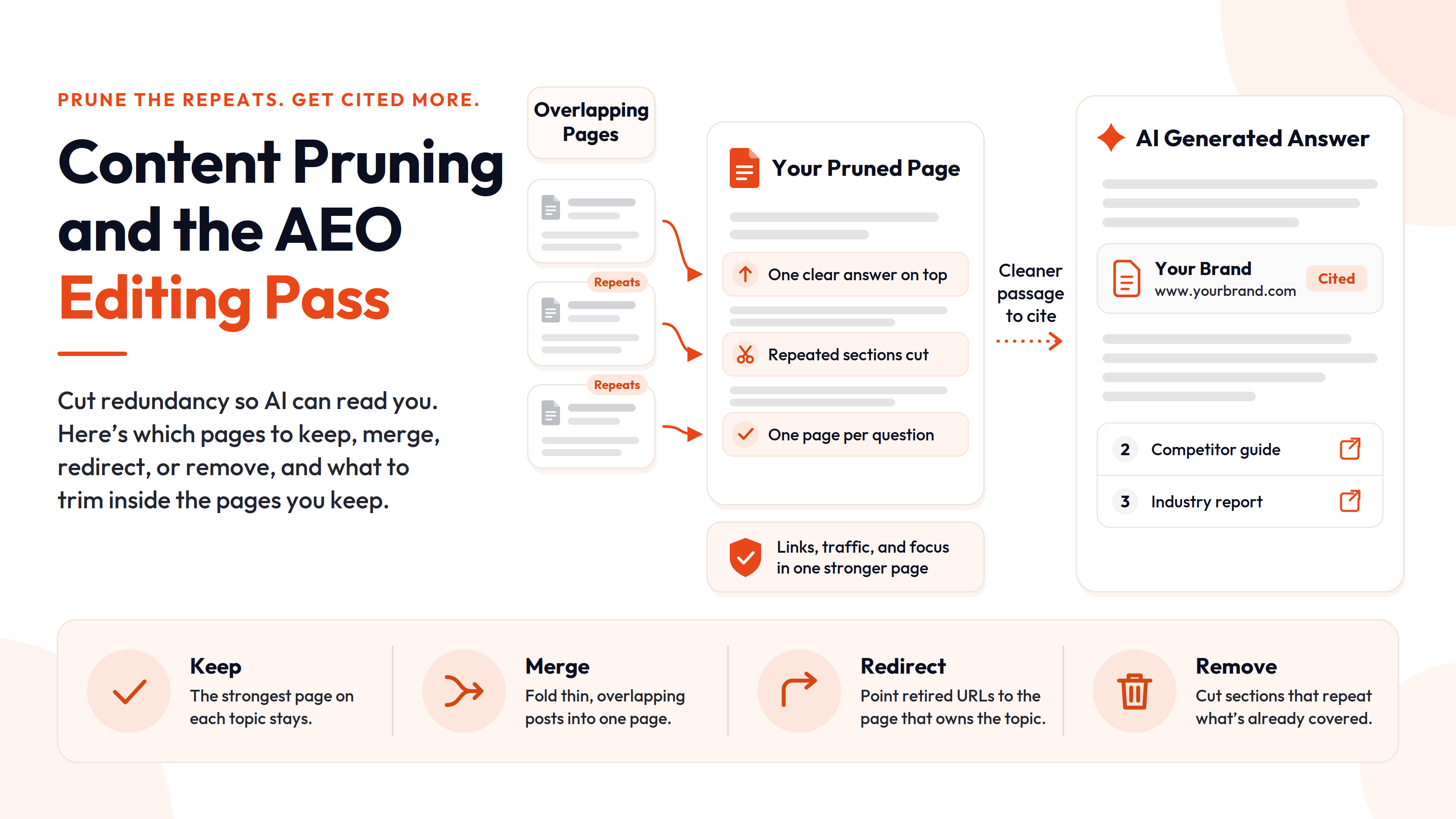
Before editing a single sentence, audit at the page level and sort every page into one of four outcomes. Most of your AEO gains come from this step, not from line editing.
.png?width=1646&height=819&name=editing_decisions%20(1).png)
Decide the fate of each page first. Only the "keep and tighten" pages are worth a line-by-line edit.
Keep and tighten the pages that own a real question and draw real interest; they go on to the section-level pass below. Merge pages that target the same buyer question into one comprehensive page, so you present a single source instead of several competing partial ones. Redirect pages that have earned backlinks but no longer deserve to stand alone, using a 301 to the page that now owns the topic, so the authority follows. Delete pages with no traffic, no links, and no relevance, because leaving weak pages indexed dilutes how focused your site looks to an engine.
Judge pages on the questions they answer and the signals they carry, not on word count or age. A short page that cleanly answers a real buyer question is worth keeping; a long page that repeats a stronger one is a merge candidate. When you merge, preserve the best passages from each source, set the redirects, and update the page so it reads as current.
Step two: cut the redundant sections inside the pages you keep
Once a page is worth keeping, the clarity pass begins. The most common problem on B2B pages is not missing information; it is the same information said three times, with the actual answer buried among the repeats.
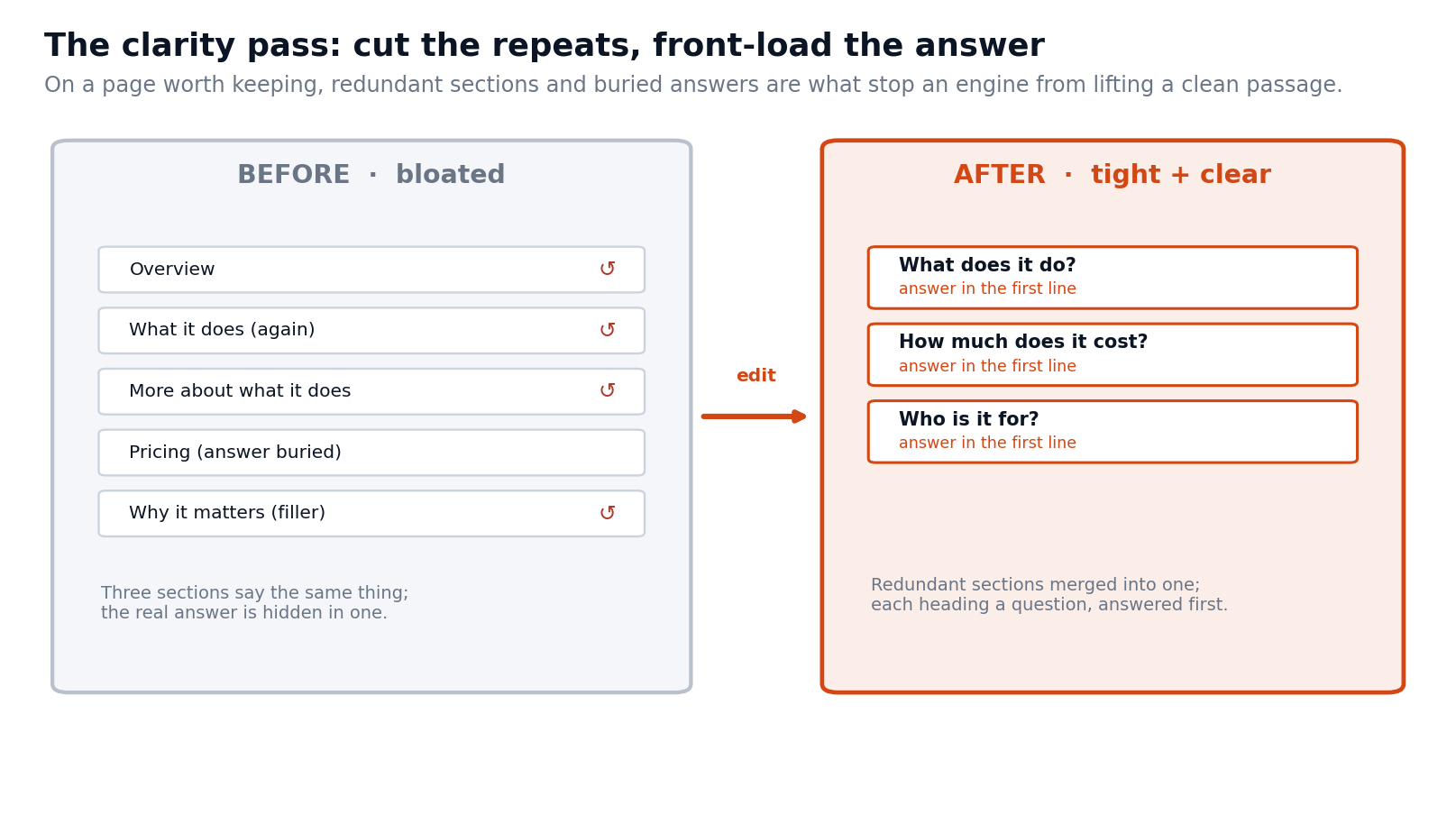
On a page worth keeping, the win is cutting the repeats and moving each answer to the front.
Find the sections that say the same thing. Read the page as a list of section purposes, not paragraphs. If two or three sections all answer "what does it do," collapse them into one that answers it well. Overlapping sections do not add depth; they add noise that an engine has to wade through.
Cut the filler sections that answer nothing. "Why it matters" preambles, throat-clearing introductions, and generic context paragraphs rarely contain a citable answer and often sit where the answer should be. If a section does not answer a specific question a buyer would ask, it is a candidate for removal.
Merge near-duplicates instead of deleting outright when both hold a unique detail. Sometimes two overlapping sections each contain one fact worth keeping. Combine them into a single block that carries both, rather than leaving two weak sections or losing a detail.
The test for every section is simple: does it answer a distinct question that no other section on the page already answers? If not, cut it or merge it.
Step three: front-load the answer in every section you keep
A section can be unique and still be hard to cite if its answer is buried. After cutting redundancy, move the direct answer to the top of each remaining section. Lead with a clean, self-contained statement that answers the section's question in the first line or two, then explain underneath. Retrieval favors the front of a section, so an answer that arrives after three sentences of setup is an answer an engine may never reach. This is the same answer-first discipline that wins featured snippets, covered in featured snippets and position zero, applied here as an edit rather than a first draft.
Two specific edits do most of the work. Turn each retained heading into the question a buyer actually asks, "How much does it cost" rather than "Pricing," so the heading marks the start of a clear answer block. And name the subject in the answer itself instead of leaning on "it" or "this," so the passage still makes sense when an engine lifts it out of the page.
Step four: tighten the sentences that carry the answer
The last pass is at the sentence level, on the lines most likely to be quoted. A quotable sentence makes one claim, leads with it, and stands on its own. Split sentences that bundle three ideas into one, because a tangled sentence is hard to extract cleanly. Replace vague qualifiers with the specific fact, and when a sentence states a number, keep its source and date in the same sentence so the claim is verifiable where it sits. You are not rewriting the page; you are sharpening the handful of sentences that answer the buyer's real questions, since those are the ones an engine reaches for. The deeper craft of what makes a passage citable is covered in the signals that make a page citable.
Don't skip the post-pruning cleanup
Merging and removing pages leaves loose ends that can undo the benefit if you ignore them. When you retire or merge a page, set a 301 redirect to the page that now owns the topic, so the authority and any inbound links follow rather than dying on a dead URL. Update the internal links that pointed to the old page so they aim at the keeper, since broken or orphaned links make a site harder to crawl and read. On the consolidated page, refresh the modified date to reflect the real update and carry over any structured data the merged pages had, so the page still declares what it is. These steps are unglamorous, but skipping them turns a clean consolidation into a set of dead ends that cost you the very authority you were trying to concentrate.
A worked example: three posts into one
Suppose you find three posts circling one buyer question: an old "intro to AI search visibility" explainer, a newer "AI visibility guide," and a thin "why AI visibility matters" post. Impressions sit mostly on the newer guide; the old explainer has a handful of backlinks; the thin post has neither traffic nor links.
The decisions fall out of the audit. The newer guide is the keeper: it owns the question and draws the interest. The old explainer gets redirected into it, so its backlinks transfer. The thin post gets deleted, since it dilutes the topic and adds nothing. Before redirecting, you lift the one genuinely useful passage from the old explainer and fold it into the guide.
Then the keeper goes through the clarity pass. The three overlapping "what it is" sections that accumulated across drafts collapse into one; the "why it matters" filler comes out; each remaining heading becomes a buyer question with its answer in the first line. Three competing, half-answered pages become one page that clearly owns the question, which is exactly what an engine can cite with confidence.
A repeatable editing pass
Turn this into a routine rather than a one-time cleanup, because content drifts back toward bloat as teams keep adding.
Work from your priority buyer questions. For each, find every page that touches it, and decide which single page should own it; merge, redirect, or delete the rest into that one. Then run the keeper through the clarity pass: cut redundant and filler sections, front-load each answer, turn headings into questions, and tighten the quotable sentences.
Re-check whether AI engines cite the consolidated page for that question over the following weeks, using repeated checks rather than a single look, since answers vary from run to run, a behavior covered in why AI search results fluctuate. Tracking that across a full question set is why frequent automated checks are the practical way to confirm a prune worked.
Where B2B teams get pruning wrong
- Treating volume as authority. More pages and longer pages are not more citable. Overlapping content splits signals and hides the answer worth quoting.
- Deleting pages that hold backlinks. A page with earned links but no standalone value should be redirected to the keeper, not removed, so the authority follows.
- Merging without preserving the best parts. Consolidation means keeping the strongest passage from each source, not pasting them together or dropping a unique detail.
- Editing sections without cutting any. Rewriting five redundant sections still leaves five redundant sections. Cut and merge first, then polish what remains.
- Pruning once and stopping. Content re-bloats as teams keep publishing. The editing pass is a routine, not a project.
- Measuring nothing. Without checking citations before and after, you cannot tell whether a prune helped. Re-check the consolidated page over repeated runs.
Frequently asked questions
Does removing content help or hurt AI search visibility?
It usually helps, when done deliberately. Consolidating overlapping pages and cutting redundant sections concentrates your authority signals and gives engines a single clean passage to cite, rather than several competing partial ones. Removing pages that carry backlinks without redirecting them is the main way pruning goes wrong.
What is content pruning for AI search?
It is auditing your existing content and deciding, for each page, whether to keep and tighten it, merge it into a stronger page, redirect it, or delete it, then cutting redundancy and front-loading answers inside the pages you keep. The goal is fewer, sharper, more citable pages.
How do I decide whether to merge or delete a page?
Merge when a page targets the same buyer question as a stronger page and holds passages worth keeping. Delete when it has no traffic, no links, and no relevance. If it has earned backlinks but no standalone value, redirect it instead of deleting so the authority transfers.
How do redundant sections hurt a page's chances of being cited?
They bury the one passage worth quoting under near-duplicates and make it harder for an engine to tell which section to trust. Collapsing repeated sections into one clear answer gives retrieval a single, obvious block to lift.
How often should I run a content pruning pass?
Treat it as a recurring routine rather than a one-time cleanup, because content re-bloats as teams keep publishing. Revisit your priority questions and the pages that answer them on a regular cadence, and re-check citations after each pass.
Fewer pages, clearer answers
The editing pass reverses the old instinct to add. For AI search, the win comes from subtraction: fewer pages, each owning a real question; fewer sections, each answering something distinct; and tighter sentences, each carrying a claim an engine can lift. You are not making your content thinner. You are removing what was hiding the answer.
To see which of your pages actually earn citations and which are overlapping dead weight, run a free scan with the AI Search Visibility Checker, or track how your citations move as you prune and consolidate with AI Search Intelligence.