


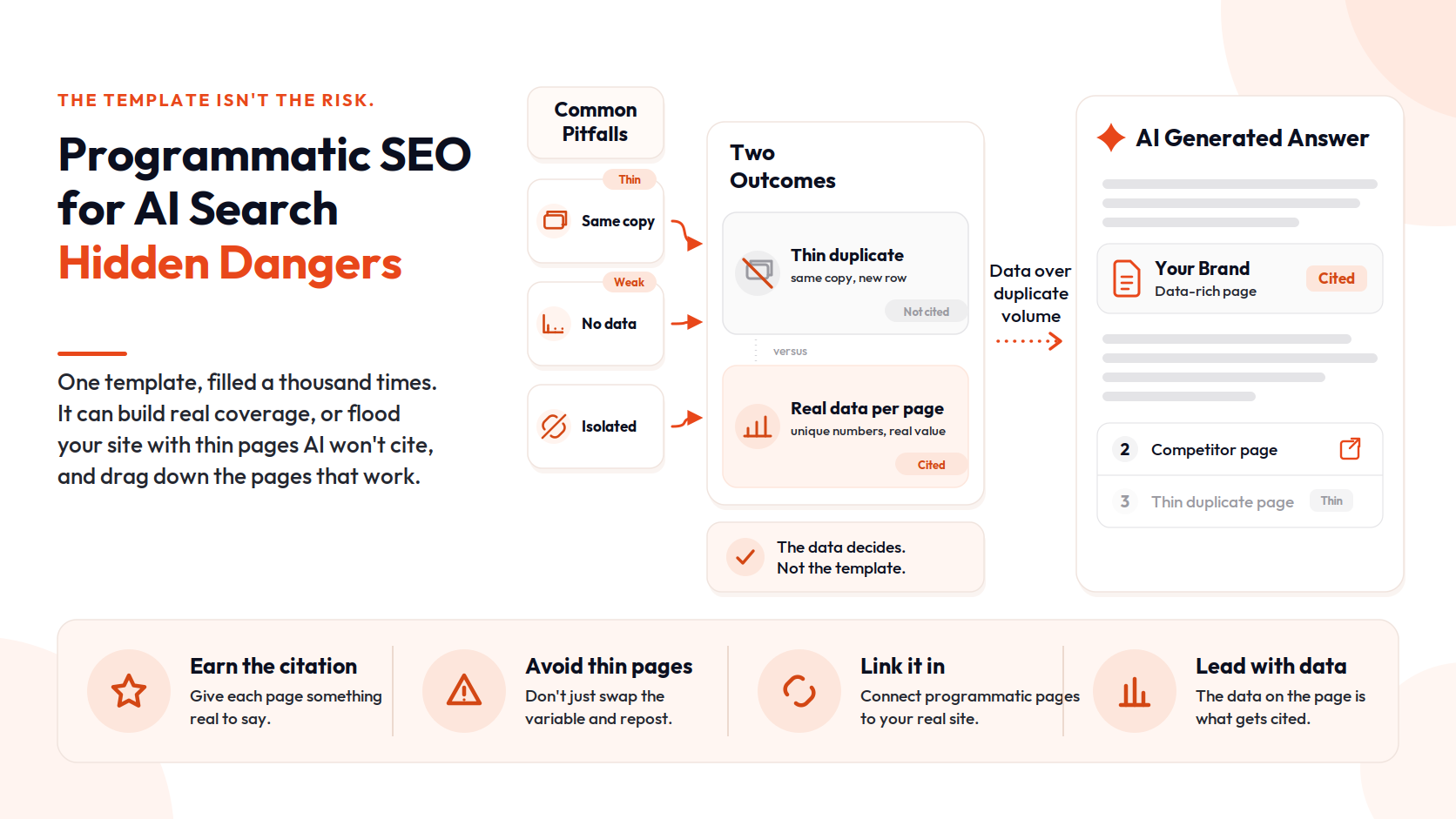


Programmatic SEO is the practice of mass-producing pages from a single template and a dataset: one layout, filled a thousand times with different rows. For a decade it was a long-tail growth engine, spin up a page for every city, every integration, every "X alternative," and collect the traffic. AI search has made it a far riskier bet. The same technique that can build genuine coverage at scale can also flood your site with thin pages that no AI engine will cite and that quietly drag down the pages that were working.
The deciding factor is not whether you go programmatic; it is what sits on each page. This piece covers when programmatic SEO earns AI citations, the specific ways it backfires in AI search, and how a B2B team can use it without wrecking its own visibility. The short of it: the value of a programmatic page in AI search is the data on it, not the fact that it exists.
What programmatic SEO is, and why AI changed the math
A programmatic page is generated, not hand-written: a template with slots, populated from a spreadsheet, an API, or a database. The output can be excellent (a comparison page pulling live pricing for every tool in a category) or worthless (a thousand near-identical pages where only the city name changes). Classic SEO tolerated a lot of the worthless kind, because ranking for a sliver of long-tail queries still returned some traffic even from thin pages.
AI search removed that tolerance in two ways. First, AI answers absorb much of the long-tail informational click that thin programmatic pages used to catch, so the traffic those pages were built for is drying up regardless of their quality. Second, and more important, AI engines cite sources, and they do not cite generic templated filler. A page has to carry something worth quoting to be a candidate, and a page that is identical to a thousand others, minus one variable, has nothing distinct to quote. The math that made thin programmatic SEO worth it has largely inverted.
What actually changed
Two shifts turned thin programmatic SEO from low-return to actively risky, and both are worth understanding before you commit to a set.
Search engines got serious about scaled, low-value content. Producing pages at scale whose main purpose is to catch rankings rather than help a reader is now something search engines act against directly, and that enforcement tends to land at the domain level. A site with a large base of thin templated pages is not risking those pages alone; it is risking how the whole domain is judged. The tactic that used to be low-downside now carries a site-wide one.
The long tail those pages fed is being answered by AI. Thin programmatic pages historically survived on scraps of long-tail informational traffic, the exact queries AI answers now handle without a click. So even setting enforcement aside, the traffic the thin pages were built to capture is shrinking on its own. You can do everything the old playbook said and still watch the return fall, because the queries no longer send the click.
Put together, the downside of thin programmatic SEO went up while its upside went down. That is why the same technique now splits so sharply into a version that works and a version that backfires.
When programmatic pages help AI visibility
Programmatic SEO is not dead for AI search; the thin version is. Done on the right foundation, it still builds citable coverage faster than hand-writing ever could.
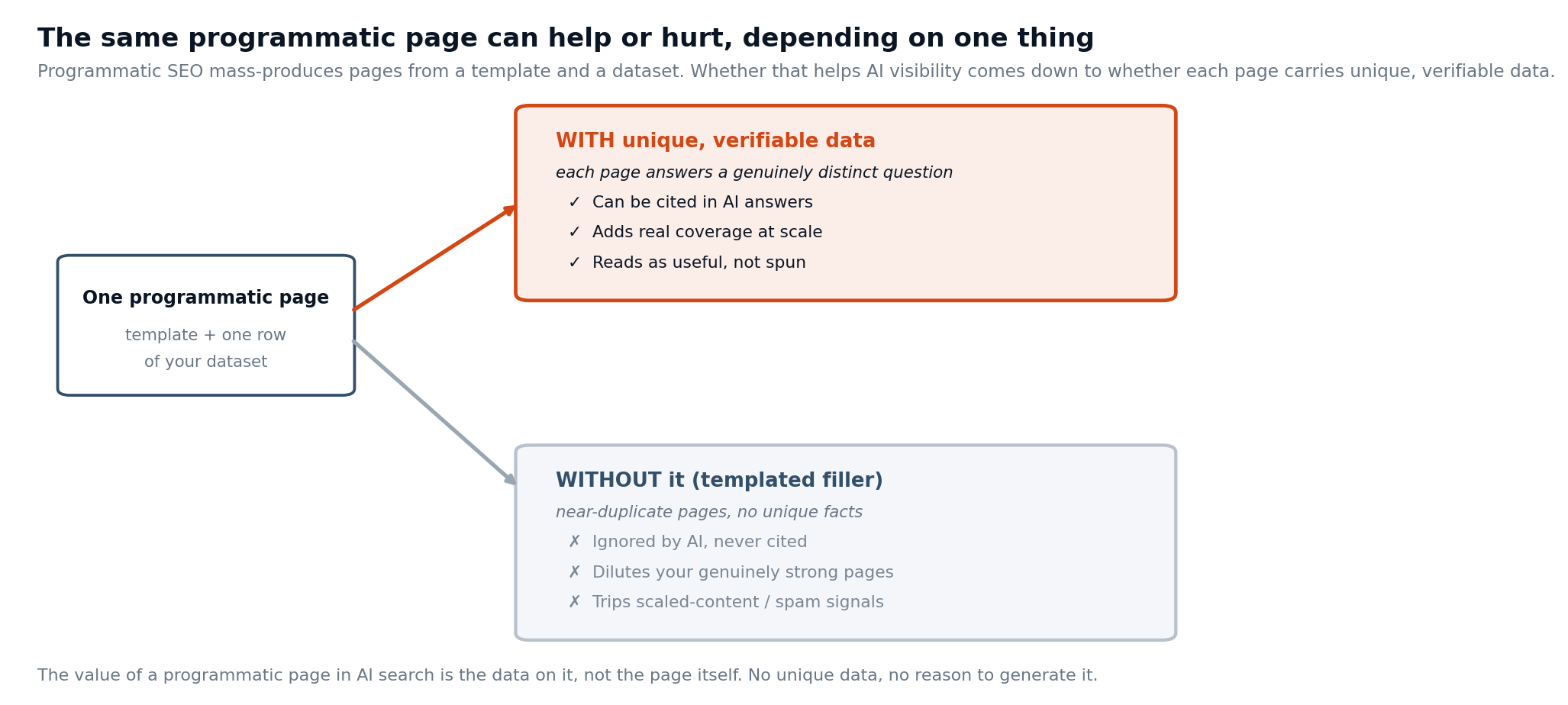
What decides the outcome is whether each generated page carries unique, verifiable data and answers a genuinely distinct question.
The pages that work share one trait: each one carries data that cannot be copy-pasted onto the next page. A few patterns hold up well for B2B. Comparison and alternatives pages that pull real, current features and pricing for each competitor give an engine specific, quotable facts. Integration pages that document how your product actually connects to a named tool, with real setup details, answer a distinct question per integration. Calculators and interactive tools produce a genuinely different answer for every input. Data-backed pages built on proprietary numbers, your own benchmarks or usage data, are exactly what AI reaches for, because the facts exist nowhere else.
What these have in common is that the template is just a delivery mechanism for real, per-page data. The page earns its place because someone would get a specific answer from it that they could not get from its siblings.
The hidden dangers
The failure mode is seductive because it looks productive: you ship hundreds of pages in a week and the CMS fills up. The damage shows up later, and it is worse in AI search than it was in classic SEO.
Thin pages are simply never cited. An AI engine has no reason to quote a page whose only distinct content is a swapped noun. You spend the production effort and get no citations in return, so the pages are dead weight from the day they publish.
Near-duplicates dilute the pages that do work. This is the danger teams miss. AI leans on your few genuinely citable pages, and burying them among hundreds of thin templated pages makes them harder to find and makes the whole domain read as lower quality. The thin pages do not just fail on their own; they pull down the strong ones around them.
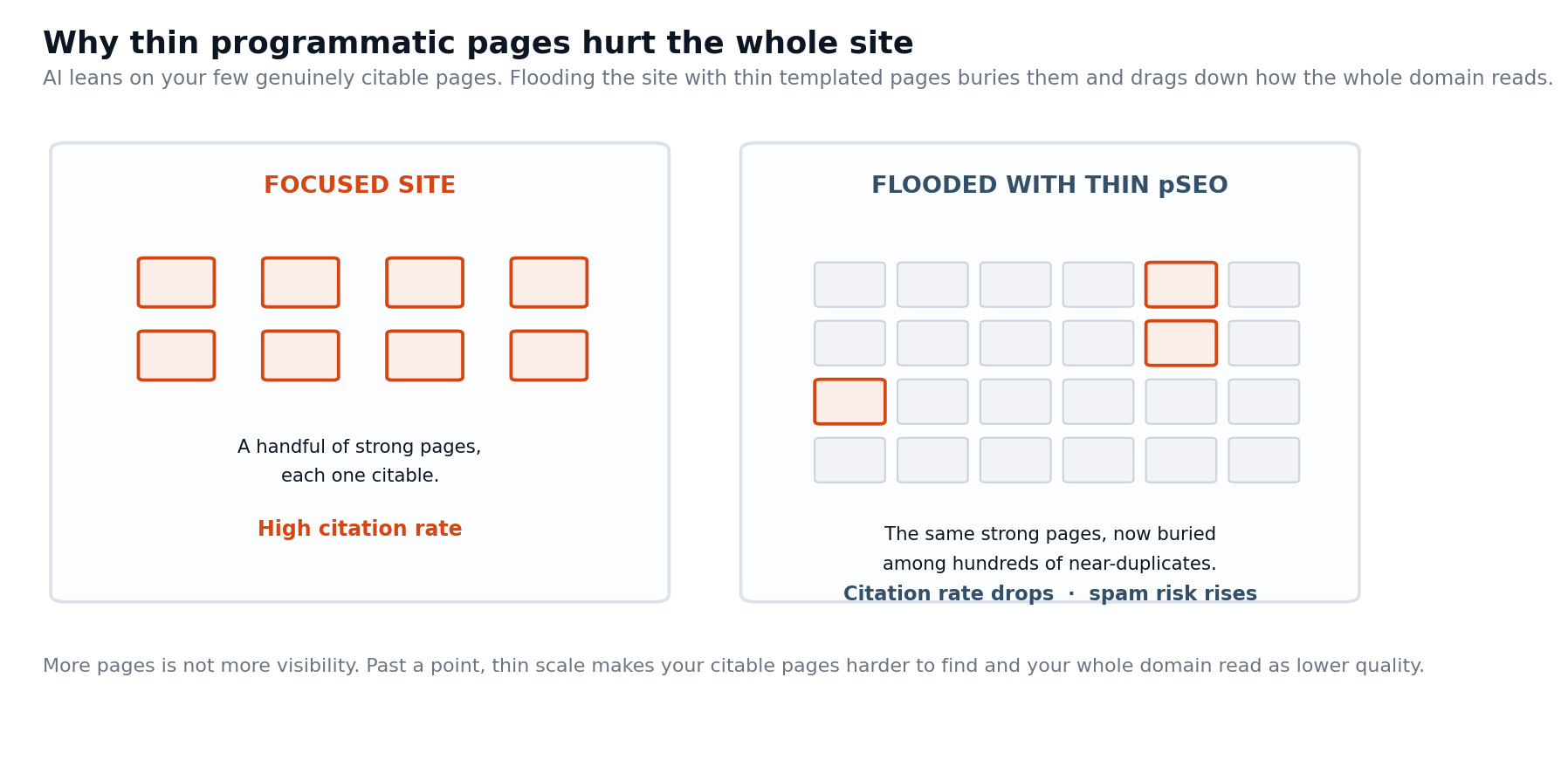
More pages is not more visibility. A flood of thin templated pages buries the citable ones and lowers how the whole domain reads.
Mass generation invites inaccuracy, and inaccuracy gets you misquoted. Programmatic pages are increasingly filled by AI at scale with little review, and unreviewed generation produces confident, wrong statements: a feature a competitor does not have, a price that is out of date, a spec that is invented. If such a page does get cited, the engine repeats your error as fact, which is worse than not being cited at all.
Scale for its own sake trips quality and spam signals. Search engines actively act against content generated primarily to game rankings, and enforcement against scaled, low-value content tends to hit at the domain level rather than page by page. A large base of thin templated pages can put your whole site at risk, not just the pages themselves, which turns a growth tactic into a liability the rest of the site pays for.
How to use programmatic SEO safely for AI search
The safe version is disciplined about one question, asked before any page is generated: does each page carry unique, verifiable data that answers a distinct buyer question? If the honest answer is no, do not generate the set.
Lead with the data, not the template. Start from a dataset that is genuinely different per row, ideally something proprietary or hard to assemble, and build the template around it. If the only thing that changes between pages is a keyword, there is no dataset, only a mad-lib.
Gate quality before publishing, not after. Every generated page should be checked for accuracy and for whether it actually answers its question, especially when AI wrote the body. Reviewing a sample and shipping the rest unread is how the inaccurate, misquote-inducing pages slip through. The structural basics that make any page citable still apply per page, covered in how to structure content for LLMs and the signals that make a page citable.
Pick page types that reward per-page data. The formats that hold up are the ones where the data is the point: comparison, integration, calculator, and data-backed pages, which are the same page types that earn AI citations in the first place. Templated informational filler is exactly the type AI answers have taken over.
Cap the scale to the data you actually have. The right number of programmatic pages is the number of rows of real, distinct data you can stand behind, not the number of keyword permutations a tool can generate. When you run out of unique data, stop.
A four-question test before you generate a set
Before building any programmatic set, run it against four questions. If it fails any of them, the set will more likely dilute your visibility than add to it. Is there a unique fact on every page? Not a unique keyword, a unique fact: a different price, spec, dataset, or answer that exists on that page and nowhere else in the set. If the pages are the same minus a noun, stop here.
Would each page answer a real question a buyer asks? A page has to map to a question someone would actually pose to an engine. "Best CRM for dentists" is a real question; a permutation nobody searches is just a URL.
Can you stand behind every page's accuracy? If you cannot verify the facts on all of them, especially when AI generated the body, you are shipping misquote risk at scale. The answer has to be yes for the whole set, not a sample.
Do you have enough real data to fill it? If the genuine, distinct data runs out at fifty rows, the set is fifty pages, not five hundred. Padding the rest with filler undoes the value of the fifty good ones. Four yeses means the set is worth generating. A single no means you either find the missing data first or do not build it.
A worked example: 500 integration pages
Say a B2B SaaS wants an integration page for every tool it connects to, and there are five hundred of them. The template is the same for all: a hero, a "why connect X" section, and a setup blurb. Two versions of this project go very differently.
In the thin version, the only thing that changes per page is the tool's name and logo, dropped into boilerplate that says the integration "saves time and boosts productivity." Five hundred near-identical pages ship in a sprint. No AI engine cites any of them, because there is nothing specific to quote, and the flood of duplicates buries the company's genuinely strong pages and reads to search engines as scaled, low-value content. The project produced work, not visibility.
In the data-backed version, each page is built from a real record per integration: the exact triggers and actions supported, the fields that sync, the setup steps for that specific tool, and a note on limitations. Now every page answers a distinct question, "how does the product integrate with this exact tool," with facts that live nowhere else. These pages can be cited when a buyer asks an engine about a specific integration, and they add real coverage. Same template, same five hundred pages; the difference is entirely the per-page data, which is the whole lesson.
If you already have a thin programmatic base
Many B2B sites are already carrying a programmatic set that has quietly become dead weight. Do not leave it indexed and hope. Audit which of the pages carry real, distinct data and are cited or could be, keep and strengthen those, and consolidate or remove the rest, which is the subtraction work covered in content pruning and the AEO editing pass. Removing a large base of thin pages, with proper redirects for any that hold links, often lifts the pages that remain, because it stops them being buried and improves how the domain reads. Cutting the thin set is frequently a faster AI-visibility win than adding anything new.
Where B2B teams go wrong with programmatic SEO
- Treating page count as the goal. Shipping a thousand pages feels like progress. If they carry no unique data, it is a thousand pages of dilution.
- Generating first, finding the data later. If you build the template before you have a genuinely distinct dataset, you will fill it with filler. The data comes first.
- Skipping review on AI-generated pages. Unreviewed mass generation produces wrong facts that, if cited, get you misquoted. Gate quality before publishing.
- Assuming schema or FAQs will save a thin page. Markup does not add substance. A page with no unique data is not rescued by structured data on top of it.
- Leaving an old thin base indexed. A large set of thin pages is a site-wide liability. Prune it rather than letting it drag the rest down.
Frequently asked questions
Is programmatic SEO still worth it for AI search?
Yes, but only the version built on unique, verifiable data per page. Programmatic pages that carry real per-page facts, like comparison, integration, and data-backed pages, can earn AI citations at scale. Thin templated pages that only swap a variable no longer earn traffic or citations and can hurt the rest of your site.
Why do thin programmatic pages hurt AI visibility?
AI engines will not cite generic filler, so thin pages earn nothing, and a large base of near-duplicates buries your genuinely citable pages and makes the whole domain read as lower quality. Scaled low-value content can also trigger enforcement at the site level, not just on the offending pages.
What kinds of programmatic pages still get cited?
Pages where the data is the point: comparison and alternatives pages with real current pricing and features, integration pages with genuine setup detail, calculators and tools that answer differently per input, and pages built on proprietary data. Each must answer a distinct question rather than repeat a sibling.
Can I use AI to generate programmatic pages?
You can use it to assemble pages from real data, but you cannot skip review. Unreviewed AI generation at scale produces confident, wrong claims, and a cited error means an engine repeats your mistake as fact. Gate every page for accuracy before it publishes.
How many programmatic pages should I create?
As many as you have rows of real, distinct data to stand behind, and no more. The limit is your dataset, not the number of keyword combinations a tool can produce.
Scale the data, not the page count
Programmatic SEO is not a shortcut to AI visibility, and treating it as one is how teams bury their own best pages and put the whole domain at risk. The technique is fine; the discipline is everything. If each generated page carries unique, verifiable data and answers a real question, you build citable coverage faster than you could by hand. If it does not, you are manufacturing dilution. Scale the data you genuinely have, gate it for accuracy, and prune what does not clear the bar.
To see which of your pages, programmatic or not, actually earn AI citations and which are thin dead weight, run a free scan with the AI Search Visibility Checker, or track citation coverage as you build and prune with AI Search Intelligence.