


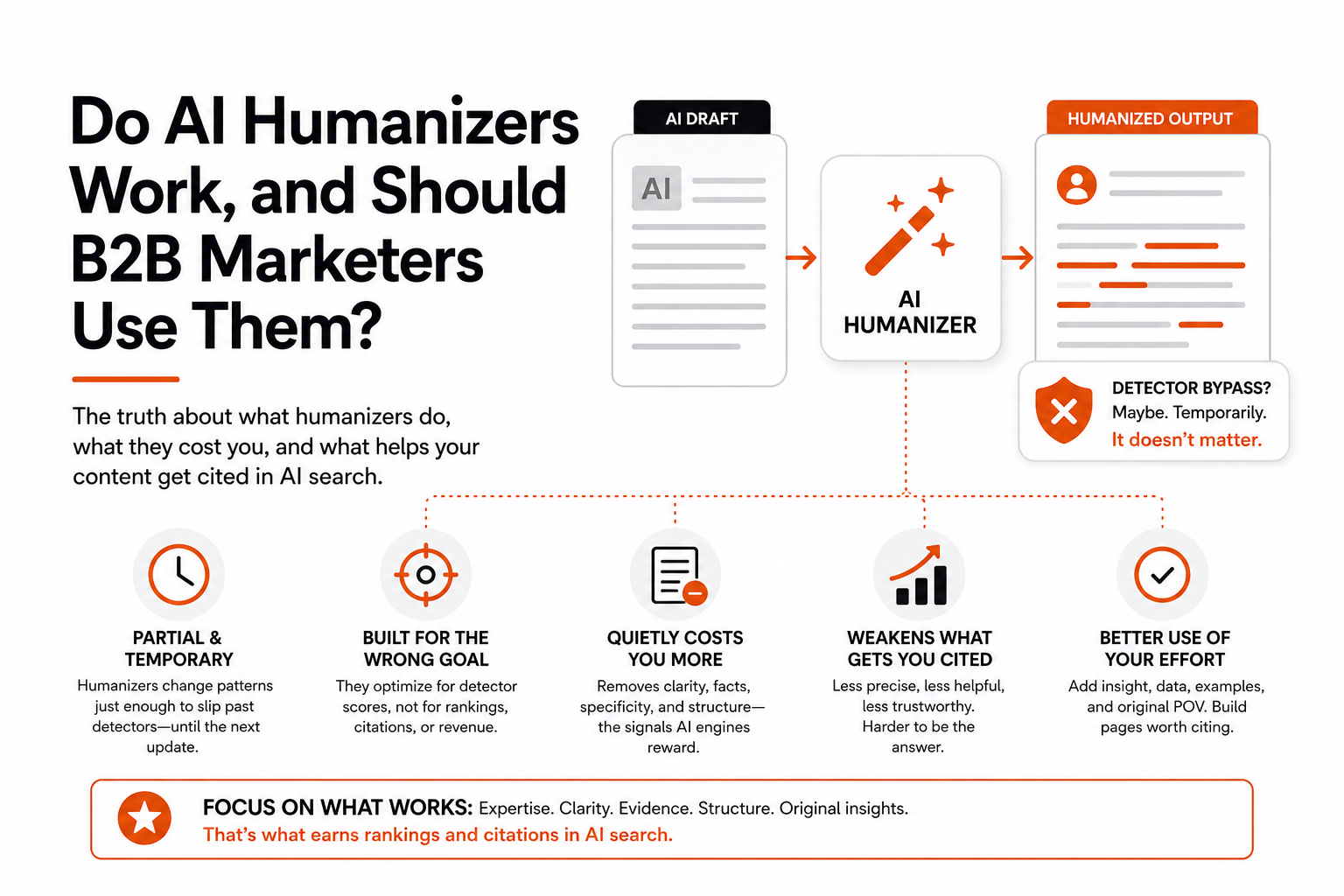


Do AI Humanizers Work, and Should B2B Marketers Use Them?
If your team drafts with AI, you have probably seen the next tool in the chain: the humanizer. Paste in an AI draft, get back a version that reads as more human and, the pitch goes, sails past AI detectors. For a B2B content team under pressure to publish, that sounds like insurance. It is worth asking two separate questions before you build it into your workflow. Do these tools actually do what they claim, and even if they do, is the thing they are optimizing for something that helps your content get found and cited.
The short honest answer is that humanizers work partially and temporarily, and they work against the very things that get B2B content cited in AI search. This piece walks through how they change your text, why the win never lasts, what the rewrite quietly costs you, and what to do with that same effort instead. It is a companion to our look at whether AI content detectors work; if detectors are the lock, humanizers are the tools sold to pick it.
How an AI humanizer changes your text
An AI humanizer is a paraphrasing tool with a specific goal. It rewrites your draft to change the surface statistics a detector keys on: how predictable the word choices are, how uniform the sentence lengths are, how smooth the rhythm is. It swaps words for synonyms, breaks up or reorders sentences, and adds small irregularities so the text looks less like typical machine output.
Notice what it is not doing. It is not checking whether the claims are correct, adding anything you know that the model did not, or improving the argument. It is editing for a machine reader, not for a human one and not for accuracy. That distinction is the root of everything below, because the goal it optimizes for and the goal you actually care about are not the same goal.
Do they work? Sometimes, and never for long
Run a draft through a humanizer and a detector score often does drop, at least on that detector, at least that day. So in the narrowest sense, yes, they can move the number. The problem is that the number will not stay moved. Detectors and humanizers are locked in an arms race.
Detector makers retrain on the output of popular humanizers, so a rewrite that reads as clean today gets flagged after the next update. You respond by running the humanizer again, or switching to a newer one, and the loop starts over. There is no stable finish line, because both sides keep moving and neither can win outright. Detection was already unreliable in both directions before humanizers entered the picture; adding a second guessing tool on top does not make the outcome more certain, it makes it less.
.png?width=1615&height=897&name=humanizer_treadmill%20(1).png)
Each pass buys a lower score for a while, then a model update flags the text again. You are running to stay in place, and the content gets a little worse every lap.
The treadmill has a cost that the arms race hides: your content degrades a little on every pass. Which brings us to what you are actually trading away.
What the rewrite costs you
Paraphrasing to dodge a detector is not free. To make text look less machine-generated, a humanizer tends to make it vaguer. Specific becomes general. Named things become unnamed. Concrete becomes hedged. Those are not cosmetic changes for B2B content, because specificity is exactly what makes a page worth citing.
Watch what happens to a single sentence. A precise claim like "Omnibound tracks citations across ChatGPT, Perplexity and Gemini, checked daily against a fixed prompt set" is the kind of self-contained, factual line an AI engine can lift and attribute. Push it through a humanizer tuned to sound casual and you can get back something like "a leading platform monitors your presence across various AI tools on a regular basis." It reads as more human and it says almost nothing. The named entity is gone, the claim is softened, the frequency is fuzzy, and there is nothing left specific enough to quote.
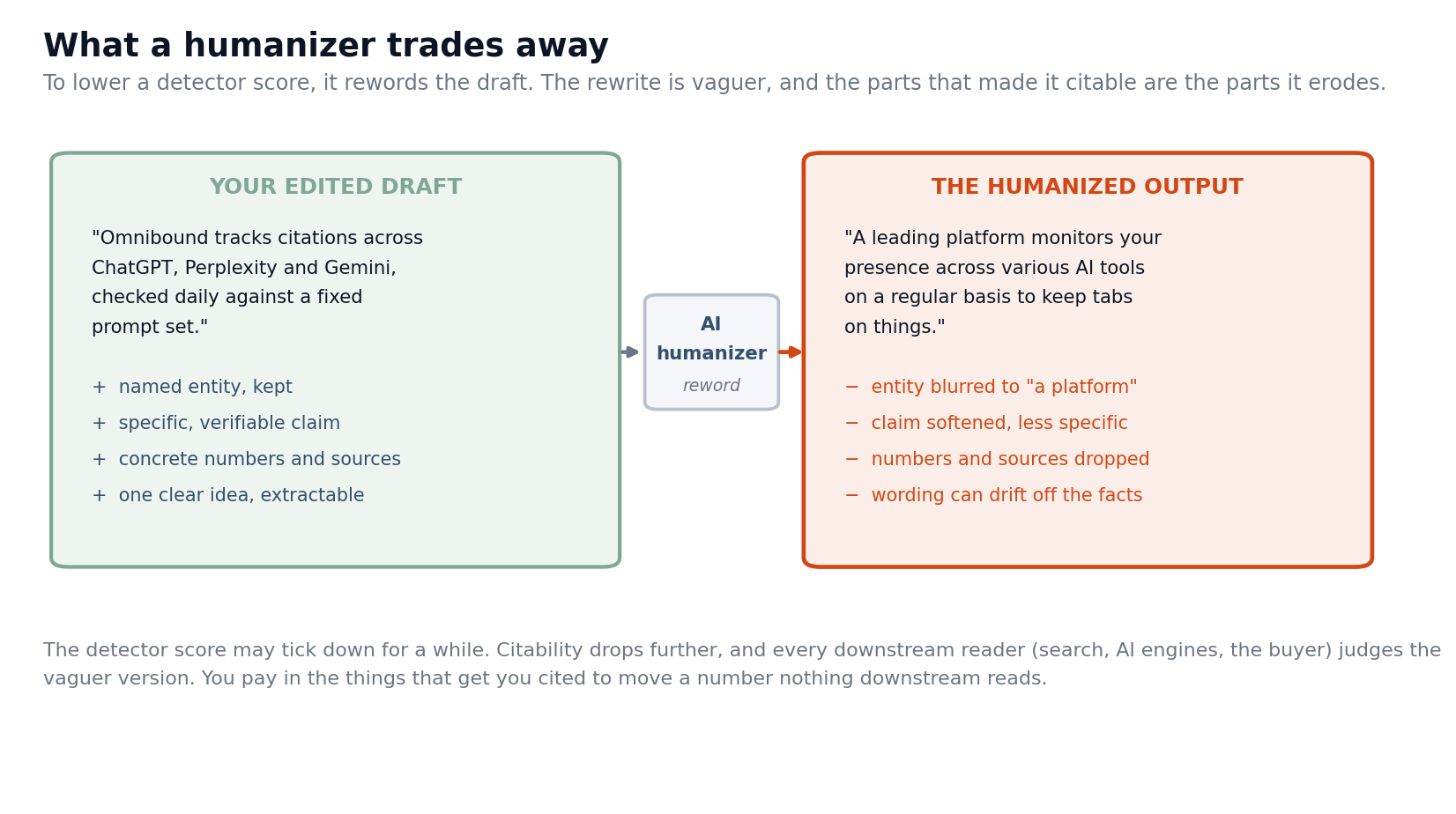
The humanizer blurs entities, softens claims, and drops the numbers and sources, the exact features that make a passage citable. And because it rewords without checking, it can drift off the facts.
That last point matters most. A humanizer rewrites without knowing what is true, so it can quietly change a number, garble a product detail, or introduce a claim you never made. If that altered sentence is the one an engine lifts, you get cited saying something wrong. You have traded an accurate, specific line for a vague one that might also be incorrect, in exchange for a score that moves back next month.
You are optimizing for the wrong reader again
Here is the part that makes the whole exercise hard to justify. The detector score you are working to lower is not a signal that search engines or AI answer engines use. Google has been consistent that it judges content on quality and usefulness, not on how it was produced, and it does not run your page through an AI detector before ranking it. AI answer engines cite sources based on relevance, accuracy, and how cleanly a passage answers a question, not on whether some third-party tool thinks a human wrote it.
So the humanizer is optimizing for a reader that sits outside your actual funnel. No detector stands between your page and a ranking. No detector stands between your page and a citation in an AI answer. When you humanize to beat one, you are spending real editing effort on a number that nothing downstream reads, and paying for it in the specificity that the readers who do matter reward. If you want the mechanics of how AI search evaluates a page, we covered how AI search rewards content differently from classic SEO and the signals that actually make a page citable.
The rewrite can make your content harder to cite
It would be one thing if humanizing were merely neutral, a wasted step. For B2B content aimed at AI visibility, it is worse than neutral, for three reasons. It weakens extractability.
AI engines pull self-contained passages that make sense on their own. The specificity and clear entity references a humanizer blurs are what let a model lift one block and attribute it to you. Vaguer text is harder to extract cleanly, which is the opposite of what structuring content for LLMs is trying to achieve.
It strips the details that earn trust. Buyers and the engines serving them reward concrete, verifiable claims: named products, real numbers, cited sources. A humanizer treats those as machine-like patterns to smooth over. You lose the evidence that makes your page the credible answer.
It introduces accuracy risk at scale. Run one page through a humanizer and you might catch a drifted fact in review. Run a programmatic content operation through one and you are systematically injecting small errors across hundreds of pages, which is the thin-and-inaccurate failure mode that already sinks scaled AI content. The humanizer does not reduce that risk; it adds a fresh source of it.
But our AI drafts really do sound robotic
This is the fair objection, and it is usually the real reason a team reaches for a humanizer. AI drafts often are flat: even sentence lengths, safe word choices, a tone that never varies, claims that stay general because the model does not know your specifics. That is a genuine quality problem, and readers feel it even when they cannot name it.
The mistake is treating that as a detection problem when it is an editing problem. A humanizer attacks the symptom a detector measures, the surface uniformity, by shuffling words around. It does not fix the underlying flatness, because the flatness comes from the draft having no real substance in it yet: no specific numbers, no named examples, no point of view. Shuffling vague sentences produces different vague sentences.
The thing that makes writing sound human is having something concrete to say, and that is added by a person who knows the subject, not by a paraphraser that does not. So the robotic-draft worry is real, and it points to more editing, not to a tool that simulates editing. If your drafts read like a machine, the answer is to put human knowledge into them, which is also, conveniently, what makes them citable.
Humanizing could weaken your best content
If your team has been running content through these tools, or you inherited pages that were, it is worth auditing for the damage rather than assuming it is harmless. A few signals that a page has been over-processed: entities that should be named have gone generic, so "Salesforce" became "a major CRM"; claims that used to carry a number now say "many" or "a significant amount"; sentences read smoothly but say nothing quotable when you pull them out of context; and, most seriously, facts that no longer match your source material because a rewrite drifted off them.
The quotable-when-pulled test is the useful one for AI search. Take any key sentence, read it on its own, and ask whether an engine could lift it and attribute a real, correct claim to you. If the answer is no because the sentence is too vague or you are no longer sure it is accurate, that page has been optimized away from citation. Fixing it is the same work as a good edit: put the specifics back, verify the facts, and make each passage stand on its own.
The honest exception
There is a narrow, legitimate use, and it is worth naming so the advice is not a blanket ban. If you have a draft that is already accurate and specific, and you use a paraphrasing tool as a light readability aid, to loosen a stiff sentence or vary a monotonous rhythm, followed by a human read for correctness, that is just editing with an assist. The tool is helping you polish content you stand behind.
That is a different activity from what humanizers are marketed for. The line is intent and review. Using a rewrite tool to improve a passage you then verify is fine. Using it to make content undetectable, with no one checking whether it is still true or still specific, is the version that costs you. If you would not be comfortable publishing the output unread, the tool is doing the wrong job.
What to do instead
The good news is that everything a humanizer claims to deliver, content that reads as human and performs, is exactly what a real editing pass produces, without the downsides. A person editing for accuracy, specificity, and voice makes the text more human and more citable at the same time. There is no trade-off and no lap two.
A practical pass looks like this. Read the draft for correctness first and fix anything the model got wrong or vague. Put your own specifics back in: real numbers, named examples, the thing you know that the model did not. Make each key passage self-contained so it answers a question on its own. Cut filler and tighten the claims so they are quotable.
Then, if a sentence still reads stiffly, loosen it by hand or with a paraphrase assist you check. Finally, stop guessing at a detector score and measure the thing that matters instead: whether you are actually being cited, tracked over time and across engines.
That is the whole reframe. The goal was never to fool a detector. It was to be the accurate, specific source an engine wants to quote and a buyer wants to trust. A humanizer moves you away from that. An edit moves you toward it.
Edit for the reader who decides
AI humanizers solve a problem you do not have. The detector score they lower is not a gate on your rankings or your citations, the win they produce does not last, and the rewrite quietly erodes the specificity and accuracy that get B2B content cited in the first place. Spend that effort on a genuine edit and you get the human-sounding, high-performing content the tools promise, plus the citability they take away.
If you want to see which pages are already earning citations and which are getting passed over, the AI Search Visibility Checker gives you a fast read. And when you are ready to make that a routine rather than a one-off, AI Search Intelligence tracks how often you are cited across engines over time, so you can edit toward what actually gets picked up, not toward a number no engine reads.