

Does AI-Generated Content Rank in Google and AI Search?
It is the question every content team asks once AI enters the drafting process: if we publish this, will Google bury it, and will AI answer engines ignore it because a model helped write it.
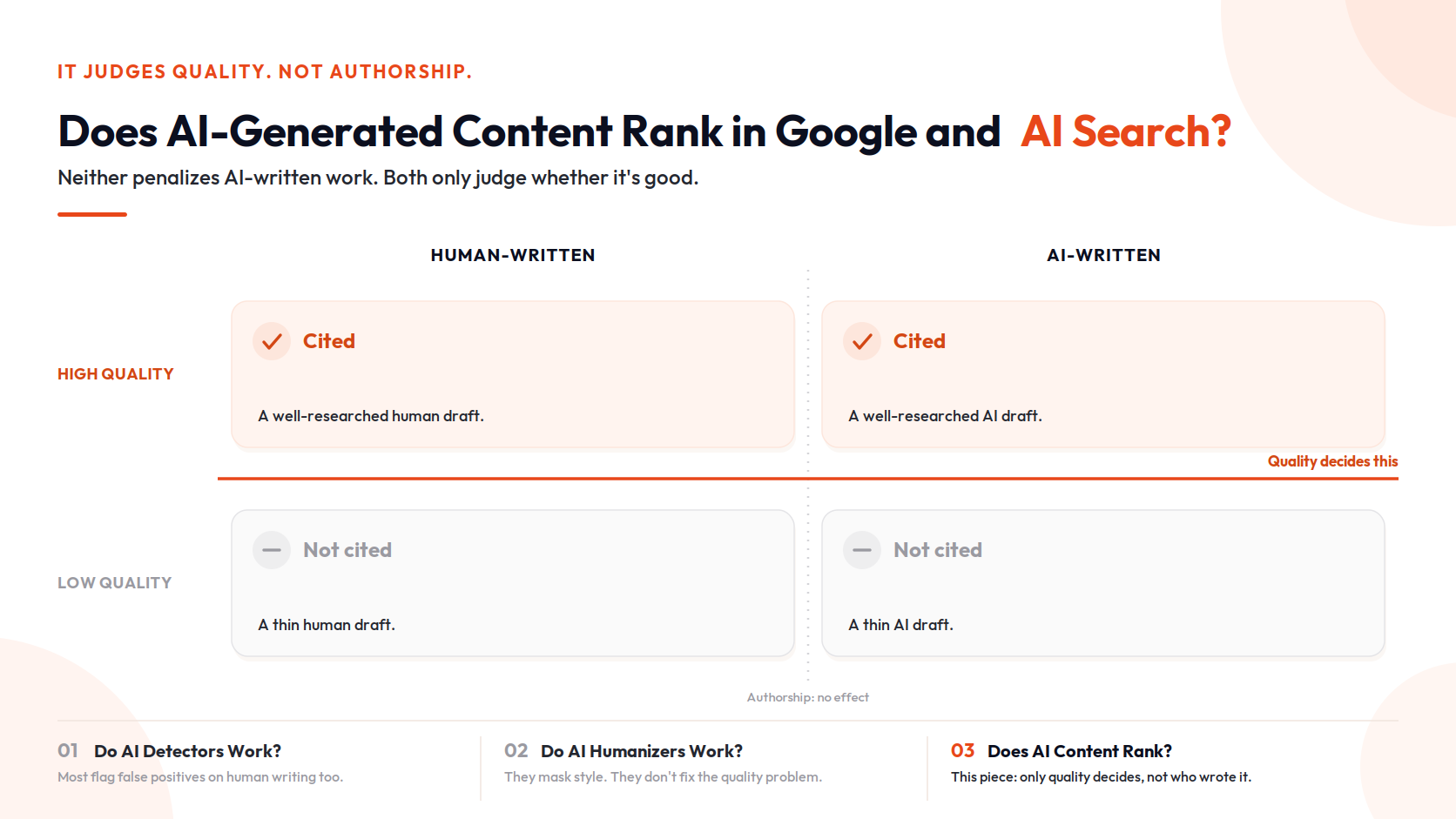
The question matters more now because AI is already part of the buying journey. Gartner reported in that 60% of B2B buyers use GenAI in some form to shape their purchase decisions. That means your content increasingly has two jobs: get discovered in traditional search and become useful enough to surface in AI-generated answers. The worry is understandable, and the answer is clearer than the noise around it suggests. AI-generated content can rank in Google and can get cited by AI search engines. Neither surface penalizes a page for being AI-written. What both of them judge is whether the page is any good.
This piece walks through what Google actually does, what AI answer engines actually do, why the production method is a non-factor on both, and what genuinely decides whether your content wins or sinks. It rounds out a set that also covers whether AI content detectors work and whether AI humanizers are worth using; the short version of all three is the same, and it is worth seeing why.
What Google actually says, and does
Google has been consistent on this for years: it rewards helpful, reliable, people-first content, and it does not care how that content was produced. There is no ranking penalty for using AI to write, and Google does not run your page through an AI detector before deciding where it ranks. Using AI to generate content is treated the same as using any other tool, so long as the result is useful.
What Google does act against is a category, not a tool: scaled content abuse, meaning pages mass-produced to game rankings rather than to help anyone. That behavior is penalized whether a human, a template, or a model produced it. The trap teams fall into is assuming the two are the same thing. They are not. AI makes it easy to mass-produce thin pages, so careless AI use and scaled abuse often travel together, but it is the thinness and the intent that get penalized, not the fact that a model was involved.
Careful AI use, where a person adds value and checks the work, sits nowhere near that line. We covered how AI search rewards content differently from classic SEO if you want the fuller picture, but the ranking answer on its own is simple: quality decides, production method does not.
Where the penalty myth comes from
If there is no penalty, why does everyone believe there is one. The myth has real roots, which is why it is sticky. Teams did watch AI-heavy sites get deindexed or lose rankings, especially after Google tightened its handling of mass-produced content. The visible cause looked like "the pages were AI-written." The actual cause was that they were thin, near-identical, and published at volume to game search. The AI was how those pages got made so fast; the thinness and the intent were what got them hit. Correlation got read as causation, and "AI content gets penalized" spread because it is a simpler story than "low-value content produced at scale gets penalized, and AI made that easy to do."
Detection anxiety keeps the myth alive. Because AI detectors exist and get talked about, it is easy to assume Google runs one and rules on the result. It does not, and even if it wanted to, the detectors are not reliable enough to gate rankings on. The belief persists because it feels like it should be true, not because the evidence supports it.
What AI answer engines actually do
The second surface is the one most "does AI content rank" articles skip, and for B2B it is now just as important. When ChatGPT, Perplexity, Gemini, or Google's AI answers assemble a response, they pull and cite sources. Do they cite content differently if it was AI-written.
No, and for the same reason. An engine choosing what to cite is judging relevance to the question, accuracy, how cleanly a passage can be lifted and attributed, and whether the source looks trustworthy. There is no step in that process that asks who or what drafted the text. It cannot ask, and it has no reason to. A precise, accurate, well-structured passage gets cited whether a person or a model wrote the first draft, and a vague or inaccurate one gets passed over on the same terms. The signals that make a page citable are about the content, not its origin.
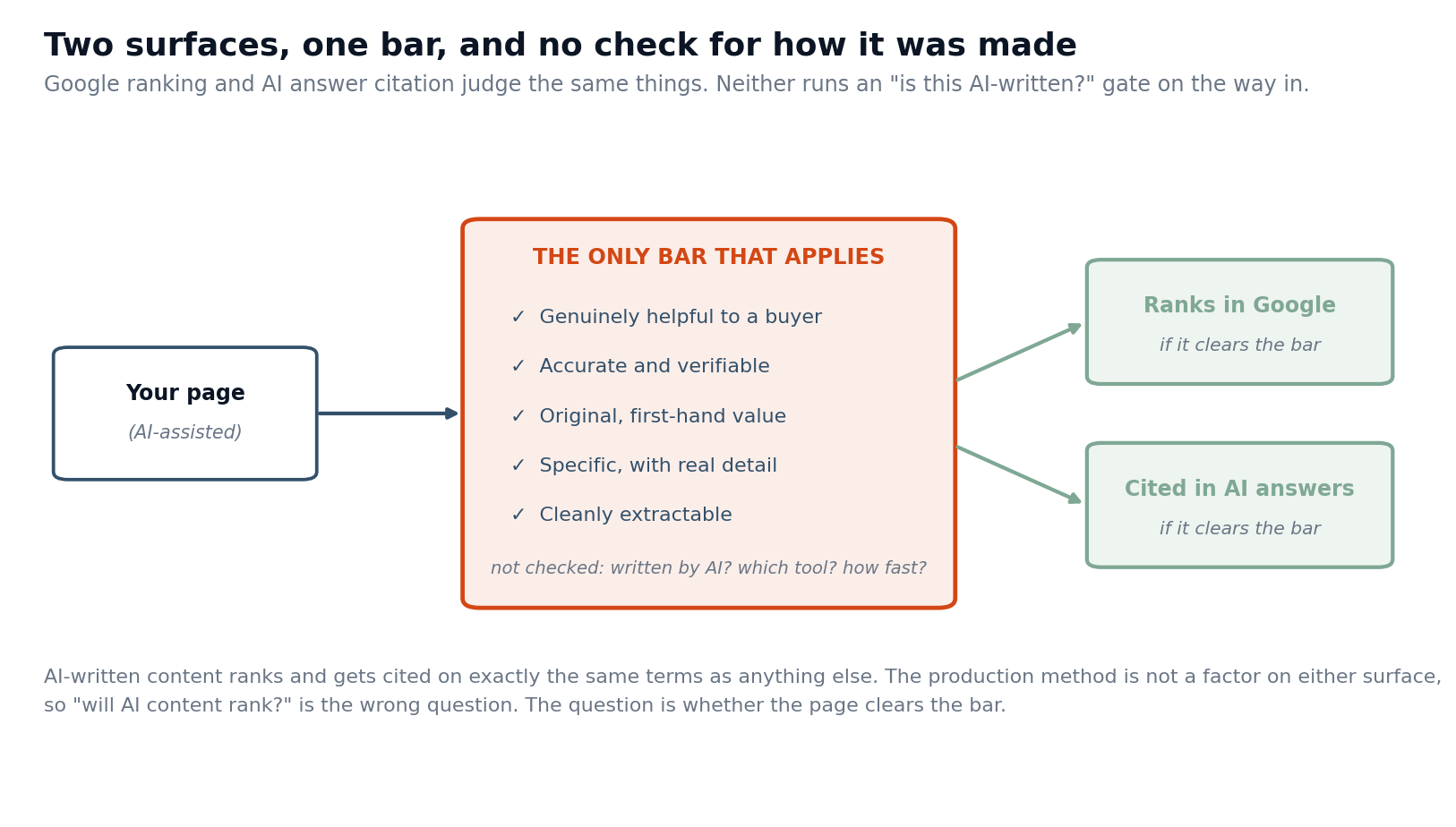 Google ranking and AI citation judge the same qualities, and neither runs an "is this AI-written?" check on the way in. "Will AI content rank?" is the wrong question; the real one is whether the page clears the bar.
So on both surfaces, the surfaces that actually decide whether your content is found, the production method is invisible. That reframes the question entirely.
Why "will AI content rank" is the wrong question
Ask the better question instead: is this page good enough to rank and be cited. That question has real, answerable criteria. Does it say something the top results do not already say. Is every claim accurate and specific. Does it draw on first-hand experience, original data, or a genuine point of view. Is it structured so a person and a model can both find the answer fast. Those are the things that separate content that wins from content that disappears, and not one of them is about whether a model helped you write it.
This is why the detector question and the humanizer question dissolve once you see the ranking answer. A detector score is not a signal Google or the AI engines use, so chasing it optimizes for a reader that does not exist. Humanizing to lower that score trades away the specificity that actually earns citations. Both are answers to a question, "how do I hide that this is AI," that neither surface is asking.
What actually sinks AI content
None of this means AI content is a free pass. Plenty of it does fail, and it is worth being precise about why, because the reasons are quality failures that careless AI use makes more likely, not penalties for using AI. The first is scale without substance. Generating hundreds of near-identical pages to blanket a keyword set is the behavior Google's scaled-content-abuse policy targets, and in AI search the same flood dilutes the few pages of yours that are genuinely citable. The volume does not help; it actively hurts.
The second is inaccuracy. Models produce fluent text that can be confidently wrong. Publish that unchecked and you either rank for nothing useful or, worse in AI search, get cited saying something false, which costs you the trust that earns future citations. The third is sameness. A raw AI draft tends to restate what is already on the web, and neither a ranking algorithm nor an answer engine has a reason to prefer the tenth version of the same paragraph. The fourth is thinness: generic, vague content with no specifics, no data, and nothing only you could have written.
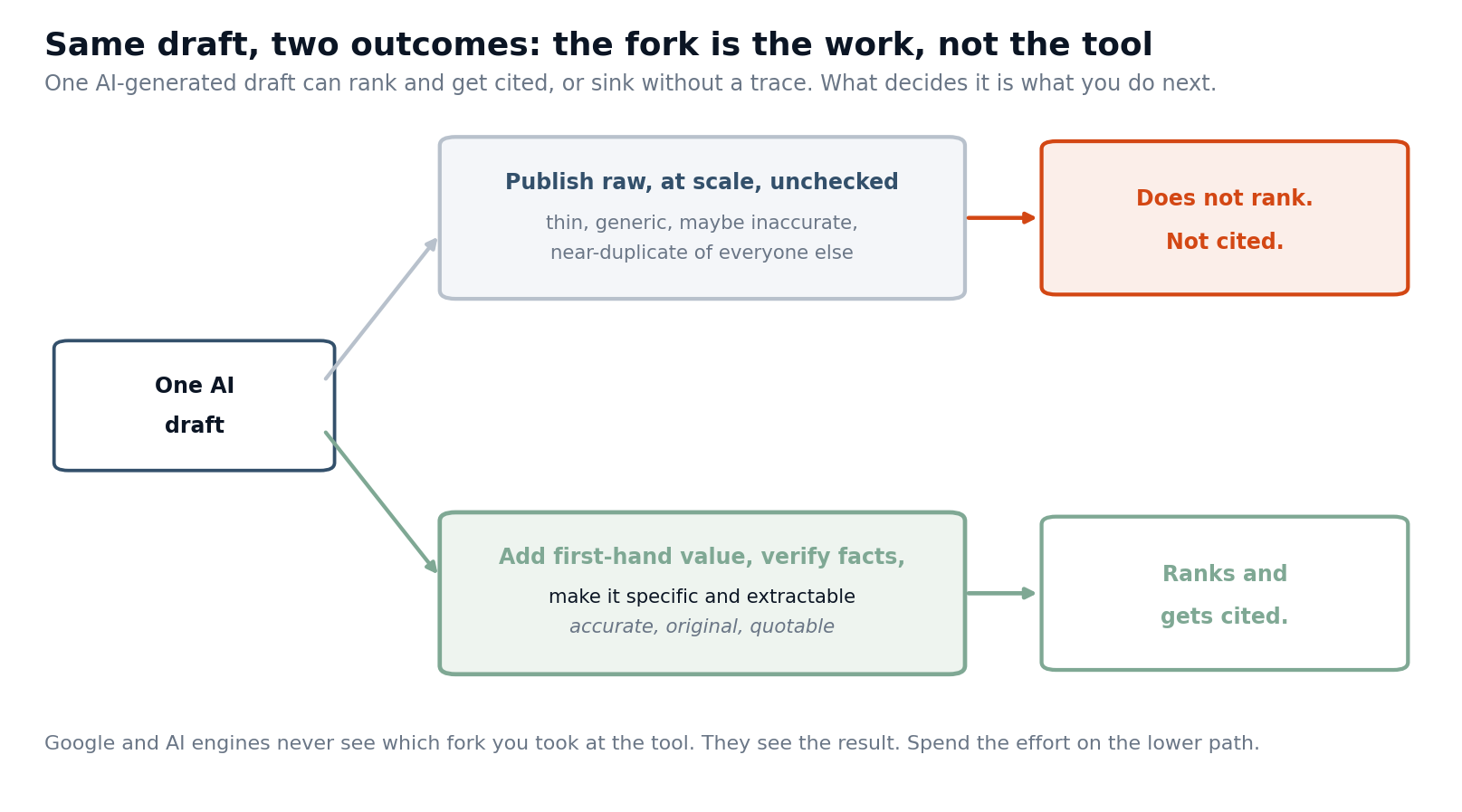
The same AI draft can rank and get cited or vanish. The fork is the editing and verification you do, not the tool that produced the first draft.
Notice that a careful human writer producing thin, inaccurate, derivative pages would fail on exactly the same four counts. The failures are about quality, and AI just makes the low-quality path faster to travel.
How to make AI-assisted content that ranks and gets cited
Start by giving the page a reason to exist that the current top results do not already satisfy: your data, your customers' questions, a clearer explanation, a real point of view. Put in specifics a model cannot invent, the named examples, the actual numbers, the first-hand detail, because those are what make a passage worth quoting. Verify every factual claim before publishing, since accuracy is what protects you from ranking for nothing and from being misquoted in an AI answer.
Structure the content so it is easy to extract, with clear answers, self-contained passages, and plain entity references. Then stop guessing whether it will perform and track whether you are actually being cited across engines over time, and edit toward what gets picked up. Do that and the AI question never comes up, because you are not publishing "AI content." You are publishing good content that a model helped you draft, and good content is what both surfaces were rewarding all along.
Quick answers to the questions underneath this one
A few related questions come up every time, so here are the direct answers. Can Google detect AI content? Sometimes, imperfectly, and it does not matter for your rankings either way, because detection is not what ranking is based on. Google is judging quality, not authorship, so whether it can spot the AI is beside the point.
Is there a safe percentage of AI in a page? No, and the question misframes the problem. There is no threshold where a page flips from safe to penalized based on how much a model wrote. A fully AI-drafted page that is accurate, specific, and genuinely useful is fine; a lightly-AI-touched page that is thin and derivative is not. The ratio is not the variable, the quality is.
Does using AI to draft hurt your E-E-A-T? Not by itself. Experience, expertise, authoritativeness, and trust come from what the page demonstrates: real first-hand knowledge, accurate claims, a credible author and site. AI drafting neither adds nor removes those. Publishing generic AI text with no real experience behind it hurts E-E-A-T, but so does publishing generic human text with none. The fix is to put genuine expertise into the page, whoever holds the pen.
Do AI Overviews and answer engines treat AI content differently from Google's blue links? No. They are pulling from the same kind of content and judging the same qualities, accuracy and clean extractability chief among them. A page that earns a ranking on quality is the same kind of page that earns a citation, which is why the two-surface answer is really one answer.
The answer, in one line
Yes, AI-generated content ranks in Google and gets cited in AI search, on exactly the same terms as anything else: it has to be accurate, specific, original, and genuinely useful. There is no penalty for the tool and no bonus for hiding it. The teams that win with AI are not the ones who found a way past a filter; they are the ones who used the speed to publish more genuinely good pages and put the saved time into the value, accuracy, and structure that get content ranked and cited.
If you want to see which of your pages are already earning citations and which are being passed over, the AI Search Visibility Checker gives you a quick read. And when you want to make that an ongoing practice rather than a spot check, AI Search Intelligence tracks how often you are cited across engines over time, so you can keep editing toward the content that actually gets picked up.