


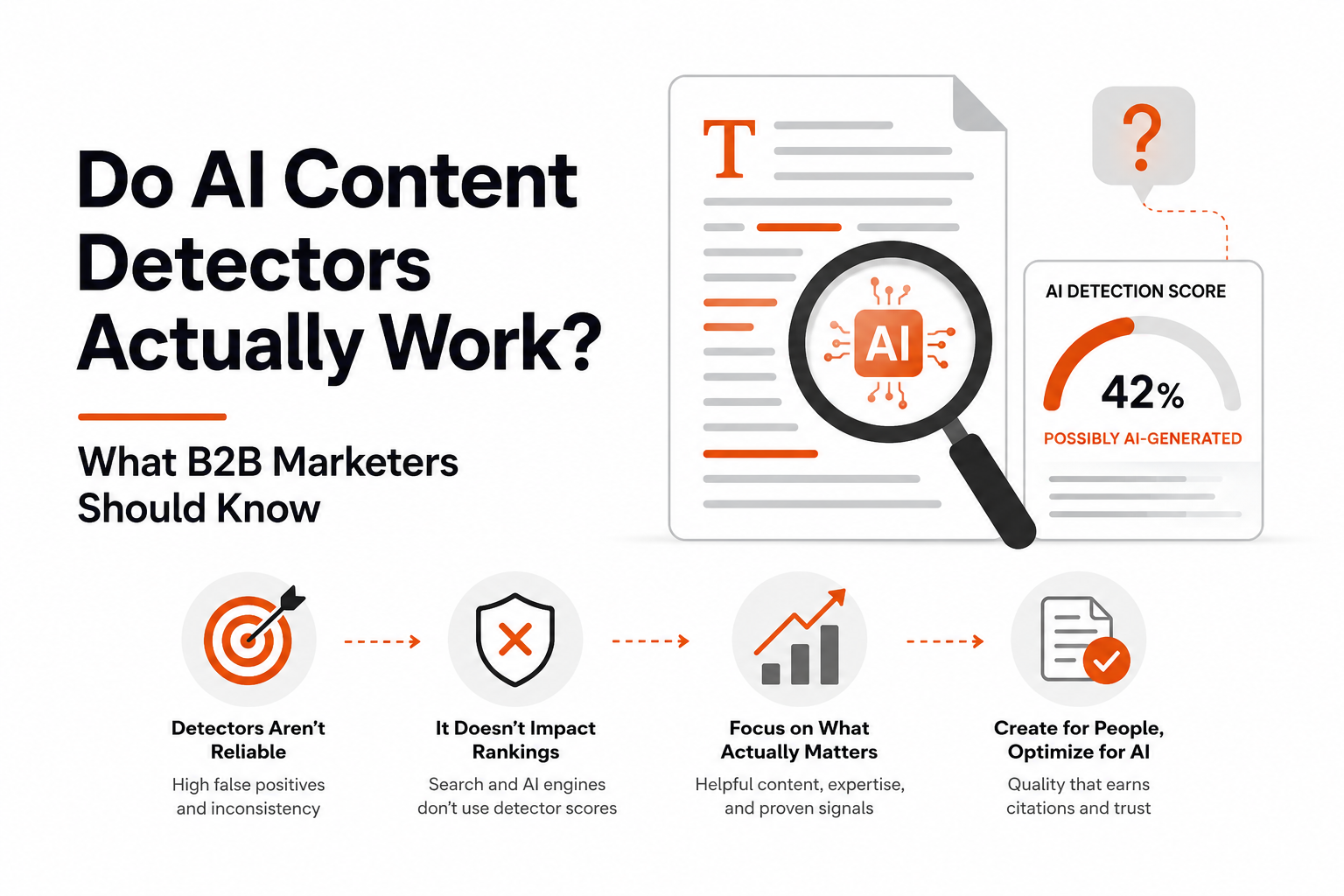


Every marketing team using AI to draft content eventually hits the same worry: should we run this through an AI detector first, and will we get penalized if it comes back "AI-written"? It is a reasonable fear and, for B2B content, a misplaced one. AI content detectors do not reliably do what they claim, and even if they did, the score they produce is not a signal that search engines or AI answer engines use. You can spend real effort chasing a number that changes nothing.
This piece answers the question two ways. First, do the detectors actually work: no, not reliably, and the reasons are structural. Second, and more useful, does it even matter for getting your content ranked and cited: also no, and understanding why redirects your effort to the things that actually decide it. This is a marketing question, not an academic-integrity one, so the focus throughout is on what helps or hurts your B2B content in search and AI answers.
What an AI detector is actually doing
An AI content detector reads a piece of text and returns a probability that it was machine-generated. It is not checking a record of how the text was made and there is no such record. It is guessing, from surface patterns like how predictable or uniform the writing is, whether the text looks more like typical AI output or typical human output. That distinction is a statistical hunch, not a fact, which is the root of every problem that follows.
Do they work? Not reliably, in either direction
The honest answer is that detectors fail in both directions at once, and neither failure is rare.
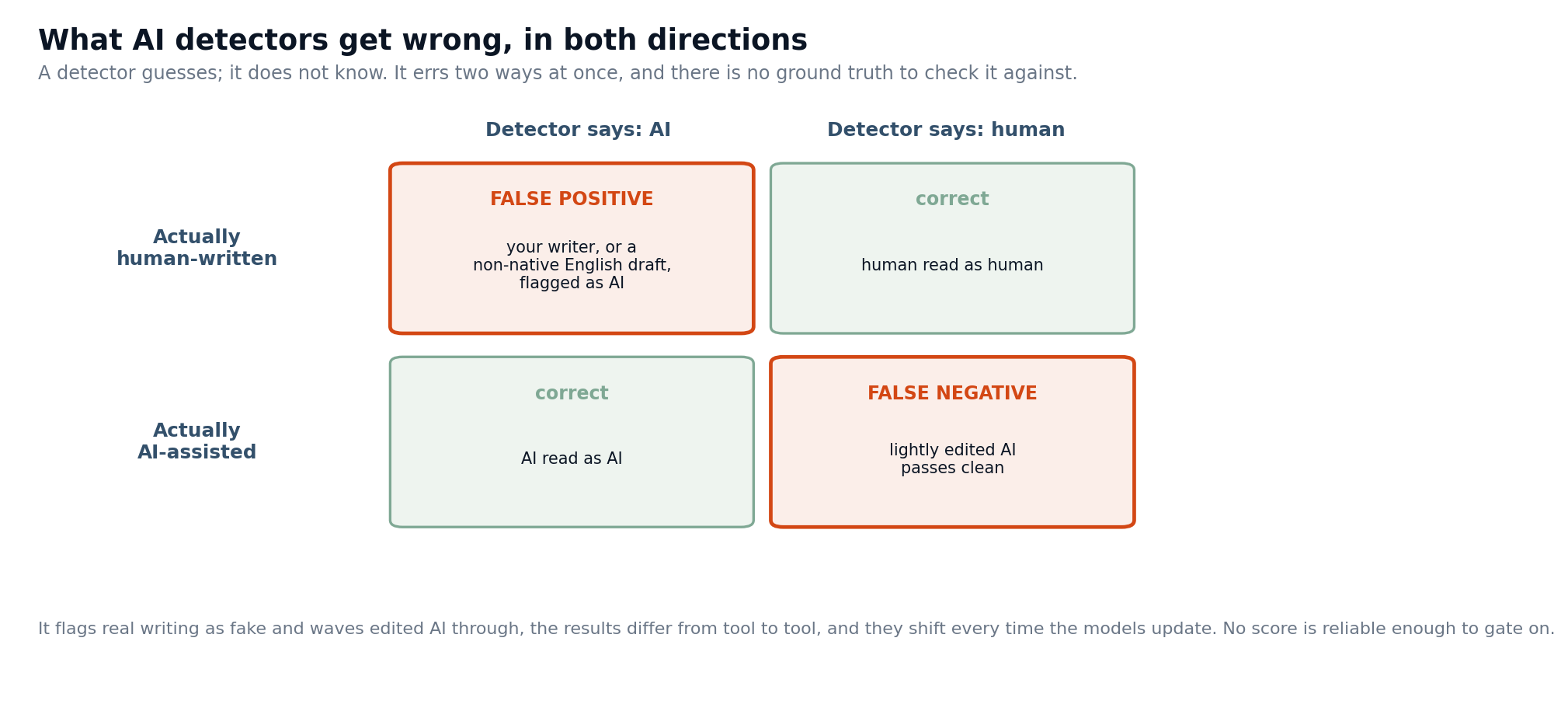
A detector errs both ways at once: it flags real writing as fake and lets edited AI through, with no ground truth to check it against.
False positives flag real writing as fake. Detectors regularly label genuinely human-written text as AI, and the bias is not random. Research has repeatedly found that writing by non-native English speakers is disproportionately flagged, because the clear, predictable phrasing common in that writing looks to a detector like machine output. Short passages and plainly written text get misflagged too. For a marketing team, that means your own writers, and your best plain-English explainers, can fail a detector while being entirely human.
False negatives let AI through. The same tools miss AI-assisted text once it has been lightly edited. Rearranging sentences, swapping a few words, or running the draft through a "humanizer" is usually enough to drop a detector's confidence sharply, and heavier editing defeats it almost entirely. So the content you were most worried about, polished AI-assisted work, is exactly what sails through.
They disagree with each other and with themselves. Run the same passage through several detectors and you get several answers, and run it again after the models update and the answer can change. Even OpenAI, which makes the model behind ChatGPT, quietly retired its own AI-text classifier after launch because it was not accurate enough to be useful. When the makers of the technology cannot reliably detect it, a third-party score deserves real skepticism.
None of this makes detectors fraudulent; it makes them probabilistic tools being used as if they were certainties. As a gate you pass or fail your content on, they do not work.
Why this does not get better with time
It is tempting to assume detectors are just early and will improve. The structure of the problem says otherwise. As language models get better, their writing gets closer to good human writing by design, which means the very signal detectors rely on, text that looks distinctly machine-made, keeps shrinking. The better the models write, the less there is to detect.
At the same time, evasion gets easier, not harder. Tools built specifically to rewrite AI text so it reads as human are improving in step with the detectors, and simple human editing already defeats most detection. There is no widely adopted, tamper-proof watermark on AI text to fall back on, so detectors are left inferring from surface patterns that are actively converging.
This is an arms race where both sides are getting stronger and the detector's evidence is getting weaker. Treating today's score as something that will soon be dependable bets against the direction the technology is moving.
Does it even matter? Not for how you get ranked and cited
Here is the part that changes what you should do. Suppose a perfect detector existed. It still would not matter for your B2B visibility, because the score is not an input to any system that decides whether you rank or get cited.
Search engines do not penalize content for being AI-assisted. Google's stated position is that it rewards helpful, reliable content made for people and acts against unhelpful, low-value content, regardless of how it was produced.
The target is thin, unoriginal, mass-produced material, not the use of AI in drafting. Well-made content that happens to be AI-assisted is not in the crosshairs; thin content is, whether a human or a machine wrote it, a distinction covered in AI search visibility versus traditional SEO.
AI answer engines cite on accuracy and relevance, not authorship method. When an engine decides what to quote, it is looking for the passage that best and most credibly answers the question, from a source it can trust. "Was this written by AI" is not a factor it can even assess or cares to; whether the answer is accurate, specific, and citable is. The signals that make a page citable are about substance and structure, not provenance.
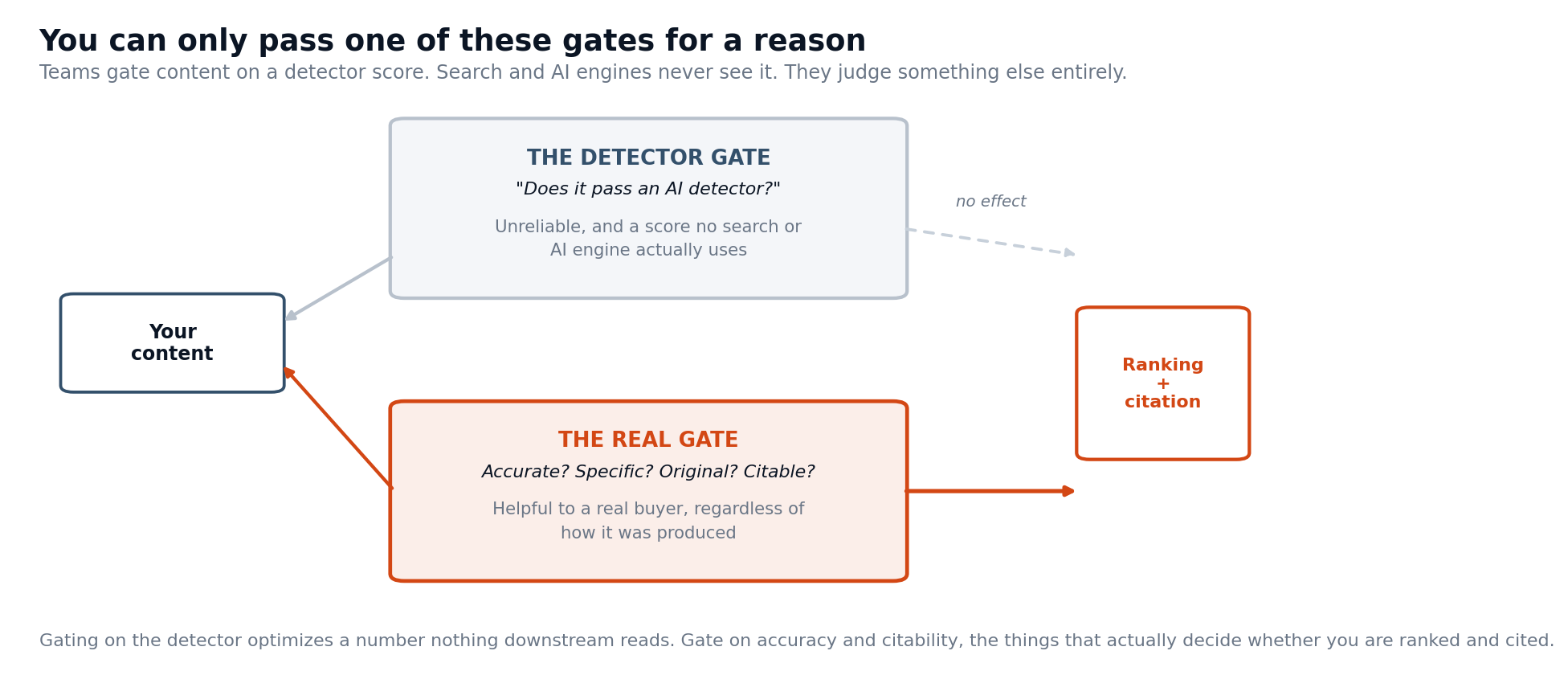
The detector score is disconnected from the outcome. Accuracy and citability are the gate that actually decides ranking and citation.
So the detector gate optimizes a number nothing downstream reads. Passing it does not help you rank or get cited, and failing it does not hurt you, because the systems that matter never see it.
What the real risk of AI-assisted content is
None of this means AI-assisted content is free of risk. The risk is just not detection. It is that content produced quickly with AI is easy to ship thin, generic, or wrong, and those are the things that genuinely cost you, the same failure mode behind thin programmatic SEO. A page that is inaccurate does not just fail to get cited; if it is cited, it gets you misquoted. A page that is generic is not distinct enough to quote in the first place.
That reframes the quality control. The check that matters is not "does this read as AI," it is "is this accurate, specific, and worth citing." A human should review AI-assisted content for correctness and substance, which a detector never evaluates, and that review is where the effort a detector wastes should go instead.
What to do instead of running a detector
Check accuracy first. Verify the facts, figures, and claims in any AI-assisted draft before it publishes, because an inaccurate cited page is worse than an uncited one. This is the single highest-value review step and the one detectors do nothing for.
Check for substance and specificity. Ask whether the page says something a generic page would not: real detail, a concrete example, a named specific, an original angle. Generic passes a detector as easily as it fails one, and generic is what does not get cited.
Structure it to be citable. Lead with the answer, keep passages self-contained, name entities, so an engine can lift and credit the content, the work covered in how to structure content for LLMs. This helps regardless of who or what drafted it.
Keep a human in the loop for judgment, not for detector-dodging. The point of human involvement is correctness, nuance, and originality, not making the text "look human" to a tool. Editing to beat a detector is effort spent on the wrong target.
Measure what actually moves. Track whether your content gets cited across AI engines, not whether it passes a detector. The frequent automated checks that show your citation rate are the real scoreboard; a detector score is not on it.
A worked example: swapping the gate
Picture the common workflow. A writer drafts a page with AI help, then runs it through a detector. It comes back "70% likely AI," so the writer spends an afternoon rephrasing sentences until the score drops, publishes, and moves on. Nothing about the page's accuracy or usefulness changed; the time went entirely into moving a number no engine will read. Worse, the rephrasing may have sanded off the specific, quotable lines that would have earned a citation, in the name of sounding less patterned.
Now swap the gate. The same draft skips the detector and goes to a reviewer with a different checklist: are the facts and figures correct and current, does each section answer its question directly, is there a specific detail or example a generic page would not have, and is the answer structured so an engine could lift it. The reviewer fixes an out-of-date figure, tightens two buried answers, and cuts a vague paragraph. The page publishes genuinely better, on the exact dimensions that decide whether it gets cited.
Same amount of effort, aimed at the reader who matters instead of the tool that does not. That is the whole change: not less quality control, but quality control pointed at accuracy and citability rather than at a detector score.
Where B2B teams go wrong here
The real problem is not whether a content is AI written, but if it is accurate, useful, and worth citing. Here’s where B2B teams get it wrong:
- Gating content on a detector score. It is unreliable and invisible to the engines you care about. Gate on accuracy and citability instead.
- Editing to beat detectors. Rewriting good content to "look human" wastes effort on a number that changes nothing downstream.
- Assuming AI-assisted means penalized. Search and AI engines act on quality and helpfulness, not on whether AI helped draft it.
- Trusting a detector on your own writers. False positives fall hardest on plain and non-native English writing. A flag is not evidence.
- Ignoring the real risk. The danger of AI-assisted content is thin or wrong material, not detectability. Review for correctness and substance.
Frequently asked questions
Do AI content detectors actually work?
Not reliably. They estimate a probability from surface patterns rather than knowing how text was made, so they flag genuinely human writing as AI and miss AI that has been lightly edited. Results differ between tools and shift as models update, and even OpenAI retired its own detector for poor accuracy. No score is dependable enough to make decisions on.
Does Google penalize AI-generated content?
No, not for being AI-generated. Google rewards helpful, reliable content made for people and acts against thin, unhelpful, mass-produced content regardless of how it was made. Well-made AI-assisted content is not the target; low-value content is, whoever or whatever produced it.
Will AI-assisted content still get cited by AI engines?
Yes, if it is accurate, specific, and citable. AI answer engines quote the best, most credible answer to a question; they do not assess or care whether AI helped draft it. Substance and structure decide citations, not authorship method.
Should I run my marketing content through an AI detector?
There is little reason to. The score is unreliable and no search or AI engine uses it, so it will not tell you anything about how your content will perform. Spend that review time verifying accuracy and improving specificity instead.
What is the real risk of using AI to help write content? Shipping content that is thin, generic, or inaccurate, which fails to get cited or, worse, gets you misquoted. The fix is human review for correctness and substance, not a detector.
Stop optimizing for the wrong reader
An AI detector is a tool that guesses at a question your buyers, and the engines that serve them, never ask. It is wrong often enough to be untrustworthy, and even a perfect one would be measuring something disconnected from whether you rank and get cited. The reader you are optimizing for is the buyer and the engine answering them, and both judge your content on whether it is accurate, specific, and worth citing, not on how it was drafted.
So retire the detector step and put that effort where it counts. To see whether your content is actually earning citations across AI engines, the scoreboard that matters, run a free scan with the AI Search Visibility Checker, or track your citation rate over time with AI Search Intelligence.