


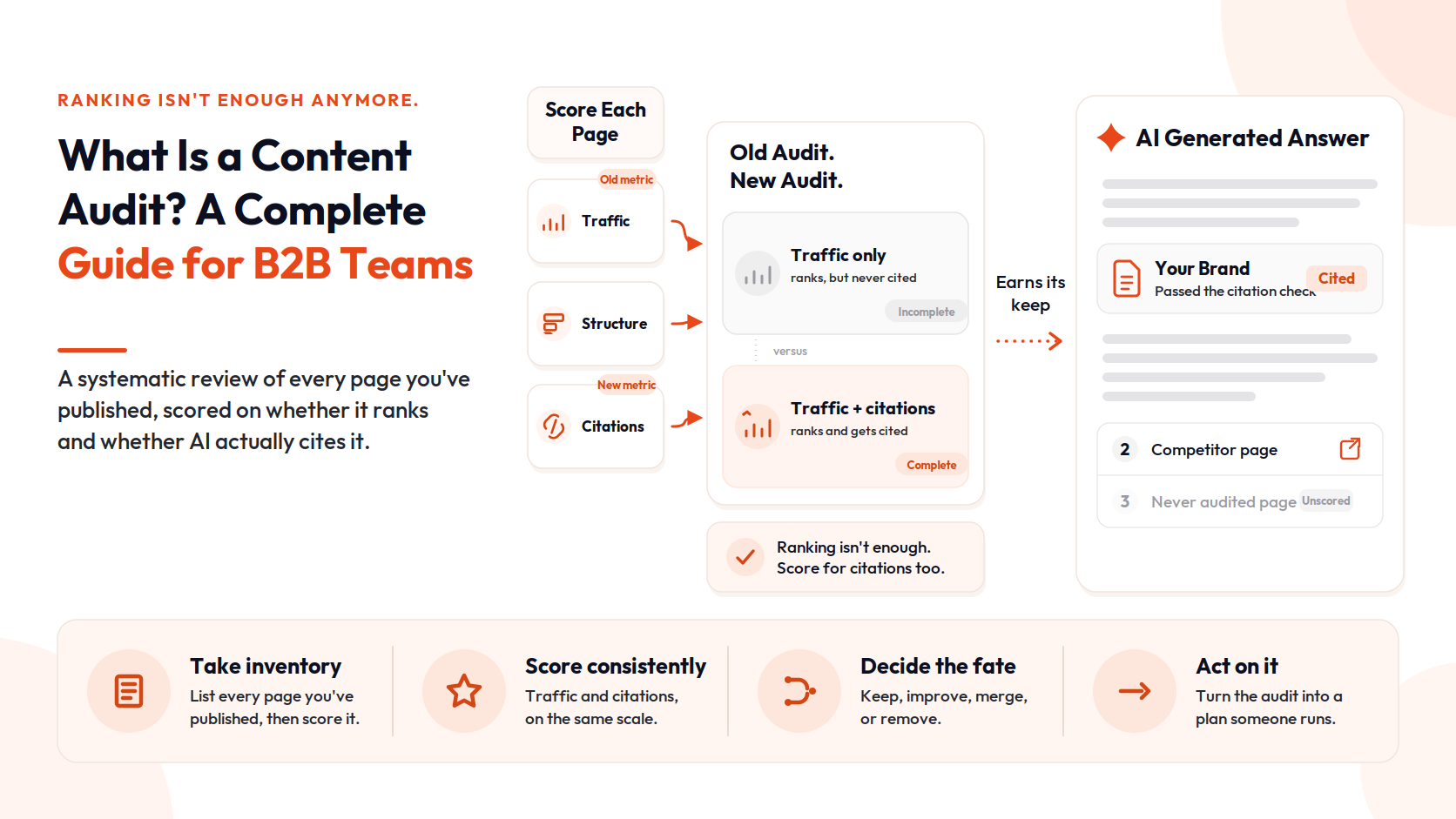


A content audit is a systematic review of everything you have published, scored against a consistent set of criteria, so you can decide what to keep, improve, consolidate, or remove. For years that review asked one main question of each page: is it bringing in traffic. That question still matters, but for a B2B team in 2026 it is no longer enough, because a page can rank, pull traffic, and still be invisible in the AI answers where your buyers now do their early research. A modern content audit has to check whether your content gets cited, not just whether it ranks.
This guide explains what a content audit is, why the criteria have changed for AI search, exactly what to score each page on, how to decide what happens to each page, and how to run the whole process for a B2B site without it turning into a spreadsheet that never gets acted on. It is written as a complete walkthrough, so you can run your first audit from it or upgrade the audit you already do.
What a content audit is, and what it is for
At its simplest, a content audit is an inventory of your content plus a judgment about each piece. You list every page, gather data on how each one performs, score them against criteria that reflect your goals, and assign each page an action. The output is not a report; it is a decision for every URL, keep it, improve it, merge it into a stronger page, or retire it.
The reason to do this is that content accumulates faster than anyone reviews it. Pages get published, then forgotten. Over a couple of years a B2B site collects duplicate posts on the same topic, pages with facts that have quietly gone stale, thin content that never earned its keep, and money pages that no one links to. An audit is how you find all of that on purpose instead of discovering it when a prospect quotes something wrong back to you. It replaces "publish and forget" with a routine that keeps your library working.
What a content audit reveals
Before the how-to, it helps to know what an audit actually surfaces, because the problems are consistent across B2B sites. It finds duplicates: several posts written over the years that all target the same question and now compete with each other. It finds decay: pages whose statistics, product details, or positioning have gone out of date without anyone noticing. It finds thin content: pages that never had enough substance to earn attention and are quietly dragging on the site's overall quality. It finds orphans: important pages, often comparison and product pages, that almost nothing links to. And it finds gaps: buyer questions your library does not answer at all.
Each of those is invisible day to day and obvious once you lay the whole library out and score it. That is the real value of the exercise: it converts a vague sense that "our content could be better" into a specific list of pages and a specific action for each one.
Content audit vs SEO audit vs AEO audit
These three get used interchangeably and they are not the same. A content audit reviews your actual content, the pages themselves, and decides what to keep, improve, consolidate, or cut. An SEO audit is broader and more technical: it checks crawlability, site speed, indexation, redirects, and other machinery that affects rankings, much of which has nothing to do with what a page says. An AEO audit, the newest of the three, checks specifically whether your content is set up to be cited by AI answer engines, extractable structure, accurate claims, entity clarity, and presence in AI answers.
For a B2B team in 2026, the practical move is not to pick one but to fold the AEO checks into the content audit, so a single review judges each page on both whether it is good content and whether an engine can cite it. That is the audit this guide describes: a content audit with the answer-engine criteria built in, run alongside a periodic technical SEO audit that handles the machinery.
Why the criteria changed for AI search
The mechanics of an audit have not changed; the scoring has. Traditional audits judged a page on organic traffic, keyword rankings, conversions, and freshness. Those are still inputs, but they miss the thing that now decides B2B visibility: whether AI answer engines cite you.
Buyers increasingly start in an AI assistant, asking it questions about their problem and the options, often without ever clicking a traditional result. If your page is not cited in those answers, you are absent from the part of the journey where the shortlist forms, no matter how well the page ranks in the blue links underneath.
So the audit has to add a question the old process never asked: is this page the kind of thing an engine can quote and attribute. We covered why quality, not production method, decides whether content ranks and gets cited; the audit is where you check each existing page against that bar. That adds several new dimensions to the score, and they are the heart of a modern audit.
What to score each page on
Keep the classic columns and add the ones that decide AI visibility. A useful B2B audit scores each page on both.
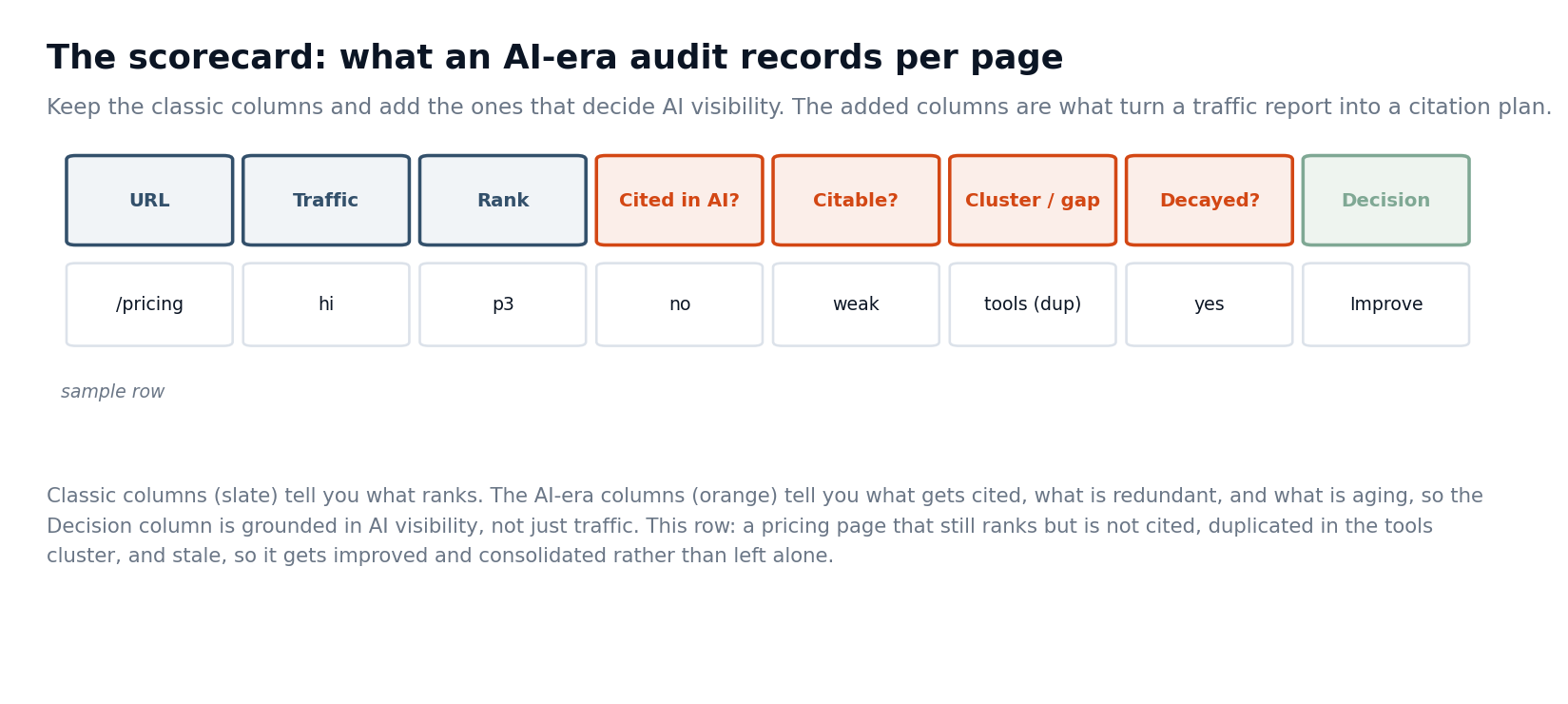
Keep the classic columns and add the ones that decide AI visibility. The added columns are what turn a traffic report into a citation plan.
The classic dimensions stay: organic traffic and its trend, keyword rankings, conversions or pipeline influence, and how recently the page was updated. To those, add the AI-era dimensions. First, citation status: is the page cited in AI answers for the questions it targets, or does it have the potential to be.
Second, citability: is the page accurate, specific, and structured so a model can lift a self-contained answer, the qualities we cover in structuring content for LLMs and in the signals that make a page citable. Third, cluster and coverage: which topic cluster the page belongs to, and whether it duplicates another page in that cluster. Fourth, decay: whether the facts on the page have aged, which matters more than it used to because a stale-but-cited page gets you misquoted in AI answers.
Fifth, differentiation: whether the page contains anything a competitor could not reproduce from a model, or whether it is commodity content an engine has no reason to prefer. Those five additions are what separate an AI-era audit from a traffic report. A page can score well on every classic column and fail all five, which is exactly the page that ranks but never gets cited.
How to decide what happens to each page
Scoring is only useful if it ends in a decision. Run each page through the same short set of questions and let the answers route it to one action.
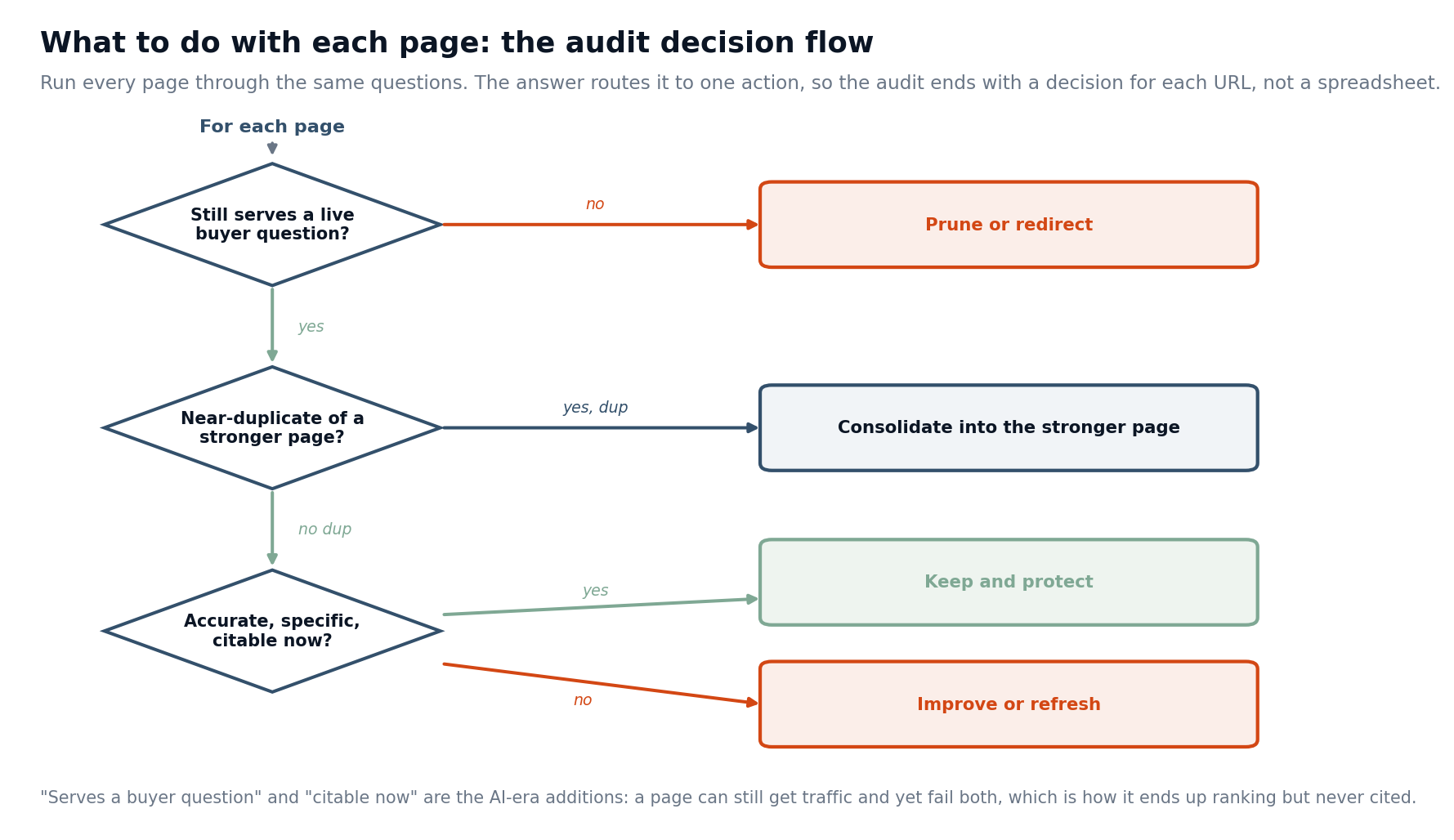
Run every page through the same questions. The answer routes it to one action, so the audit ends with a decision for each URL, not a spreadsheet.
Start with relevance: does the page still serve a live buyer question. If it does not, and it has no traffic or citations worth preserving, prune or redirect it. If it does serve a real question, check whether it is a near-duplicate of a stronger page in its cluster; if so, consolidate the two so you stop competing with yourself and concentrate authority on one asset. If it is distinct and relevant, the last question is whether it is accurate, specific, and citable as it stands. If yes, keep it and protect it. If no, it goes into the improve-or-refresh pile. Each of those actions has a deeper method behind it: the editing and pruning pass for consolidation and cleanup, and the refresh decision for pages whose facts have aged. The audit is the parent process that decides which of those a page needs.
One B2B-specific note: weight the decision by the page's role. A comparison, alternatives, or product page that shapes a buying decision earns improvement even on modest traffic, because that is where pipeline forms. A years-old blog post with no traffic, no citations, and no strategic role is a prune candidate even if it is harmless. The audit is where you make those calls deliberately.
How to run the audit, step by step
Start by building the inventory: every URL, with its title, publish or update date, and the buyer or funnel stage it serves. A crawl or your CMS export gets you the list. Next, add the data: organic traffic and rankings over a consistent window, conversions where you can attribute them, and, the new part, whether each page is cited in AI answers for its target questions.
Then score each page on the scorecard above, classic columns plus the five AI-era ones. With the scores in front of you, run each page through the decision flow and record one action per URL. Then execute in priority order, starting with the pages that touch a buying decision, and consolidating duplicates rather than leaving them to compete. Finally, set a date to re-measure, because the point of the audit is to change outcomes, not to produce a document.
The gap-finding step is worth calling out, because it is where an audit becomes offense rather than cleanup. When you lay your pages against your topic clusters, the clusters with no strong page are the buyer questions you are not answering, and each one is a citation you are handing to a competitor. Finding those gaps and building for them is often the highest-return output of the whole exercise; the clustering that defines those topics is what makes the gaps visible.
The tools you actually need
You can run a content audit with less tooling than most guides imply. Four things cover it. A crawler or your CMS export builds the inventory, the full list of URLs with titles and dates. Your analytics and Search Console give you traffic, rankings, and the queries each page already earns. A spreadsheet, or an audit tool, holds the scorecard and the decision per page. The one addition for the AI era is a way to see whether your pages are cited in AI answers, which analytics will not tell you, because a citation in an AI response is not a click you can see in your traffic reports.
That last piece is the gap in most audit stacks. Traffic tools were built for a search world where being seen meant being clicked. In AI search you can be the source an engine quotes without ever getting the visit, so you need to check citations directly rather than infer visibility from traffic. Everything else, you likely already own.
A worked example
Walk one page through the process to see how the pieces fit. Take a comparison page, "us versus a named competitor." Inventory: it exists, last updated eighteen months ago, serves a late-stage buyer. Data: it still ranks on page one and gets steady traffic, but it is not cited in AI answers for "which tool does X," and a check shows a second, weaker post covers nearly the same comparison. Score: strong on the classic columns, weak on citation status and citability, and flagged as a duplicate in the tools cluster.
Now the decision flow. Does it serve a live buyer question? Yes. Is it a near-duplicate of a stronger page? It is the stronger of the two, so the weaker post consolidates into it, not the other way around. Is it accurate, specific, and citable as it stands? No, the facts are eighteen months stale and the answer is buried, so it goes into the improve pile. The action for this URL: consolidate the weaker post into it, refresh the facts, and restructure the key comparison into a self-contained, quotable block. One page, one clear set of actions, all traceable to the score. Multiply that across the library and the audit becomes a prioritized work plan rather than a list of complaints.
Common content audit mistakes
A few mistakes make audits fail, and they are easy to avoid once named. The first is auditing without deciding: teams produce a beautiful inventory, score every page, and then never assign or execute actions, so nothing changes. An audit that does not end in actions per URL was a data-collection exercise, not an audit.
The second is deleting the wrong pages. A page with low traffic may still earn backlinks or citations, or serve a strategic buying question; cutting it because a traffic column looks low can remove something that quietly matters. Check citations and links before you retire anything. The third is scoring only for traffic. For B2B, pipeline influence and citation presence matter more than raw visits, so a high-traffic post that never touches a buying decision should not outrank a low-traffic comparison page that does.
The fourth is treating AI citability as an afterthought, a box ticked at the end rather than a real dimension of the score, which leaves you with a library that ranks and still goes unquoted. And the fifth is running the audit once and never again; the library keeps growing, so a one-time audit ages as fast as the content it reviewed.
How often to run one
For most B2B teams, a full audit once or twice a year is the right cadence, with lighter continuous review in between. The full pass is when you inventory everything and make keep-or-cut decisions across the whole library. Between those, watch your highest-value pages continuously: the comparison and product pages, the pillars, and anything you know buyers ask about, so a page that stops being cited or goes stale gets caught in weeks rather than at the next annual review. The pages that shape pipeline deserve monitoring, not a once-a-year look.
Tie the cadence to change, not the calendar alone. A fast-moving comparison page in a category that ships features monthly needs review far more often than an evergreen definitional page. Let how quickly the facts move, and how quickly you lose citations, set the schedule for each tier of content.
Measure the audit by what changes
An audit is worth the effort only if you can see it working, so measure the outcome, not the activity. After you execute, track whether the pages you improved start getting cited for their target questions, whether consolidations lifted the surviving page, and whether the gaps you filled earned new citations. You can track how often your pages are cited across engines over time and read the results against the decisions the audit made, which turns each audit into a baseline for the next one. Traffic still matters, but for AI search the number that tells you the audit worked is whether more of your library is being cited than before.
Quick answers to common questions
A few questions come up every time a team plans an audit. How long does a content audit take? It depends on library size and how much of the data-gathering you automate, but the inventory and scoring are the slow part and the decisions are fast once the scorecard is in front of you. A focused audit of your most important few dozen pages is worth more than a stalled attempt to score everything, so start with the pages that shape pipeline and expand from there.
Do you need a tool? No. A spreadsheet plus your analytics covers a first audit. Tools help at scale, and a citation tracker is the one genuinely new thing you cannot get from traffic data, but the method matters more than the software.
What is the difference between a content audit and a content inventory? The inventory is just the list of everything you have; the audit is the inventory plus a judgment and an action for each item. An inventory tells you what exists; an audit tells you what to do about it.
Should you delete underperforming content? Sometimes, but not on traffic alone. Retire a page only when it serves no live buyer question and has no citations or links worth preserving; otherwise improve or consolidate it. Deleting a page that quietly earns citations removes visibility you cannot easily rebuild.
Turn the audit into a habit
A content audit is the routine that keeps a growing B2B library from working against you: it finds the duplicates, the decay, the gaps, and the pages that rank but never get cited, and it ends with a clear decision for each one. Keep the classic checks, add the AI-era ones, run every page through the same decision, and measure the result by citations, not just clicks. Do that on a regular cadence and your content stops accumulating quietly and starts compounding.
If you want a fast read on which of your pages are already cited and which are being passed over before you start, the AI Search Visibility Checker gives you that picture. And when you want the citation data that makes an audit precise, page by page and across engines, AI Search Intelligence tracks it over time, so every audit is scored on what actually gets picked up rather than on traffic alone.