


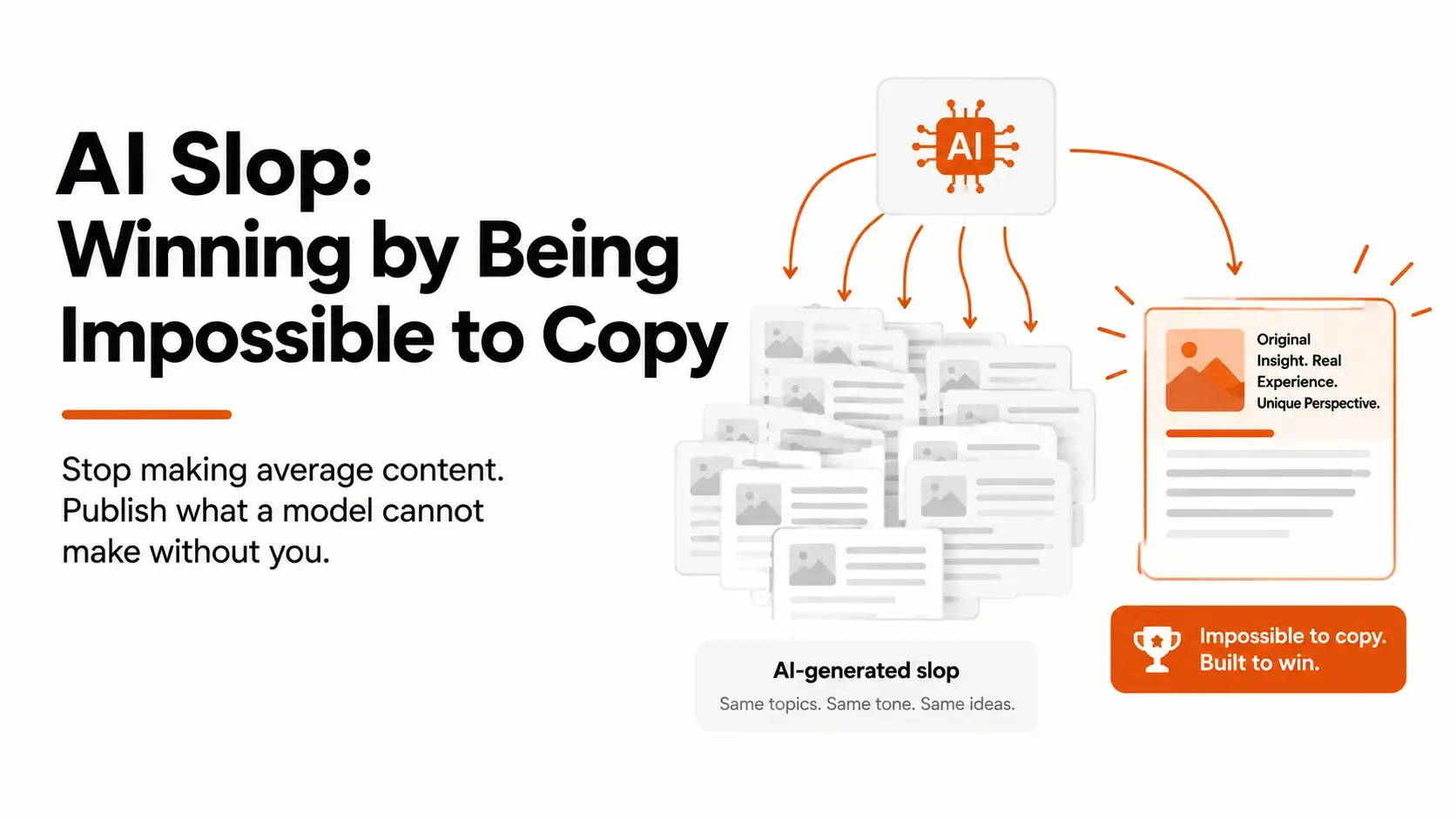


AI Slop: Winning by Being Impossible to Copy
There is a name now for what happens when a company points AI at its content calendar and publishes whatever comes out: slop. Generic posts, the same handful of points every competitor is also making, phrased in the same smooth and forgettable way. When everyone can produce the average page in seconds, the average page becomes worthless, and the content that cannot be reproduced becomes the only content that wins.
This piece makes the case that the winning move in a slop-flooded market is to publish what a model cannot make without you. It covers what slop actually is, why the flood works in your favor if you respond to it correctly, what "impossible to copy" means in concrete terms, why uncopyable content is what gets cited in AI search, and a simple test for keeping your own output on the right side of the line. It follows on from our look at whether AI-generated content ranks at all; the answer there was that quality decides, and this is about the specific quality that now decides most.
What AI slop actually is
Slop is not "content that used AI." It is content that could have been made by anyone pointing a model at the same prompt: a summary of what is already on the web, a listicle of well-known tips, an explainer that restates the obvious in a confident voice. The defining trait is reproducibility. If a competitor could type a similar prompt and get a similar page, what you published has no floor under its value, because supply is effectively infinite.
That is why slop feels hollow even when it is grammatically fine and factually unobjectionable. It carries nothing that originated with the person who published it. The reader has seen it before, the search engine has indexed a hundred versions of it, and the AI answer engine has no reason to prefer your copy of a commodity over anyone else's. The problem was never the tool. It is that the output has no source, in the sense that nothing in it traces back to you.
Why the flood is an opening
Here is the counterintuitive part. As slop floods a topic, it does not just add noise; it changes the economics of everything around it. When the generic middle of a market is being produced for free at unlimited volume, that middle stops earning attention, rankings, or citations, because scarcity is gone. What keeps its value is the content on either edge of that middle: the genuinely uncopyable material that no amount of prompting can reproduce.
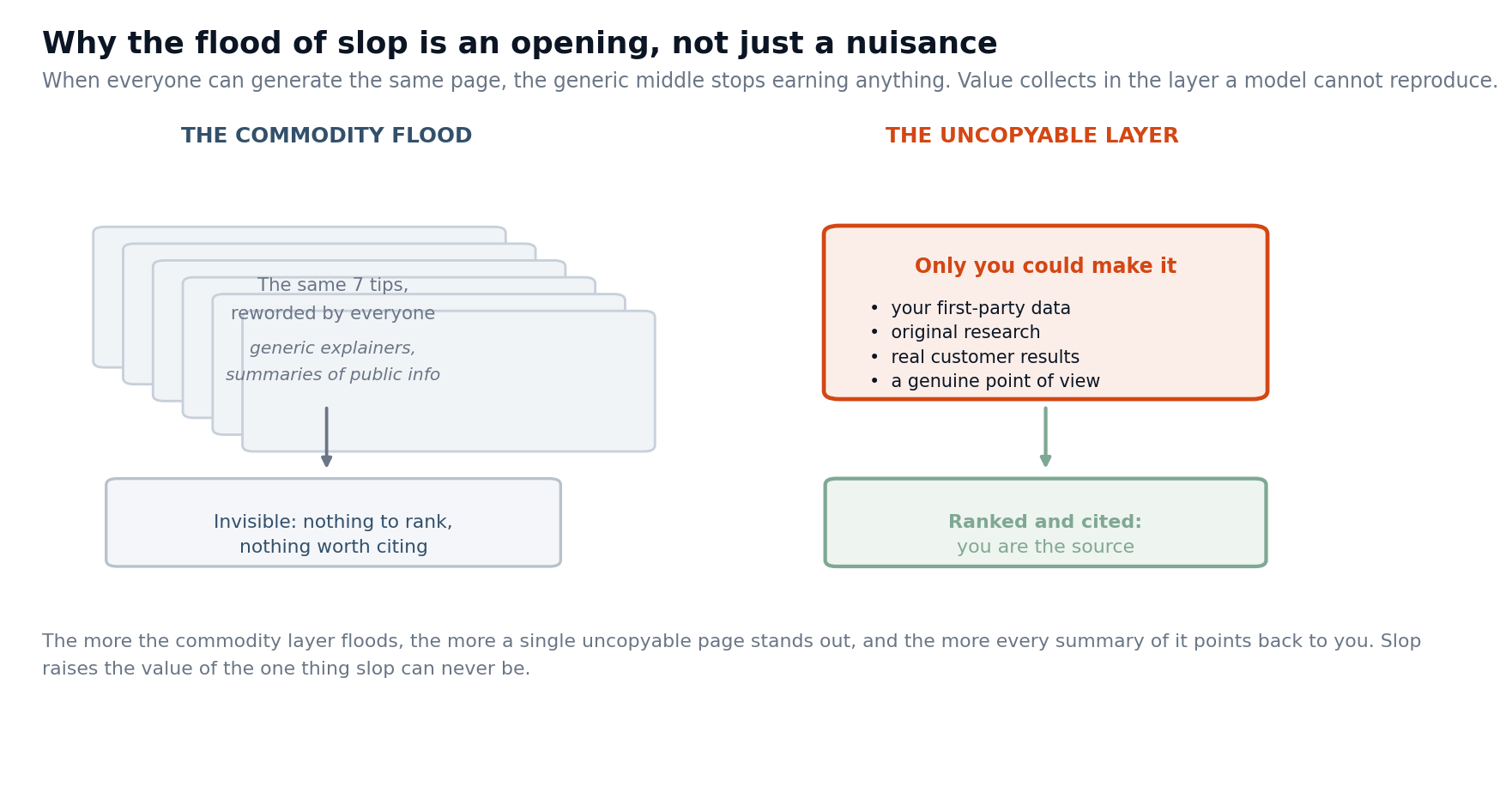
As the commodity layer floods, a single uncopyable page stands out more, not less, and every summary of it points back to you. The flood raises the value of the one thing slop can never be.
So the flood is doing your competitive positioning for you. Every rival who fills the middle with slop is vacating the territory that matters and making the few distinctive pages easier to find by contrast. The teams that panic and match the volume are competing for a space that no longer pays. The teams that go the other way, publishing less but making each piece impossible to copy, are moving into the space where all the remaining value collected.
What "impossible to copy" actually means
Uncopyable is a concrete standard, not a vibe. It means the page is built on at least one input a model does not have and cannot generate, so no prompt can reproduce it. Your first-party data is the strongest of them: numbers only you have, from your product, your customers, or your own testing. A model can write about a topic in general; it cannot report what your data shows, because it has never seen it. Original research you run, a survey, a teardown, a benchmark, sits in the same category.
So do real customer results and stories, named and specific, because the details of an actual engagement exist nowhere in a training set. First-hand practitioner experience counts too: the thing you learned doing the work that is not written down anywhere else. And a genuine point of view, an actual argument you are willing to defend rather than a balanced summary, is uncopyable because a model defaults to the consensus, not to your conviction.
Notice what these have in common. They are all things that existed in your company before you wrote the page, and that a competitor cannot obtain by typing a better prompt. That is the whole test. Everything else, the framing, the structure, the smoothing of sentences, is copyable and fine to accelerate with AI. The uncopyable input is what makes the page yours.
Why uncopyable content wins in AI search
This matters more in AI search than it ever did in classic SEO, because of how citations work. When an AI engine answers a buyer's question, it pulls facts and attributes them to sources. The page it cites for a specific number, finding, or claim is the page that appears to be the origin of it. If you published the original data, you are that origin, and every downstream article that summarizes your finding points back to you as well. Being uncopyable is how you become the source everyone else has to cite.
Slop cannot occupy that position, by definition. A page that only restates public information has nothing an engine would attribute specifically to it, because the same information is available from a hundred equivalent pages. It can be part of the undifferentiated pool a model reads, but it is never the thing the model names. This is the same reason being the cited source depends on signals about the content itself, and why original, first-party sources carry weight that reworded third-hand summaries do not. Uncopyable content is citable content, and citable content is what gets you found in AI answers.
The copyability test
You can turn all of this into one question you ask before publishing anything: could a competitor regenerate this from a model in ten minutes without us. If the answer is yes, what you have is slop-adjacent, no matter how polished it reads. If the answer is no, because the page rests on your data, your research, your results, or your genuine argument, it is the kind of content that earns its place.
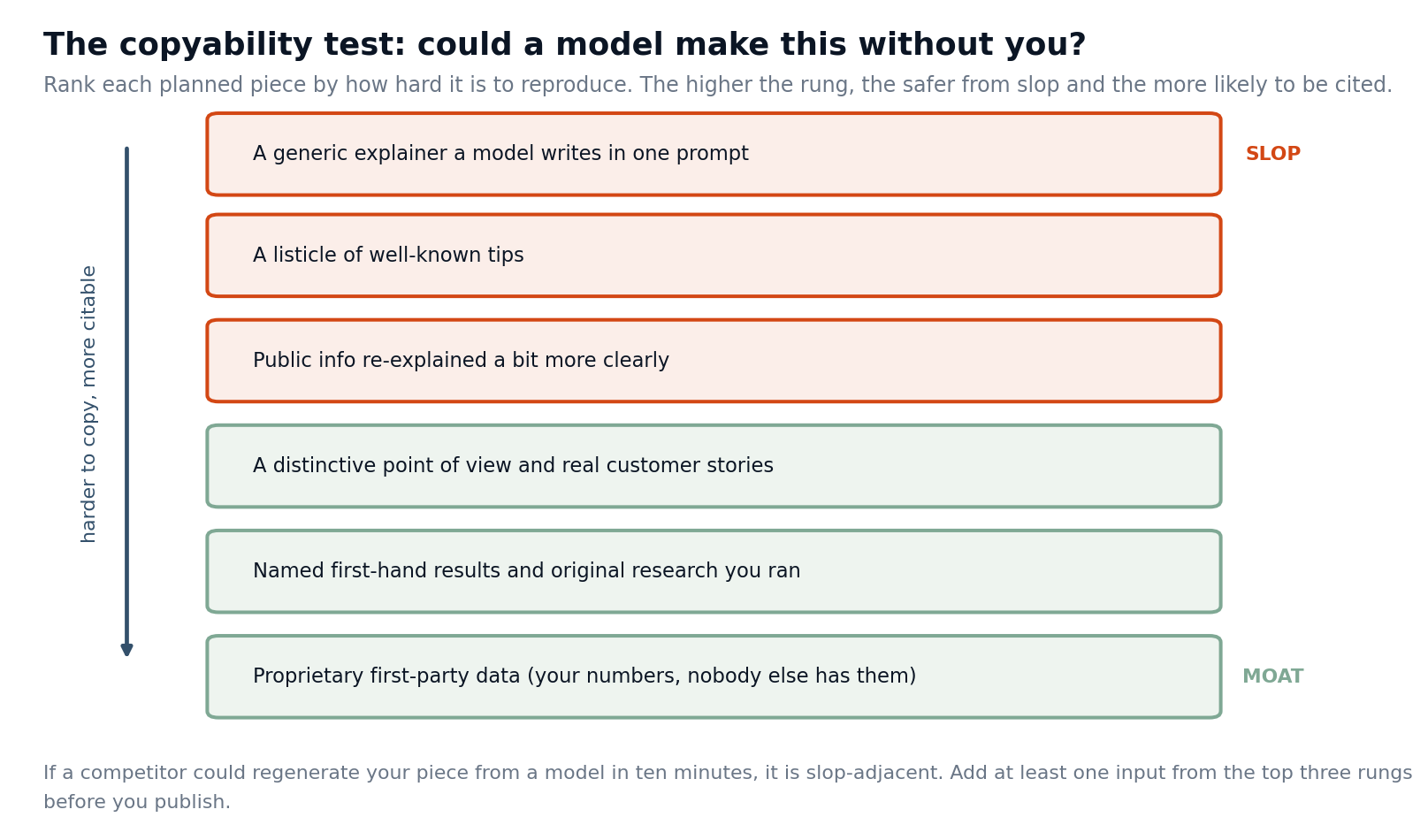
Rank each planned piece by how hard it is to reproduce. If it sits in the copyable band, add at least one input from the top three rungs before it goes out.
Run your content plan against that ladder honestly. Most calendars are heavier at the top than teams want to admit: explainers, roundups, and "ultimate guides" that a model could assemble in one pass. The fix is not to kill those topics but to raise each one a few rungs by adding something only you could contribute. An explainer becomes uncopyable the moment you put your own data or a real client example into it. The topic can be common; the version of it that you publish should not be.
What raising a piece up the ladder looks like
The move is easier to see with examples, because the topic usually stays the same; only the input changes. Take a common one: a guide to AI search visibility. Written from public knowledge, it is slop, one of hundreds of near-identical guides. Add your own citation-rate benchmarks across ChatGPT, Perplexity, and Gemini, and suddenly it is the guide that reports numbers no competitor can reproduce, and the one an AI answer is likely to cite when a buyer asks how visibility actually varies by engine.
The same lever works everywhere. A generic "how to reduce churn" post becomes uncopyable when you publish the specific churn signals you found in your own account base. A roundup of email subject-line tips becomes yours when you report open rates from your own tested sends rather than repeating advice from other roundups. An "X versus Y" comparison stops being a spec table anyone can assemble the moment you add what your customers actually said when they switched. In every case the headline topic is copyable and common; the version you publish is not, because it rests on something that started inside your company.
That is the reframe for a content calendar. You are not looking for topics no one else covers, which barely exist. You are looking for an uncopyable input to bring to topics everyone covers, so your entry is the one with a source behind it.
But we do not have a research team
The most common objection is that this sounds like it requires original studies and a data team, and most B2B teams have neither. They have more uncopyable material than they think; it is just not labeled as content yet. Your support tickets and sales calls are a record of the real questions and objections your market has, in your buyers' own words, which no model has seen. The patterns in them are original research you already ran without calling it that. Your own product usage is data: what customers do, in what order, where they get stuck.
A small test counts too, running one thing for a month and reporting honestly what happened is original research at a scale any team can manage. And a point of view costs nothing but nerve: taking a clear, defensible position on a debated question in your field is uncopyable precisely because a model will hedge and the safe consensus is what everyone else already published. The barrier is usually not access to uncopyable inputs. It is the habit of shipping the generic draft before adding one.
How to use AI without producing slop
None of this is an argument against using AI. It is an argument for using it on the right layer. AI is genuinely good at the copyable work: drafting a structure, tightening prose, producing a first version you will heavily rework. The mistake is letting it do the whole job, because the whole job includes the uncopyable layer it cannot supply.
Publishing the raw output is how you end up flooding your own site with the exact commodity content that earns nothing, and doing it at scale is how you trip the thin-and-duplicative problems that sink programmatic content.
The workflow that avoids slop is simple to state. Let AI accelerate the scaffolding, then spend the time it saved on the part that makes the page yours: pull the data, write the real example, take the position, verify every fact. Then structure that value so a model can extract and attribute it cleanly, because uncopyable content still has to be readable to be cited. Used this way, AI increases your output of genuinely differentiated pages instead of your output of forgettable ones.
Publish what only you can
The slop era rewards a strategy that sounds almost old-fashioned: have something to say that no one else can, and say it clearly. What changed is the stakes. When average content was scarce and expensive, producing competent, reproducible pages was a viable business. Now that it is free and infinite, the only durable position is the uncopyable one, and the flood of slop keeps making that position more valuable, not less. Publish less if you have to, but make each piece something a competitor could not recreate with any prompt.
If you want to see which of your pages are already being treated as a source in AI answers, the AI Search Visibility Checker shows you where you stand. And when you want to watch that over time, so you can tell which uncopyable investments are actually earning citations, AI Search Intelligence tracks how often you are cited across engines, and points you toward the content worth doubling down on.