


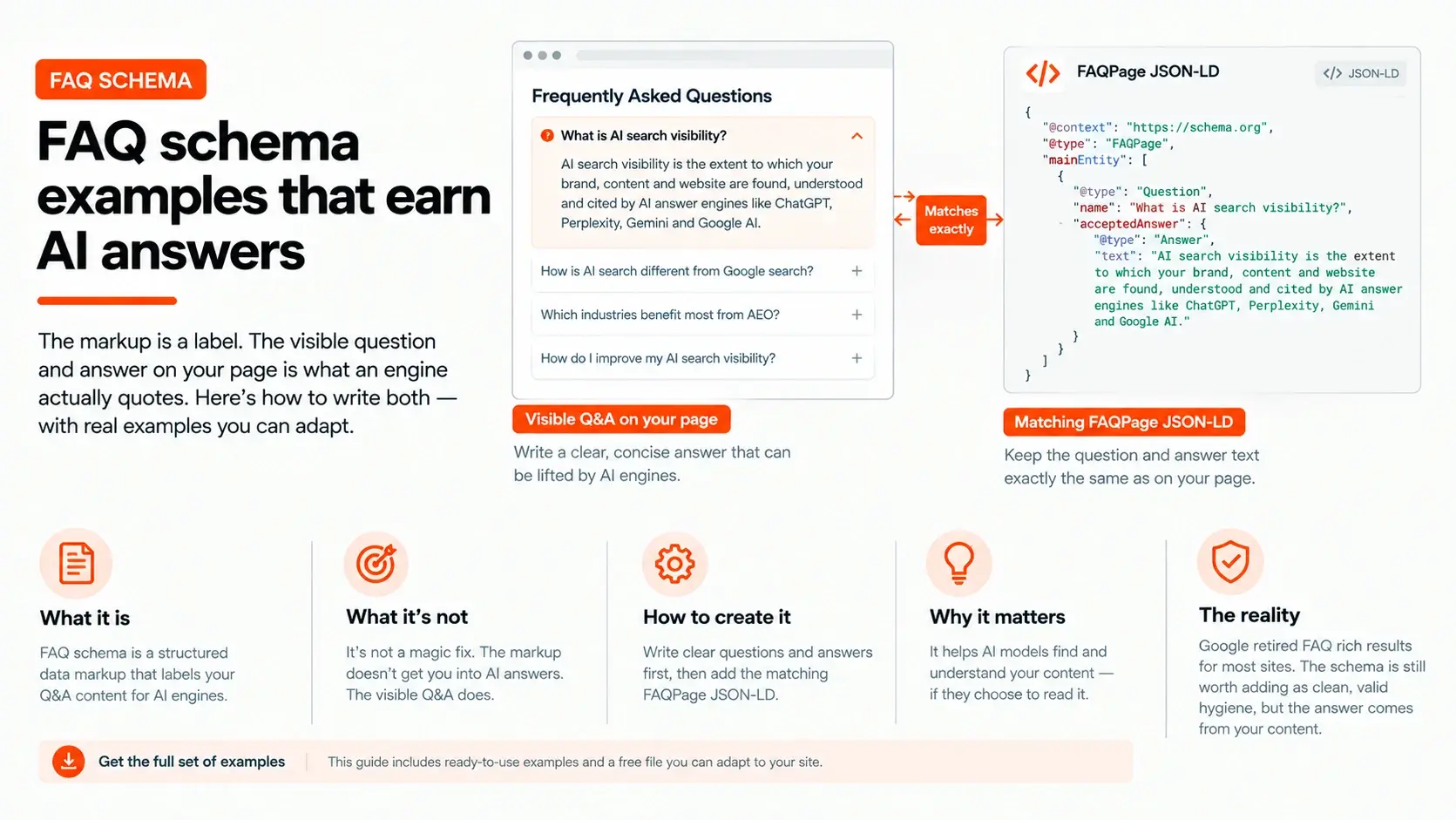


Most FAQ schema guides hand you a block of JSON-LD and imply the markup is what gets you into AI answers. It is not. The markup is a label; the visible question and answer on your page is what an engine actually quotes. So the examples in this guide come in two halves every time: the visible Q&A written to be the clean answer an engine can lift, and the matching FAQPage JSON-LD that mirrors it exactly. Copy them, adapt them to your product, and you have FAQ entries that are genuinely quotable, with correct markup behind them.
A note up front, because it changes how you should use these: Google retired FAQ rich results for most sites, and there is no reliable evidence that the FAQPage markup itself earns an AI citation. What earns the answer is the quality and clarity of the visible Q&A. The schema is still worth adding as clean, valid hygiene, but write the answer first. This guide gives you the examples and the writing rules together, plus a free file of all of them to adapt.
What an FAQ entry that earns the answer looks like
Before the copy-paste blocks, it helps to see the anatomy of one good entry, because the same shape repeats across all of them.
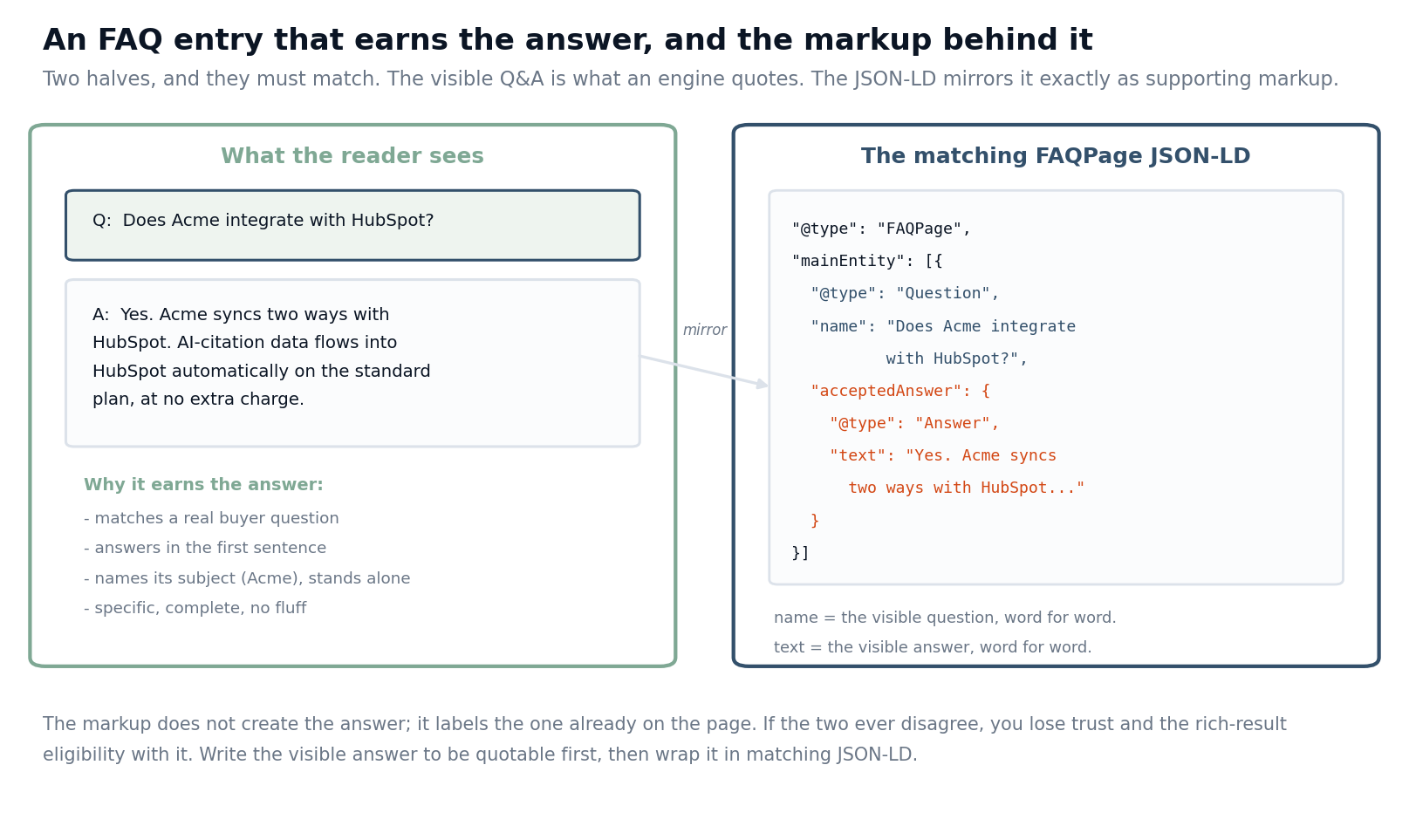
On the left is what a reader sees: a question phrased the way a buyer would actually ask it, and an answer that resolves in its first sentence, names its subject, and stands on its own. On the right is the matching FAQPage JSON-LD, where the question becomes the name and the answer becomes the text, word for word. The markup does not create the answer. It labels the one already on the page. If the two ever disagree, you lose trust and any rich-result eligibility with it, so the order of operations is always: write the visible answer to be quotable, then wrap it in matching JSON-LD.
That "write it to be quotable" part is the whole game, so here is the test for it before we get to the examples. Pull the answer out of the page and read it alone. If it still answers the question completely, an engine can lift it. If it needs the paragraph above it to make sense, it will not. This is the same passage-level logic behind how to structure B2B content for LLMs, applied to the tightest unit you have: a single Q&A.
An answer that earns the answer, and one that does not
The difference between an FAQ that gets quoted and one that gets ignored is rarely the markup. It is the writing.
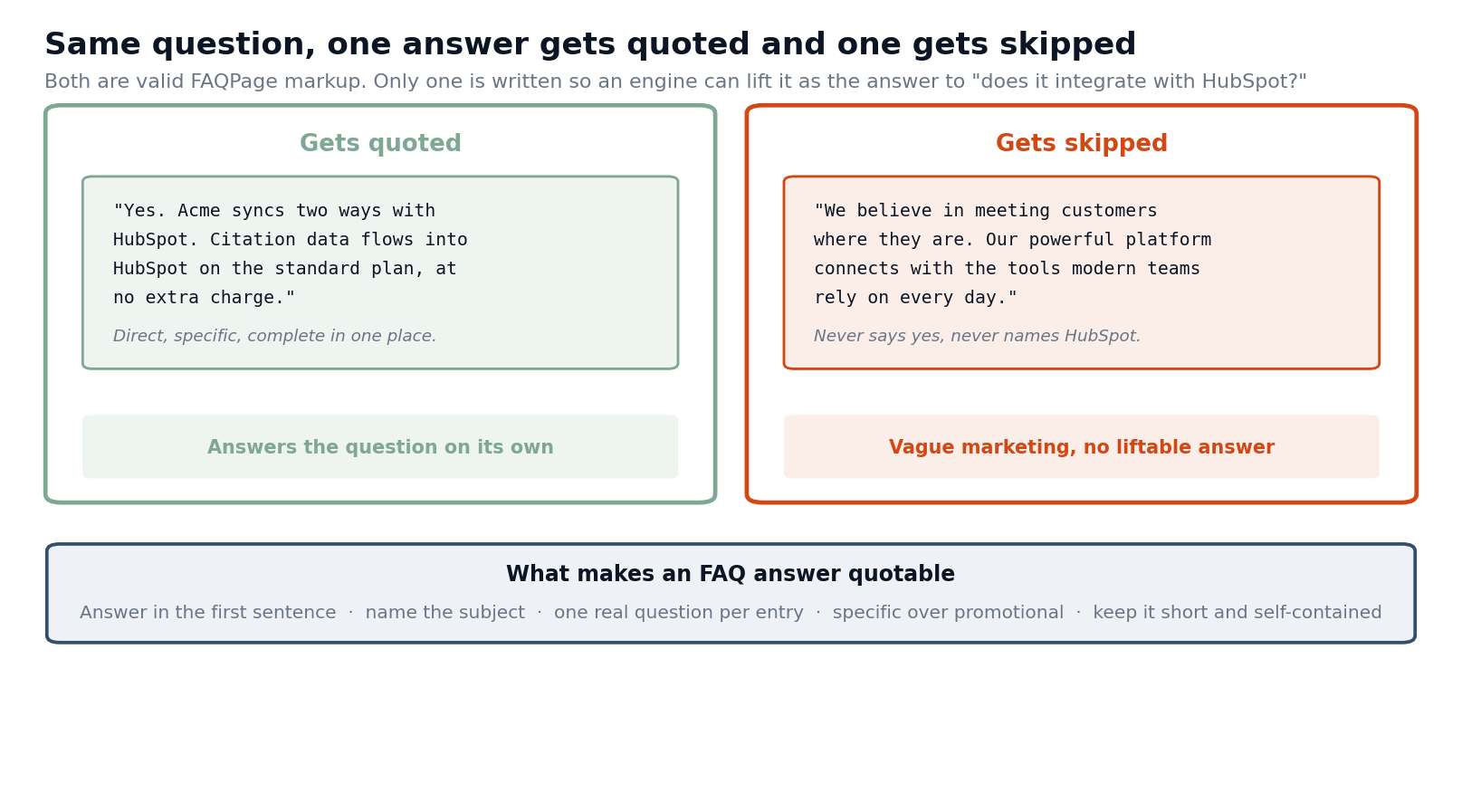
Take the question "does it integrate with HubSpot?" A quotable answer says: "Yes. Acme syncs two ways with HubSpot. Citation data flows into HubSpot on the standard plan, at no extra charge." It leads with yes, names the product and the tool, and is complete in one place. A wasted answer says: "We believe in meeting customers where they are, and our platform connects with the tools modern teams rely on." It never says yes and never names HubSpot, so an engine has nothing to lift. Both can carry identical, valid FAQPage markup. Only the first can become the answer. The markup was never the deciding factor.
So the rules that make an FAQ answer quotable are writing rules: answer in the first sentence, name the subject rather than leaning on "it" or "we," keep one real question per entry, choose specific over promotional, and keep each answer short and self-contained.
Four FAQ schema examples you can adapt
Here are the patterns that cover most B2B pages. Each shows the visible Q&A; the full JSON-LD for every one is in the downloadable file at the end, so you are not copying code out of a paragraph.
A product and pricing FAQ is the most common. The visible entries read like: "Q: Does [Product] integrate with HubSpot? A: Yes. [Product] syncs two ways with HubSpot, and your data flows in automatically on the standard plan." And "Q: How is [Product] priced? A: [Product] is priced per [unit] on a flat monthly plan." Each answer leads with the fact a buyer wants and names the product, so it survives being pulled out on its own. Here is the full markup for that pair, which is the same boilerplate you will reuse for every example:
<script type="application/ld+json">
{
"@context": "https://schema.org",
"@type": "FAQPage",
"mainEntity": [
{
"@type": "Question",
"name": "Does [Product] integrate with HubSpot?",
"acceptedAnswer": {
"@type": "Answer",
"text": "Yes. [Product] syncs two ways with HubSpot, and your data flows in automatically on the standard plan, at no extra charge."
}
},
{
"@type": "Question",
"name": "How is [Product] priced?",
"acceptedAnswer": {
"@type": "Answer",
"text": "[Product] is priced per [unit] on a flat monthly plan."
}
}
]
}
</script>
A comparison or alternatives FAQ answers the questions buyers ask when they are deciding between you and a competitor. "Q: What is the difference between [Product] and [Competitor]? A: [Product] focuses on [specific capability], while [Competitor] focuses on [their focus]." The trick here is to answer honestly and specifically, because a vague "we are the best choice" answer is exactly what an engine discards. These pages are high intent, and a clean comparison answer is some of the most citable content you can write, which ties to the page types that earn B2B citations.
A how-to or support FAQ covers setup and security questions. "Q: How do I connect [Product] to my CRM? A: Go to Settings, then Integrations, choose your CRM, and authorize the connection." Steps stated plainly in the answer are easy to lift. And a single-question block is the simplest useful unit of all: one real buyer question, answered completely, with matching markup, dropped on any page where that question naturally comes up. You do not need a dedicated FAQ page to use FAQ schema; one strong Q&A in context often works better.
How to implement these without tripping a penalty
Place the JSON-LD in the page's head or body as a script block, and generate it from the real Q&A content where you can, so it never drifts out of sync. Mark up only question-and-answer content that is genuinely visible on the page: Google's guidelines require the marked-up Q&A to match what the user sees, and marking up hidden or invented answers is a policy violation that can cost you rich-result eligibility and trust.
Keep answers reasonably short, a few sentences rather than an essay, and do not stuff a page with dozens of thin questions to game it. A handful of real, high-value questions beats a wall of filler. For the deeper question of which questions to answer in the first place, our guide on query fan-out and FAQ automation covers how to find the full set of sub-questions buyers actually ask.
Mistakes that keep FAQ answers out of AI responses
A few recurring errors waste the effort, and none of them are about the code. The first is the vague answer: a question that gets a paragraph of positioning instead of a direct response, so there is nothing for an engine to lift. The second is the buried answer, where the actual yes or number arrives in the third sentence after a wind-up; move it to the front. The third is the pronoun trap, where the answer opens with "it" or "we" and makes no sense once pulled out of the page, so name the subject every time. The fourth is the mismatch, where the JSON-LD says one thing and the visible page says another, which is a guideline violation that costs you trust. And the fifth is the stuffed page, a list of twenty thin questions written for the markup rather than the reader, which reads as manipulation and dilutes the few questions that matter. Fix the writing and the markup takes care of itself.
How to check it works
Validate every template before you rely on it. Google's Rich Results Test tells you whether the page is eligible for FAQ rich results and flags markup errors, and the Schema.org validator confirms the JSON-LD is well-formed. Run both after any change, and watch Search Console for structured-data errors at scale.
Then measure the thing that actually matters, which no validator reports: whether your answers are showing up in AI responses. Schema validation tells you the markup is correct; it tells you nothing about citations, because the markup is not what earns them. For the full picture of where structured data does and does not help, our schema markup for AI search guide covers the other types and the honest verdict on each.
Frequently asked questions
Does FAQ schema still work now that Google retired the rich result?
The rich result is gone for most sites, but the markup is still valid and still describes your Q&A for machines. Add it as clean hygiene, and rely on the visible answer, not the markup, to earn placements.
Will FAQ schema get me into AI Overviews or ChatGPT answers?
There is no reliable evidence the markup itself does. The visible, well-written Q&A is what gets quoted. Treat the schema as supporting, not as the lever.
How many FAQs should a page have?
A handful of real, high-value questions, not dozens of thin ones. Quality and specificity beat quantity, and over-stuffing looks manipulative.
Can I put FAQ schema on any page?
Yes, as long as the Q&A is genuinely visible on that page. A single strong question answered in context often performs better than a separate FAQ page.
What is the most common mistake?
A mismatch between the markup and the visible page, followed closely by vague answers that never actually answer the question. Fix the writing first, then the markup.
Put the examples to work
The quickest way to use this is to take the example file, drop the pattern that fits your page, replace the brackets with your real product facts, make sure the same Q&A is visible, and validate. The markup takes minutes. The part worth your attention is writing answers a model would be glad to quote: direct, specific, and complete on their own.
Then confirm it moved something, because correct markup and an earned citation are different outcomes.
You can see where your pages stand today with our AI Search Visibility Checker, and if you want to track whether your answers start getting cited after you ship them, that is what live model checks are for. Omnibound's AI Search Intelligence shows you which of your answers engines actually quote, so you can tell a tidy schema pass from an FAQ that genuinely earned the answer.