


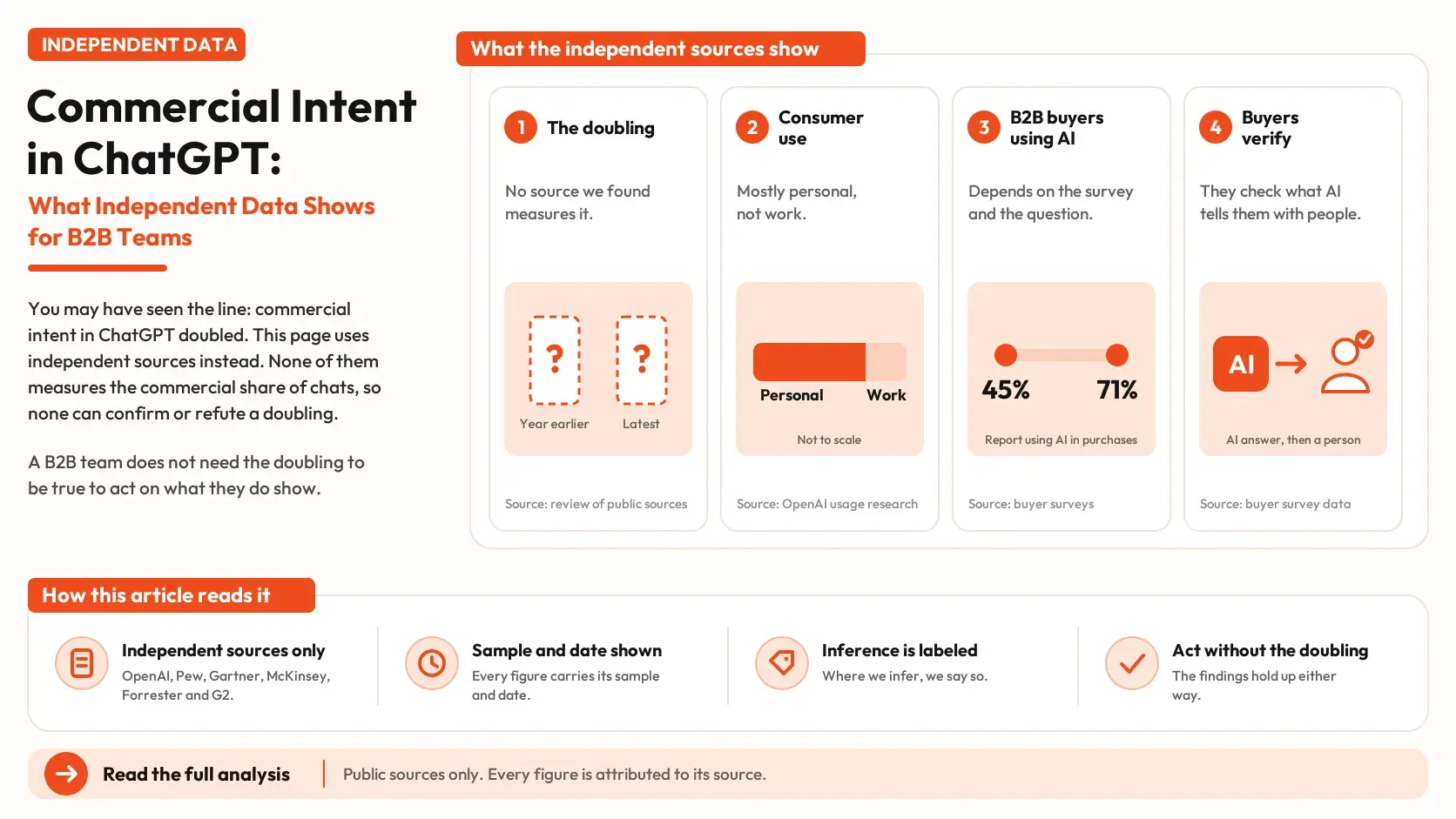


A B2B marketer planning the next quarter needs two facts about ChatGPT: how many buyers use it to research a purchase, and whether that use is growing. Sorted by what each source can support, the picture is this. ChatGPT's consumer use is mostly personal, not work. B2B buyers report using AI in purchases, from 45 percent to 71 percent depending on the survey and the question. Buyers also say they check what AI tells them with people. What none of these sources measures is the share of ChatGPT conversations that are commercial, or how that share has changed, so none can confirm or refute a doubling.
Why a count that doubled tells you little
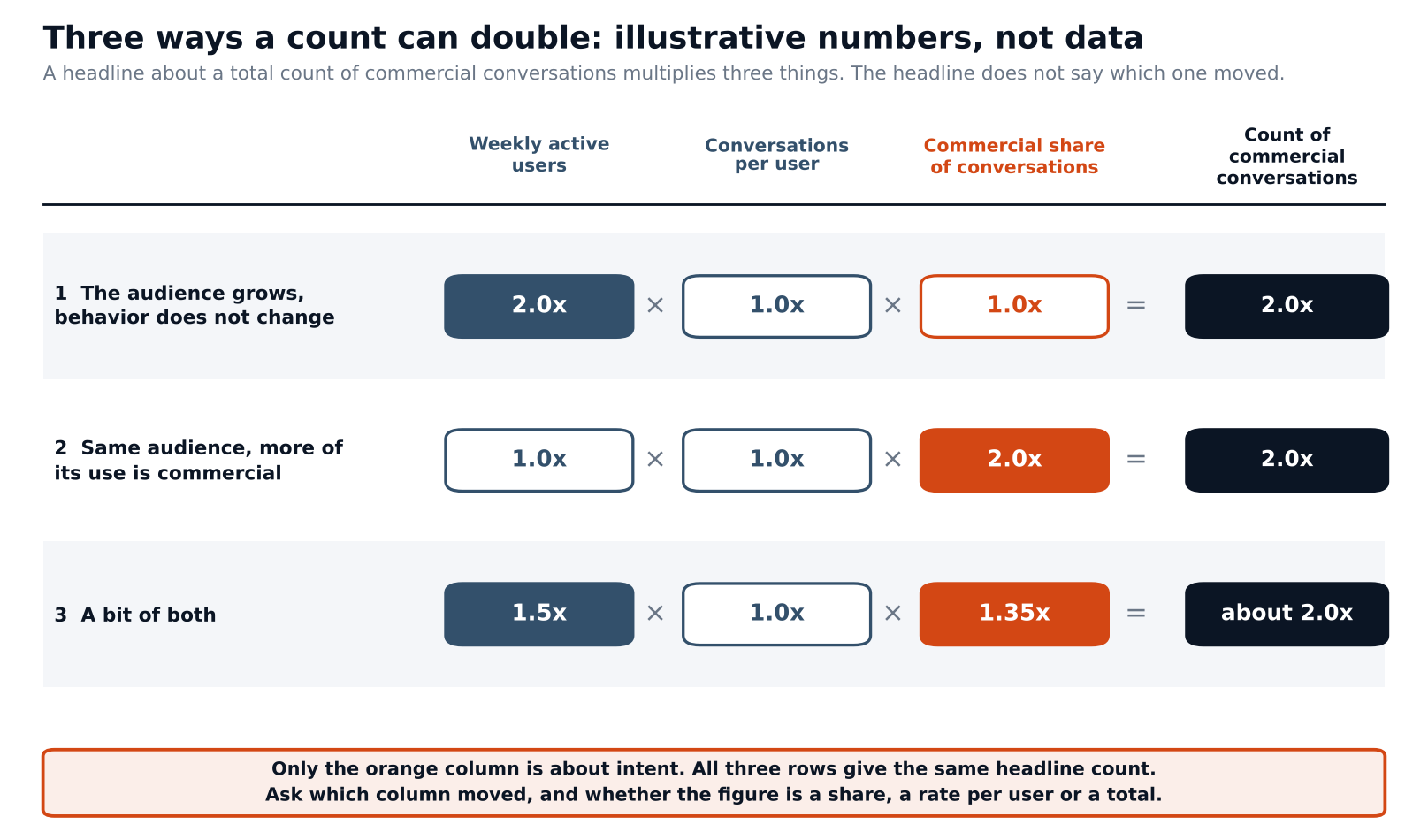
A headline about doubling usually describes a total: the number of commercial conversations in a week. A total is the product of three things: how many people are using the tool, how many conversations each person has, and what share of those conversations is commercial. The chart uses made-up numbers to show how three different stories give the same headline. The audience can double while behavior stays put. The share can double while the audience stays put. Or each can grow part of the way. Only the third factor, the share, is about intent.
So a claim like this one needs three questions before it goes into a plan. Is the figure a share, a rate per user or a total? How was commercial defined, and by what classifier? And whose conversations, over what window? Our piece on the fastest-growing sources in AI search covers the same trap with citation data: a percent change without its starting level and its count tells you very little. The fourth question matters as much as the other three: who published it, and what do they sell?
What OpenAI's own research says ChatGPT is used for
The most direct independent look at what people do in ChatGPT is a working paper published by the National Bureau of Economic Research in September 2025, "How People Use ChatGPT," by Aaron Chatterji, Thomas Cunningham, David Deming, Zoe Hitzig, Christopher Ong, Carl Yan Shan and Kevin Wadman. Two of the authors are OpenAI employees, and OpenAI's economic research team ran the analysis. According to OpenAI's summary of the paper, it analyzed 1.5 million conversations with automated, privacy-preserving tools, and covers consumer plans only.
Its headline figures: about 30 percent of consumer usage is work-related and about 70 percent is not. By message type, asking made up 49 percent, doing 40 percent and expressing 11 percent. Three-quarters of conversations focused on practical guidance, seeking information and writing. The NBER abstract adds that non-work messages grew from 53 percent to more than 70 percent of all usage and that the authors see ChatGPT's value as coming mainly through decision support.
For a B2B reader the useful points are the limits. The 70 percent figure covers consumer accounts, and OpenAI's current usage data page says it covers individual Free, Go, Plus and Pro accounts and excludes enterprise accounts, so business use is likely underrepresented. A buyer researching software from a company-provided seat would not appear in these numbers. We also did not find a share for commercial or buying prompts on the pages we read. A secondary summary of the paper reports that queries leading to purchasable products were about 2 percent of messages, but we could not confirm that in the paper itself, and purchasable products is a narrow slice of what a commercial prompt covers.
How many people use chatbots to look things up
Pew Research Center surveyed 5,119 US adults between February 17 and 23, 2026. It found that 49 percent say they ever use AI chatbots, up from 33 percent in 2024, and that about a quarter use them daily. About four in ten US adults say they use chatbots for searching for information, the most common use listed. Among employed adults, 38 percent say they use them for tasks at work. Pew's report, as we read it, has nothing on shopping, product research or buying, so it tells you how widely chatbots are used for lookup and not whether the lookups are commercial.
What B2B buyers say about using AI to buy
Four sources measure B2B buying directly. They are surveys, so they record what buyers say they do, and each has a different sample.
| Source | Sample and date | What it reports | Caveat |
|---|---|---|---|
| Gartner, press release May 20, 2026 | 645 B2B buyers, August to September 2025 | 45% used generative AI during a recent purchase, mainly to gather information on vendors and products; buyers reported seven information sources on average, and sales reps remained the most important source at several stages | Press release from the party that ran the survey; base and question wording not given |
| McKinsey, tenth B2B Pulse survey, reported June 1, 2026 | Nearly 4,000 B2B decision-makers in 13 countries | AI-enabled search, chatbots and LLMs are among buyers' top five channels in the purchase journey; 58% trust these tools to help them learn about products and services, close to the roughly 60% reported for search engines, peer recommendations, vendor information and trade publications | We read secondary reporting, not the survey; trust is not defined |
| Forrester, State of Business Buying 2026, reported January 22, 2026 | 2025 Buyers' Journey Survey; sample size not stated | Generative AI was the single most cited meaningful interaction type for researching purchases in 2025 | Secondary reporting; no sample size |
| G2, published April 15, 2026 | 1,076 B2B software buyers, March 2026 | 51% start research with an AI chatbot more often than with Google, up from 29% in G2's 2025 report; 71% use AI chatbots at some point in research; 53% say chatbot research is more productive than traditional search | G2 runs a review marketplace and has a stake in how vendors think about research |
The four agree on direction: AI is now part of how B2B buyers research, and for some a first stop. They do not agree on size, and they should not be expected to. The questions differ ("used during a recent purchase," "a top five channel," "start more often than Google"), the samples differ, and the G2 sample is software buyers only. A range from 45 percent (used generative AI in a recent purchase) to 71 percent (use an AI chatbot at some point in research) is a fair reading of "how many B2B buyers use AI in research," and none of these numbers says how many of those buyers typed a commercial prompt into ChatGPT specifically.
Two 69 percents, and what buyers do with the answer
Two of the figures above share a number and mean different things. G2 reports that 69 percent of buyers chose a different vendor than they originally planned because it appeared in a chatbot recommendation. Gartner reports that 69 percent of B2B buyers prefer to validate AI-generated insights with sales reps. One is about AI changing a shortlist. The other is about buyers checking an answer with a person. Both can be true, and together they are a better description of the buying process than either alone.
Other figures point the same way. In Forrester's survey, 36 percent of buyers felt more confident they made a better-informed decision because they used generative AI, and 20 percent felt less confident because they met unreliable or inaccurate information. Gartner found that 51 percent of buyers say they are more likely to meet misleading information from generative AI and 49 percent say the same about sales reps. G2 says AI chatbots build the shortlist and review sites validate it. Our piece on whether review sites drive B2B AI citations covers what the public evidence says about that second half.
The pattern, as these sources describe it, is that an AI answer is an input to a decision made by several people over weeks. A vendor named in the answer gets considered, and then the checking begins with your site, your reps, your reviews and your peers' opinions. That is one reason to treat a commercial prompt as the start of an evaluation, not the end of one.
What no independent source measures
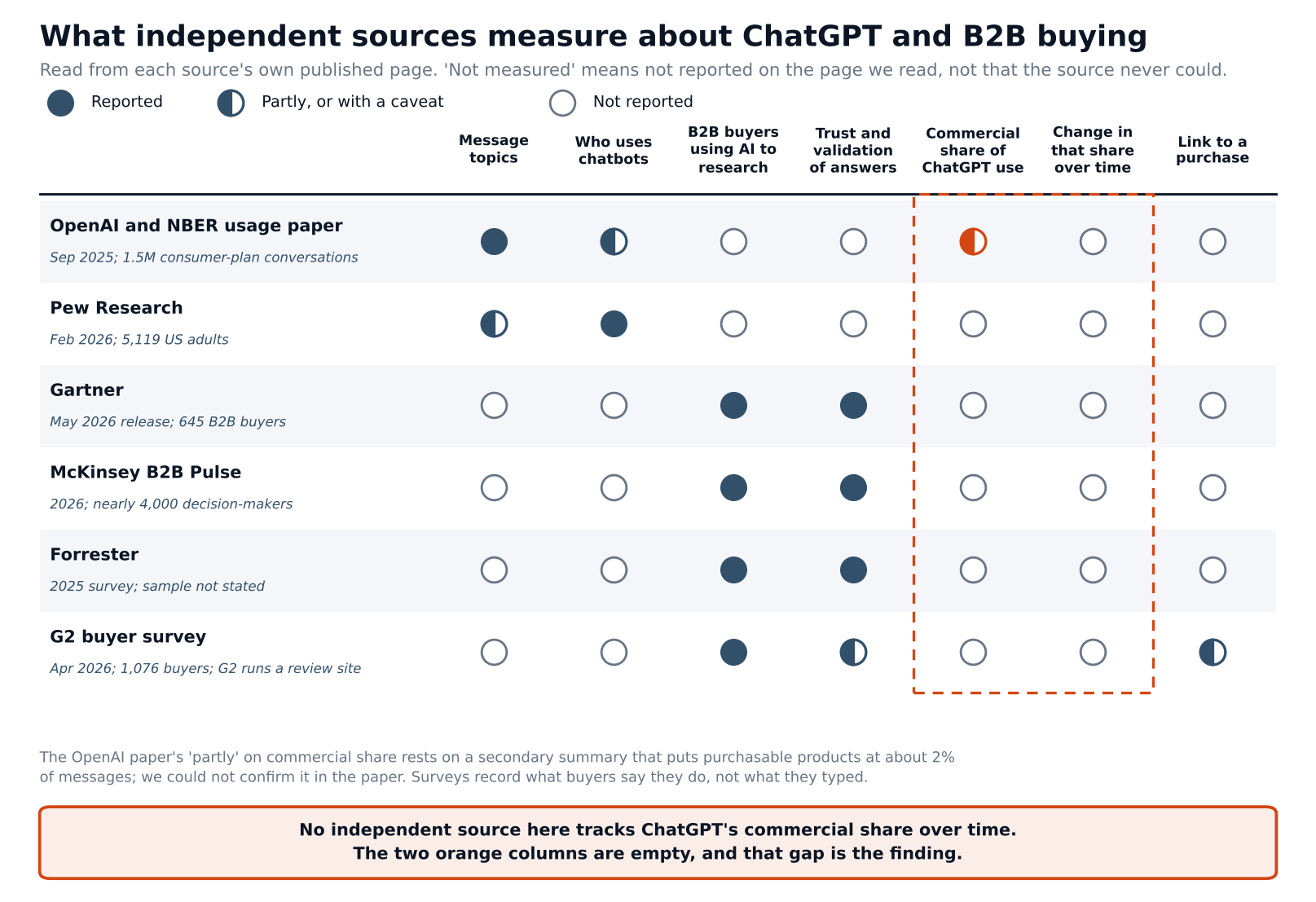
The chart sets the sources side by side against the questions a B2B team might want answered. The first five columns have something in them. The last three, which are the ones the headline claims address, do not. Nothing we found tracks what share of ChatGPT conversations are commercial, how that share has moved, or what proportion of commercial conversations ends in a purchase. The one partial mark, on the OpenAI paper, rests on a secondary summary we could not verify.
That gap is why the claim is hard to check. A vendor with a large database of conversations can measure the share, and may be right. Only that vendor can see the data, and it also sells the tracking. Independent surveys can tell you that buyers use AI and how much they trust it. They cannot tell you what a typical commercial prompt looks like or how often one appears.
What B2B teams can do without the number
None of the studies tells you what to publish. They suggest where the evaluation conversation is happening and how loose any market-wide figure is, which supports a few modest steps.
- Build a commercial prompt set from your own buyers. Take the words from sales calls and lost-deal notes: "best [category] for [company type]," "[you] vs [competitor]," "alternatives to [competitor]," "[you] pricing," "is [you] good for [use case]," "how to choose [category]." Twenty to thirty prompts is enough to start.
- Track presence per prompt and per engine, with the denominator labelled. Surveys tell you buyers use AI. Only your own prompt set tells you whether you are named when they do.
- Look after the validation step. Buyers check AI answers with reps, peers and review sites. Make sure pricing, comparison and proof pages say the same thing the answer does, and that third-party profiles are current. Our piece on first-party and third-party citations covers how citations split between your pages and other sites. Earning independent mentions is slow. Review programs, PR and AI Authority Building, which Omnibound offers in beta, are among the ways to do it, and our off-site signals hub maps the rest.
- Put every market-wide number through the four questions. Share, rate or total; how commercial was defined; whose conversations and when; who published it and what they sell.
- Report your own results as shares with their denominators, and compare a figure only with a later figure from the same source.
Questions people ask
Did commercial intent in ChatGPT double?
A report from an AI search tracking vendor says commercial conversations did. We have not used its data, and none of the independent sources we found measures the share of ChatGPT conversations that are commercial, so we cannot confirm or refute it.
What share of ChatGPT use is commercial?
We found no independent measure. A secondary summary of an OpenAI-coauthored paper puts purchasable products at about 2 percent of messages, which we could not confirm and which covers a narrow slice of commercial prompts.
Do B2B buyers use AI to research purchases?
Surveys say yes, with different numbers. Gartner found 45 percent used generative AI in a recent purchase, McKinsey reports AI search and chatbots among buyers' top five channels, and G2 found 51 percent of software buyers start research with an AI chatbot more often than with Google.
Do B2B buyers trust AI answers?
Partly. McKinsey reports 58 percent trust these tools to help them learn about products, Forrester found 36 percent more confident and 20 percent less confident, and Gartner found 69 percent prefer to validate AI-generated insights with sales reps.
What should a B2B team do about it?
Build a prompt set from your own buyers' wording, track whether you are named per prompt and per engine, and keep your validation pages consistent with what AI says about you.
Start with your own commercial prompts
A market-wide number, however well sourced, describes ChatGPT in general. Your pipeline depends on a few dozen prompts your buyers type when they compare vendors like you. To see where you stand on those today, the AI Search Visibility Checker shows how engines describe your company and which pages they draw on, which is a sensible first draft of a prompt list. AI Search Intelligence then tracks those prompts engine by engine over time, so the next time a headline says commercial intent doubled, you can check what happened to your own mentions and your own denominators first.