


%20drive%20B2B%20AI%20citations.webp)


Ask three vendors whether G2 reviews affect AI visibility and you tend to get three answers, each with a chart. One says reviews are the biggest lever you have. One says the effect is real but small. One says the review sites are barely cited at all. They are all quoting published numbers, and the numbers are all roughly accurate for what they measured.
This article lays the studies next to each other. It covers how often review platforms are cited, which one gets the share, when they show up, and what the evidence says about whether more reviews or a better profile change which vendors an engine names. It reads public studies only. It contains no Omnibound data, each figure is attributed, and where we infer something rather than quote it, we say so.
One caution runs through all of it. G2 published or commissioned some of the most detailed analyses, and several other sources come from vendors of AI visibility tools. That does not make them wrong. It does mean the sampling choices, the groupings and the framing deserve a close read.
Review sites are cited, in a minority of answers
The most careful public measurement of review platforms in a Google surface is SE Ranking's study of AI Overviews. It took 30,000 commercial keywords on December 1, 2025, of which 22,729 returned an AI Overview, and tracked 23 review platforms. Only 34.5 percent of those AI Overviews cited at least one review platform. Review platforms made up 8.5 percent of all links, which still put them among the five most-cited domains.
Those two figures come from the same data. One counts answers, the other counts links, and they differ by a factor of four. That is the first thing to check in any review-site number. The table below puts the other published readings next to it.
| Source | Engine and window | Scope | What the percentage counts | Review platforms |
|---|---|---|---|---|
| SE Ranking | Google AI Overviews, Dec 1 2025 | 30,000 commercial keywords, not only B2B | Answers citing at least one review platform | 34.5% |
| SE Ranking, same data | Same | Same | Share of all links | 8.5% |
| G2-commissioned analysis | ChatGPT, Dec 2025 | About 35,000 citation URLs, US, by buying stage | Share of citations | 7.4% to 13.2% |
| Overthink Group | ChatGPT, Gemini, Perplexity, AI Overviews, June 2026 | 1,263 prompts in niche B2B software categories | Share of citations: G2 network, with g2.com alone at 5.8% | 8.0% |
| Growfusely | ChatGPT and Perplexity | 128 B2B software queries in 16 categories | Share of citations | 7.3% |
Across the sources that count citations or links, review platforms land in a band of about 7 to 13 percent. That is a consistent finding, and it is also a minority. In Growfusely's data, independent content and vendors' own pages together made up nearly 79 percent of citations. For how those groups compare, see our piece on first-party versus third-party citations.
One more placement detail from SE Ranking: 93 percent of review-platform citations sat in the sources block rather than inline in the answer text, and only 35.9 percent were among the top three sources. Being listed is not the same as being quoted.
Which review site? The counts disagree
If review sites are cited, the next question is which one. Here the sources split more sharply than on the overall share.
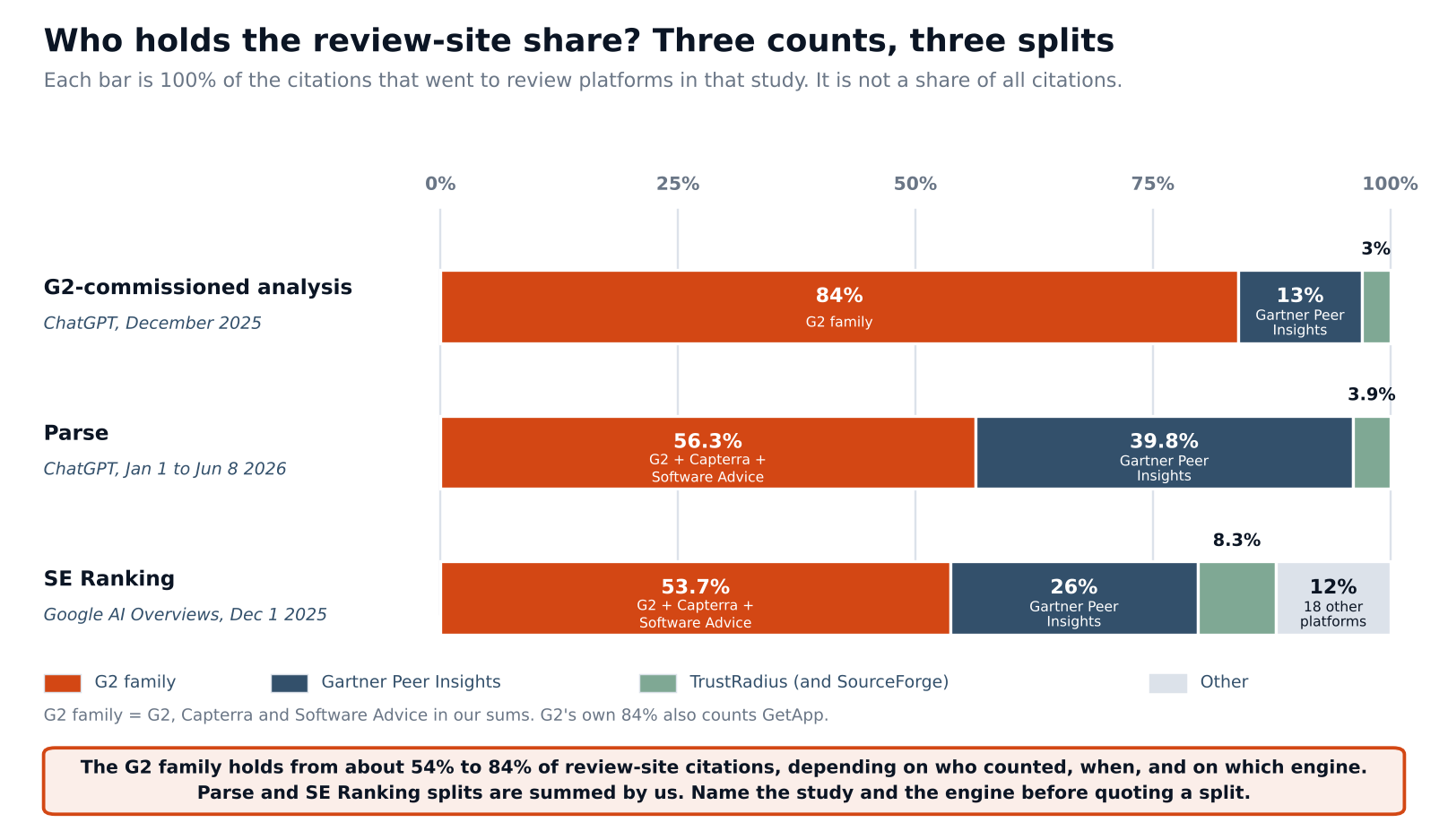
G2's analysis, published in February 2026, grouped G2 with Capterra, Software Advice and GetApp and found that family at 84 percent of review-platform citations in ChatGPT, with Gartner at 13 percent. Parse, using ChatGPT data from January 1 to June 8, 2026, reported a different split: Gartner Peer Insights at 39.8 percent, G2 at 37.5, Capterra at 12.7, Software Advice at 6.1 and TrustRadius at 3.9. Adding G2, Capterra and Software Advice gives us 56.3 percent, which is our sum, not Parse's. SE Ranking's AI Overviews data also had Gartner Peer Insights first, at 26.0 percent, with G2 at 23.1.
Several things could explain the gap, and none can be tested from the outside. The windows differ: one month against five. The unit differs: G2 says it de-duplicated domains within each analysis run, while Parse counts citation references across 5,422 prompts. The prompt sets and the data providers differ. Our inference is that the groupings matter too, since a family total hides which member is doing the work. Whatever the cause, "G2 is cited far more than anyone else" and "Gartner Peer Insights is cited about as often as G2" were both published within months of each other, and a team planning where to invest should not accept either on its own.
There is also a moving part on the ownership side. On January 29, 2026, G2 announced that it had agreed to acquire Capterra, Software Advice and GetApp from Gartner. We did not confirm whether the deal has closed. Studies that treat these sites as separate and studies that group them are both reasonable, and they will not line up with each other.
Engines do not read review sites the same way
The overall share also hides a split by engine. In Overthink's June 2026 data, Perplexity accounted for more than 71 percent of all G2 citations, which means a test run only in ChatGPT could understate G2's presence badly. Growfusely found that ChatGPT and Perplexity cite very different mixes for the same questions: ChatGPT cited vendors' own pages about twice as often as Perplexity did, 24 percent against 12 percent, while Perplexity cited YouTube and Reddit that ChatGPT barely touched.
SE Ranking measured only Google AI Overviews, and G2's analysis only ChatGPT. Neither can tell you how your buyers' engine of choice behaves. Our reading of AI Mode's most-cited domains found G2 among the sources cited for 12 of the 37 tracked organizations in one B2B-focused study that covered three engines, a reminder that it appears widely but not uniformly.
When review sites show up
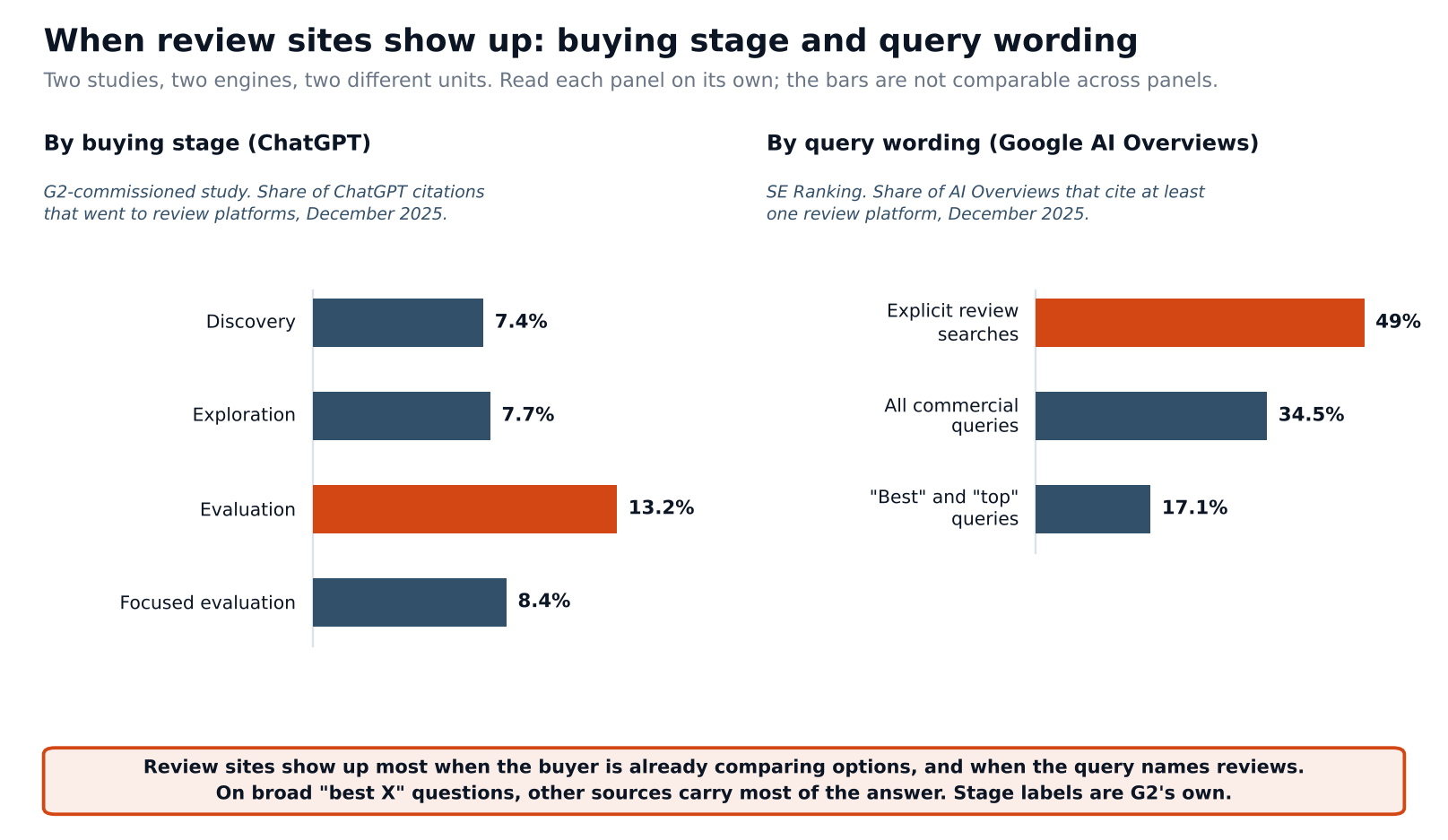
Two studies split the share by context. G2's analysis, using ChatGPT data, found review platforms at 7.4 percent of citations for discovery prompts and 7.7 percent for exploration, rising to 13.2 percent at the evaluation stage, then 8.4 percent for focused evaluation. The stage labels are G2's own. SE Ranking found review platforms cited in 49 percent of AI Overviews for explicit review searches, against 17.1 percent for "best" and "top" queries.
The two panels use different units and different engines, so they should not be compared directly. They agree on the direction: review sites show up most when the buyer is already comparing named options or asking about reviews, and least on broad "best of" questions, where other sources carry most of the answer.
Cited is not the same as moved
Everything above is about presence. The harder question is whether more reviews, or a stronger profile, change which vendors an engine recommends. Three kinds of evidence exist, and they point in different directions.
G2's own regression. G2 analysed 30,000 citations across 500 random categories, using Profound data, and published the result. It found a small positive relationship: roughly 10 percent more reviews went with about 2 percent more citations. The R-squared values were 0.009 to 0.012, meaning review volume explained about 1 percent of the variation. G2 states that the design is cross-sectional and cannot show cause, that omitted variables are a problem, and that it looked at G2 only. It also conducted the study. A review platform reporting that its own review counts matter only a little is, if anything, a result against interest, but it is still one design with one set of exclusions.
A vendor's ratios. Presenc reports, from about 6,800 procurement-intent queries across four engines, that brands in G2's top 20 were cited 3.1 times as often as brands absent from it, that profiles with 100 or more reviews were cited 2.3 times as often as those with fewer than 20, and that leader badges went with a further 20 to 35 percent lift. The page calls the estimates directional and gives no dates or sampling detail beyond May 2026. Our inference: larger, better-known vendors tend to have more reviews, higher rankings and more mentions of every kind, so ratios like these cannot separate the effect of reviews from the effect of being a bigger brand.
Presence as a baseline. MaxAEO, relaying research from Quoleady that we could not locate directly, reports that every tool ChatGPT recommended in a set of alternatives queries had Capterra reviews and 99 percent had G2 reviews. One write-up from Strive Labs reads that as review profiles acting as an eligibility gate, though it does not name the studies behind its claim. It is a reasonable hypothesis. It is also exactly what you would see if every established B2B product simply has a profile, in which case the figure cannot show that the profile caused the mention.
Putting these together, the defensible reading is narrow. Review pages are cited, more so at evaluation. Review volume has a small measured association with citations in one platform-run study. Larger associations in vendor data are confounded by brand size. Nobody has shown, with a comparison group, that adding reviews changes which brands an engine names. For the same question on communities, see our piece on whether Reddit drives AI answers; the shape of the evidence is similar.
A citation is not a visit
SE Ranking added a detail worth knowing. Over 2024 and 2025, organic search traffic to the main review platforms fell sharply: G2 by 84.5 percent, Capterra by 89 percent and Gartner Peer Insights by 76.5 percent, even as the platforms stayed among the most-cited domains. Our inference: for a buyer using an AI engine, your listing may be read by the engine far more often than it is opened by a person. The text on your profile is working as source material, so accuracy matters more than polish.
Review sites still matter to buyers directly. MaxAEO, citing G2's 2025 buyer behavior report, reports that generative AI chatbots and review sites were the two leading influences on software shortlists, at 17.1 and 15.1 percent. That is G2's survey, relayed second-hand, so treat it as a pointer.
What a B2B team can do with this
The evidence supports moderate, unexciting actions and does not support a campaign built around review counts.
Keep your profile accurate and complete on the platforms your category actually uses: category placement, pricing information, a clear description, and the alternatives you are compared with. When an engine does cite your listing, those fields are what it reads. This is the same consistency point we make in our guide to entity SEO for AI search.
Ask real customers for reviews on a steady schedule and follow each platform's rules on incentives. Do this because buyers read reviews, not because review volume is a proven lever for AI answers; G2's own data says volume explains about 1 percent of the variation in citations.
Check which review platform appears for your category and engine before choosing where to spend. The splits above disagree enough that an assumption carried over from another category can be wrong.
If you want help building a consistent third-party footprint across review sites and other independent sources, AI authority building is the service we offer for it. Our piece on offsite signals grades which of those signals are documented and which are only plausible.
Check your own category
The published numbers describe other people's questions. Your category may lean on review sites far more or far less than the averages above.
Fix 15 to 30 prompts a buyer in your category would type, covering discovery, evaluation, alternatives and pricing. Run each several times in each engine you care about, on the same schedule, and record every cited URL. Then count, for each engine separately, three rates with the denominator written next to each: the share of answers that cite any review platform, the share of review-platform citations that go to each platform, and whether your own listing page appears among the cited URLs.
Do not claim a trend until you have two dated snapshots of the same prompts, and do not average engines together; the Perplexity share of G2 citations alone shows why.
What we do not know
- Whether more reviews cause more AI citations. The only large public regression is cross-sectional and was run by a review platform; vendor ratios are confounded by brand size.
- Which review platform engines favor in a given category. Published splits for the G2 family range from about 54 percent to 84 percent of review-platform citations.
- How the G2 and Capterra acquisition changes any of this. The announced agreement may alter how the sites are grouped, linked and described.
- How much of the effect runs through training data. Citation counts only capture what is shown, not what shaped an answer that carries no link.
- How B2B-specific most of this is. SE Ranking's data covers commercial queries generally, and only some of the other studies are limited to B2B software.
Questions people ask
Do AI engines cite G2?
Yes. Across the studies we read, review platforms received about 7 to 13 percent of citations, and G2 and its family held the largest share in G2's own analysis. In SE Ranking's AI Overviews data, Gartner Peer Insights ranked first among review platforms.
Does having more G2 reviews improve AI visibility?
G2's own analysis found a small positive association, with review volume explaining about 1 percent of the variation in citations. It does not show cause. Vendor claims of larger effects do not control for brand size.
Is Capterra or G2 cited more by ChatGPT?
It depends on the study. G2 grouped Capterra with itself, while Parse's ChatGPT data showed G2 at 37.5 percent and Capterra at 12.7 percent of review-platform citations.
Do review sites show up for "best X software" questions?
Less than for review-focused ones. SE Ranking found review platforms in 17.1 percent of AI Overviews for "best" and "top" queries and 49 percent for explicit review searches.
Should we buy reviews or run incentive campaigns?
The evidence does not show that review volume is a strong lever for AI answers, and each platform has its own rules on incentives. Collect reviews from real customers, and read the platform's policy first.
Start with the pages the engines already read
Before deciding how much to invest in review sites, find out whether engines cite them for your category at all. That is a small measurement job, and it should come before a review-count target.
The AI Search Visibility Checker shows how engines describe your company today, including whether your listing is among the pages they lean on. AI Search Intelligence tracks the cited sources for your category prompts over time, so you can see which review platforms appear on which engines and whether that changes, and plan from your own numbers.