


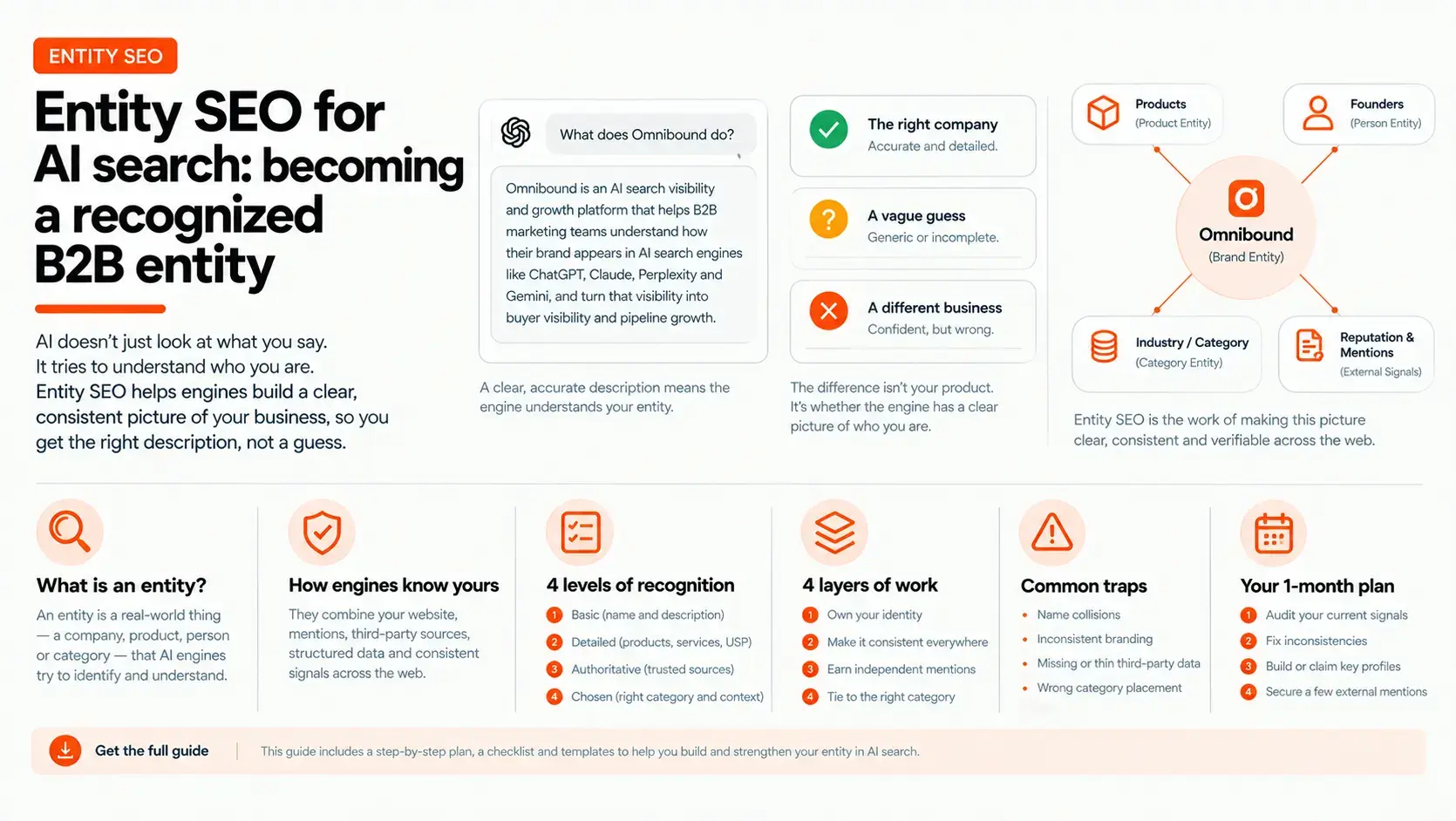


Open an AI assistant and type your company's name with the words "what does it do." What comes back is a small test of everything this guide covers. Some companies get a clean, accurate paragraph. Some get a vague guess. Some get a confident description of a different business that happens to share the name. The difference is rarely about how good the product is. It is about whether the engine has a clear, consistent picture of who you are.
That picture is what people mean by an entity. Entity SEO is the work of making it clear: stating your identity in one place, repeating it the same way everywhere, getting independent sources to describe you the same way, and tying your name to the category you want to be chosen in. For a B2B company that sells to buyers who now ask an assistant for vendor shortlists, it is the foundation under everything else. Content gets you cited for a topic. Entity clarity decides whether the engine knows who is speaking.
This guide covers what an entity is and how engines come to know yours, four levels of recognition you can test, the four layers of work that build it, the traps that waste time, and a plan for the first month. It is written for B2B teams, so it deals with name collisions, product and founder entities, and category placement, not local business listings.
What an entity is, and why engines need one
An entity is a specific, identifiable thing: a company, a product, a person, a place, a concept. It has a name, a type, attributes such as what it does and where it is based, and relationships to other entities, such as its founder, its category and its competitors. Search engines moved from matching strings of words to modelling these things years ago, and AI engines lean on the same idea. When a buyer asks for the best tools in a category, the engine does not look for pages containing a phrase. It assembles a set of things it believes belong in that category.
If the engine has no confident model of your company, you are not in the set. You may still appear if a page about you happens to match a prompt, but you are competing as a page, and not as a known vendor. If the model is wrong, you can be placed in the wrong category, credited with a competitor's feature, or confused with another business. Entity clarity does not guarantee that you are recommended. It removes a reason for being skipped.
How an engine comes to know your company
Nobody outside the model builders can say exactly which sources shaped a given answer, so treat any claim of a precise recipe with suspicion. What can be said is that an engine's picture of a company tends to come from three places.
The first is what the model absorbed when it was trained, which includes a large amount of public text about companies. You cannot edit that directly, and it lags behind reality. The second is structured knowledge bases and graphs, such as the one Google maintains and public ones like Wikidata, which store entities with identifiers, types and links. The third is live retrieval: when an engine searches the web to answer a question, it reads the pages it finds and takes its description of you from them.
The practical consequence is that your identity is assembled from many places at once, and the engine tends to trust what several independent places agree on. A company that describes itself one way on its site, another way on LinkedIn, and a third way in press coverage hands the engine three candidate pictures. A company whose site, profiles and coverage tell the same story hands it one.|
There is evidence that being talked about elsewhere matters. In its study of 75,000 brands, Ahrefs found that branded web mentions correlated with how often a brand was mentioned in answers from ChatGPT, Google AI Mode and Google AI Overviews, at roughly 0.66 to 0.71, while backlinks sat around 0.2. The Ahrefs study covered brands with a domain rating above 40 and is explicit that it shows correlation, not causation, so read it as a pointer toward what to build and not a promise of what it will produce.
Four levels of recognition, and how to test each
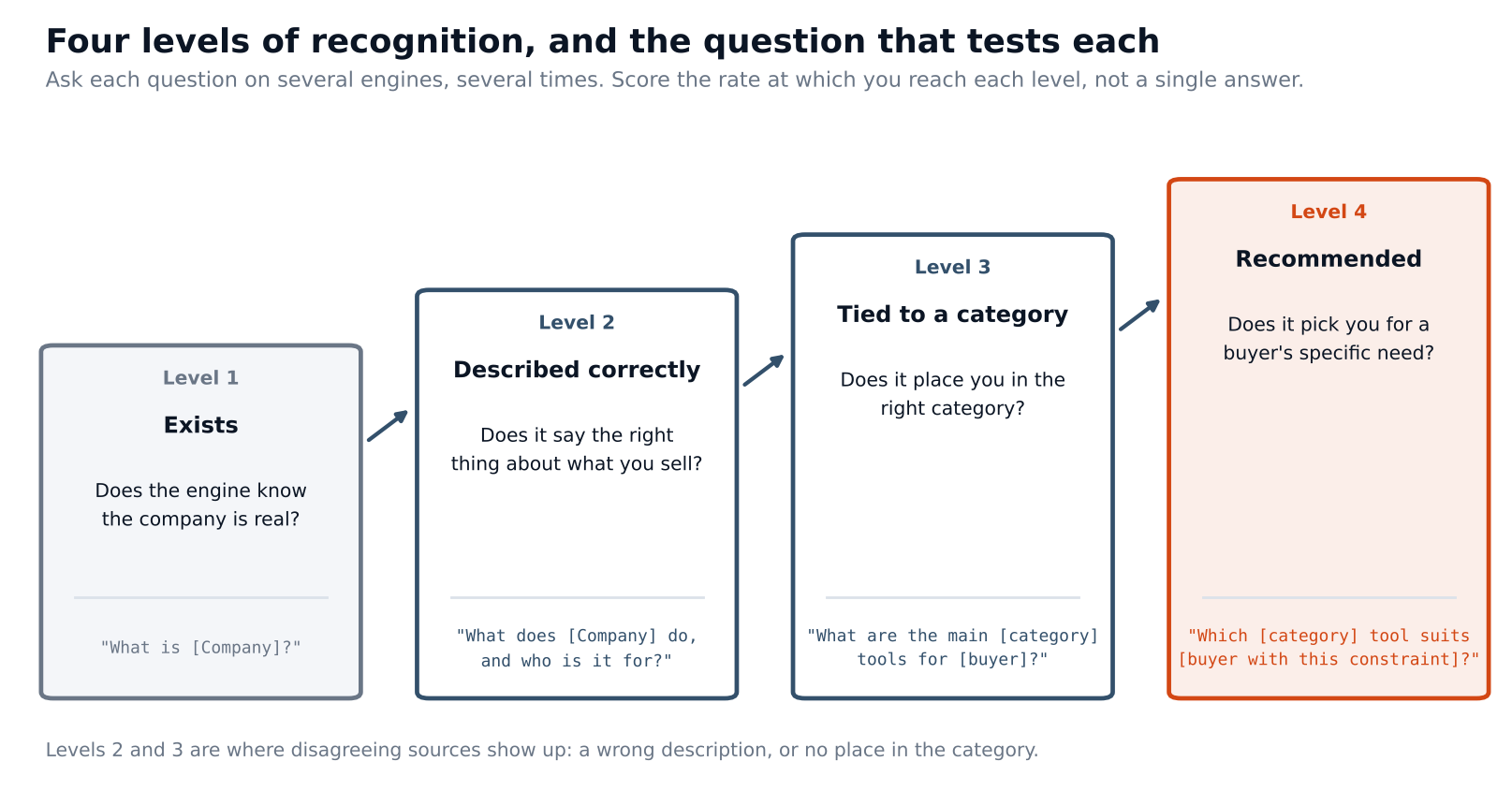
At level one, the engine knows you exist. At level two, it describes you correctly: what you sell, who for, what category. At level three, it ties you to the right category when a buyer asks about the category without naming you. At level four, it recommends you for a specific need. Each level depends on the one below it. If the engine cannot describe you correctly, it will not place you reliably in a category, and if it cannot place you, it will not recommend you.
Run the test on several engines, and run each question more than once. Answers vary from run to run, which we cover in model variability, so a single result tells you little. Record the rate at which each level is reached. Most of the work in this guide is aimed at levels two and three, because that is where disagreeing sources show up as a wrong description or a missing place in the category.
The four layers that build it
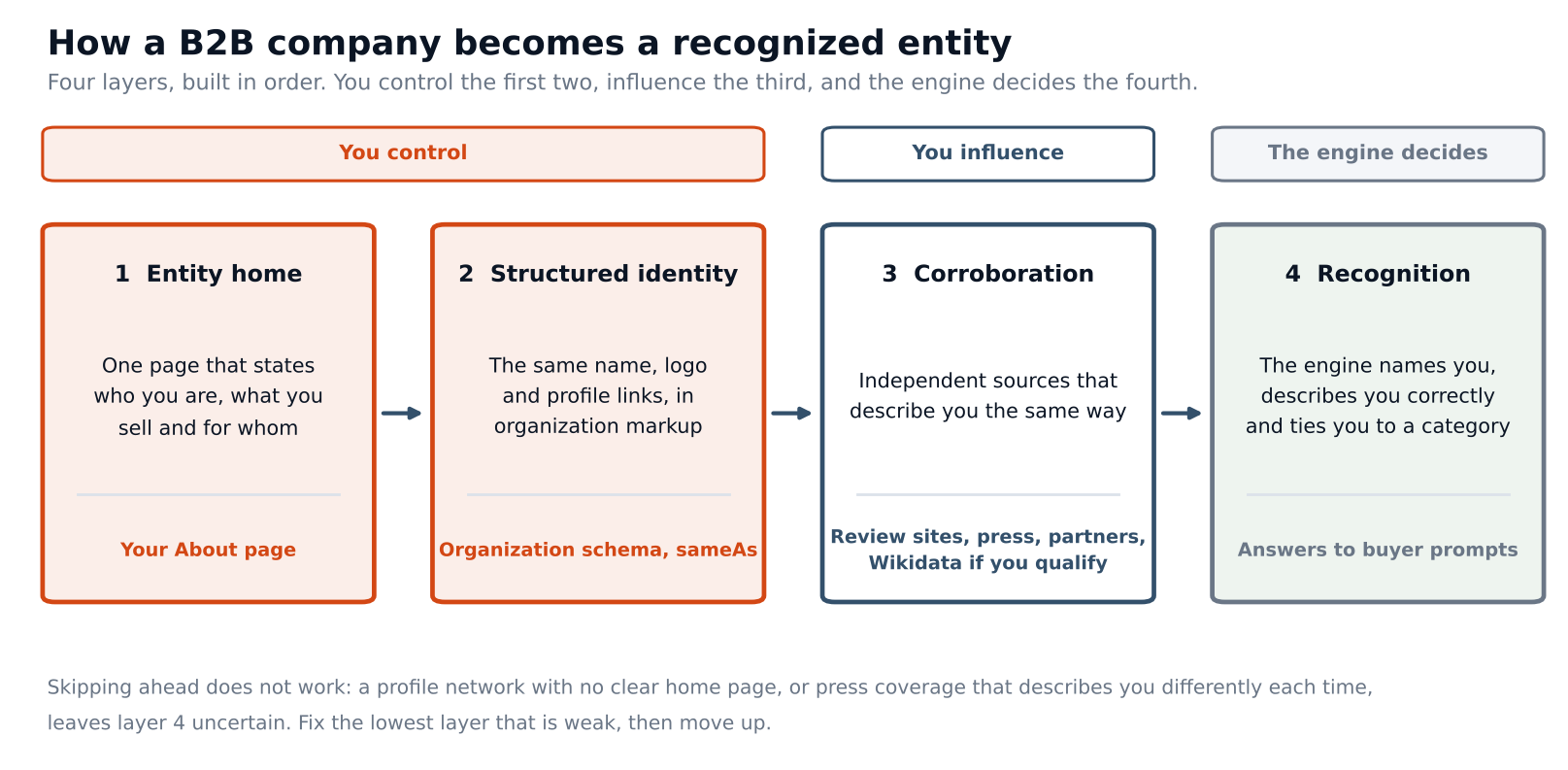
The work falls into four layers, built in order. You control the first two. You influence the third. The engine decides the fourth. The layers are in the order you should fix them, because each one depends on the one before it. The sections that follow take them in turn.
Start with a page that says who you are
The first layer is a single page that states your identity plainly. In the SEO world this is often called the entity home: the page on your own site that every other source can be checked against. For most companies it is the About page, or the homepage if the About page is thin.
It needs to do five jobs. State the full company name as you want it used everywhere. Give a one-sentence description in the form "[Company] is a [category] for [buyer] that [what it does]." Name the people who run it, with roles. Give the facts a reader would check: where you are based, when you were founded, what you sell. And link out to your main profiles, so a reader can confirm they belong to you.
Write that one-sentence description with care, because it becomes the master copy. The aim is not clever copy. It is a sentence an engine can lift and a journalist can paraphrase without changing the meaning. If you cannot write it in one sentence, the engine will not manage it either.
Keep this page crawlable and in the HTML the server sends. If your About page loads its text through a script, a crawler that does not run JavaScript sees an empty page.
Say it the same way everywhere
The second layer is consistency. Take the master description and the exact company name, and check every place the company is described: LinkedIn, Crunchbase and similar company databases, review sites, app marketplace listings, partner directories, conference speaker pages, GitHub or developer documentation if you have them, and the bios of your founders and executives.
You are looking for four kinds of mismatch. The name varies: "Acme", "Acme Inc.", "Acme Software", "Acme Cloud." The category varies: one profile says "marketing platform," another "analytics tool," a third "AI assistant." The description is stale: a profile still describes a product you retired. And the facts conflict: different founding years, different headquarters, different employee ranges.
None of these is a disaster on its own. Together they are what an engine meets when it tries to work out who you are. Fix them in order of how much the source is likely to be read. Your own site and LinkedIn come first, then the review and database listings buyers actually use, then everything else.
Pick one canonical name and one canonical category phrase, and write them down. A shared document that holds the name, the one-sentence description, the short and long descriptions, the logo files and the list of official profile URLs is more valuable than it sounds. It is what stops the next marketing hire from inventing a fourth way to describe the company.
Tell machines which profiles are yours
The third part of the identity work is structured data. Organization markup on your homepage gives a machine the same facts in a form it does not have to interpret: name, URL, logo, description, and a list of links to your official profiles under the sameAs property.
Google's documentation says organization markup can help it understand your organization's administrative details and disambiguate your organization in search results, and it recommends placing it on your homepage or about page and not on every page. It is also plain that Google does not guarantee any feature that uses structured data will appear. Read the Organization markup documentation before you implement it, and treat the markup as hygiene that supports the first layer, not as a lever that creates recognition on its own.
The consistency rules matter more than the markup. The name, logo and URLs in the markup should match what is visible on the page and what your profiles say, and the sameAs list should contain only profiles you actually run. We cover exactly where this code goes, and why it should live in the server-rendered template, in where to add schema markup on your site.
Get described by sources you do not control
The third layer is the one most teams underinvest in, and it is the one that moves recognition furthest. Corroboration means independent sources describing your company in ways that agree with each other and with your own page.
For a B2B company, the sources that matter are the ones buyers and engines already read when they are comparing vendors: review and comparison sites, trade publications, analyst and industry reports, partner and integration directories, podcasts and conference pages, and community discussions. We lay out why engines lean on these for vendor questions in first-party versus third-party citations. If your goal is to be placed in the sources AI engines already cite, Omnibound's approach to AI authority building is built around that work.
Three habits make corroboration agree with your identity. Give every outside writer the same short fact sheet, with the canonical name and description, so their description matches yours. Ask for the category phrase you use. And favor sources that publish a stable page about you, such as a profile or a review listing, over a one-off mention that scrolls out of view.
What about Wikipedia and Wikidata?
Many entity guides treat a Wikipedia page or a Wikidata item as the goal. They are worth understanding, and they are also where teams waste the most effort.
Wikipedia has a notability standard. In practice it expects significant coverage of the subject in reliable sources that are independent of it. A company that has not been written about by independent publishers will not hold a page, and an article written by the company's own staff tends to be removed. If the coverage exists, a page may follow without your involvement. If it does not, the work is to earn the coverage, not to write the page.
Wikidata is a structured database, and its criteria are looser. An item is generally acceptable if it links to a Wikimedia page, or if it describes a clearly identifiable thing that can be backed by serious, publicly available references, or if it fills a structural need for other items. Self-published material, routine directories and company-controlled profiles do not count as those references. Read the Wikidata notability policy before you create anything, because an item that fails the standard can be deleted.
Tie your name to a category
An engine that knows who you are can still fail to place you. Category association is the part of entity work specific to commercial intent: when a buyer asks for the best tools in a category, the engine has to believe you belong there.
Association is built by repetition in independent places. Your canonical category phrase should appear in your own description, in your profile and review listings, in the way partners and press describe you, and in the language of the pages you want cited. A company that calls itself an "AI search visibility platform" in one place and a "content intelligence suite" in another is splitting its own signal. Pick the phrase buyers actually use, which you can find by looking at how they phrase prompts, and use it consistently.
Review sites matter here because their categories are explicit. Being listed in the right category on a review platform is a clean, third-party statement that you belong there. Comparison pages and "alternatives to" pages written by others do the same, and they are worth monitoring for wrong categories as well as for mentions.
Relationships: partners, integrations and customers
An entity is defined partly by what it connects to. For a software company, the connections an engine can read are mostly commercial: the tools you integrate with, the partners who list you, the platforms where you sell, and the customers who are willing to be named.
Each of these is a statement made by someone else. An integration page on a partner's site that names your company and describes the connection in plain words is a stable, independent record that you work with that product and sit in that part of its ecosystem. A marketplace listing does the same. A customer who names you in a case study or on their own site does it with more weight, because it is a claim about real use.
So treat these as entity work and not only as partnership work. When you sign an integration, ask for a listing that uses your canonical name and description. When you list partners on your own site, link to them and describe the relationship precisely, so the connection is visible from both ends. Name customers only with their permission, and keep the descriptions factual. The aim is a web of consistent, specific connections, not a wall of logos.
Name the entity on the page, too
Entity clarity is not only a matter of profiles and markup. It is also a property of how your own pages are written.
Engines read pages to work out what they are about and who is speaking. Copy that says "our platform" and "we help teams" gives them less to work with than copy that says "Meridian is scheduling software for field service teams" and uses the name where the subject changes. Use the full product and company names the first time they appear in a section, avoid pronouns where the antecedent is a page away, and state relationships directly: what the product integrates with, which category it belongs to, who it is built for. A passage that names its subject survives being lifted out of the page, which is the same property we cover in how to structure B2B content for LLMs.
Some tools score how prominent an entity is within a page, using a language analysis service. These can be a useful sanity check that the page is about what you think it is, but the scores are an output of those tools, not a published ranking input for any AI engine, so do not chase a number.
Entity authority and topical authority
The two ideas are often blurred. Entity recognition is about who you are: whether the engine knows the company, describes it correctly and places it in a category. Topical authority is about what you are known for: whether your content covers a subject thoroughly enough that you are treated as a reliable source on it.
They support each other. A recognized entity that publishes deep, original content on a subject becomes associated with that subject, and a site that is clearly about one subject makes the company's category easier to infer. But they fail differently. A company can publish excellent content and still be described wrongly, because its profiles and coverage disagree. A company can have a clear identity and no depth, so it is known but not cited. Diagnose which one you have before deciding where to spend effort.
When your name is shared with something else
B2B names collide often. A company can share a name with another company, a common word, a product, or a person. The engine's model of the name can blend them, and what surfaces is a blend: the wrong headquarters, the wrong product, a competitor's feature.
The fix is disambiguation, written into every description. Pair the name with the category and the buyer every time: not "Meridian," but "Meridian, a scheduling platform for field service teams." Use the full legal or formal name in markup and profiles. Link your profiles to each other. And check the engine's answer for your name alone, since a collision shows up there first.
Products and people are entities too. If a product has its own name, it deserves its own page and consistent description, with the parent company named. Founders and executives are entities that engines connect to the company, so their bios should match the company description, their roles should be current, and each should have a stable page of their own. A real, named author on your articles who has a real profile page does more for identity than an unsigned byline, as we note in our guide on what makes AI cite a webpage.
A worked example
Say you run marketing for a company called Meridian, which sells scheduling software to field service teams. You run the four-level test and find the following. Asked what Meridian is, three engines describe a hospitality scheduling product. Asked for the main tools in your category, none of them name you. One engine, asked who founded the company, names someone you have never heard of.
You then audit the descriptions. Your site calls Meridian a "workforce platform." LinkedIn says "scheduling and dispatch software." Your review listing is under a general business category. A press piece from last year describes the product you sold two years ago. A different company, in hospitality, has the same name and a much older web presence.
The plan follows from the findings. You write one description: "Meridian is scheduling and dispatch software for field service teams." You put it on the About page, with founders' names and roles. You align LinkedIn, the review listing, the app marketplace page and the founder bios to it, and move the review listing to the right category. You add organization markup to the homepage with the profile links. You write a one-page fact sheet and send it to the two publications that cover your space, and to partners who list you. And you make sure every description pairs the name with the category, to separate you from the hospitality company.
None of this is complicated. What it replaces is a pattern of accidents with a decision. After a few weeks you rerun the test and look at whether level two moved first, since that is the quickest to shift.
Measuring recognition
Entity work is measurable without special tools. Use the four-level questions as a fixed set, run them on the engines your buyers use, and repeat each several times over a few weeks. Record two things for each run: whether you were named, and whether the description was right. Report the rate across runs, not the result of any one.
Track accuracy as well as presence. A mention with the wrong category is a problem, and counting it as a win hides it. Keep a short log of the specific errors you find, such as a wrong category, an old product, or a wrong founder, so each fix can be matched to a source you can change.
A knowledge panel in Google is a visible sign, but it is not the goal and it is not required. Plenty of companies that engines describe well have no panel, and a panel does not guarantee citations. Measure what the engines say, not a feature.
Tactics that waste time
A few popular tactics deserve skepticism. Entity stacking, which means creating dozens of thin profiles on sites with no independent standing, adds noise and no corroboration. Schema alone does not create recognition; it describes what your pages and profiles should already say. Buying or writing a Wikipedia page for yourself invites removal.
Rewriting the About page with keywords produces the opposite of a clear sentence. And chasing a knowledge panel as an end in itself is optimizing for a display feature when the target is what engines say about you.
The pattern in all of these is the same. They try to produce the appearance of recognition without the independent agreement that makes it real.
Questions people ask
What is the difference between entity SEO and branded search?
Branded search is people searching your name, which we cover in what is branded search. Entity work is making sure that when they do, and when an engine answers a question about you, it knows who you are. Ahrefs found branded search volume also correlates with AI mentions, though less strongly than web mentions, but they are different things.
Do I need a Wikipedia page?
No. Most B2B companies do not have one and are still recognized. If independent coverage builds up, a page may follow.
Is organization schema enough?
No. It describes your identity, but recognition depends on the sources that agree with it.
How long does it take?
There is no reliable timeline. Fixing your own site and profiles can be done in weeks, and engines pick up changes at different speeds. Corroboration builds over months.
Does this help in Google as well as AI engines?
The same work helps both. Clear entities are how Google has modelled the web for years, and AI engines draw on much of the same information.
Should I track my own brand in AI answers?
Yes, using a fixed set of questions run repeatedly, as described above.
A first thirty days
You do not need a large program to start. In the first week, run the four-level test and write down every wrong or missing answer. In the second, write the canonical name, the one-sentence description and the category phrase, and put them on your About page. In the third, align your own profiles and the review and database listings to it, and add organization markup to the homepage. In the fourth, write the fact sheet, send it to the sources that matter, and set the monthly retest.
To see where you stand today, our AI Search Visibility Checker gives you a first read on how engines treat your brand. And to follow whether recognition is improving over time, rather than relying on spot checks, Omnibound's AI Search Intelligence tracks how often and how accurately you appear across engines.