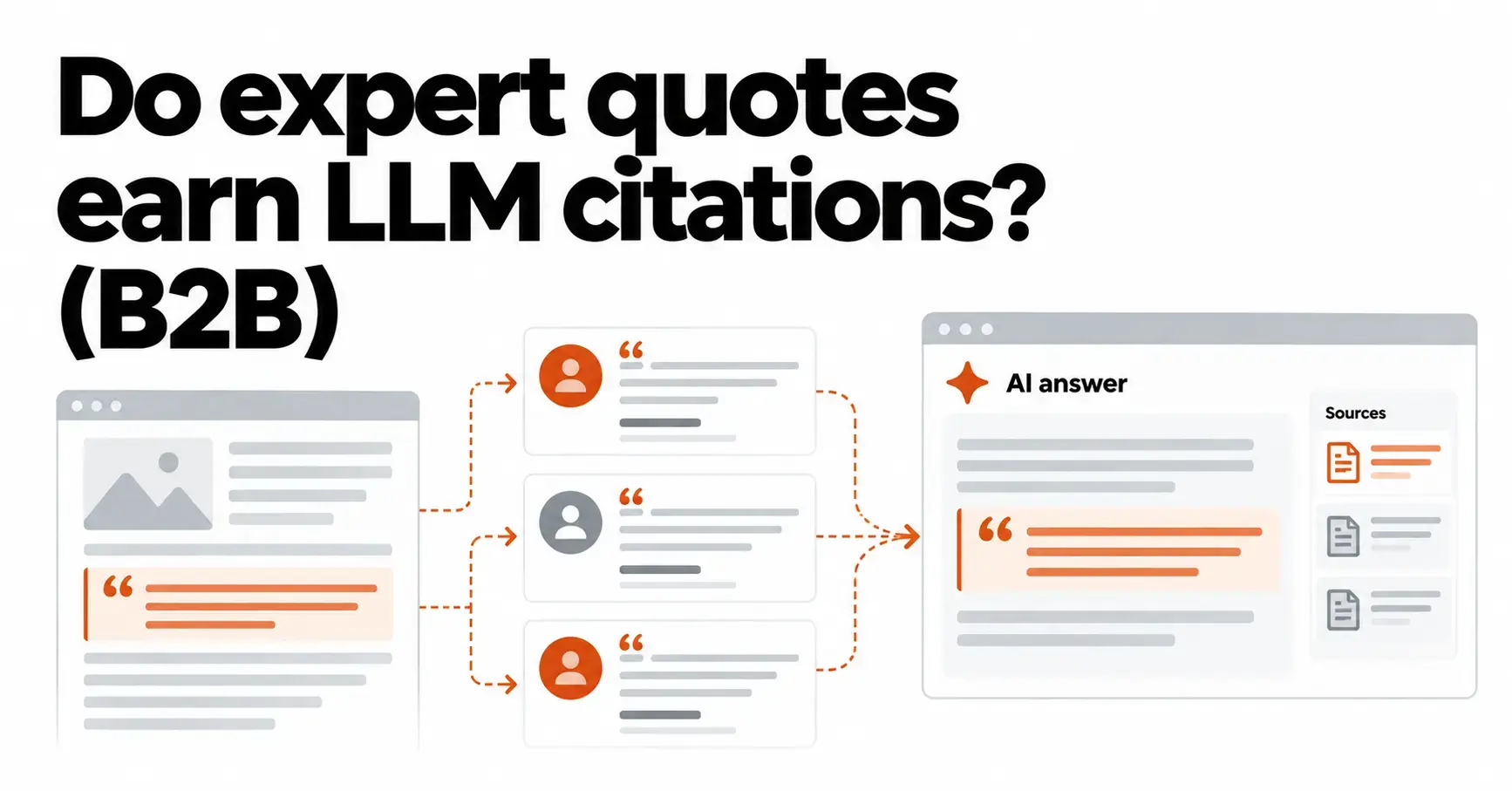


Do expert quotes earn LLM citations? There is real evidence that they help, and there is a lot of invented precision stacked on top of that evidence. One controlled study found that adding quotations to a page raised its visibility in generated answers. Dozens of articles then turned that single result into platform-by-platform multipliers that no one can trace to a source.
This guide separates the two. It covers what the research measured, what it left out, and the two different things people mean by "expert quote." It then gets practical for B2B: whose quotes to use, how to collect them without inventing anything, what a quote needs to look like to be worth lifting into an answer, and how to test the effect on your own pages. If you need the basics first, start with what AI citations are. This piece assumes you already know the difference between being cited and being mentioned.
What the research actually measured
The study behind nearly every claim about quotes is the 2023 paper GEO: Generative Engine Optimization from researchers at Princeton, Georgia Tech, the Allen Institute for AI, and IIT Delhi. The team built a benchmark of search queries and tested nine ways of rewriting a web page to see whether the rewritten version showed up more in a generated answer.
Three of the nine methods mattered most. Quotation addition added quotations from credible sources to the text. Statistics addition replaced vague statements with numbers. Cite sources added references to named sources. The same test also included keyword stuffing, which is the old habit of repeating the query terms, and it did not help. In some conditions it made visibility worse.
Quotation addition was among the strongest performers. In the paper's main setup, it lifted a position-weighted visibility score by roughly 40 percent at best, ahead of or close to the other two. On a smaller sample run through Perplexity, the gain was about a fifth. The paper also reported that lower-ranked sources gained the most, while the pages already at the top gained little or lost ground.
The benefit also varied by topic. The authors reported that quotations helped most for question types built around people, explanations and history, where a personal account or a named voice carries real weight. Read that as a hint, not a rule: for a B2B site it points toward putting quotes on explanatory and decision pages, such as why a process works or what trade-offs a buyer faces, and expecting less from a spec sheet.
So the direction is clear. In a test where a generated answer drew on a handful of pages, pages that carried quotations, numbers and named sources were used more than pages that did not. That is worth acting on. The size of the effect is where people go wrong.
What the research did not measure
The first is the setup. The main test fed the engine the top five Google results for each query and asked a language model to write an answer. That is a small, zero-sum contest, which makes relative gains look large. A real engine draws on far more candidates, and your page competes with all of them.
The second is who wrote the quotes. The rewritten pages were produced by a language model, so the test shows what a quote-shaped passage does to visibility. It does not show what a named human expert does. Those are related but not the same thing.
The third is age. The paper reflects engines as they worked in 2023 and 2024, and the authors say the methods may need to change as engines change. The fourth is that a headline figure is an upper bound for one metric in one benchmark, not an average effect you should plan around.
This is also where the circulating multipliers fall apart. In the pages we reviewed, claims like "quoted content is several times more likely to be cited on one engine than another" came with no source and no method. Treat any multiplier you cannot trace to a study the way you would treat an unattributed quote: as decoration. It is also worth checking the figures that are attributed to the paper, because a few popular summaries mix up which method produced which number.
Two routes for a quote to matter
"Expert quote" gets used for two different tactics, and they have different evidence behind them.
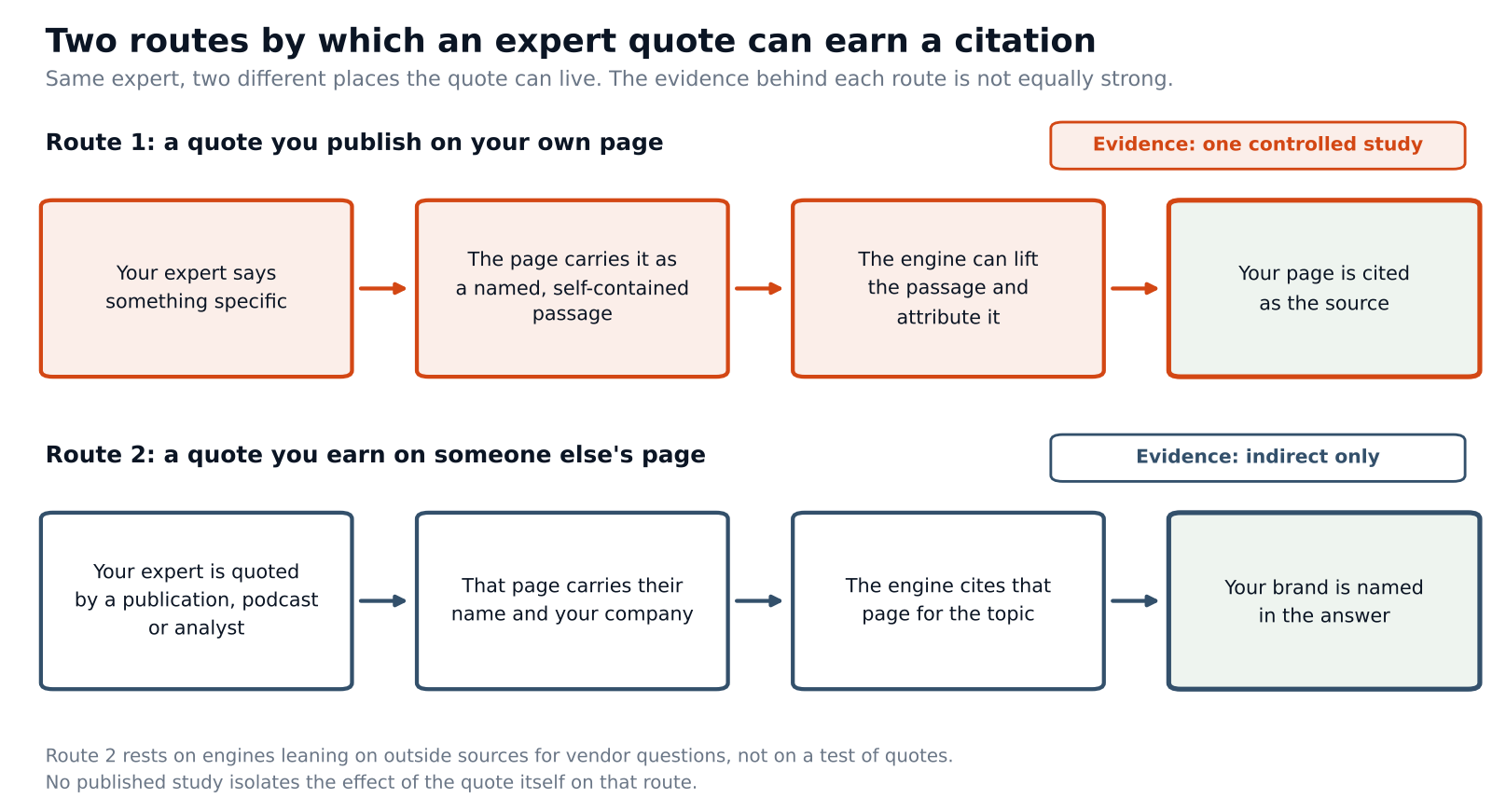
The first route is a quote you publish on your own page. Your expert says something specific, your page carries it as a named, self-contained passage, and an engine can lift that passage and attribute it. This is the route the research touches, and it is the one you control completely.
The second route is a quote you earn on someone else's page: your expert quoted in a trade publication, on a podcast page, in an analyst note, or in a roundup. Here the cited page belongs to the third party, and the benefit to you is that your name and company travel with it. No study isolates the quote itself on this route. It rests on a broader pattern: for questions about vendors and categories, engines lean on outside sources. We lay out that argument in first-party versus third-party citations.
Most B2B teams should run both. Route one is cheap and fast. Route two is slower and depends on someone else's editorial choice, but it puts you in the sources the engines already trust.
Why a quote might help, and what is guesswork
Nobody outside the engine builders can say why the quotation result held. Here is the reasoning that fits the evidence, labelled for what it is: inference.
A quote tends to make a passage more specific. A generic sentence can come from anywhere, while a sentence tied to a person and a claim is harder to substitute. A quote also gives the engine something to attribute. "According to [Name], head of [function] at [Company]" is a statement an engine can credit and a reader can verify, and named expertise already appears among the trust signals in our guide to what makes AI cite a webpage. And a good quote is short and self-contained, which is exactly the shape that survives being split into passages. We cover that mechanism in how LLMs chunk B2B content.
Notice what is missing from that list: the quote itself as a magic ingredient. If a quote helps, it probably helps because it makes a page more specific, attributable and extractable. A quote that does none of those things should not be expected to do anything.
What a quote worth lifting looks like
This is the part you can change today, and it is where most pages with quotes still fall short.
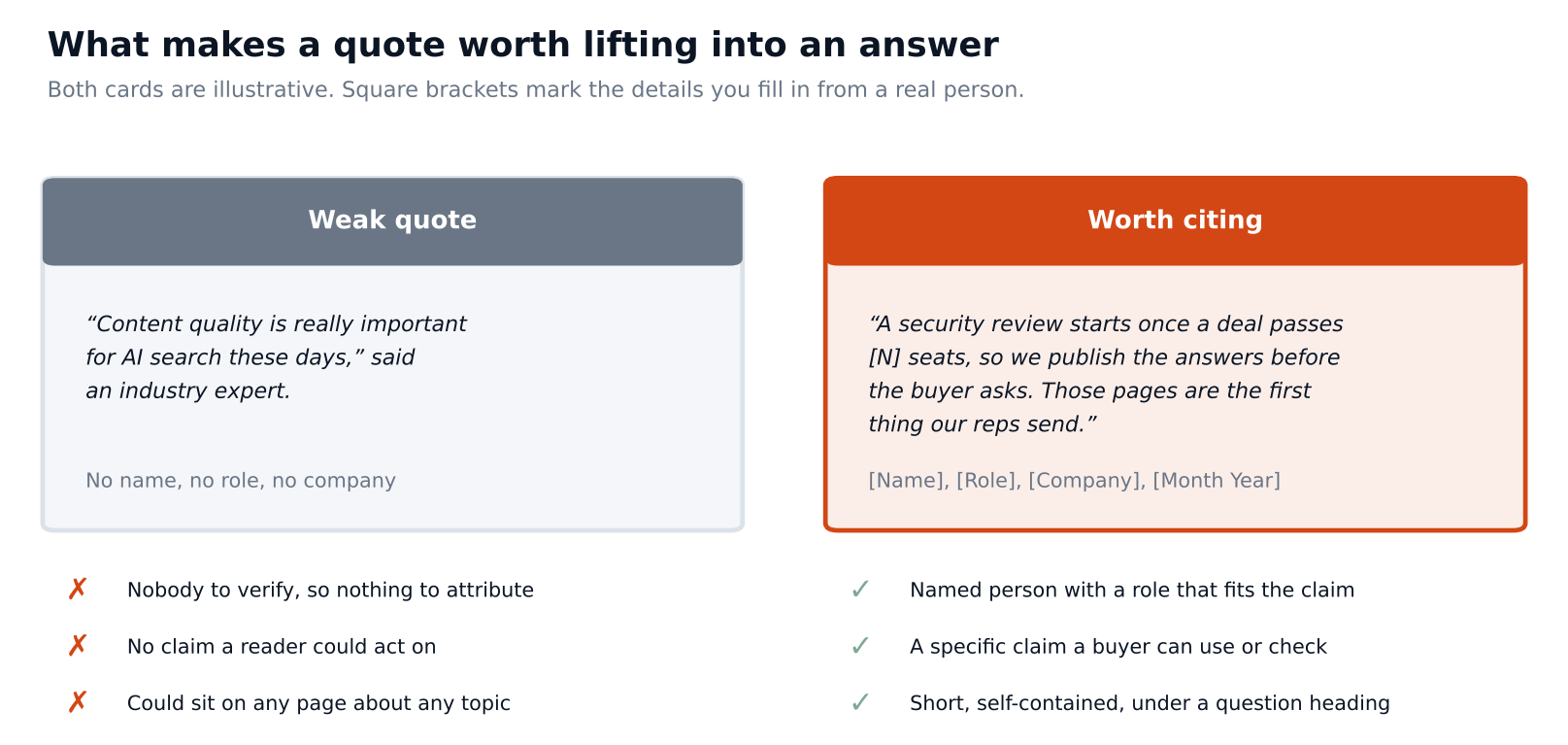
A quote worth lifting has four qualities. It names a real person with a role that fits the claim, so a security lead quotes on security reviews and not on content strategy. It makes a specific claim a buyer can use or check, such as a threshold, a sequence or a trade-off, and not a statement that would be true of any topic. It runs one to three sentences and stands on its own, so it still makes sense when lifted out of the page. And it sits under a heading that asks the question it answers, so the passage and its question travel together.
The weak version is the one you have seen a thousand times: "Content quality is really important for AI search these days," said an industry expert. No name, no role, no claim. An engine has nothing to attribute and a reader has nothing to verify.
Two small habits help. Write a one-line lead-in that states the point in your own words, then give the quote as support. And keep the attribution as plain text in the same sentence or the line right under the quote. A decorative pull quote rendered as an image, or in a slider that only loads with JavaScript, may never reach a crawler that does not run scripts. We cover why in can AI crawlers render your JavaScript.
One page, before and after
Take a hypothetical page titled "How to prepare for a security review." The first version opens with a definition, lists six steps, and ends with a checklist. It is accurate and could have been written by anyone, including a model.
The revised version keeps the same steps but changes three things. Under the heading "When does a security review start?" it adds a two-sentence quote from the company's head of security, naming the deal size or seat count that usually triggers the review. Under "What do buyers get wrong?" it adds one line from an implementation lead about the document most teams forget to prepare. And near the end it adds a short customer quote, approved in writing, about what the review looked like from the buyer's side.
Nothing about the topic changed. What changed is that three passages now carry a named source, a specific claim and a question that frames them. Each can be lifted without the rest of the page, and each is something a competitor's page cannot copy, because it came from your people. That is the real test of whether a quote is earning its place: remove the name and the claim should still be worth reading.
Whose quotes to use in B2B
Generic advice says "quote an expert," which in B2B usually turns into quoting someone famous who has never heard of your product. That is rarely the best choice. Four kinds of voice work better, and each suits a different page.
Your own practitioners are the most underused. The person who runs implementations, handles security questionnaires or sits on renewal calls knows things a model cannot guess, and a named quote from them turns a generic how-to into a page nobody else could have written. If you are building pages specifically to be cited, this is the raw material behind citation-worthy content: inputs a model does not already have.
Customers are the second source, and the one that needs the most care. A customer's description of how they evaluate or deploy something is valuable on comparison and use-case pages. It needs their written approval, a current role and employer, and no numbers you cannot back. If a result is part of the quote, express it the way you would anywhere else: as a percentage you can verify, not an invented figure.
Analysts and researchers are the third. A short, accurate excerpt with a link to the source works well on category and definition pages. Keep the excerpt brief, quote it exactly, and check the publisher's terms before reproducing more than a sentence or two. Partners and adjacent practitioners are the fourth: people who know the buyer's problem from another angle, such as a systems integrator or a procurement lead. Match the quote to the page type. Practitioner and customer voices fit pages where a buyer is deciding. Analyst and academic voices fit pages that define or explain
How to collect quotes without inventing them
Run a fifteen-minute interview, not an email request. Ask three questions: what do buyers get wrong about this topic, what would you tell a team starting out, and what did you see happen that surprised you. The answers to the second and third are usually quotable. Short answers to vague emailed questions usually are not.
Mine what you already have. Recorded webinars, internal enablement sessions and customer calls hold plenty of specific statements. Use them only with the speaker's consent, and send the exact wording back for approval before you publish.
Keep a log. For each quote, record the person, the role and employer at the time, the date, the page it appears on, and who approved the wording. When someone changes jobs, the log tells you which pages carry a stale title. This is dull work, and it is also what keeps a quote library trustworthy as it grows. If your team's call and conversation data already lives in a shared context layer, that is the best place to start looking.
One firm rule: a quote is something a person said. Do not have a model write a quote and attach a name to it, and do not "tidy" a quote past what the speaker approved. Beyond the ethics, a fabricated or misattributed quote is the kind of thing that gets screenshotted and corrected publicly.
Ways quotes backfire
The first is vague attribution. "Experts say" and "industry leaders agree" give an engine nothing to attribute and a reader nothing to check. The second is quote stuffing, where every paragraph gets a pull quote and none of them add a claim. The third is the quote with no claim, a pleasant sentiment that could be pasted into any article. T
he fourth is the quote with no context, dropped in without saying who the person is or why they would know. The fifth is the stale quote, with an old job title or a statement that was true two years ago. The sixth is the fabricated or AI-written quote described above, which carries the biggest risk of all. Notice that none of these are formatting errors. Blockquote tags, quotation marks and schema do not fix a quote with nothing in it.
Testing it on your own pages
Because the research is a benchmark and not your site, the honest answer to "will quotes help my pages?" is a test. Keep it small and fair.
Choose pairs of pages that are as similar as possible in topic, type and age. Add two or three well-formed quotes to one page in each pair and leave the other alone. Keep every other change off both pages for the test window. Track a fixed set of prompts that your buyers would ask, and record whether each page is cited.
Then respect the noise. AI answers vary from run to run and across engines, which we cover in model variability. A single check proves nothing. Run each prompt repeatedly over several weeks and compare citation rates, not individual outcomes. If the quoted pages are cited more often across the window, you have a result for your site. If they are not, you have also learned something, and you have saved yourself from rewriting a whole library on the strength of a paper's upper bound.
Questions people ask
Do quotes need to be in blockquote tags?
There is no evidence that engines require it. Blockquote markup helps human readers, and a plain attributed sentence is fine. What matters is that the quote and its attribution are in the HTML the server sends.
Should I link to the expert's profile?
It helps verification. A link to their author page or professional profile gives both readers and engines a way to confirm who they are.
How many quotes should a page have?
No tested number exists. One to three where a claim needs support is a sensible starting point. More than that and each one carries less weight.
Does a customer quote count as an expert quote?
If they are describing something they know firsthand, yes. Treat it as a practitioner voice, and get written approval.
Can I use a quote from a published article?
A short excerpt with a link and a clear attribution is standard practice. Quote it exactly and keep it brief.
Will adding quotes get me cited?
Not on its own. The research suggests they can help a page that is already a candidate. They cannot rescue a page that is hard to reach, off-topic or thin.
Start with three quotes and one test
You can try this in a week without rebuilding anything. Pick three pages that already rank or get crawled but are rarely cited. Interview one practitioner per page for fifteen minutes. Add one or two named, specific quotes under the questions they answer. Log who approved each one, then recheck your fixed prompts over the next few weeks.
Before you start, it helps to know where those pages stand today. Our AI Search Visibility Checker gives you a starting read. Once the quotes are live, Omnibound's AI Search Intelligence tracks whether those pages begin to appear in answers across engines, so you are comparing before and after instead of guessing.
.webp?height=245&name=Where%20to%20Add%20Schema%20Markup%20on%20Your%20Site%20(B2B%20Page-by-Page%20Guide).webp)