




Internal Linking for AI Search: A B2B Guide
Internal linking is one of the oldest moves in SEO, and most guides still explain it the way they did a decade ago: links pass authority between your pages and help Google crawl your site. That is still true, but it is no longer the whole story. AI search engines read your internal links for something extra, and getting that part right is now one of the higher-return, lower-effort things a B2B content team can do. This guide covers what internal links actually do for AI search, where B2B sites go wrong, and how to build a linking structure that helps engines find, understand, and cite your pages.
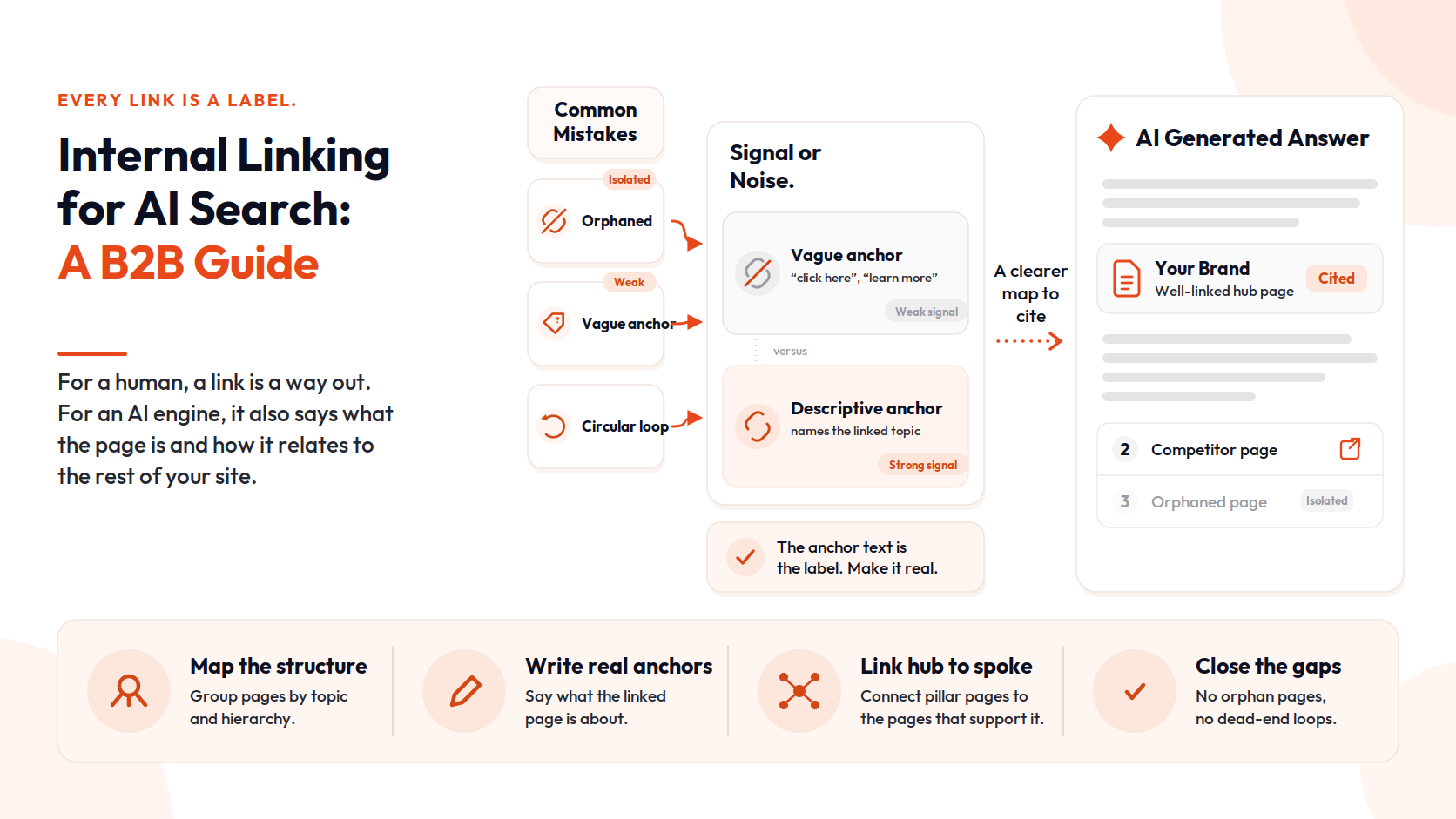
The short framing to hold onto: for a human, an internal link is a way to get somewhere else. For an AI engine, it is also a statement about what a page is and how it relates to the rest of your site. Every link you place is a small signal, and most B2B sites are either wasting those signals or sending them in circles. This piece follows on from how to structure content within a page for LLMs; this is the between-page counterpart.
What internal links do for AI search
An internal link does three jobs for an AI engine, and they build on each other. The first is discovery. Search crawlers, including the crawlers that feed AI answer engines, follow links to find and re-crawl pages. A page with no internal links pointing to it, an orphan, is hard to find and easy to miss, which means it is effectively invisible as a citation source no matter how good it is. Links are how your pages get into the pool an engine can draw from in the first place.
The second is relatedness. When an engine sees a link from one page to another, with a descriptive anchor and surrounding context, it learns that the two pages are related and how. That is how it starts to understand your site as a set of connected topics rather than a pile of unrelated URLs. Your linking is, in effect, a map of what you cover and how the pieces fit.
The third is topical authority. When a cluster of your pages links together around a central page, the engine can tell that the central page is your main resource on that topic, supported by the others. That is the signal that makes an engine treat you as a source worth citing on a subject, rather than as one page that happened to mention it once.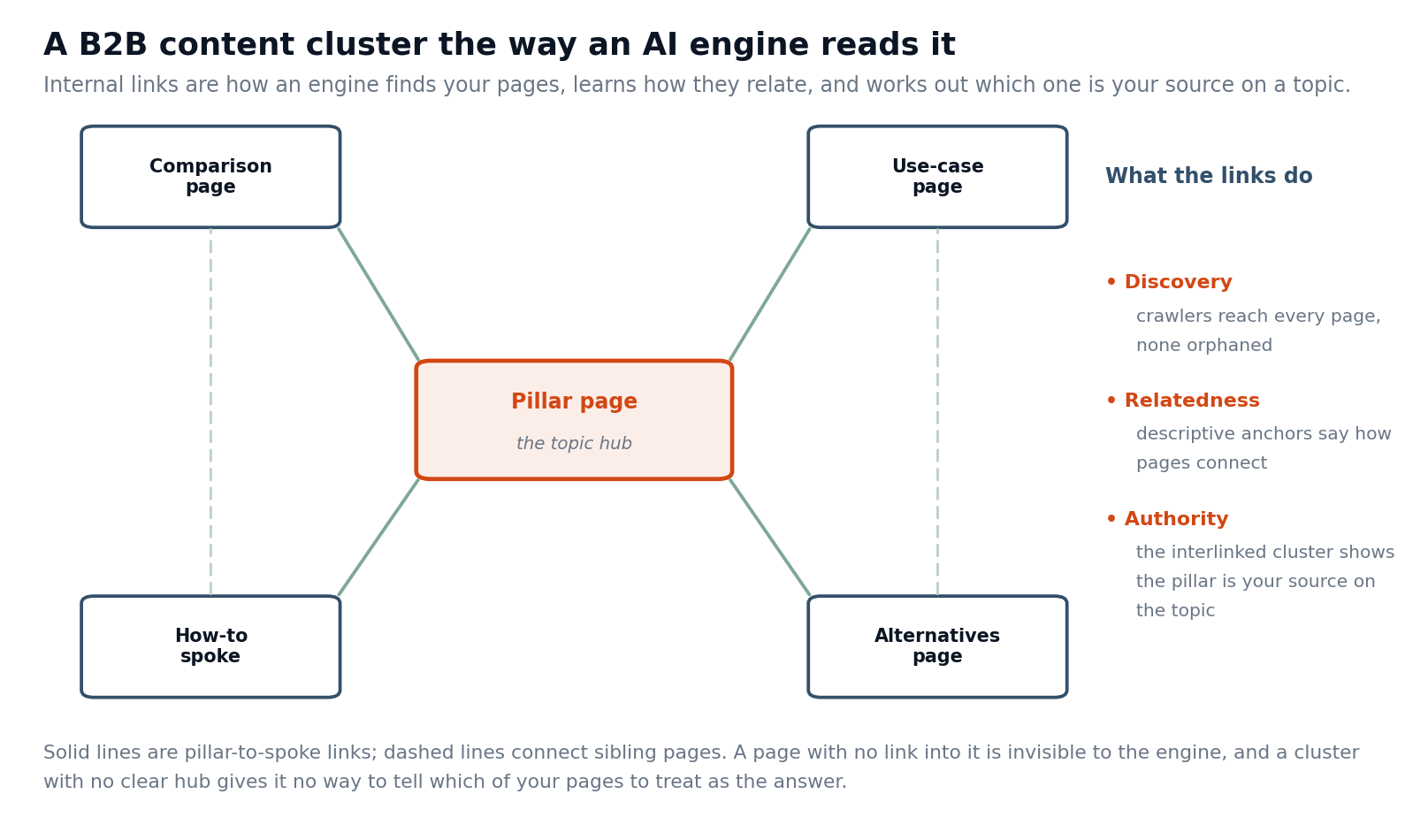
Internal links do three jobs at once for an engine: they let it find every page, tell it how the pages relate, and show it which page is your source on the topic.
How this differs from classic internal linking
The mechanics look similar, but two things change in AI search, and both matter for how you link. The first is that AI engines work at the passage level. Rather than reading a page top to bottom, they pull the specific passage that answers a question and often land a reader directly on that section. This has a direct consequence for linking: a link is most useful when it sits inside the relevant content, with an anchor that describes the destination, because the engine reads that link as context for the passage around it. A pile of links stuffed into a footer or a generic "related posts" box still helps crawlers find pages, but it carries far less meaning about what any single passage is about.
The second is that the payoff has shifted from ranking position to being the cited source. In classic SEO, internal links helped a page climb the results. In AI search, they help an engine decide which of your pages is the authoritative answer to attribute. That reframes the goal of a linking strategy: you are not just spreading authority around, you are concentrating it on the specific pages you most want to be cited.
Build the cluster, not a pile of links
The structure that communicates all of this is the topic cluster: a central pillar page that covers a subject broadly, surrounded by spoke pages that each go deep on one part of it, all linked together. For a B2B site the spokes are usually your highest-intent pages: comparison pages, alternatives pages, use-case pages, and the how-to and explainer content that supports them.
Link the pillar to each spoke and each spoke back to the pillar, so the hub is unambiguous. Then link siblings to each other where it genuinely helps, a comparison page to the relevant use-case page, for instance, so the engine sees the cluster as a connected whole rather than a wheel with no rim. The goal is that any page an engine lands on has a clear path to the rest of the cluster, and the cluster has a clear center. Done well, this is also how you tell an engine which page to treat as your definitive answer on a buying question, which is exactly where B2B pipeline forms.
Anchor text is the signal, so use it
The anchor text, the visible words you link from, is the single clearest thing you control about what a link means. An engine reads it as a short description of the destination, so vague anchors throw away the signal. "Click here" and "learn more" tell an engine nothing. Exact-match keyword anchors repeated on every link look manipulative and flatten the meaning.
The useful middle is a descriptive, entity-rich anchor that names what the destination is about in natural language: linking to your structure guide with the words "how to structure B2B content for LLMs" tells both the reader and the engine precisely what they will find. Vary the anchor naturally across links to the same page rather than repeating one phrase, and let the anchor name the actual entity, product, or concept on the destination page.
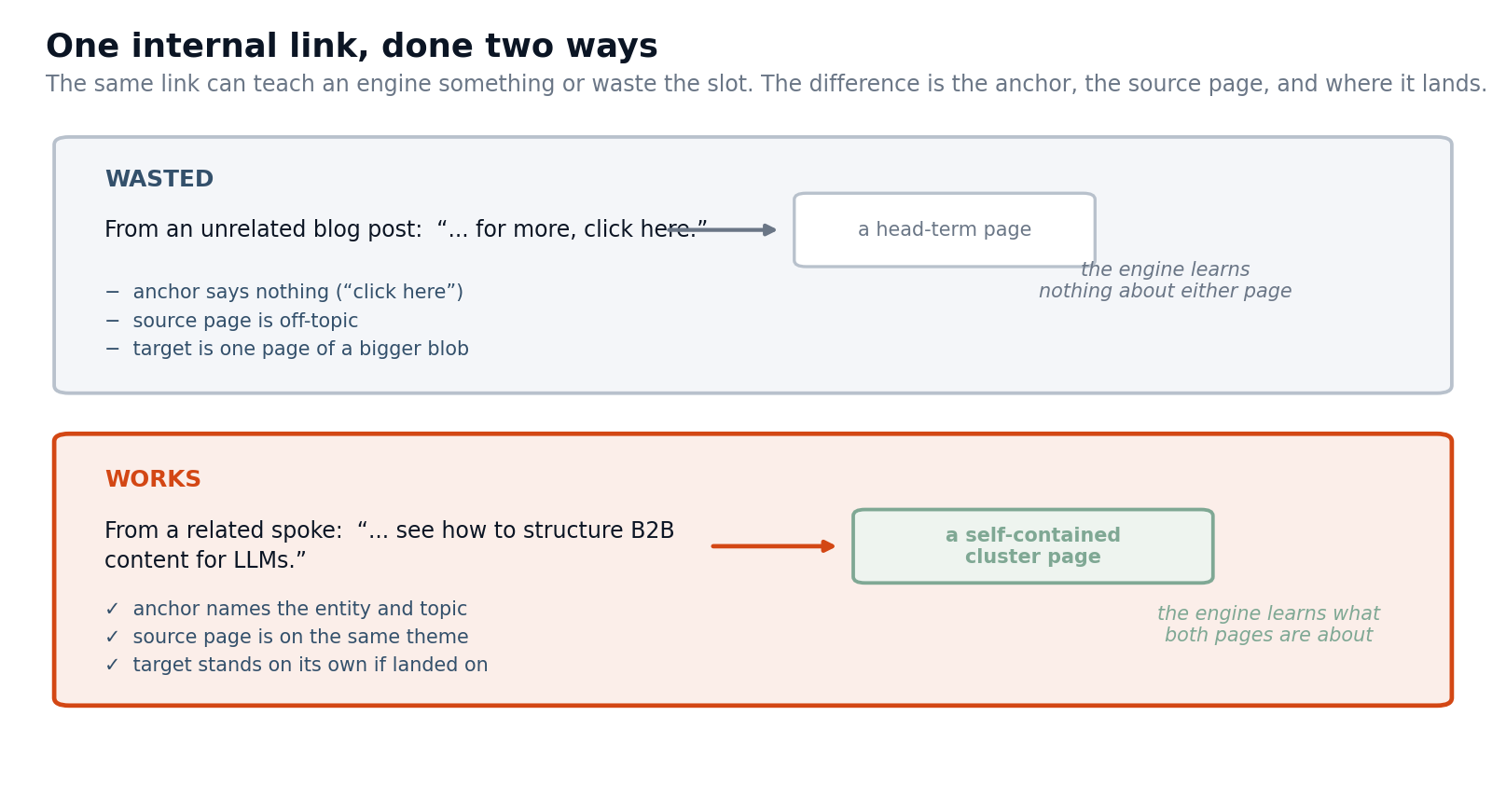
The same link can teach an engine what two pages are about or waste the slot entirely. The difference is the anchor, whether the source page is on-topic, and whether the destination stands on its own.
How many links, and where they belong
The question every team asks is how many internal links a page should have, and there is no magic number. The useful rule is that every link should be there for a reason, so the count follows from the content: a thorough pillar page naturally links to many spokes, a short post links to a few. Adding links to hit a quota produces the muddy, meaningless links described above; adding them where a genuine relationship exists produces a clean map. If a link would not help a reader or clarify a relationship for an engine, it should not be there.
Placement matters as much as count. A link inside the body copy, next to the claim it relates to, carries the most meaning for AI search, because the engine reads it as context for that passage. The same page linked only from a footer or a generic "related articles" strip still gets found by crawlers, but the link says little about what any specific passage is about. So put your most important internal links in the flowing text where they are relevant, and treat navigational and footer links as a discovery backstop rather than the main event. Internal links are the counterpart to outbound links, which work as a modest trust and verifiability signal; the difference is that internal links are entirely within your control, so they are worth getting right first.
Link from your strongest pages
Not every page on your site carries the same weight, and you can use that. Your homepage, your most-visited blog posts, and the pages that already earn links and citations have authority you can pass along by linking from them to the pages you want an engine to treat as sources. A new comparison page linked only from other new, low-traffic pages is starting cold; the same page linked from a popular guide that already ranks and gets cited inherits some of that standing.
So when you decide what to link to a priority page, start with your strongest existing pages rather than only your newest ones. This matters most for the high-intent B2B pages, comparison, alternatives, and product, that tend to be created in isolation and left disconnected from the content that already has an audience. Pointing your best pages at them is one of the fastest ways to get them into the pool an engine draws from. The same discipline keeps large sets of programmatically generated pages from becoming orphaned islands: a page at scale still needs a real link into it from a page that matters.
Keep every linked page self-contained
Because engines retrieve and land on individual pages and passages, a page cannot rely on the reader having come through the pillar first. Each page in the cluster has to make sense on its own: define its own terms, state its own key answer near the top, and not depend on context that only exists two clicks away. The links give the engine the relationship between pages; the page itself has to carry the substance.
This is where within-page structure and between-page linking meet. A well-linked cluster of self-contained pages is far more citable than either a tightly linked set of pages that only make sense in sequence, or a collection of strong standalone pages with no links connecting them. You need both: pages that stand alone, and links that tell the engine how they fit together.
Where B2B sites get internal linking wrong
Most of the value here comes from fixing what is broken, because the common failure modes are consistent across B2B sites. Orphaned money pages are the most costly. Comparison and product pages often get created outside the blog and end up with few or no internal links pointing to them, so the exact pages you most want cited are the hardest for an engine to find. Generic anchors are the most widespread: sites link with "click here" or the same head term over and over, wasting the relatedness signal on every link.
Circular linking is subtler: pages that link back and forth without any of them resolving to a clear answer or a next step, so the engine loops without learning which page is the destination. Competing hubs cause the same confusion at cluster level, when three pages all try to be the main page on one topic and none of them clearly wins. And quota-driven linking, adding a fixed number of links per post to hit a checklist, produces links that point wherever, teaching the engine nothing and sometimes actively muddying your topic map. Notice that most of these are not about too few links. They are about links that carry no meaning. Volume is not the goal; clarity is.
Run a simple internal-linking audit
You do not need a heavy process to catch the big problems. Start by finding your orphans: the important pages, especially comparison, alternatives, and product pages, that have few or no internal links pointing to them, and add links to them from relevant, higher-traffic pages. Next, look at your anchors: search your own site for "click here" and "learn more" and rewrite those into descriptive anchors. Then check each key topic for a clear hub: if several pages compete to be the main resource, pick one as the pillar and point the others at it.
Finally, confirm your highest-value pages are being linked to from the places a reader and an engine would expect, not stranded off to the side. Prioritize the pages that matter most to pipeline. A single comparison page that suddenly gets clear internal links from your relevant blog content, with descriptive anchors, from a coherent cluster, is a bigger win than tidying up links between low-intent posts.
A worked example
Picture a B2B software company with a comparison page, "Us versus a named competitor," that quietly earns demo requests but sits almost disconnected from the rest of the site. It was built by the product team, lives outside the blog, and the only links to it are from the main navigation. On the blog, meanwhile, a dozen posts discuss the same problem the product solves, none of them linking to that comparison page, and several linking to each other with anchors like "read more."
The fix takes an afternoon and changes what an engine can do with the page. First, add in-body links to the comparison page from the three or four highest-traffic blog posts on the relevant topic, using descriptive anchors that name the comparison rather than "read more." Second, make the topic's pillar page link to the comparison page as one of its spokes, and have the comparison page link back to the pillar and to the most relevant use-case page.
Third, rewrite the vague blog-to-blog anchors so each says what it points to. Nothing about the comparison page's own content changed, but it went from an orphan the engine could barely place to a clearly-supported node in a cluster about that buying decision, linked from pages that already have an audience. That is the difference between a page that exists and a page an engine can confidently cite.
Measure whether it worked
The point of all this is to get your best pages cited, so measure that, not link counts. After you concentrate internal links on a page you want to be the source for a topic, watch whether it actually starts getting cited in AI answers for the questions it targets. If it does, you have confirmation that the structure is doing its job; if it does not, the issue is usually either the page itself, it is not self-contained or specific enough to cite, or the cluster, the engine still cannot tell it is your main resource. You can track how often your pages are cited across engines over time and use that to tell which linking changes are paying off, the same way you would measure any other content investment. This is also why internal links belong alongside the other on-page signals that make a page citable rather than being treated as a separate technical chore.
Give every link a job
Internal linking for AI search is not a bigger version of the old checklist. It is the difference between a site an engine can read as a set of connected, authoritative topics and one it reads as scattered pages. Make each link earn its place: point it at a page you want found, from a page that is genuinely related, with an anchor that says what the destination is about. Fix the orphans, kill the "click here" links, give each topic one clear hub, and keep every page able to stand on its own. That is what turns a pile of links into a structure an engine can cite.
If you want to see which of your pages are already being cited and which of your best assets are getting overlooked, the AI Search Visibility Checker gives you a fast read on where you stand. And when you want to connect linking changes to results over time, AI Search Intelligence tracks how often each page is cited across engines, so you can see which parts of your cluster are earning their place and which still need the work.