


-2.webp)


Schema markup has become one of the most confidently recommended tactics for AI search, usually with a promise it cannot keep: add structured data and the AI engines will cite you. The reality is more useful once you see it clearly. Schema is a strong SEO and entity signal, and it is worth implementing, but it is not the thing that earns an AI citation. The visible content on your page is.
This guide covers what schema actually does for AI search, the four types that carry most of the value for a B2B site, how to implement each, and where the popular advice oversells it. The reason to get this right is that structured data takes real developer time, and it is easy to spend that time on the wrong markup for the wrong reason. Knowing what schema does and does not do lets you add the pieces that pay off and skip the ones that do not.
What schema markup is, in plain terms
Schema markup is a block of code, almost always written as JSON-LD, that describes your page's content in a vocabulary from schema.org that machines understand. It sits in the page's source, invisible to human readers, and states things like "this page is an article, written by this person, published on this date" or "this is an organization, and here are its official profiles." Search engines have used it for years to build rich results: the star ratings, FAQ drop-downs, and knowledge panels you see in Google.
The key thing to hold onto is that schema describes content that should already be visible on the page. It is a machine-readable label on top of what a human can see, not a separate channel for information you are hiding from readers. That distinction turns out to be the whole story for AI search.
What schema does, and does not do, for AI search
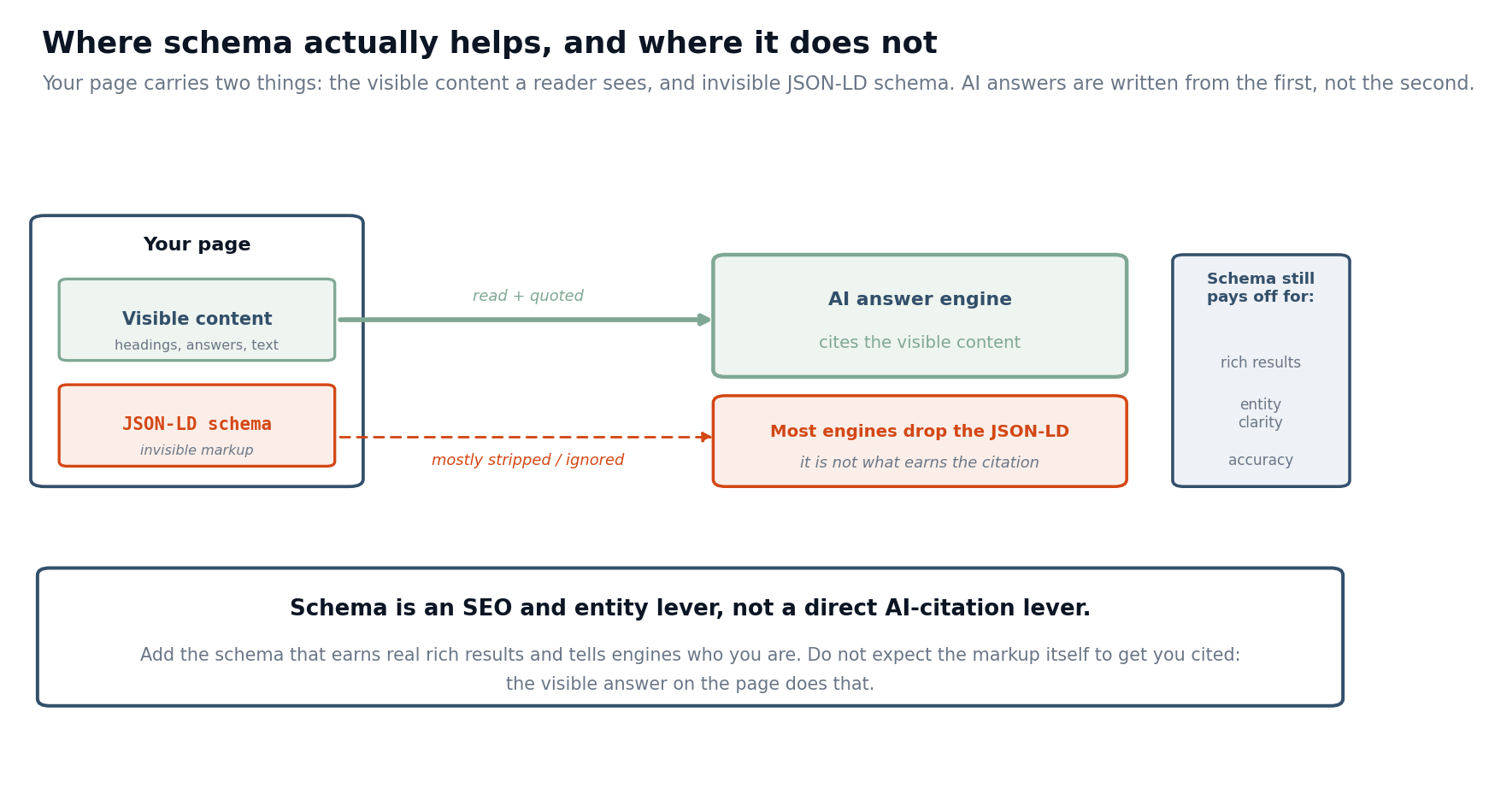
When an AI answer engine builds a response, it reads and quotes the visible content of your page. The JSON-LD is a different story. A controlled experiment by Otterly that implemented several schema types and tracked AI citations for three months found that schema behaved as an SEO lever, not a generative-search growth lever, and that most AI search platforms could not even fetch or correctly interpret the JSON-LD when asked directly. The gains that did appear showed up on Google's surfaces and tracked with broader algorithm movement rather than the markup itself. That lines up with how these systems work: many strip script tags, including JSON-LD, when they process a page for an answer, so the markup never reaches the part that writes the citation.
So what is schema good for? Three real things. It earns traditional rich results where those still exist, which drives clicks in regular search. It helps engines resolve your entity, meaning it tells them who you are and connects you to your authoritative profiles, which supports how confidently they can attribute a fact to your brand. And it reinforces accuracy, because clean markup that matches your visible content gives a machine a second, unambiguous read on the facts. None of those is "the markup gets you cited." All of them are worth having.
The practical stance that follows: add schema for its SEO and entity value, keep it accurate, and put your citation effort into the visible content, since that is what an engine actually quotes. If you want the full picture of the technical layer this sits in, our B2B guide to technical AEO covers crawling, rendering, and entity resolution alongside schema.
The four schema types worth your time for B2B
You do not need dozens of schema types. For a B2B site, four carry almost all of the value, and the rule for all of them is the same: mark up what is genuinely on the page.
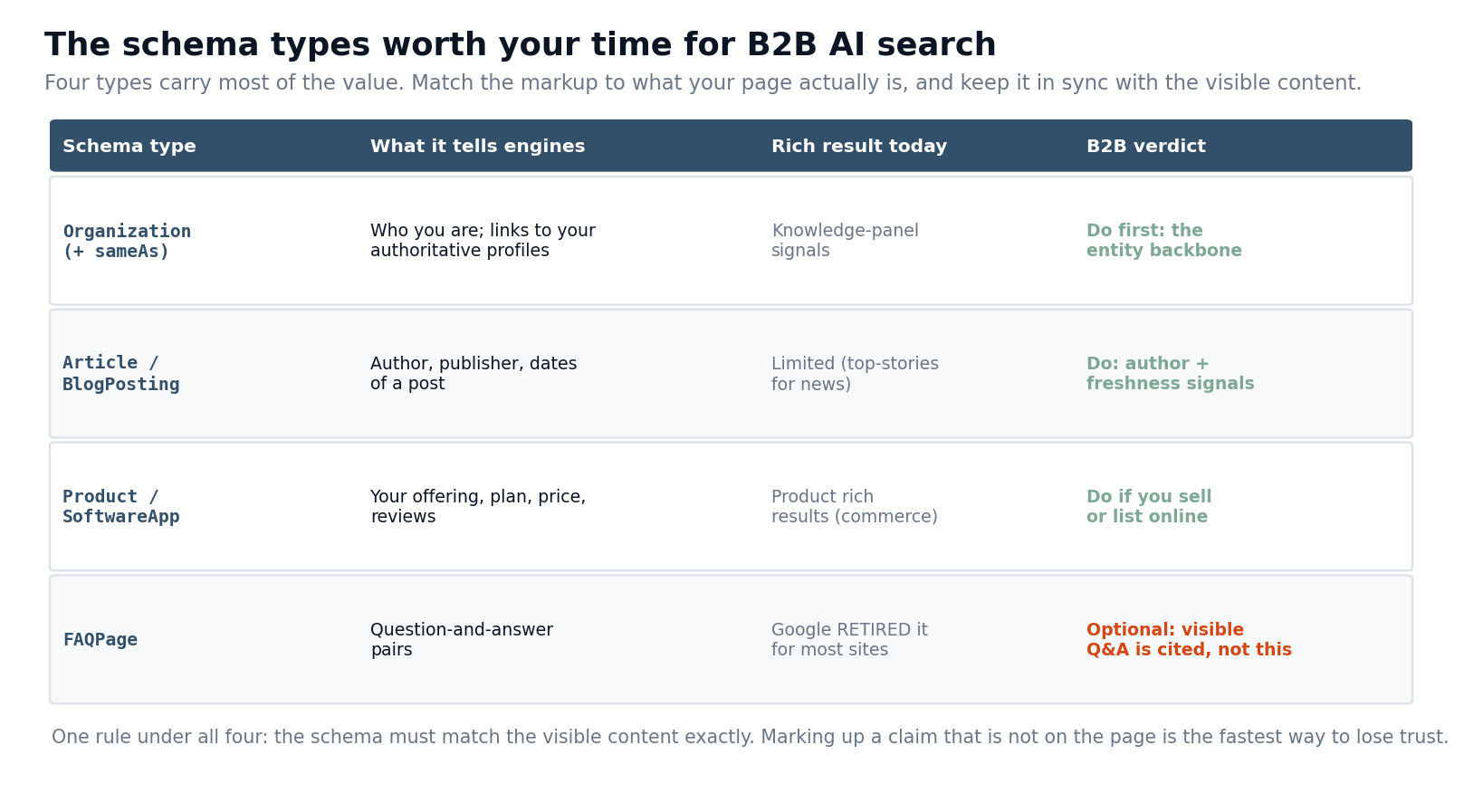
Organization schema, with sameAs, is the one to do first, because it is your entity backbone. It states your company name, logo, and the sameAs links to your authoritative profiles like LinkedIn, Crunchbase, and Wikidata if you have them. This is the markup that most directly helps an engine know who you are and connect scattered mentions of you into a single, confident entity. For a B2B brand trying to be attributed correctly in AI answers, entity clarity is foundational, and this is where it starts.
Article or BlogPosting schema goes on your editorial content. It names the author, the publisher, and the published and modified dates. Its rich-result payoff is limited now, mostly relevant to news, but it still does two useful things: it makes your author and expertise explicit, which supports E-E-A-T, and it exposes clean freshness dates, which matter because engines favor current sources. If you produce thought leadership, this is worth having on every post.
Product schema, or SoftwareApplication for a SaaS, describes what you sell: the offering, plan, price, and reviews. If you have commerce or public pricing, this earns product rich results and gives engines structured facts about your offering. For a pure B2B SaaS with gated pricing, use it where it genuinely fits, SoftwareApplication and Offer on the pages that describe the product, rather than forcing it everywhere.
FAQPage schema is the one to be careful with. It marks up question-and-answer pairs, and for years it produced an expandable FAQ rich result in Google. Google has since retired FAQ rich results for most sites, so the visible payoff is largely gone. The markup is still valid, and structured Q&A is still good content, but do not add FAQPage expecting a rich result or an AI-citation boost. The visible question and answer on the page is what an engine can quote; the schema around it is not. Our guide on query fan-out and FAQ automation covers how to build genuinely useful Q&A content that earns citations on its own merits.
How to implement it without creating problems
The mechanics are straightforward, and a developer can add the core types quickly. A few principles keep it from backfiring. Use JSON-LD, which is Google's preferred format and the easiest to maintain, and place it in the page's head or body as a script block. Generate it from your real page data where you can, so it stays in sync, rather than hand-writing static blocks that drift out of date. Start with Organization and sameAs sitewide, add Article or BlogPosting to your content template so every post inherits it, and add Product or SoftwareApplication to the pages that describe your offering.
The one rule that overrides all the others: the schema must match the visible content exactly. Marking up a rating, a price, or an answer that does not appear on the page is a policy violation that can cost you rich results and, more importantly, trust. Schema is a label on what is there, never a claim about what is not.
What good Organization schema looks like
Because Organization is the type to start with, here is a compact, realistic example. It names the company, points to the logo, and uses sameAs to connect the brand to its authoritative profiles, which is the part that does the entity-resolution work.
<script type="application/ld+json">
{
"@context": "https://schema.org",
"@type": "Organization",
"name": "Acme Analytics",
"url": "https://www.acme.example",
"logo": "https://www.acme.example/logo.png",
"description": "Product analytics for B2B SaaS teams.",
"sameAs": [
"https://www.linkedin.com/company/acme-analytics",
"https://www.crunchbase.com/organization/acme-analytics",
"https://www.wikidata.org/wiki/Q000000"
]
}
</script>
Everything in that block should be true and, where it is a description, reflected on the page. The sameAs array is the highest-value part: each link is a vote that ties a separate, engine-trusted profile back to your brand, which is exactly what helps an engine attribute a fact to you with confidence. Keep the list to profiles you actually control or that genuinely describe you, and make sure they point back to your site in turn. This ties directly to the off-site side of authority, which we cover in first-party vs third-party citations.
Common mistakes that waste the effort
A few errors turn schema from an asset into a liability. The biggest is marking up content that is not visible on the page, which violates Google's guidelines and can trigger a manual action. Close behind is stale markup: dates, prices, or author names in the JSON-LD that no longer match the page, which quietly misinforms every machine that reads them. Then there is over-marking, adding every schema type you can find rather than the few that describe your page, which adds maintenance and risk without adding value. And the strategic mistake underneath all of them is treating schema as an AI-visibility play, so the markup gets built while the visible content that actually earns citations goes unimproved.
How to check your schema works
Validate before you rely on it. Google's Rich Results Test shows whether a page is eligible for specific rich results and flags errors, and the Schema.org validator checks that your markup is well-formed. Run your key templates through both after any change. Then, in Google Search Console, watch the enhancement reports for the schema types you use, which show what Google actually recognized and any errors it found at scale. If a type you implemented is not showing up, the tool will usually tell you why.
What you will not find in any of these tools is a report on AI citations, because schema does not drive them directly and the engines do not expose that. That is the right expectation to hold: validate schema for correctness and rich-result eligibility, and measure AI visibility separately, by checking where you actually show up in AI answers.
Frequently asked questions
Does schema markup get me cited in ChatGPT or Perplexity?
Not directly. The available testing shows most AI engines do not use the JSON-LD to decide citations, and many strip it during processing. Schema helps through SEO and entity clarity; the visible content earns the citation.
Is FAQ schema still worth adding?
Only for the content itself, not the markup's payoff. Google retired FAQ rich results for most sites, and the schema does not boost AI citations. Write genuinely useful Q&A because the visible answer can be quoted, and add the markup only if it is cheap.
Which schema type should I add first?
Organization with sameAs. It is your entity backbone and does the most to help engines know who you are and attribute facts to you correctly.
Will more schema types help more?
No. Adding types that do not match your content adds risk, not value. Use the few that describe what your page actually is, and keep them accurate.
Does schema hurt anything?
Only if it is wrong. Markup that does not match the visible page can trigger manual actions and lost rich results. Accurate schema is safe and useful; inaccurate schema is a liability.
Where to spend your structured-data effort
The clean way to think about schema for AI search is to separate the two jobs it is often confused between. Schema's job is to help machines understand and trust your page and to earn rich results in traditional search. Earning the AI citation is the visible content's job. Do the first with a small, accurate set of types, Organization and sameAs first, Article on your content, Product or SoftwareApplication where you sell, and FAQPage only where it is cheap, and spend the rest of your effort on content a model can actually quote.
The way to know whether any of it is moving the number is to look at where you show up in AI answers, which no schema validator will tell you. You can see where you stand today with our AI Search Visibility Checker, and if you want to track whether engines are citing your pages as you ship changes, that is what live model checks are for. Omnibound's AI Search Intelligence shows you which pages engines actually cite, so you can tell the difference between markup that tidied up your SEO and content that genuinely earned you an answer.