


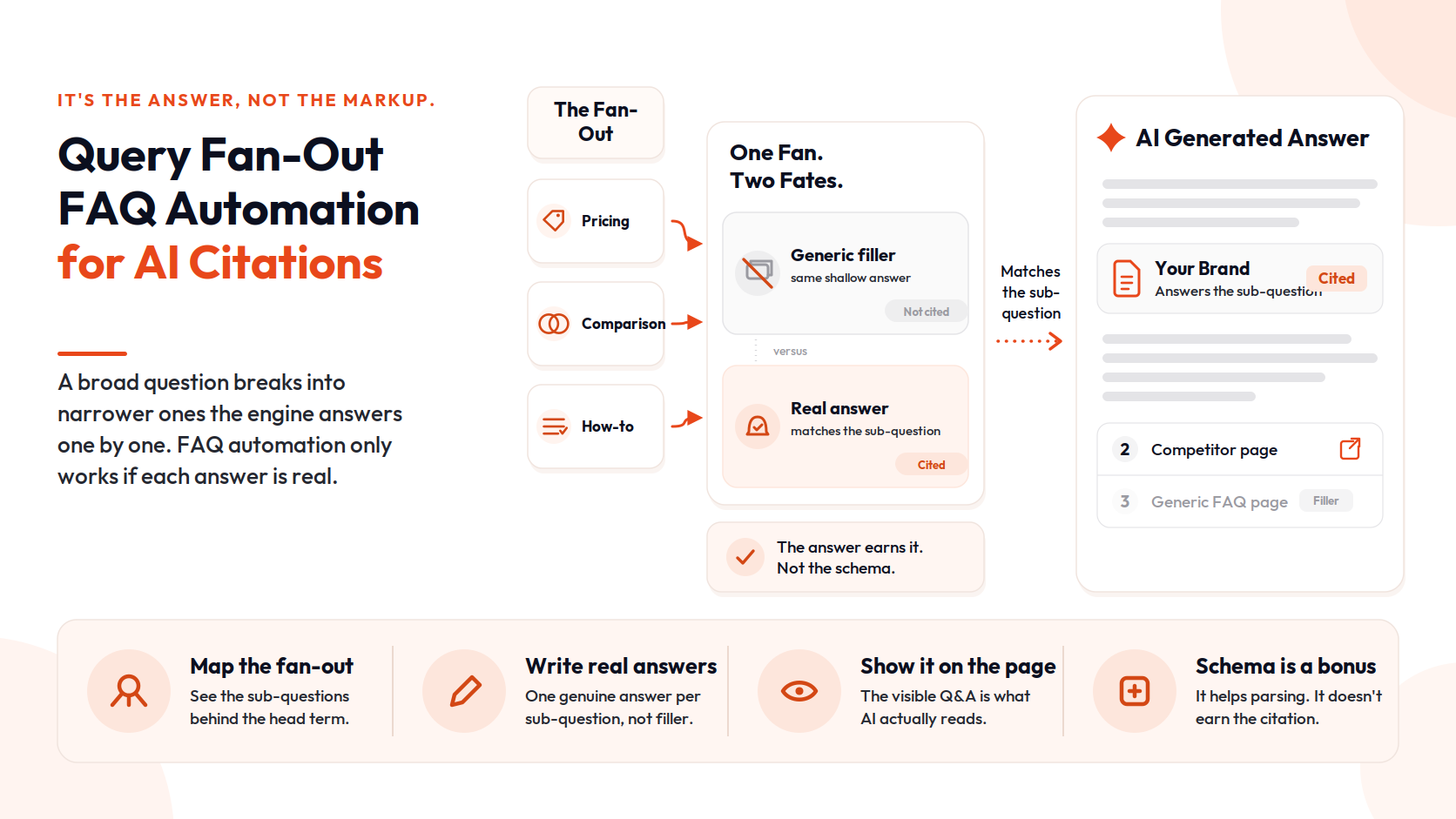


Ask an AI engine a broad question and it does not answer the question you typed. It quietly breaks that question into a set of narrower ones, retrieves an answer for each, and assembles them. This decomposition is what people mean by query fan-out, and it changes what "covering a topic" requires. You are no longer competing to answer one head question; you are competing to answer the whole fan of sub-questions behind it.
FAQ content is the most direct way to do that, and automation is how you do it at the scale the fan demands. But FAQ automation has a sharp edge: done with a real answer per question it builds citable coverage fast, and done as scaled generic filler it produces exactly the thin content AI ignores. This piece covers how to use fan-out to map the question set, how to automate FAQ answers that actually get cited, and the part most teams get wrong, that the visible question-and-answer is what earns the citation, not the schema markup underneath it.
Query fan-out: one topic is really many questions
When an engine handles a topic like "AI search visibility," it expands it into the questions a person would actually need answered: what it is, which tools do it, what it costs, how to measure it, whether it works for a given use case. It answers those and composes a response. The mechanics of that decomposition and retrieval sit inside how AI search works; the consequence for content is what matters here.
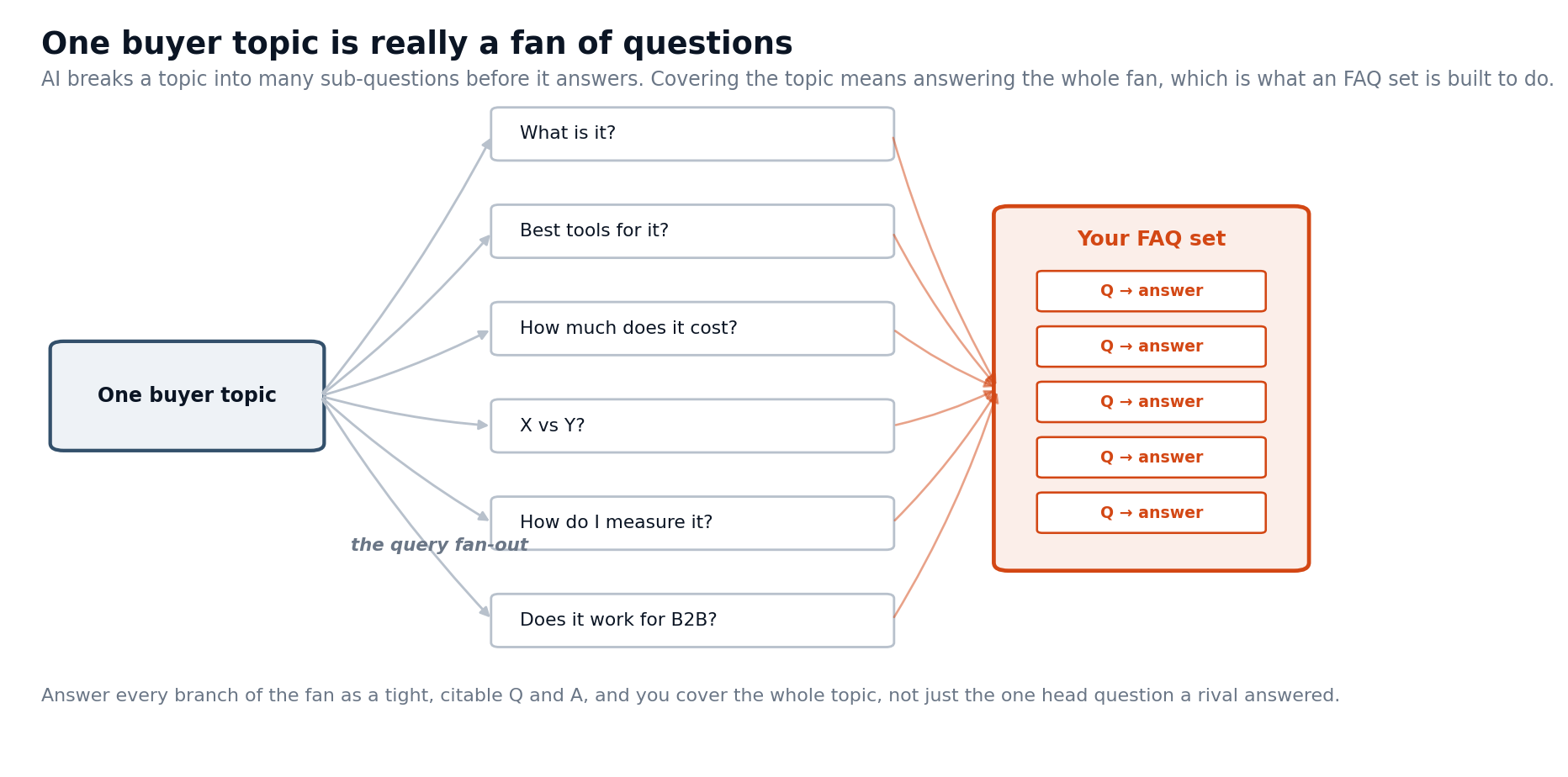
AI breaks a topic into sub-questions before it answers. Covering the topic means answering the whole fan, which is what an FAQ set is built to do.
This reframes the goal. A single strong article answers the head question well and leaves most of the fan uncovered, so a competitor gets cited for "how much does it cost" while you own only "what is it." Mapping the fan, the real set of sub-questions behind your priority topics, and answering each one is how you get cited across the cluster rather than on a single query. The questions come from where buyers actually ask them: the People Also Ask box, the follow-up questions an engine suggests, your sales and support conversations, and your own prompt tracking.
Building the fan: where the real questions come from
The fan is only useful if it is the real one buyers ask, not a list you guessed. Assemble it from sources that reflect actual demand. The People Also Ask box and the related-questions an engine suggests show the sub-questions search systems already associate with the topic. Your sales and support conversations surface the questions buyers ask a human, which are often the commercial ones no keyword tool captures. Your prompt tracking, the buyer questions you already monitor across AI engines, is the most direct source of all, because it is the exact set you are trying to get cited for. Competitor FAQs and comparison pages reveal branches of the fan others are answering and you are not.
Pull those together for a priority topic and you get its real fan: the ten or twenty questions that actually make up the topic, ranked by how close they sit to a buying decision. That ranked list, not a keyword's search volume, is the build order for the FAQ set. Start with the commercial branches, pricing, comparisons, fit, where being the cited answer is worth the most, and work outward.
Why FAQ content fits the fan
An FAQ is a set of explicit question-and-answer pairs, which is the exact shape a fanned-out topic takes. Each pair maps to one branch of the fan, and each is a self-contained unit an engine can lift and cite on its own. That makes well-built FAQ content some of the most extractable on a site, for the same reasons covered in how to structure content for LLMs: a clear question, a direct answer, one idea, no dependence on surrounding text.
FAQ content also concentrates the questions that matter for B2B. The fan behind a buying topic is full of commercial sub-questions, pricing, comparisons, fit for a use case, that a general article buries but an FAQ answers head-on. Those are the questions closest to a decision, and they are exactly where being the cited answer is worth the most.
The part teams get wrong: schema is not what gets you cited
Here is the correction that saves a lot of wasted effort. FAQ schema, the FAQPage structured data you add in the code, is not what earns an AI citation. Engines read the rendered page; they lift the visible question-and-answer text, not the JSON-LD underneath it. Schema helps an engine understand what your content is and still has a role, but the citation is earned by the answer a reader can see, not the markup a crawler parses.
Two things follow. First, Google largely retired FAQ rich results for most sites, so the old reason to add FAQ schema, the rich snippet in the search result, is mostly gone. The reason to build FAQ content now is AI extractability, not a rich result. Second, if the visible answer is weak, no amount of schema rescues it. Add the schema as a secondary signal, but spend your effort on the answers themselves.
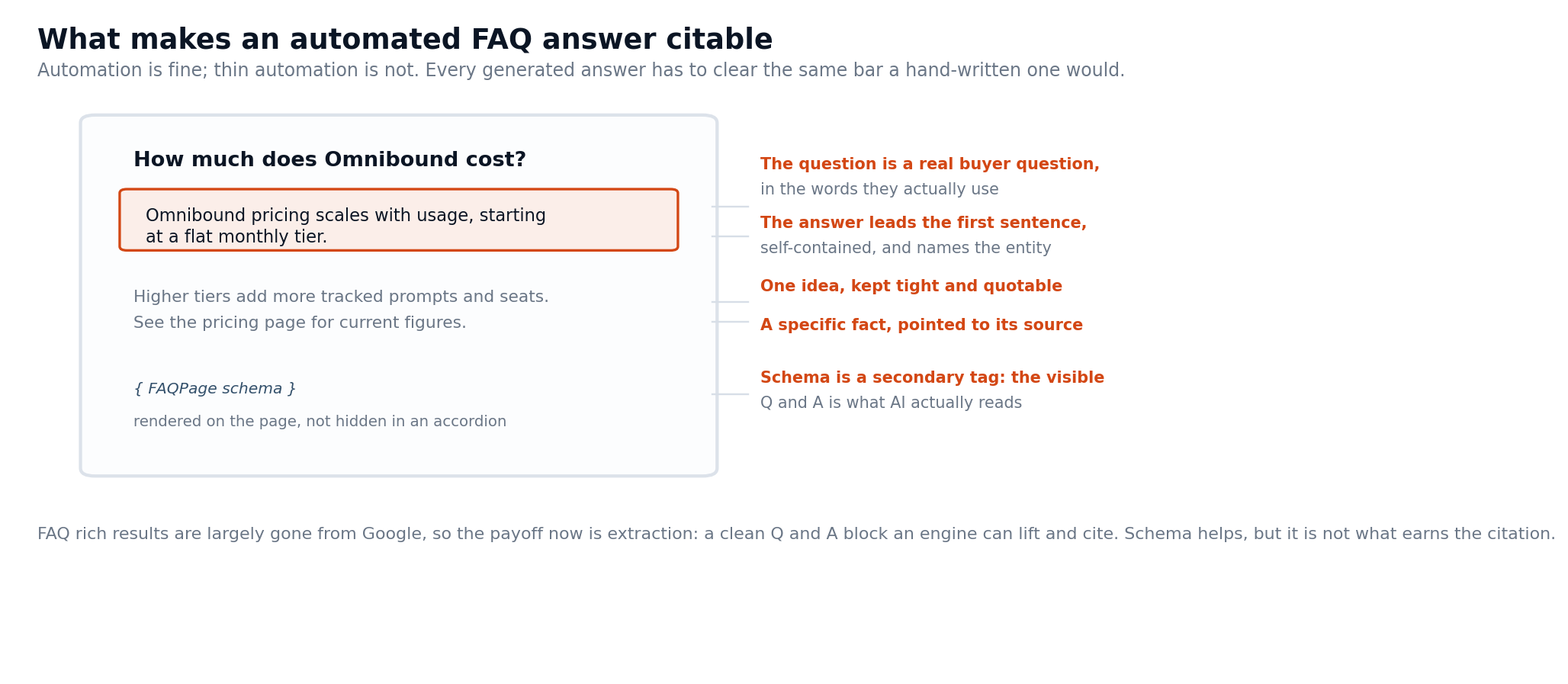
The citation is earned by the visible, well-built answer. Schema is a secondary tag, not the thing an engine quotes.
How to automate FAQ content without making filler
Automation is the right tool for the fan, because a topic can fan out into dozens of real sub-questions and hand-writing every one across every topic does not scale. The danger is that automation makes it just as easy to mass-produce generic answers that get ignored, the thin-content trap covered in programmatic SEO for AI search. The line between the two is whether each answer is real.
Automate the assembly, not the substance. Use automation to gather the fanned-out questions, apply a consistent answer structure, and publish and mark up at scale. Do not use it to invent answers from nothing. The value of an automated FAQ is the specific, correct answer in each entry, and if that answer is not real, the entry is filler no matter how cleanly it is generated.
Give every answer the same shape. Lead with a direct answer in the first sentence, phrased so it stands on its own when lifted out. Name the subject rather than leaning on "it." Keep each answer to one idea, tight enough to quote. When a fact or number belongs in the answer, put its source with it. This is the anatomy in the diagram above, and it applies to a generated answer exactly as it does to a written one.
Gate every generated answer for accuracy. This is the non-negotiable one, because a wrong FAQ answer that does get cited means an engine repeats your error as fact. Any answer produced with AI has to be checked before it publishes, especially the commercial ones about pricing and capabilities. Reviewing a sample and shipping the rest unread is how the inaccurate entries slip through.
Cap the set to the questions you can genuinely answer. The right number of FAQ entries is the number of real sub-questions you have a specific, correct answer for, not the number a tool can generate. When you run past the questions with real answers, stop, because padding the set with generic entries dilutes the good ones.
Put it on the page the right way
How you present the FAQ decides whether the work pays off. Render every answer in the page itself; answers hidden inside accordions or tabs that only load on click can be invisible to the systems that read your content, so an FAQ whose answers are collapsed by default may never be seen.
Add FAQPage schema as the secondary signal, matched exactly to the visible text. And place the FAQ where it fits the fan: sometimes that is a dedicated FAQ section on a topic page, sometimes it is question-shaped sections woven through the page, which double as the answer blocks that win featured snippets, covered in featured snippets and position zero.
Measure coverage of the fan, not just the page
Because the goal is covering the whole fan, measure at that level. Track, per priority topic, which of its sub-questions you are actually cited for, and treat the gaps, the branches of the fan where a competitor is cited and you are not, as your next FAQ entries. Run the check repeatedly rather than once, since AI answers vary from run to run, and watch it against competitors. Doing this across a full set of topics and their fanned-out questions by hand does not scale, which is why frequent automated checks across your prompt set are the practical way to see which branches you own and which you still need to answer.
A worked example: fanning out one topic
Say the topic is your own category, "AI search visibility platforms," and today you rank and get cited only for the definitional "what is AI search visibility" question. Fanning it out from real sources produces the set buyers actually ask: what does it cost, which platforms are best for B2B, how is it different from traditional SEO, how do you measure it, does it work for a small team, and how does one tool compare to another. That is the fan you are currently leaving to competitors.
Each branch becomes an FAQ entry with a real answer. "What does it cost" gets a direct first-line answer about how pricing works, with a pointer to current figures. "How is it different from traditional SEO" gets a two-sentence distinction, not a lecture. "Which platforms are best for B2B" gets an honest, specific answer rather than a thinly veiled pitch. Each answer leads with the point, names the subject, stays to one idea, and is checked for accuracy before it ships, and the schema is added to match.
The result is coverage of the whole topic instead of a single branch. When an engine fans the topic out for a buyer, your content has an answer waiting for each sub-question rather than only the easy definitional one. Nothing here required inventing content at scale; it required answering the real questions, one solid answer at a time, at the pace automation makes possible.
Where B2B teams get FAQ automation wrong
- Answering only the head question. A great article on the main topic still leaves most of the fan uncovered. Map the sub-questions and answer them too.
- Betting on schema. FAQPage markup does not earn the citation and no longer earns a Google rich result for most sites. The visible answer earns it; schema is secondary.
- Automating the substance. Generating answers from nothing produces filler that AI ignores and can get you misquoted. Automate assembly; keep the answers real and reviewed.
- Hiding answers in accordions. Collapsed answers can go unread by the systems that would cite them. Render them on the page.
- Padding the set. More FAQ entries is not more coverage if the extra ones are generic. Cap the set to the questions you can answer specifically.
Frequently asked questions
What is query fan-out, and why does it matter for FAQs?
Query fan-out is how an AI engine breaks one topic into many narrower sub-questions, answers each, and assembles a response. It matters because covering a topic now means answering that whole set of sub-questions, and an FAQ, a set of question-and-answer pairs, is the natural way to do it.
Does FAQ schema help you get cited by AI? Only indirectly. Engines read and cite the visible question-and-answer text, not the FAQPage schema in the code. Schema helps an engine understand your content and is worth adding as a secondary signal, but the citation is earned by the answer a reader can see, and Google has largely retired FAQ rich results for most sites.
Can I automate FAQ creation for AI search? Yes, if you automate the assembly and not the substance. Use automation to collect the fanned-out questions, apply a consistent answer structure, and publish and mark up at scale, but every answer must be a real, specific, accuracy-checked response. Generated filler gets ignored and can get you misquoted.
How many FAQ entries should a page have? As many as you have real, distinct sub-questions with specific, correct answers, and no more. Cap the set to genuine questions from the fan; padding it with generic entries dilutes the ones that would otherwise be cited.
How do I know which FAQ answers are getting cited? Track, per topic, which sub-questions you are cited for across AI engines, over repeated checks and against competitors. The branches of the fan where a competitor is cited and you are not are your next FAQ entries.
Answer the whole question, not the headline
Query fan-out means a topic is never one question, and being cited on it means answering the set, not the headline. FAQ content is the cleanest way to cover that set, and automation is how you keep up with it, as long as every answer is real, specific, accuracy-checked, visible on the page, and built to stand on its own. Do that, and the schema becomes a helpful footnote rather than the thing you were counting on.
To see which sub-questions your topics are already cited for and which branches of the fan you are missing, run a free scan with the AI Search Visibility Checker, or track your citation coverage across the whole question set with AI Search Intelligence.