


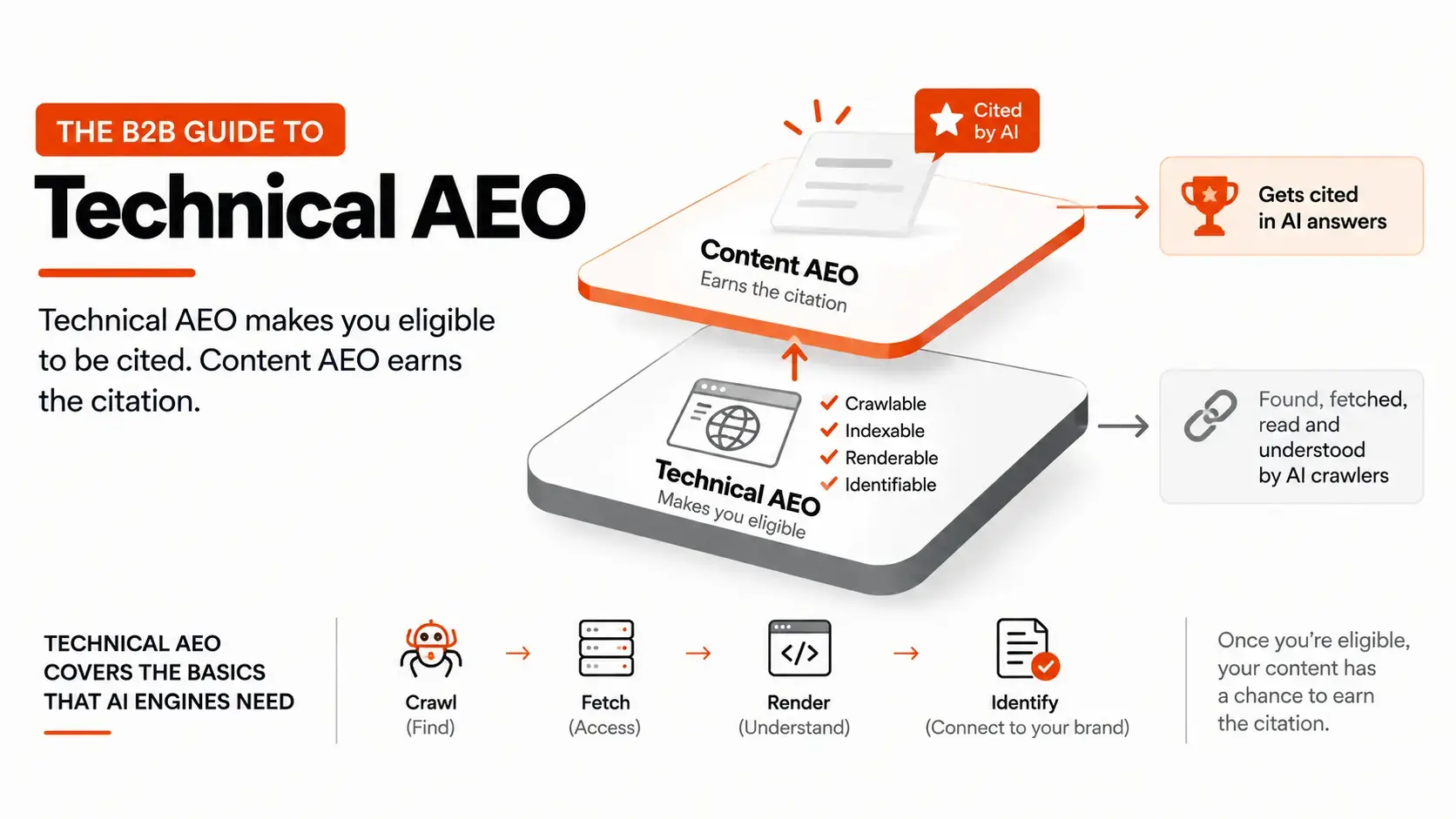


Most advice on getting cited by AI engines is about content: write clearly, answer the question, add data. That advice is right, and it is also useless if an AI crawler cannot reach, render, or make sense of your page in the first place. Technical AEO is the other half: the infrastructure that decides whether an engine can find, fetch, read, and identify your content at all. It does not win citations on its own, but skip it and nothing your writers do will land. This guide covers the technical work that makes a B2B site AI-ready, in the order that matters, with an honest read on what helps and what is hype. A downloadable checklist is included at the end.
The frame to hold onto: technical AEO makes you eligible to be cited; content AEO earns the citation. They are two layers, and the technical one comes first because it is the foundation everything else sits on.
What technical AEO actually is
Answer Engine Optimization is the work of getting your content quoted and cited in AI answers. Most of it is about the substance of the page, which we have covered across the content side of AEO. Technical AEO is the subset that has nothing to do with what the page says and everything to do with whether a machine can use it: can an AI crawler access the URL, does the real content appear in the HTML it receives, can it parse the structure, and can it work out who published it. Get those wrong and the page is invisible to the engine no matter how good the writing is.
Think of it as four gates a page passes through before its content is even read: crawl, render, parse, identify. A failure at any gate drops the page out of consideration entirely.
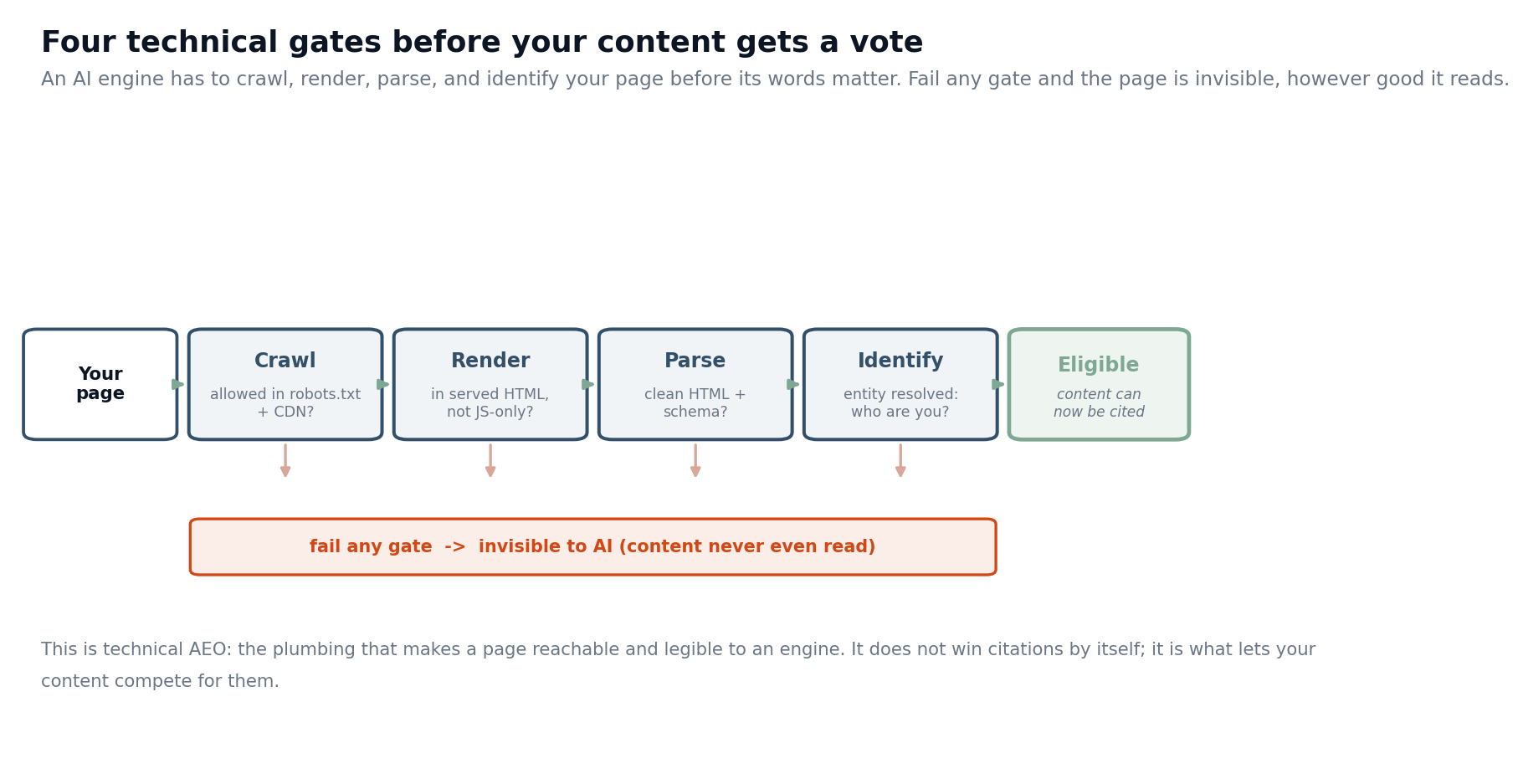
An AI engine has to crawl, render, parse, and identify your page before its words matter. Fail any gate and the page is invisible, however well it reads. This is the plumbing technical AEO fixes.
Gate one: let the AI crawlers in
The single most common technical own-goal is blocking the crawlers you want citing you. AI answer engines fetch pages with named bots, and if your robots.txt or your CDN turns them away, you are invisible to that engine by your own hand.
Know the crawlers. The main ones to allow are GPTBot and OAI-SearchBot (OpenAI and ChatGPT), ClaudeBot (Anthropic), PerplexityBot (Perplexity), Google-Extended (Google's AI training and AI features), and Bingbot, which feeds Copilot. Check your robots.txt and confirm you are not disallowing any bot you want to be cited by. Teams often added blocks during the early "keep AI off our content" reflex and never revisited them.
The trap that catches people now is at the CDN, not robots.txt. Cloudflare began blocking many AI crawlers by default, so a site can be perfectly open in robots.txt and still be turned away at the edge without anyone changing a setting on purpose. If you use Cloudflare or a similar service, check its bot-management settings and explicitly allow the AI crawlers you want. This is worth doing first, because every other technical fix is wasted if the bot never gets through the door.
Gate two: make sure the content is in the HTML
Once a bot is allowed in, it has to actually receive your content. This is where modern JavaScript sites quietly fail. If your page renders its main content client-side, meaning the HTML arrives mostly empty and JavaScript fills it in after load, a crawler that does not execute that JavaScript sees a blank page. Some crawlers render JavaScript, many do not, and you should not gamble your visibility on which does.
The fix is to serve the content in the HTML the crawler first receives. If you run a React, Vue, or similar framework, use server-side rendering or pre-rendering for the pages you want cited, so the text is present in the initial response. Keep real text as text rather than baked into images, and make sure pages return quickly and reliably. None of this is exotic; it is the same renderability discipline good SEO always needed, and it matters more now because a missed render means the content is never read at all.
Gate three: structure it so a machine can parse it
A bot that receives your HTML still has to make sense of it. Clean, semantic markup does most of this work: real headings, lists, and tables rather than an undifferentiated wall of divs, so the structure of the page is legible. This is the technical side of the content structuring we cover in how to structure B2B content for LLMs; the difference is that here the concern is the markup, not the prose.
Structured data, or schema, is the other half of parsing. Adding schema does not make you rank or get cited by itself, but it makes your facts machine-readable and unambiguous, which reduces the chance an engine misreads or misattributes them. For B2B, prioritize Organization schema with a sameAs array, Article or BlogPosting, and BreadcrumbList before you worry about Product or FAQPage.
Two rules keep schema honest: it must match the visible content exactly, never marking up claims that are not on the page, and you should remember that the engine cites the visible content, not the JSON-LD. Schema helps the machine understand the page; it is not a shortcut around having the answer visibly on it. Worth noting, since teams still chase it: Google has largely retired FAQ rich results, so FAQ schema is now about extractability and clarity, not a rich snippet.
Gate four: make your identity unambiguous
The last gate is entity clarity: can the engine work out who you are and treat you as a consistent, credible source. AI engines build a model of entities, organizations, products, people, and they cite sources they can confidently identify. If your brand is described three different ways across your site, or an engine cannot connect your site to your known profiles, you are harder to attribute.
Fix this with consistency and connection. Use one consistent organization name across the site, and consistent contact details if you have a physical presence. Add Organization schema with sameAs links to your authoritative profiles, LinkedIn, Crunchbase, and Wikipedia or Wikidata if you have them, so the engine can resolve your site to a known entity. Keep a clear, factual About page that states plainly what you do, because that is often what an engine draws on to describe you. This is the technical footing under the off-site authority that earns trust.
Freshness and discovery signals
Two smaller technical items round out the foundation. First, discovery: keep an accurate XML sitemap with real lastmod dates, submit it, and make sure internal links reach every important page so nothing is orphaned and unreachable. Second, freshness: show accurate published and updated dates on your content, because recency is a signal engines use and a stale-looking page is easier to pass over. Neither is a heavy lift, and both help an engine find your newest work and trust that it is current.
How to test whether your site is AI-ready
You can check the gates in under an hour without special tools. For crawler access, open your robots.txt in a browser and read it for any Disallow lines that hit the AI bots, then check your CDN or bot-management dashboard for default AI-crawler blocking. For rendering, open one of your important pages, view the page source, the raw HTML rather than the inspected DOM, and confirm the main content text is actually there; if the source is nearly empty and the content only appears in the rendered view, you have a client-side rendering problem.
For parsing, run a key page through a structured-data validator to confirm your schema is present and error-free and that it matches what is on the page. For identity, search your brand name in an AI assistant and see whether it describes you accurately; a vague or wrong description points to weak entity signals. Do this for a sample of your highest-value pages, the comparison, product, and pillar pages, rather than the whole site. The gates fail the same way across a site, so a handful of checks usually surfaces the systemic problems.
Common technical AEO mistakes
A few mistakes account for most of the damage. The biggest is blocking AI crawlers without realizing it, whether in robots.txt from an old decision or at the CDN by default; the page is perfect and the engine never sees it. The second is shipping content that only exists after JavaScript runs, so the crawler receives an empty shell. The third is a stray noindex or a broken canonical left on a page you want cited, quietly telling engines to skip it.
On schema, the common error is marking up claims that are not visible on the page, which is both against the rules and pointless since the visible content is what gets cited. And the most expensive mistake of attention is over-investing in llms.txt or chasing schema rich-result tricks while the crawler-access and rendering gates are still failing. Fix the gates that block reading before the flourishes that assume you are already read.
A word on llms.txt, honestly
llms.txt comes up in every technical AEO conversation, so here is the straight version. It is a proposed standard: a file at your site root that lists your key content in a clean, model-friendly format. The idea is reasonable. The reality, as of now, is that no major AI service has confirmed it uses llms.txt to decide what to cite, and Google has publicly compared it to the old keywords meta tag, a self-declared claim about your own site that search engines learned long ago to ignore.
So treat it accordingly. If publishing an llms.txt is cheap for you, and especially if it helps people paste your documentation into AI tools, there is little harm in having one. Just do not mistake it for an AI-visibility strategy or let it distract from the gates above, which actually determine whether you get read. It is a nice-to-have at the bottom of the list, not a lever.
How technical AEO fits with everything else
Technical AEO is necessary, not sufficient. Clearing all four gates does not earn you a single citation; it earns you the right to compete for one. The citation itself is won by the content: accurate, specific, original, answer-first, and extractable, which is the work covered in the signals that make a page citable and in whether AI-generated content ranks and gets cited at all. The two layers depend on each other: great content on an unreachable page earns nothing, and a flawlessly crawlable page full of commodity content earns nothing either.
The practical sequence is to fix the foundation once, then work continuously on content. Technical issues tend to be set-and-check: you allow the crawlers, fix rendering, add schema, clean up entity signals, and then verify periodically that nothing regressed after a redesign or a CDN change. Fold that verification into your regular content audit so a technical regression gets caught alongside content decay, and track whether your pages are actually being cited so you can tell the fixes worked.
Quick answers to common questions
How is technical AEO different from technical SEO?
They overlap heavily; crawlability, rendering, and site health matter for both. Technical AEO adds the pieces aimed at AI engines specifically: allowing the AI crawlers by name, entity clarity so an engine can identify you, and schema and structure aimed at machine extraction rather than at Google rich results. If you already do technical SEO well, technical AEO is a short list of additions, not a separate project.
Do I really need schema?
t helps and it is low-cost, so it is worth doing for Organization, Article, and Breadcrumb at least. Just hold the right expectation: schema clarifies your facts for machines, it does not earn a citation on its own, and it must match the visible page.
Does llms.txt matter yet?
Not much, on the current evidence. Publish one if it is cheap, but do not prioritize it over crawler access, rendering, or schema.
Is technical AEO a one-time job?
Mostly. Fix the foundation once, then re-check it after any redesign, replatform, or CDN change, since those are what silently reintroduce crawler blocks and rendering problems.
Where to start this week
If you do nothing else, do the first gate. Check your robots.txt and your CDN bot settings and confirm the AI crawlers you want are allowed, because that one issue silently erases everything downstream and it is the most common problem on B2B sites right now. Then confirm your important pages render their content in HTML, add or correct Organization and Article schema with same, and tidy your sitemap and dates. Leave llms.txt for last, if at all.
If you want a fast read on whether your pages are currently being cited, and where the gaps are, the AI Search Visibility Checker gives you a starting picture. And when you want to confirm that a technical fix actually moved the needle, AI Search Intelligence tracks your citations across engines over time, so you can see eligibility turn into visibility.