


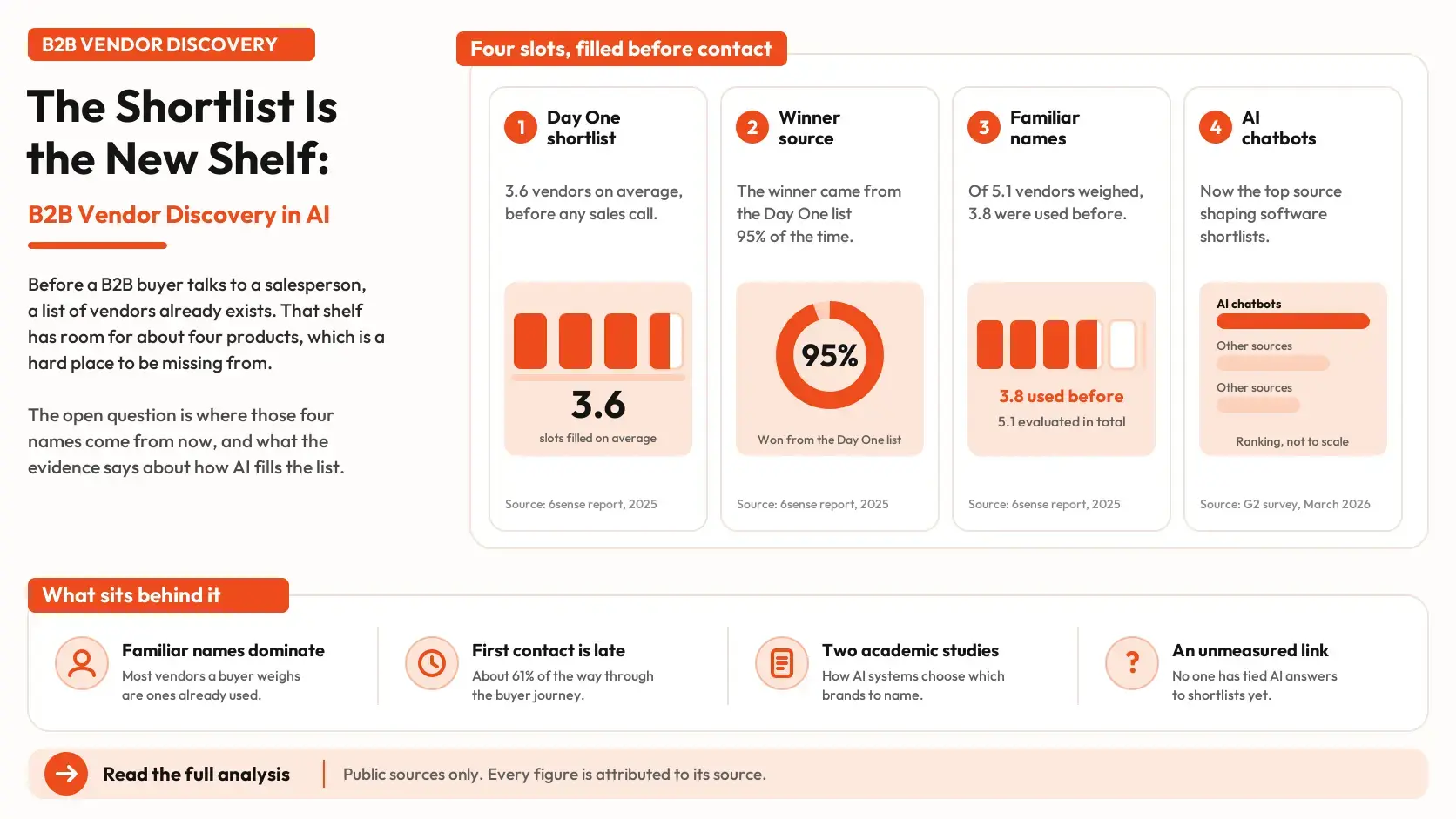


In 6sense's 2025 survey of about 4,000 buyers, that Day One shortlist held 3.6 vendors on average, and the winning vendor came from it 95 percent of the time. A shelf with room for about four products is a hard place to be missing from. The open question is where those four names come from now. G2's March 2026 survey of software buyers says AI chatbots have become the top source influencing which vendors make shortlists. This piece sets out what that evidence supports, what two recent academic studies add about how AI systems choose which brands to name, and the link between the two that nobody has yet measured.
It follows our reading of what B2B buyers actually ask ChatGPT, which covered the questions. This one is about the answers: which vendors those questions put on the shelf.
Four slots, filled before first contact
The 6sense Buyer Experience Report is the clearest public picture of the shortlist itself. Buyers filled 3.6 slots on the Day One shortlist on average, they evaluated 5.1 vendors in total, and they had used 3.8 of those vendors before. Buyers' first contact with a vendor came about 61 percent of the way through the journey, and 95 percent of the time the winner was already on the Day One list.
Two details matter for anyone selling into a new account. First, familiarity fills the shelf: on average, nearly four of the five vendors a buyer weighs are ones the buyer has already used. Second, the shelf is not sealed. G2's survey, discussed below, found that about one in three software buyers had purchased from a vendor they had never heard of before.
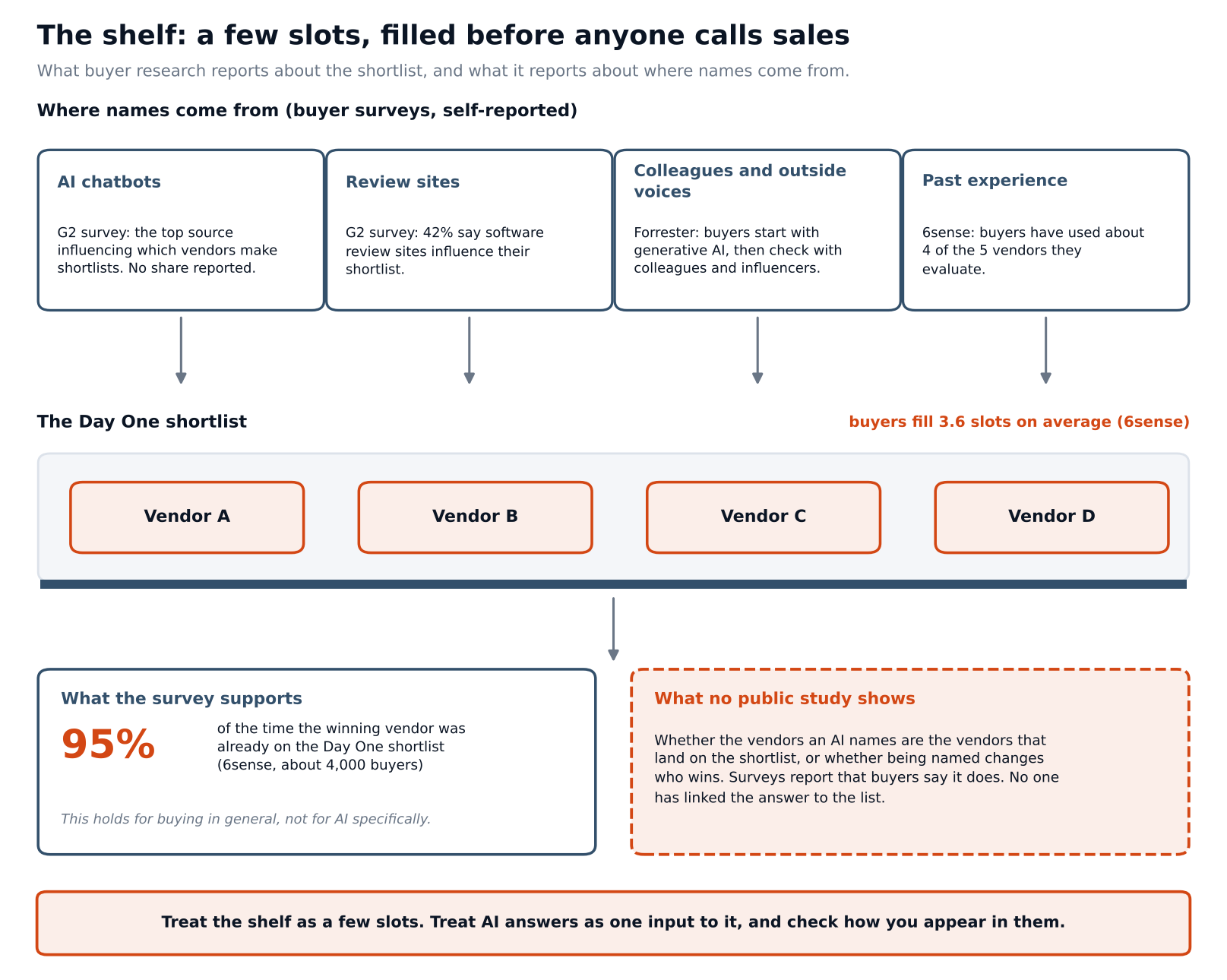
Read the 6sense numbers with their limits in view. The survey spans services (41 percent of purchases), software (33 percent) and physical goods (26 percent), among buyers who had spent at least $25,000 in the past two years, so the averages are not software-only. The report says 94 percent of buyers use large language models, but the text we could read does not tie the shortlist figures to AI use. It does not state when the survey was fielded. The answers are self-reported, and 6sense sells account-based marketing software. What the report shows is how small and early the shortlist is. It does not show how AI changes it.
Where the names come from now
G2's 2026 Answer Economy report is the main source on AI and shortlists. It surveyed 1,076 B2B decision-makers in March 2026. Its headline findings: 51 percent start software research with an AI chatbot more often than with Google, 71 percent rely on chatbots at some point, and chatbots are now the top source influencing which vendors make a shortlist, ahead of review sites. For comparison, 42 percent said software review sites influence their shortlist. Of the buyers surveyed, 85 percent think more highly of a vendor that an AI answer cites, and 69 percent said a chatbot led them to choose a different vendor than the one they expected.
Three cautions apply. G2 runs a software review marketplace, which is itself one of the report's subjects. The figures are what buyers say, not what they did. And the report gives no share for the "top source" ranking and no base for several of the percentages above, so we cannot say how many of the 1,076 answered each question.
Forrester's 2026 State of Business Buying report points the same way with a limit attached. Forrester says generative AI search is now the starting point for buyers, who then lean on colleagues and outside influencers to confirm what they found, because AI answers often come back incomplete or unreliable. A starting point is not a finish line. The names an answer puts first still get checked.
All of this is stated use. How often buyers actually type vendor-search questions is a different measurement, and our piece on what independent data shows about commercial intent in ChatGPT explains why that number is hard to find.
Why a well-known brand can be missing from the answer
If AI answers feed the shelf, the next question is how a system decides which brands to name. A September 2026 preprint from Northwestern University researchers (Malthouse and colleagues) gives the cleanest public test, though in consumer products and not B2B.
The team asked six models from three providers to recommend up to five brands in five categories, with web search switched off. When the prompt named only the category, several famous brands got nothing: Craftsman and Black+Decker in cordless drills, L.L.Bean, Eddie Bauer and REI in hiking jackets, among others. They were in none of the lists.
The team then wrote 20 situation-based prompts for two of those brands, each describing a buyer, a use and a constraint without naming the brand. Craftsman appeared in 35.4 percent of the lists, and L.L.Bean in 5.4 percent, each out of 240 lists. When the prompts borrowed language from the brand's own marketing, the brands appeared in 81.3 and 88.5 percent of lists. The authors call those prompts intentionally unrealistic. They draw a narrow conclusion from them: a low recommendation rate cannot simply be put down to the model not knowing the brand.
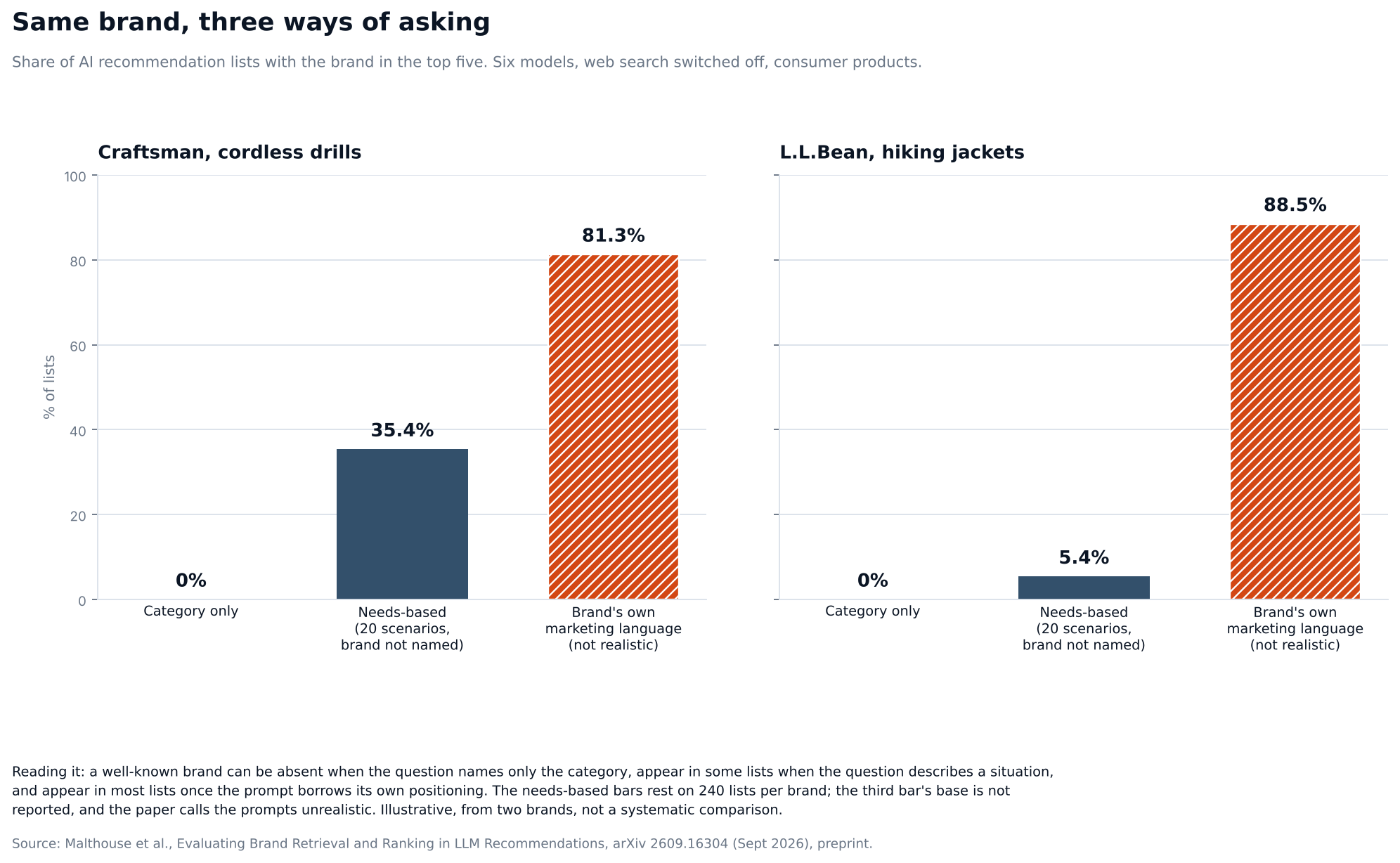
The limits are large. The products are consumer goods. Web search was off and the answers were requested as lists with no conversation, which real chatbots do not do. The two-brand test was handwritten and the authors describe it as exploratory. It is a preprint. What a B2B team can take from it is modest and useful: the same company can be absent under one wording and present under another. Our piece on how query phrasing changes which B2B brands get cited covers that mechanism for B2B questions.
Who sits at eye level
On a real shelf, position counts as much as presence. The same Northwestern study scored brands on both how often they appeared and how high they ranked. A handful of household names appeared in every list for their category, and rank separated them: DeWalt ahead of Milwaukee and Makita, then Bosch and Ryobi, for drills. In two of the five categories, premium brands got more prominence than mass-market ones. The authors say that pattern does not hold across all five.
The researchers also checked which outside measures moved with a brand's prominence. In their regression, search interest and news coverage were the two with a statistically detectable relationship; advertising spend, Wikipedia views and social conversation volume were not. The authors warn that the five measures overlap heavily, so individual coefficients are unstable, and they make no causal claim. Read it as a pointer to what to examine, not as a recipe.
A second preprint, from Xi Chu and YuPeng Hou, looks at the same question from the other side. In skincare, with one real brand and nine fictional ones, across three models, the real brand won every trial when product details were identical. When a fictional brand's details were clearly better, it won 96 to 98 percent of the time. The authors' reading is that the barrier for a lesser-known brand is mostly a lack of distinguishing information. That is a result about invented products in one consumer category, from a paper that has not been peer reviewed, and we would not carry it over to B2B software. It does fit the idea that specifics, not slogans, are what an answer can use.
The check after the list
G2's interview study of 335 buyers, published in June 2026, reports that buyers use AI to start vendor research and then verify what it says: most confirm critical claims through documentation, reviews, references and demos. Its page also says 64 percent return to original vendor sources to make a final choice. The interview figures come from coding transcripts, most have no stated base, and the page contradicts itself in places, so we use only the broad pattern.
The same pattern shows up in the G2 survey, where buyers named citations from a software review site as the top signal that raises their confidence in an AI answer. For a vendor, that means the shelf has a label as well as a slot. What an answer says about you has to hold up when a buyer opens the sources behind it. Our pieces on whether review sites drive B2B AI citations and on first-party and third-party citations cover the evidence on which pages those answers lean on. Building the third-party presence those checks land on is the work behind AI Authority Building.
What the research cannot tell you yet
| Claim | Best public source | What it supports | What it does not support |
|---|---|---|---|
| Buyers keep about four vendors on a Day One list and pick from it | 6sense, about 4,000 buyers | A small, early shortlist across purchase types | A software-only figure, an AI role, or a fieldwork date |
| AI chatbots are the top influence on shortlists | G2 survey, 1,076 buyers, March 2026 | What software buyers say shaped their lists | A share, or any link to who won |
| Which brands an AI names depends on how it is asked | Malthouse et al., preprint | The same brand present under one wording and absent under another | B2B results, or behavior with web search on |
| A known name wins when details tie | Chu and Hou, preprint | A pattern with fictional rivals in skincare | B2B software, or any real market |
| How many vendors a chatbot names | No public source | Nothing | The Northwestern prompts asked for up to five, so five is a setting, not a finding |
Three gaps follow. No public study connects the vendors an AI names to the vendors on a buyer's shortlist, or to the vendor that wins. Buyers say AI changed their choice, but nobody has set an answer beside a list and an outcome. No source reports how many vendors real chatbots name for real B2B shortlist questions, so the idea that an answer holds a fixed number of names has no data behind it. And answers vary from run to run and engine to engine, a point our piece on model variability in AI citations develops: one check is a sample of one.
A shelf audit for your own category
You can run a small version of the Northwestern test on your own market. It needs no tools beyond the engines your buyers use.
- Write three questions for one category. One names only the category. One describes a situation: the company type, a system it must work with and a constraint. One names a rival and asks for alternatives.
- Run each question in the engines your buyers use, several times each, with the wording fixed.
- Record whether you are named, where you sit in the list, which words the answer uses about you, and which pages it cites.
- Compare across the three questions. If you appear for the situation question and not the category question, you have an entry-point gap, not a general visibility problem.
- Read the label. Check that the description matches your positioning and that a page behind it, yours or a third party's, supports it.
- Repeat on a schedule without changing the wording. If you change a question, start a new series.
Questions people ask
Is the shortlist really only four vendors?
On average, in 6sense's data: 3.6 on the Day One list and 5.1 evaluated in all. Those are averages across services, software and physical goods, so a software-only figure may differ, and the text of the report does not break it out.
Does being named by AI win the deal?
G2's survey says 85 percent of buyers think more highly of a vendor an AI answer cites, and 69 percent say a chatbot changed which vendor they picked. Both are self-reports.
Do I need to appear in every engine?
Buyers use several tools and the answers differ, so the practical move is to ask your own buyers which they use and audit those first.
Can a newer or smaller vendor get on the shelf?
The signs are mixed. About one in three of G2's buyers purchased from a vendor they had not heard of, and situation-based prompts surfaced brands that category-only prompts missed. Against that, known names dominated when details tied in the skincare test. Nothing here proves a B2B result either way.
Look at your own shelf
The research gives you a frame, about four slots filled early, and a gap, the missing link between AI answers and the list. It cannot give you your own position, and that takes asking the questions and reading what comes back. Run a handful of the situation questions through the AI Search Visibility Checker for a first look at whether your name appears and in what words. When you want to see how that changes after a new page or a new review, AI Search Intelligence tracks each prompt individually, so you can watch the specific questions that matter to your buyers.