


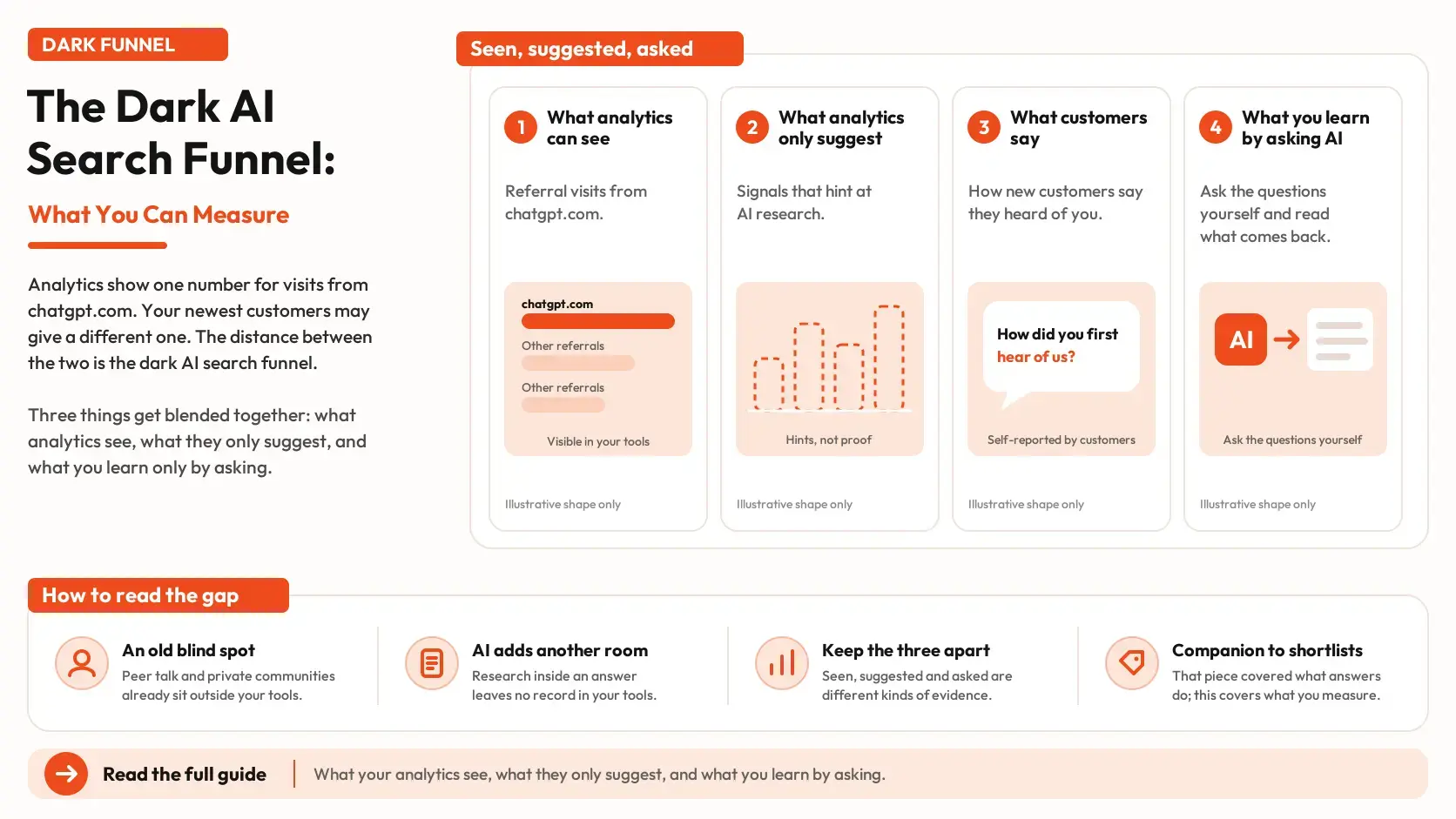


Search your analytics for visits from chatgpt.com and you will find a number. Ask your newest customers how they first heard of you and you may find a different one. The distance between the two is the dark AI search funnel: the part of a buyer's research that happens inside an answer and leaves no record in your tools.
Marketers have long talked about a dark funnel, meaning research that happens where their tools cannot see it, such as peer conversations and private communities. AI answers add another place for it. This piece separates three things that often get blended together: what your analytics can see, what they can only suggest, and what you can learn only by asking the questions yourself.
It follows our look at how B2B shortlists form in AI answers, which covered what the answers do. This one covers what you can measure of them.
Most of the journey was already out of sight
AI did not create the dark funnel. It added a room to it. In 6sense's 2025 survey of about 4,000 buyers, buyers' first contact with a vendor came about 61 percent of the way through the journey, buyers started 79 percent of first engagements themselves, and the winner was already on the Day One shortlist 95 percent of the time. Much of the work is done before a vendor's tools know the buyer exists.
G2's June 2026 interview study of 335 buyers adds a pattern that matters for measurement. Buyers use AI early and then verify what it says through documentation, reviews, references and demos, and the page reports that 64 percent return to original vendor sources to make a final choice. If that holds, a buyer who met your name in an answer may arrive later through your own site, a branded search or a typed address, which is exactly where your analytics cannot say why.
These are buyer self-reports. 6sense sells account-based marketing software, the 6sense figures span services, software and physical goods, and its page does not state when the survey was fielded. G2 runs a software review marketplace, and the interview figures come from coded transcripts with no stated base for most of them.
Three ways an AI answer leaves no trace
The answer is read and nobody clicks
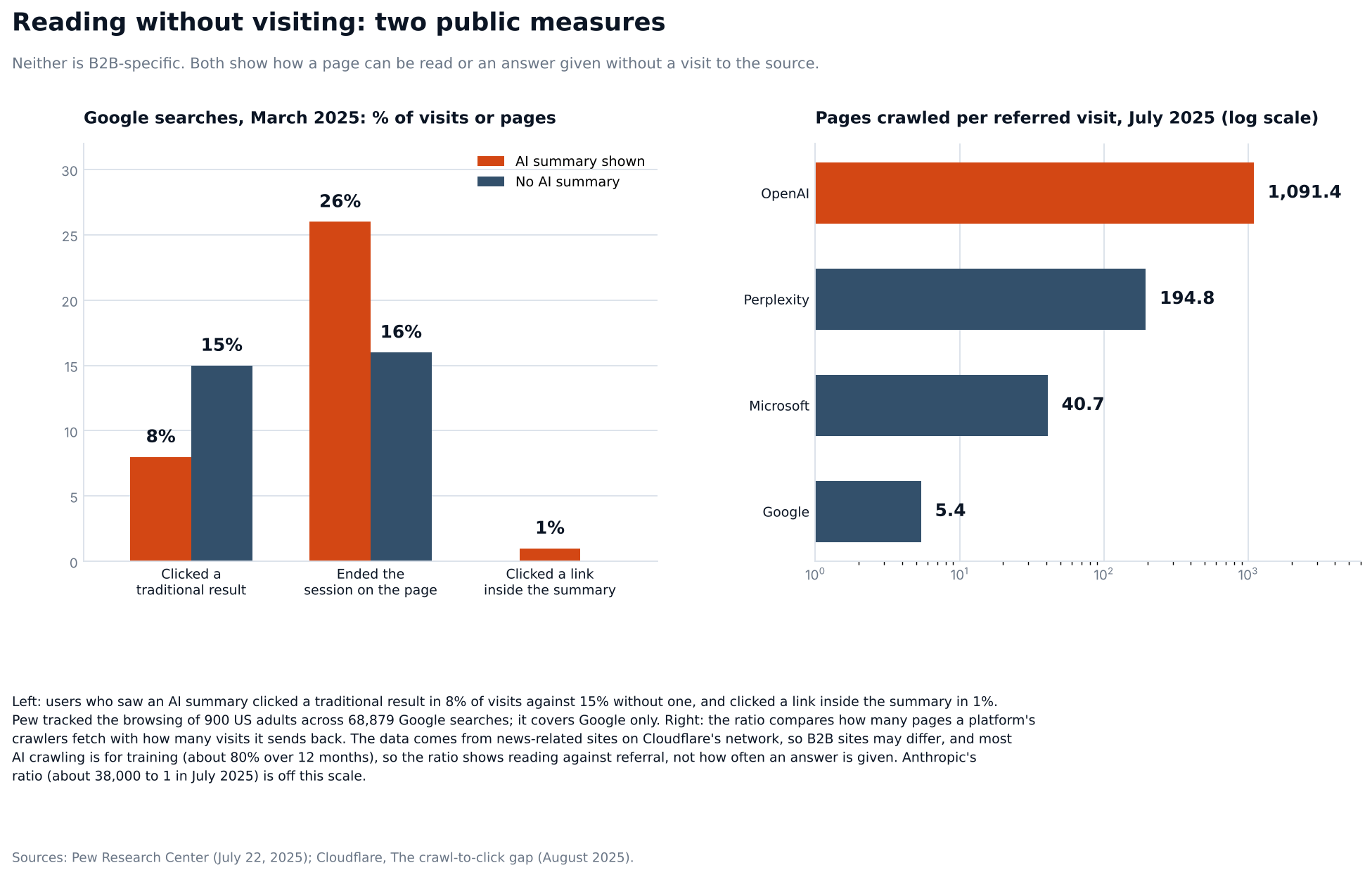
Pew Research tracked the browsing of 900 US adults across 68,879 Google searches in March 2025. When a search page showed an AI summary, users clicked a traditional result in 8 percent of visits, against 15 percent when there was no summary. They clicked a link inside the summary in 1 percent of visits, and they ended their session on the page 26 percent of the time, against 16 percent without a summary. That is Google's AI summaries only. We found no independent study of click behavior inside chatbots, which may differ.
Your pages are read and nobody visits
Cloudflare compared how many pages AI platforms' crawlers fetch with how many visits they send back. In July 2025 the ratio was about 1,091 pages per referred visit for OpenAI, 195 for Perplexity, 41 for Microsoft and 5.4 for Google. The data comes from news-related sites on Cloudflare's network, so B2B sites may look different, and most AI crawling is for training, about 80 percent over twelve months. The ratio shows how much more is read than is sent back. It does not show how often your page was used in an answer.
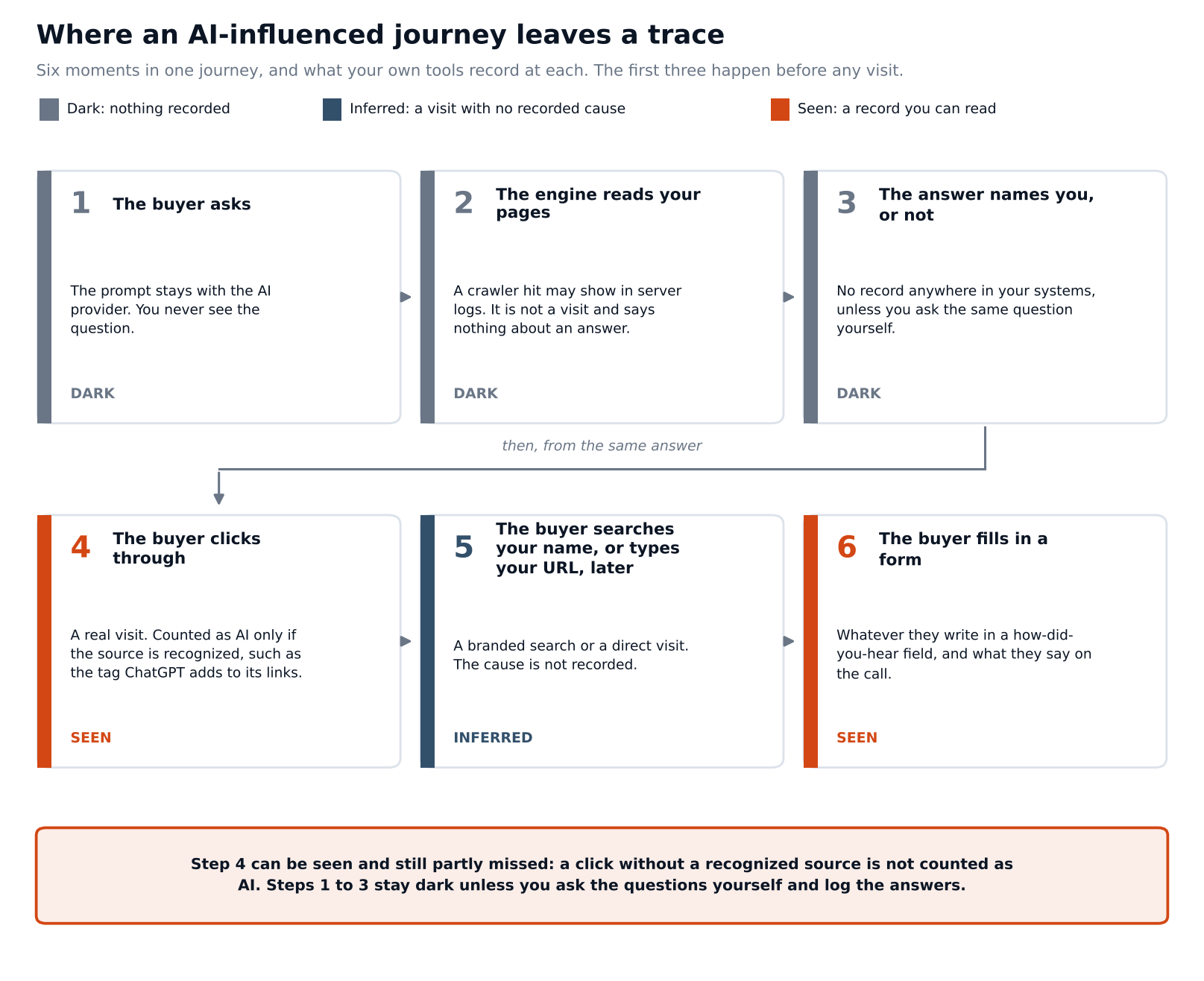
A visit arrives and nobody labels it. OpenAI says ChatGPT adds the parameter utm_source=chatgpt.com to referral links, and that publishers who allow its search crawler, OAI-SearchBot, can track that traffic in tools such as Google Analytics. Google Analytics 4 has an AI Assistant channel for visits from sources such as ChatGPT, Gemini, Deepseek, Copilot and Grok. Its documentation says the channel excludes Google's AI Overviews and AI Mode, so clicks from those stay with Google's other traffic. Google defines Direct as arrival by a saved link or a typed address and says nothing about where an untagged click from an app lands. Do not assume. Test it: open a link to your site from inside an AI app, then see which channel GA4 reports it under.
How big is the part you cannot see?
Nobody has published a figure for it, but the pressure on it is easy to describe. Pew's 2026 survey of 5,119 US adults found 49 percent use AI chatbots, and searching for information is among the uses it lists. G2's March 2026 survey of 1,076 software buyers found 51 percent start research with a chatbot more often than with Google, 69 percent said a chatbot led them to choose a different vendor than they expected, and about one in three had bought from a vendor they had not heard of before. Forrester's 2026 report says generative AI search is now where buyers start, and that they then lean on colleagues and outside influencers to confirm what they found. Those conversations are another dark channel, and they sit on top of the AI one.
What does not exist is a public study that follows B2B buyers from an AI answer to a purchase and counts the share that never left a click. Pages that put a precise number on the hidden part should be read with care: one we traced states that 93 percent of AI search sessions end without a website visit and names no study. Our piece on what independent data shows about commercial intent in ChatGPT covers why even the basic usage figures are harder to pin down than they look.
| Question | Best public source | What it supports | What it does not support |
|---|---|---|---|
| Do users click less when an AI summary appears? | Pew, March 2025, 900 US adults | Fewer clicks on Google results pages with a summary | Chatbot behavior, B2B behavior, or any later period |
| Do AI platforms read more than they send? | Cloudflare, Jan to Jul 2025 | Crawls far outnumber referrals on news-related sites | B2B sites, or how often a page appears in an answer |
| Do buyers use AI to start and then verify? | G2 survey and interviews, 2026 | What buyers say they do | A share of buyers or any link to who won |
| How many buyers does AI influence without a click? | None found | Nothing | Any specific percentage |
What you can see today
Four sources give you records, each a floor and not a total.
- The AI Assistant channel in GA4. Check which landing pages these visits reach. They show where an answer sent a buyer, and which pages answers cite often enough to produce clicks.
- Server or CDN logs. Crawler requests by page tell you which pages the AI crawlers fetch. Treat that as reading, not as appearing in an answer.
- A how-did-you-hear field on forms. Free text, with "AI assistant" as an option and a follow-up asking which one. Self-reports show what buyers say, and they capture the buyer who typed your name later.
- Sales-call notes. Add a tag for calls where the buyer says an AI tool suggested you or compared you with a rival. A short tag costs little and gives you quotes to set beside the numbers.
All four undercount. A visit without a recognized source is missing from the first, and the buyer who never fills in a form is missing from the third.
What you can infer, and how far to trust it
Branded search and direct visits are where a buyer who met your name in an answer is most likely to show up later. That is a plausible mechanism, and no study has measured it. Treat it as a pattern to examine, with three safeguards.
Set a baseline before you change anything. Keep a dated log of what you change: new pages, new reviews, new mentions elsewhere. Then compare like with like, the same pages and the same weeks, and look for rises that follow a change. If direct visits to your comparison page climb in the month after you rewrite it, and an answer you check starts describing you the way the page does, you have something worth a note. You do not have a result. Seasonality, campaigns and sales activity move the same lines.
Search Console clicks on queries that contain your brand name are a useful companion line. They cover Google only, so they miss buyers who open your site from a chatbot, but they show whether more people are looking for you by name.
What you can learn only by asking
The prompts buyers type, the answers they read and the vendors those answers name leave nothing in your systems. The one way to see them is to ask. Run a fixed set of questions in the engines your buyers use, several times each, and log whether you are named, where, in what words and with which cited pages. Our piece on what B2B buyers actually ask ChatGPT describes the kinds of question worth including, and the audit sheet that goes with our shortlist piece gives you a layout.
Answers vary from run to run and engine to engine, so one run tells you little. Our piece on model variability in AI citations explains why, and why you should report the share of runs that named you, not one answer. This number describes a sampled test. It says nothing about how many real buyers saw the answer.
A reporting layout that keeps the tiers apart
The mistake to avoid is adding the tiers together. Keep them in separate rows, and give each its own label.
| Tier | What goes in it | Example measures | Label to use in a report |
|---|---|---|---|
| Seen | Records from your own tools | GA4 AI Assistant sessions, landing pages, form fields that mention AI, tagged calls | AI-referred visits (a floor) |
| Inferred | Visits with no recorded cause | Brand-name search clicks, direct visits to key pages, set beside a change log | AI-associated change (inferred) |
| Asked | What you learn by asking | Share of sampled runs that named you, the words used, pages cited | Answer presence (sampled) |
Three rules go with it. Never sum the rows. Show the Seen row as a floor. Use the word "influenced" only for buyers who said so themselves.
Questions people ask
Is AI traffic just filed as direct in GA4?
Some of it may be. GA4 has an AI Assistant channel that matches visits from recognized sources, and ChatGPT adds a tag to its links. Google's documentation does not say where untagged arrivals land, so test it by opening a link from inside an app and checking the report.
Should we ask buyers whether they used AI?
Yes, as a free-text field with a follow-up. It records what buyers say they did, which is useful and incomplete. Use it alongside the other tiers, not in place of them.
Does blocking AI crawlers make this darker?
Tracking ChatGPT referrals in analytics depends on allowing OAI-SearchBot, according to OpenAI. That is a measurement reason to review a block. Whether to block is a separate decision with its own trade-offs, and we do not cover it here.
Can one number summarize the dark funnel?
No. Each tier measures something different with a different error, so a single total would hide which part you can defend.
Report what you can defend
The dark AI search funnel is mostly a labeling problem. What you can see is a floor, what you can infer is a pattern, and what you can ask is a sample. Reports hold up when each is named for what it is. Run a few of your buyers' questions through the AI Search Visibility Checker for a first look at how an answer describes you today. When you want the asked tier to be a log and not a one-off, AI Search Intelligence tracks each prompt individually, so you can set what the answers say next to the visits and form fields your own tools record.