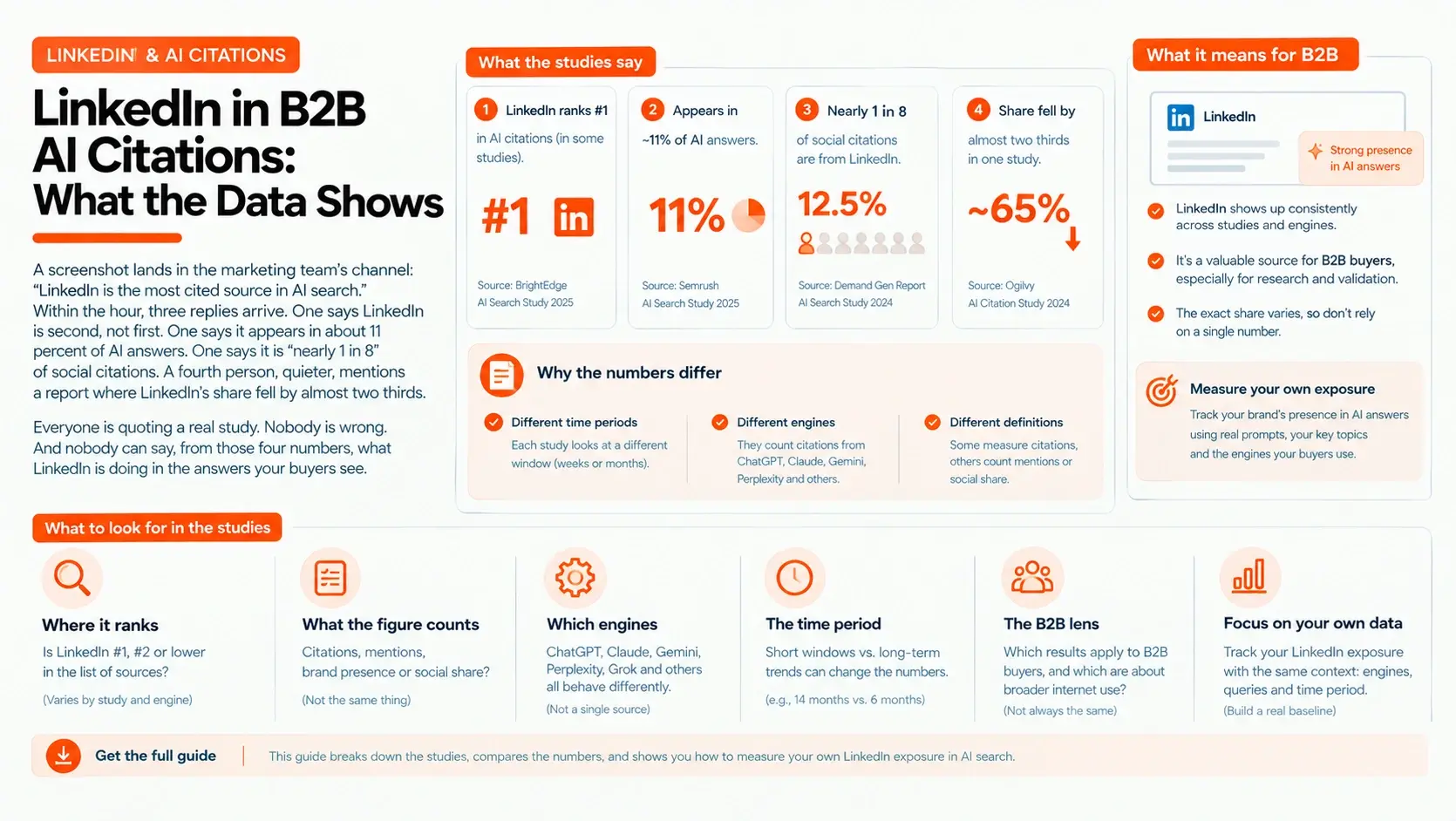


A screenshot lands in the marketing team's channel: "LinkedIn is the most cited source in AI search." Within the hour, three replies arrive. One says LinkedIn is second, not first. One says it appears in about 11 percent of AI answers. One says it is "nearly 1 in 8" of social citations. A fourth person, quieter, mentions a report where LinkedIn's share fell by almost two thirds. Everyone is quoting a real study. Nobody is wrong. And nobody can say, from those four numbers, what LinkedIn is doing in the answers your buyers see.
This article reads the published studies on LinkedIn and AI citations side by side. It covers where LinkedIn ranks, what each figure counts, what the studies agree on, where they split, and how much of it applies to B2B. Then it shows how to measure your own LinkedIn exposure instead of borrowing someone else's. It uses public research only. It contains no Omnibound data, and each figure is attributed to its source with the limits that source states.
Four claims hiding in one headline
"LinkedIn dominates AI citations" bundles four separate claims, and each has its own evidence.
The first is a rank claim: LinkedIn sits at or near the top of the most-cited domains. The second is a share claim: LinkedIn accounts for a given percentage of answers or citations. The third is a content claim: certain kinds of LinkedIn pages, written by certain kinds of authors, are the ones that get cited. The fourth is a trend claim: LinkedIn's presence is growing, or shrinking.
A study can support one of these and say nothing about the others. Most of the confusion in circulation comes from quoting a figure that supports one claim as if it settled all four.
The studies side by side
The table lists the main published figures. Read the last two columns as part of each number.
| Source | Window | Engines | Prompts | What the LinkedIn figure counts | Reported figure | The source's own limits |
|---|---|---|---|---|---|---|
| Semrush | Jan to Feb 2026 | ChatGPT Search, Google AI Mode, Perplexity | 325,000 prompts, 12 categories, mostly business topics | Share of AI responses that reference LinkedIn | About 11% on average: 14.3% ChatGPT Search, 13.5% AI Mode, 5.3% Perplexity | No B2B-only split |
| Profound | Nov 2025 to Feb 2026 | Six engines | Real ChatGPT prompts for rank; a synthetic basket for professional queries | Domain rank, and the mix of LinkedIn URL types | #5 on ChatGPT, up from about #11; #1 for professional queries | Basket size not stated; no figures for competing domains |
| Otterly.AI | Jan to Jun 2026 | Six engines | Query set not described | LinkedIn's share of social media citations | 7.8% in January to 11.7% in May, "nearly 1 in 8" | Does not say whether queries were B2B |
| Foundation x AirOps | Dec 2025 to Feb 2026 | Five engines | 50 B2B brands, about 65% unbranded | LinkedIn within the report's list of leading sources | About 11%, behind Reddit (20.8%) and YouTube (13%) | The base for "external" is not defined in detail |
| cloro | Feb to Jul 2026 | ChatGPT, Perplexity, AI Mode, Copilot | 116 fixed prompts, commercial topics such as retail, travel and software | Share of answers that cite any LinkedIn URL | 13.8% falling to 4.8% | The authors say it does not reflect B2B or recruiting questions |
| Meltwater, May 2026, as reported by trade press | Not stated | Six platforms | B2B categories | LinkedIn's share of all citations | 0.53%, second behind YouTube at 1.52% | Prompt set and method not published in the coverage |
| Meltwater, August report | Mar to Aug 2026; August against July | Eight engines | Consumer categories such as retail banking, automotive and streaming | LinkedIn's citation count | Third, behind YouTube and Reddit; citations up 24.8% on July | Consumer prompts; the report says preferences vary by prompt, category and timing |
Most of these studies come from companies that sell AI visibility tracking. That is a reason to read the method, not a reason to dismiss the numbers. We sell in this category too, which is one more reason to show the working.
A few of the figures above reached this article through summaries or trade coverage. Before you quote any of them in your own work, open the source and check the number against the page.
Where LinkedIn ranks
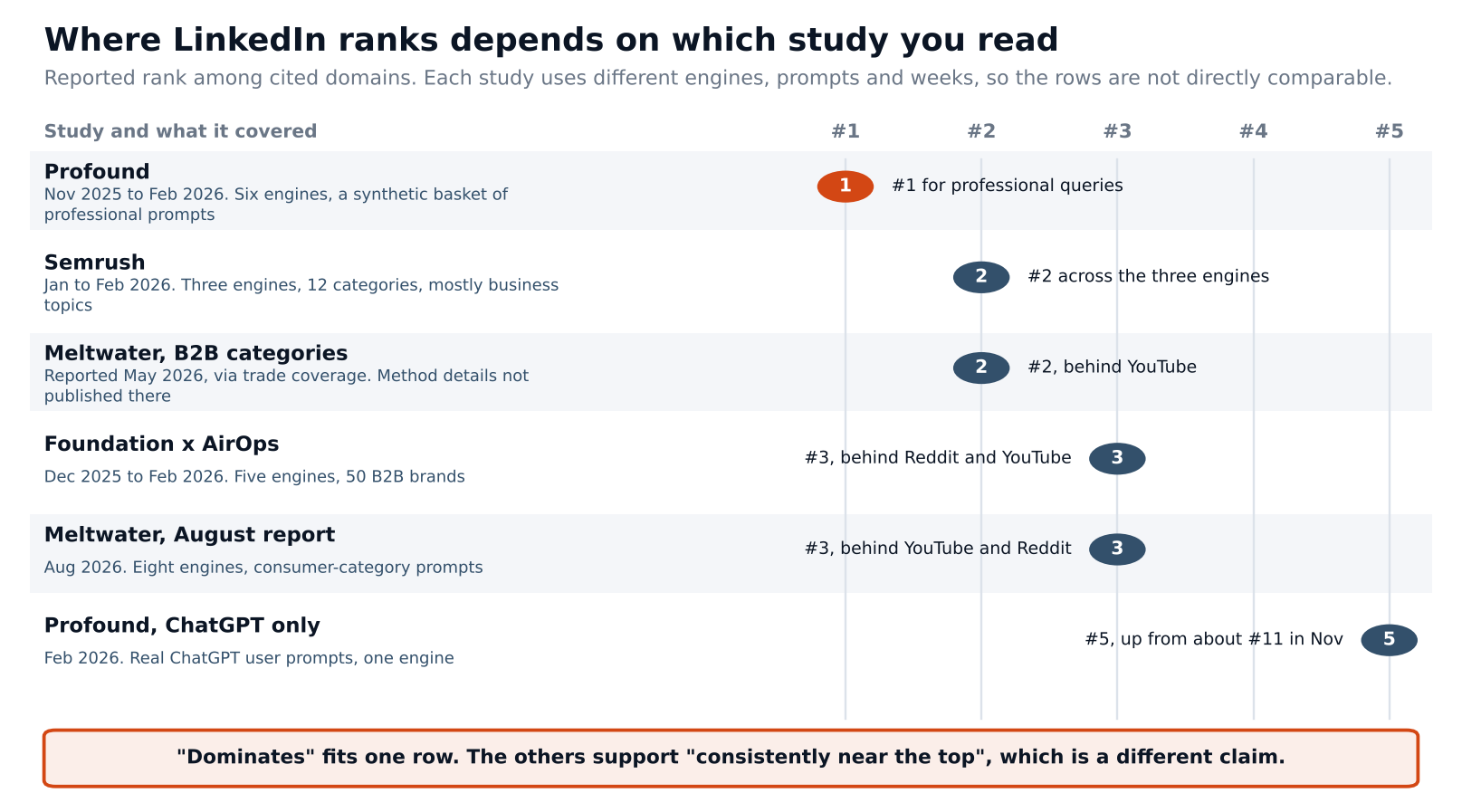
Rank is the claim that travels furthest, and it is the least stable. Profound reports LinkedIn as the number one cited domain for professional queries across the six engines it tested. That finding comes from a synthetic basket of professional prompts, and the report does not state how many prompts it contained or how the basket was built. Semrush puts LinkedIn second across its three engines. Foundation's B2B dataset has it third, behind Reddit and YouTube. Meltwater's August report has it third as well, behind YouTube and Reddit, on consumer prompts. Profound's ChatGPT-only rank, from real user prompts, is fifth.
Put together, these support a modest and defensible sentence: LinkedIn is consistently among the most cited domains, and it ranks first on professional questions in at least one study. They do not support "dominates." No study here shows LinkedIn ahead of Reddit and YouTube across B2B questions in general, and the one study built specifically on B2B brands has it in third place.
That does not make LinkedIn unimportant. Third place among cited domains is a strong position. It means the question to ask is not "is LinkedIn number one?" but "for the questions my buyers ask, on the engines they use, how often does LinkedIn show up, and does it say anything about us?"
Three elevens and a half percent
Three of the studies produce a figure close to 11 percent. They are not the same figure.
Semrush's 11 percent is the share of AI responses that reference LinkedIn. Foundation's 11 percent is LinkedIn's slice in a list of leading sources, in a dataset where 90 percent of citations point somewhere other than the 50 brands studied. "nearly 1 in 8," is LinkedIn's share of citations to social media platforms only. Each is correct for what it counts. Swap one denominator for another and the same underlying behavior would produce a different number.
Then there is Meltwater's May figure, reported as 0.53 percent of all citations. It is not a contradiction either. A share of every citation across every domain will always be smaller than a share of social citations or a share of responses that contain at least one LinkedIn link. If LinkedIn is cited in a tenth of answers but those answers each cite many other domains, its share of all citations will be a small fraction.
The same reasoning applies to the studies of Reddit. Our reading of the Reddit data walks through the five checks for any share statistic: what is counted, what it is divided by, which engine, which prompts, and which weeks. They apply here without change.
What the studies agree on
Where the studies speak to the same question, the answers line up more than the headline numbers suggest.
The content that gets cited is original and educational. Semrush found that about 95 percent of cited posts were original rather than reshares, and that educational and advice content made up 54 to 64 percent of cited posts, with promotional posts well behind.
Length is moderate, not extreme. Semrush found cited articles concentrated between 500 and 2,000 words, and cited posts most often between 50 and 299 words. Otterly's medians point the same way: about 1,000 words for articles and under 200 for posts.
Individual authors outweigh company pages in most readings. Meltwater's figure, as relayed in a LinkedIn playbook published in August, is that individual member profiles produce about 75 percent of LinkedIn citations. Semrush shows the same lean on ChatGPT Search and Google AI Mode, with Perplexity the exception, favoring company accounts.
Engagement is a weak signal. Semrush found a median cited post with 15 to 25 reactions and no more than one comment. Otterly found likes, comments, emojis and hashtags correlated near zero with citations. A post does not need to go viral to be cited.
Consistency shows up in the authors. Semrush found that nearly three quarters of cited authors had posted five or more times in a four-week period, and that about half had more than 2,000 followers, while accounts below 500 followers were still cited regularly.
These are patterns in which LinkedIn pages get cited. They are not tests of what causes citation. The authors who post often may also be the ones whose posts are relevant, specific and well written, and the studies do not separate those effects.
Where they split on content type
The content-type numbers are the least consistent, and they are worth reading slowly because they are the ones most often turned into advice.
Semrush reports that articles account for 50 to 66 percent of LinkedIn citations and feed posts for 15 to 28 percent. Otterly reports that long-form articles account for about 72 percent of LinkedIn citations, posts for about 26 percent and profile pages for under 2 percent. Profound's picture is different in a way that matters: it shows profile pages falling from 33.9 percent of LinkedIn citations in November 2025 to 14.5 percent in February 2026, posts rising from 20.9 to 26.0 percent, and long-form articles rising from 6.0 to 8.9 percent.
Articles at about 9 percent, 50 to 66 percent and 72 percent cannot all describe the same thing. The likely reasons are differences in what each study counted as a page type and what it removed before counting. Otterly says it filtered its sample to content pages first, dropping non-content pages such as job listings and company pages. Profound's report does not describe that step. Each study also covers different engines and weeks, and the mix of LinkedIn page types an engine cites is likely to shift with how it retrieves sources. None of the reports tests these explanations.
The safe reading is that both articles and posts are cited, that the balance between them differs by study, and that profile pages are a smaller and, in Profound's data, shrinking part of the picture. Anyone who tells you that one format wins should be able to say which study, which engine and which weeks.
Engines: share of answers against count of citations
The studies disagree about which engine cites LinkedIn most, and the disagreement comes partly from measuring different things.
Semrush measures the share of responses. On that measure, ChatGPT Search (14.3 percent) and Google AI Mode (13.5 percent) are well ahead of Perplexity (5.3 percent). Otterly counts citations. On that measure, Perplexity accounts for 43.3 percent of all the LinkedIn citations in its dataset, ahead of Google AI Overviews at 22.2 percent and ChatGPT at 18.7 percent. Meltwater's August report goes further: Perplexity generated about 69 percent of the LinkedIn citations in its sample, and ChatGPT and Gemini recorded none.
One reading that fits all three is simple arithmetic. An engine that lists many sources per answer produces many citations from a given share of answers. A count of citations favors engines that cite generously. A share of responses does not. That is a reading of the numbers, not something any of the studies tests.
The ChatGPT zero in the Meltwater report sits oddly beside Semrush's 14.3 percent. Different prompts, different collection methods and different months are the likely explanations, and none of the reports resolves it. If ChatGPT matters to your buyers, treat LinkedIn's ChatGPT presence as something to measure on your own prompts rather than assume.
Rising or falling?
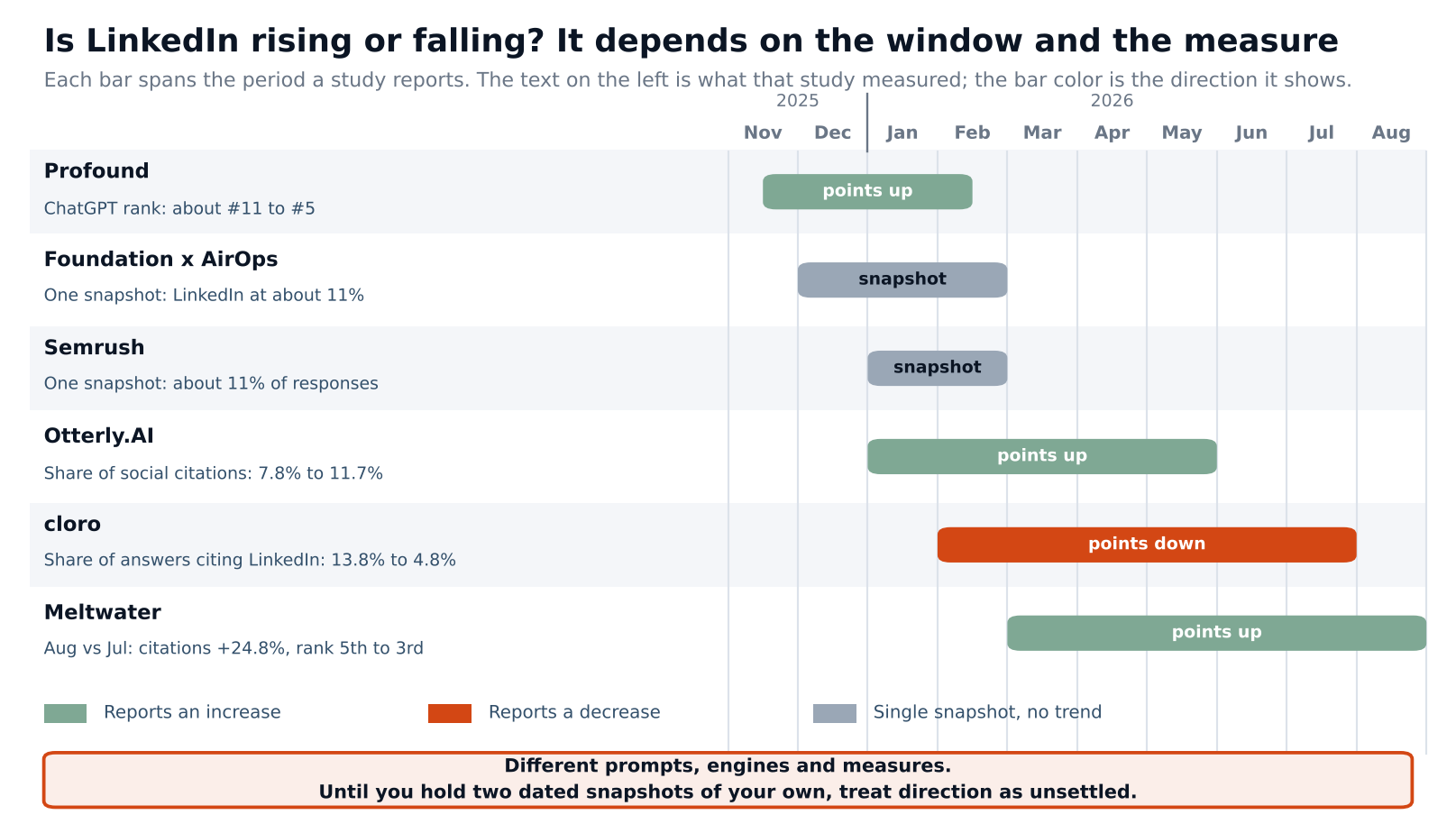
The trend claims point in different directions, and the chart above shows why. Profound reports that LinkedIn's rank on ChatGPT moved from about 11th to 5th between November and February, roughly doubling its citation frequency. Otterly reports LinkedIn's share of social citations rising from 7.8 percent in January to 11.7 percent in May.
Meltwater's August report shows LinkedIn up 24.8 percent in citations on July and moving from fifth to third place.
cloro reports the opposite. Holding 116 prompts constant from February to July, it found the share of answers citing any LinkedIn URL fell from 13.8 percent to 4.8 percent, and the share citing LinkedIn articles fell from 10.7 to 2.8 percent. The authors note that the number of sources per answer fell far less, by about 20 percent, which they read as a real shift in preference rather than fewer citations overall. They also note that their prompts are commercial rather than B2B.
These can all be true at once. Profound's window ends in February, where cloro's begins. Otterly measures a share of social citations, which can rise while LinkedIn's share of all answers falls. Meltwater measures one month against the previous one, on consumer prompts. They use different prompts, different engines and different measures.
The plain summary is that nobody has published a trend for B2B questions that two independent studies agree on. A claim that LinkedIn is "growing" or "fading" needs two dated snapshots of the same prompts on the same engines. The studies above have that in different shapes, but none has it for yours.
What a B2B team can do with this
The agreed patterns are cheap to act on, as long as you treat them as reasonable bets rather than guarantees.
- Publish original, specific advice, not reshares. Pick the questions buyers ask before they have a shortlist, and answer them from your own experience, with a concrete example or number you can stand behind.
- Put named people in front. Because individual authors are cited more than company pages in most readings, the people who know the subject, such as a head of implementation or a customer success lead, are better candidates than a brand account. This pairs with the attributed expertise that engines can check.
- Make the profile say the same thing as the site. An engine that tries to work out who you are meets your site, your LinkedIn page and your review listings. If they describe you differently, it has three candidate pictures. The guide to entity SEO for AI search covers how to fix that.
- Keep a steady rhythm instead of chasing reactions. Frequent posting showed up among cited authors, and reaction counts barely mattered. A modest weekly cadence from two or three experts is more consistent with the data than an occasional post built to travel.
- Treat LinkedIn as one source among several. It sits beside reviews, community threads and independent coverage, all of which appear in the studies. The offsite signals map shows how they fit together, and the comparison of first-party and third-party citations explains why the independent ones count differently.
One limit applies to all five. These studies measure which LinkedIn pages get cited. They do not measure whether posting on LinkedIn makes an engine name your brand. A cited post by your head of product is a good outcome, and it is a different outcome from being recommended. Teams that want a structured plan for the offsite side can look at AI authority building.
How to measure your own LinkedIn exposure
The published numbers describe other people's prompts. Yours is the one that matters, and the method is the same one you would use for any source.
Fix a set of 15 to 30 prompts that a buyer would type, spread across discovery, comparison, alternatives and implementation questions. Fix the engines. Run each prompt several times per check, on the same schedule, because answers vary from run to run. Then record, for every run, the pages cited.
From that log, calculate three shares and label the denominator every time. The first is the share of runs that cite any LinkedIn page. The second is the share of runs that cite a LinkedIn page from your company or your named experts. The third is the share of runs where a cited LinkedIn page describes you accurately. The first tells you how much LinkedIn matters for your questions. The second tells you whether you are part of that. The third is the one that touches pipeline.
Then split the cited LinkedIn pages by type, article, post, profile or company page, and report the mix as percentages of the LinkedIn citations in your own log. That tells you which kind of page your buyers' engines actually read in your category, which no published study can.
What we do not know
None of these studies tests why LinkedIn is cited. Whether it is the authority of the platform, the way pages are structured, how readily engines can retrieve them, or the quality of the writing is open, and each would imply different advice. We also do not know how much of LinkedIn's presence is B2B-specific. Only one dataset here is built on B2B brands, and it reports a single window.
The direction of travel is unsettled, for the reasons above. The Meltwater May figures reached us through trade coverage, without the method. And we do not know how stable any of this is. The Reddit data moved from about 60 percent to about 10 percent of ChatGPT responses within two months in 2025, and a source that large can change quickly. Treat every number here as a reading of its own weeks.
Questions people ask
Is LinkedIn the most cited source in AI search?
In one study of professional queries it ranks first. In others it ranks second or third, behind Reddit and YouTube. The ranking depends on the prompts, engines and weeks.
Do company pages or personal profiles get cited more?
In most of the readings above, content from individual authors accounts for most LinkedIn citations: about 75 percent in Meltwater's figure and about 88 percent of cited content URLs in Otterly's. Semrush found Perplexity favoring company accounts.
Do likes and comments help a post get cited?
The evidence says very little. Semrush's median cited post had 15 to 25 reactions and at most one comment, and Otterly found engagement signals correlated near zero with citations.
Do LinkedIn articles or posts get cited more?
Both are cited. Articles account for a larger share of citations in the studies that report it, though the share ranges from 6 to 72 percent depending on the study and what it counted.
How long should a LinkedIn post or article be?
Semrush found cited articles most often between 500 and 2,000 words and cited posts between 50 and 299. Those are descriptions of what was cited, not targets that cause citation.
How often should we post?
Nearly three quarters of the authors cited in Semrush's data posted five or more times in four weeks. That is a pattern among cited authors, not proof that frequency causes citation.
Does a LinkedIn citation mean the engine recommends my brand?
No. A cited page can mention you, describe a competitor, or answer a general question. Check what the cited page says.
What to say when the screenshot comes around
When someone shares "LinkedIn dominates AI citations," a more accurate reply is a single sentence: LinkedIn is consistently one of the most cited domains in several studies, ranks first only for professional queries in one of them, and the figures move with the engine, the prompts and the weeks. That is enough to justify putting your experts to work on it. It is not enough to stop watching.
To see what engines say about your company today, the AI Search Visibility Checker is a quick first read, and it usually shows which descriptions need fixing. AI Search Intelligence keeps the prompt set, the cited sources and the trend in one place, so you can see whether LinkedIn, and what it says about you, is changing for the questions your buyers ask.