


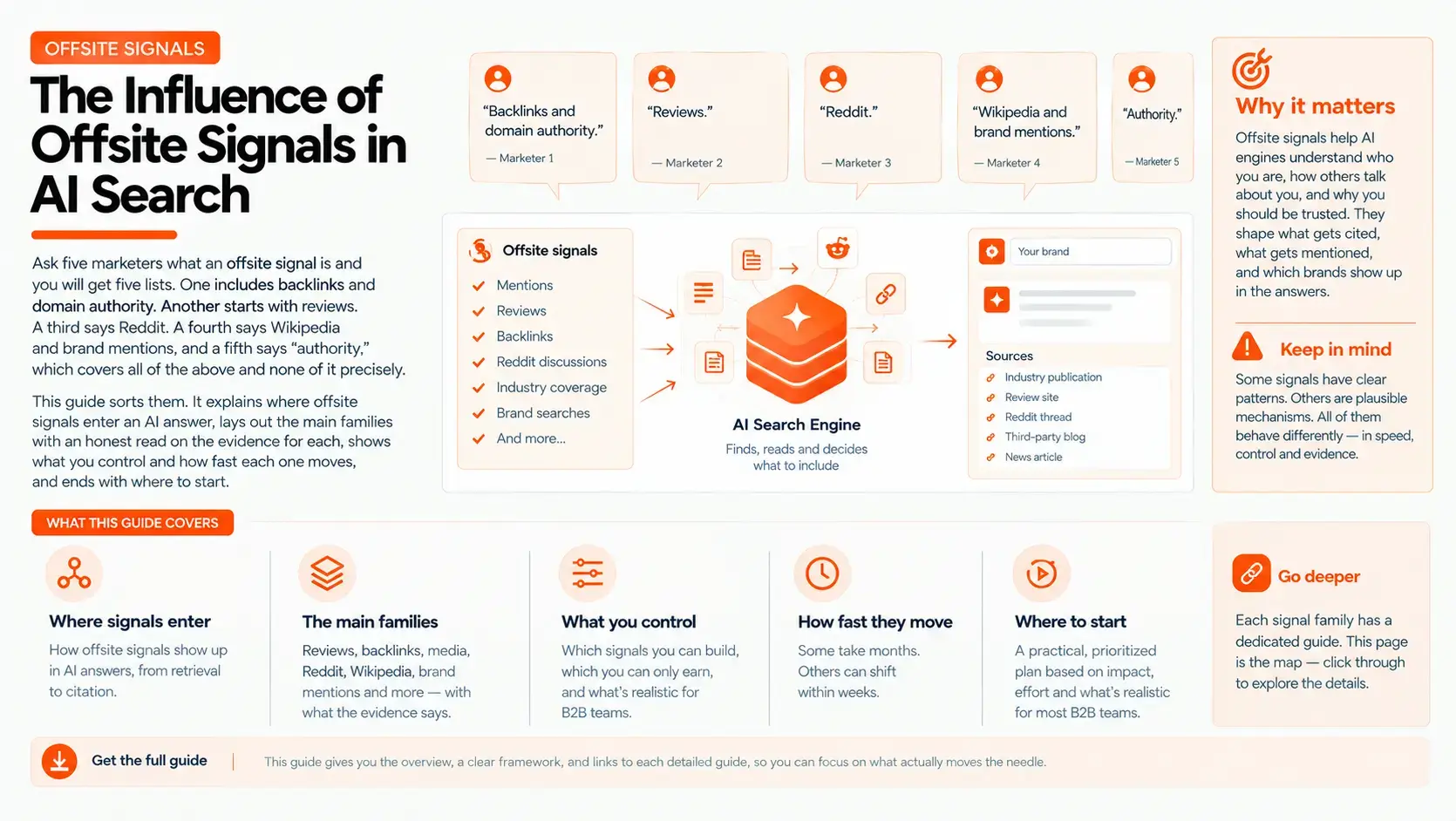


Ask five marketers what an offsite signal is and you will get five lists. One includes backlinks and domain authority. Another starts with reviews. A third says Reddit. A fourth says Wikipedia and brand mentions, and a fifth says "authority," which covers all of the above and none of it precisely.
The lists are all partly right, which is the problem. Treating them as one pile makes it hard to decide what to do first, because the items in the pile behave differently. Some have documented patterns behind them and some rest on a plausible mechanism. Some move slowly and some swing within weeks. Some you can build yourself and some you can only earn.
This guide sorts them. It explains where offsite signals enter an AI answer, lays out the main families with an honest read on the evidence for each, shows what you control and how fast each one moves, and ends with where to start. For each family there is a dedicated guide that goes deeper; this page is the map, and it links to each of them instead of repeating them.
What people mean by offsite signals
An offsite signal is anything on a page you do not control that tells an AI system something about your company: that it exists, what it does, who it is for, how people feel about it, and whether independent sources agree. The page can be a review, a roundup, a news article, a forum thread, a partner's integration page, a podcast transcript, an encyclopedia entry or a customer's write-up.
Two clarifications keep the rest of this article tidy.
First, offsite is not the same as off-page SEO in the older sense. Link building asks whether a page passes authority to yours. This guide asks a different question: what do independent pages say about you, in how many places, and do they agree? A page can be valuable to an AI system without linking to you at all.
Second, offsite signals sit beside your own site, not above it. If the first-party half is not in place, offsite work has nothing accurate to echo. The guide to what signals make AI models cite a webpage covers the whole picture, including what you control directly. This article zooms into the half you earn.
Where offsite signals enter an answer
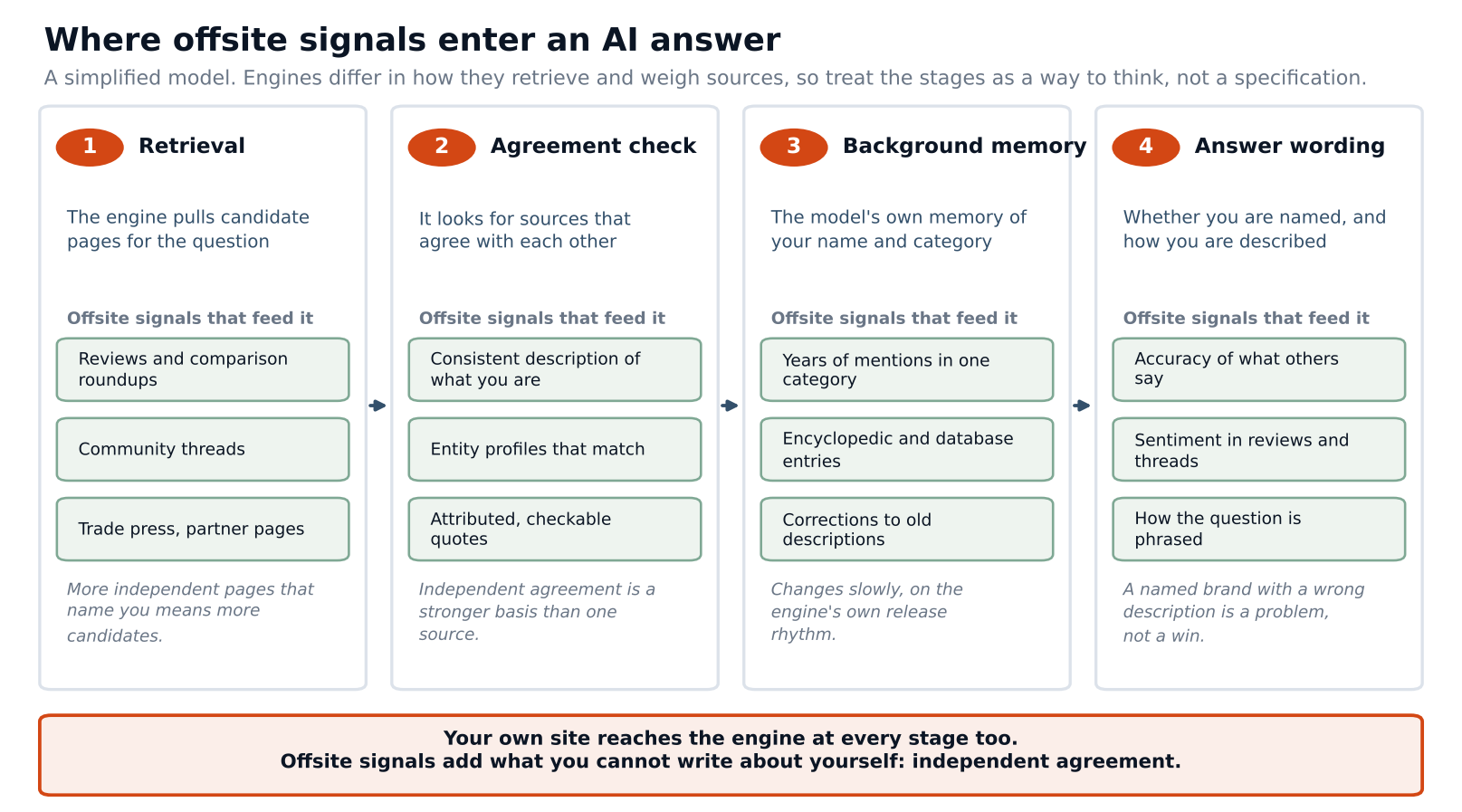
The diagram shows a simplified model of how an answer comes together. Engines differ, and none of them publish their full recipe, so read it as a way to think, not a specification.
At the retrieval stage, the engine pulls candidate pages for the question. Every independent page that names you is another candidate. At the agreement stage, it looks for sources that say the same thing; independent agreement is a stronger basis for naming a company than a single page making claims about itself. Behind both sits the model's own background memory of your name and category, which changes slowly and on the engine's own schedule. The last stage is the wording of the answer: whether you are named and how you are described.
Offsite signals feed all four stages. They add candidates, they supply agreement, they shape the long-run association between your name and your category, and they decide what the engine has to say about you when it does name you. That last point deserves emphasis. A mention is not automatically good news. If the pages describing you are out of date or wrong, more offsite signal makes the wrong description more likely to be repeated.
The signal ledger
The table lists the main families. "Evidence" is a plain label for how much is actually known: documented means a published study shows a pattern, plausible means the mechanism makes sense but nobody has tested it directly, and unstable means the pattern is documented but moves a lot.
| Signal family | What it is | Why an engine might use it | Evidence | Read more |
|---|---|---|---|---|
| Independent mentions | Pages you do not control that name you and say what you do | More candidate pages; independent agreement | Documented pattern (correlational) | How offsite brand mentions compound |
| Reviews, roundups and press | Review profiles, comparison pages, trade coverage, analyst notes | Sources engines read for "which tool" and "what do people think" questions | Plausible; share varies by study | First-party vs third-party citations |
| Community discussion | Forum threads, Q&A, public discussion | Practitioner experience in buyers' own words | Documented, unstable | The data on Reddit and B2B AI search |
| Entity corroboration | Consistent profiles and records that confirm who you are | Identifies you as one distinct company in one category | Plausible | Entity SEO for AI search |
| Attributed expertise | Named experts quoted on your pages or on others | A checkable source for a claim | Limited, with caveats | Do expert quotes earn LLM citations? |
| Consistent description | The same plain account of what you are, everywhere | Makes agreement across sources easy | Plausible | Entity and mentions guides above |
| Backlinks and domain authority | Links and authority scores for your domain | Classic search ranking input | Weak relationship with AI mentions in the one large study | Covered below |
Treat the evidence column as a reason to sequence the work, not to ignore the lower rows. A "plausible" signal can still be cheap to fix, and a "documented" one can still be out of your reach in a given quarter.
Independent mentions: the strongest documented pattern
The most cited piece of evidence in this area is Ahrefs' analysis of 75,000 brands. It found that how often a brand is mentioned across the web correlates with how often AI engines mention it, at roughly 0.66 to 0.71 across ChatGPT, AI Mode and AI Overviews. Backlink-based measures showed much weaker relationships in the same study. The full study states its own limit: correlation is not causation. It also covers brands with an established web presence, so a young B2B company with a small footprint may sit differently.
That is a strong pattern with an obvious mechanism and no controlled proof. The practical reading is modest. Being written about, independently and accurately, in many places looks like part of what makes a brand easy for an engine to name. It does not give you an exchange rate between new mentions and new citations.
The mechanism matters more than the correlation, and it is covered in full in the guide to how offsite mentions compound: more pages to retrieve, agreement among independent sources, roundups that pick from what already exists, and visibility that feeds awareness. It also separates the mentions that compound from the ones that sit idle, using two tests: is the page independent of you, and can an engine fetch and read it?
Reviews, roundups and press
When a buyer asks which tool to use, an engine tends to lean on pages that compare tools or report what customers think. Review profiles, "best tools for X" pages, analyst coverage and trade press are the usual suspects, and the distinction that matters is who wrote them. A review written by a customer and a placement you paid for are both pages, but only one of them is independent.
The evidence here is mostly descriptive: studies of which domains get cited show review and comparison sources appearing regularly for vendor questions, with the share varying by study, engine and week. That supports treating them as a priority and does not support a promise of any particular share.
The working method is a gap list. Run your buyer prompts, record the pages cited, and sort them into pages that already name you, pages that name only competitors, and pages about the category that name no one. The second group is your list of reachable targets. The guide to first-party versus third-party citations explains why B2B teams tend to under-invest in this side, and how to avoid the shortcuts that backfire.
Communities: large, useful and unstable
Community discussion is the most visible offsite signal and the least stable. Public threads hold practitioner experience in the questions buyers actually ask, which is why engines read them. Published studies also disagree about how large the share is, and several have recorded sharp drops and rises within weeks, in different engines, at different times.
The sensible stance is to treat communities as worth taking part in for their own sake, because buyers read them, and to treat their share of AI citations as something to watch, not to plan around. The data on Reddit and B2B AI search sets the published figures side by side, explains why they differ, and gives a method for measuring your own exposure. Participation without gaming is the part of the job that is entirely in your hands: accurate answers, plain disclosure of affiliation, and no scripted or paid replies presented as independent.
Entity corroboration: being recognized as one company
An engine needs to be sure which company a page is about before it can use that page to describe you. Entity signals do that work: a clear page on your own site that says who you are, consistent profiles elsewhere, structured data that links them, and independent sources that describe you the same way.
Google's own documentation recommends marking up an organization with its name, URL, logo and the profiles that belong to it, and notes that no rich result is guaranteed. That is a reasonable basis for doing the work and a poor basis for expecting a specific outcome. The evidence for entity signals in AI answers is mostly inference from how identification must work, not direct testing. The guide to entity SEO for AI search covers the four levels of recognition, how to test each, and how to fix name collisions.
Entity work has a useful property: it sits in the part of the map you control, and it improves the accuracy of everything else. Fixing a vague or inconsistent description at the source gives every other offsite page something correct to copy.
Experts and authors: attribution that can be checked
Pages that attribute a claim to a named person with a real role give an engine something it can check. That is the logic behind adding expert quotes, and it is why the evidence is more nuanced than the popular summaries suggest. A well-known research paper tested quotation addition as one of several methods, in a controlled setting with its own limits, and later commentary tends to flatten those limits.
The guide to whether expert quotes earn LLM citations separates what the research measured from what it did not, describes two routes (a quote you publish and a quote you earn on someone else's page), and warns against the one thing that backfires: attributing words to a person who did not say them. For this map, the point is where it sits: it is partly in your control, because you choose who to interview, and partly earned, because the best version of it is being quoted by others.
Backlinks and domain authority: weaker than they look
Links still matter for ordinary search ranking, and they help engines discover pages. What the Ahrefs study suggests is a weaker relationship between link-based measures and how often AI engines mention a brand than between brand mentions and AI mentions. That does not make links worthless. It means a program built only on link acquisition is aimed at a different outcome than one built on being described accurately in many independent places.
A link from a page that also describes you well does both jobs. A link from a page that says nothing about what you do passes classic authority and gives an AI system little to quote. When you have to choose where to spend effort, the page that explains you in words is the better target.
What you control and how fast it moves
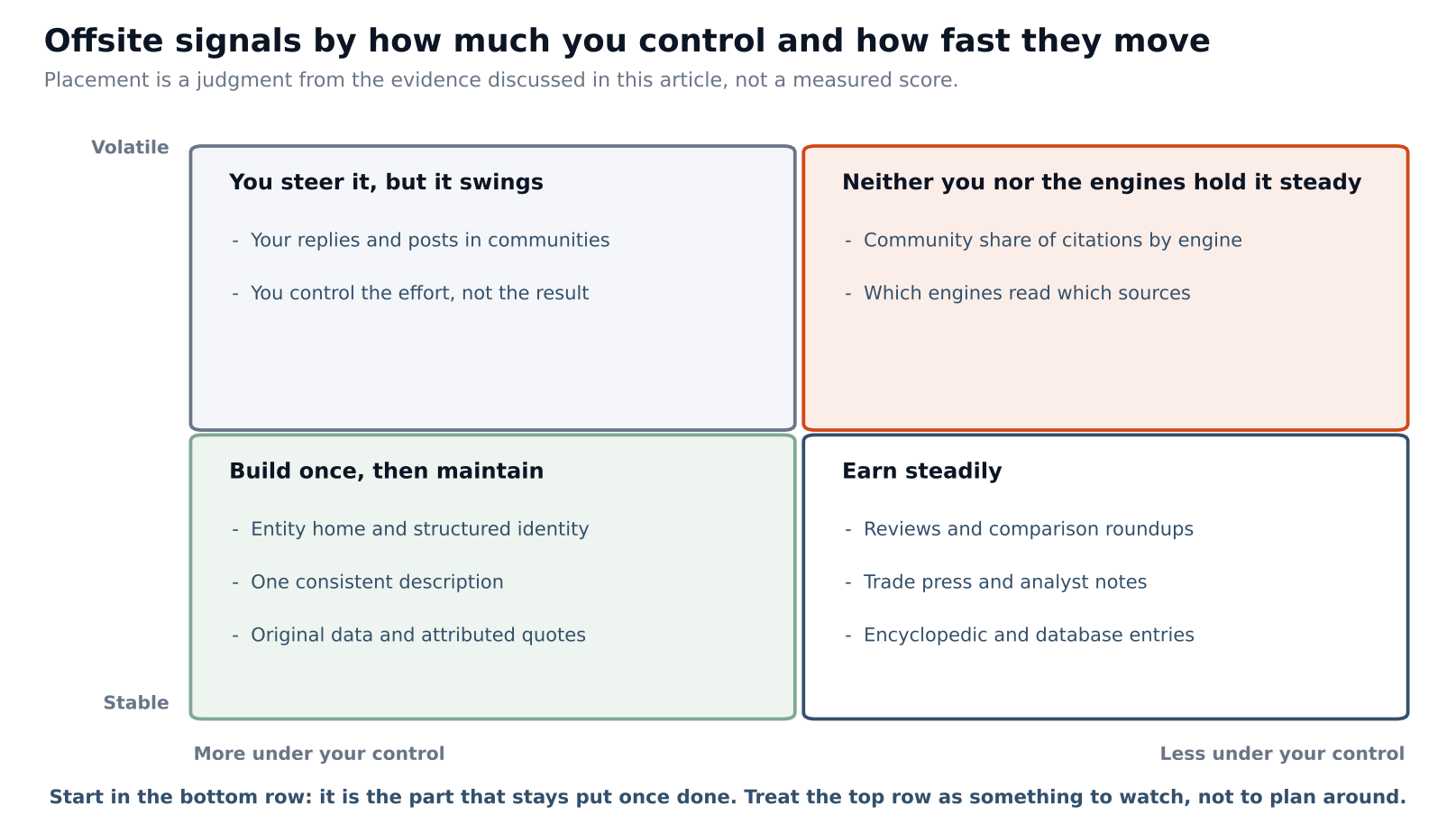
Plotting the families by control and stability makes the sequencing clearer.
The bottom-left quadrant is the part you build once and then maintain: your entity home, structured identity and one consistent description, together with the original data and attributed quotes you publish for others to use. It is stable because it sits on pages you own, and it makes every other signal easier to get right.
The bottom-right is earned, and moves steadily: reviews, roundups, trade press, analyst notes and encyclopedic or database entries. You cannot write these, but you can make yourself easy to cover and easy to describe correctly.
The top row is where the volatility lives. Your own participation in communities is under your control as effort, though not as result. The share of citations that communities earn, and which engines read which sources, are not under anyone's control and have moved sharply in published studies. Start in the bottom row, because it is the part that stays put once it is done.
Which questions lean on offsite signals most
Not every buyer question depends on offsite signals to the same degree. Definitions and how-to questions are answered mainly from explanatory pages, which is why your own educational content earns citations there. The questions that lean on offsite signals are the ones that ask for judgment: which tool for a given situation, what people regret, how two options compare, what the alternatives are, and whether a vendor is credible.
That has a practical consequence for prioritization. If your pipeline depends on shortlist and comparison questions, offsite signals are not a bonus layer; they are the main place the answer is decided. If your buyers mostly arrive through definition and explanation, your own pages carry more of the weight, and the offsite work is about making sure the descriptions that do appear are right. Engines also differ in what they read for the same question, which the guide to citation overlap across AI engines covers; running your prompts on more than one engine keeps you from optimizing for a single engine's habits.
Where to start
A sequence that fits most B2B teams, in order:
- Fix the source description. Write one plain account of what you are, who you serve and which category you belong to. Put it on a clear entity page on your own site first.
- Make profiles agree. Bring review profiles, partner pages, directories and social profiles in line with that description.
- Find your gap list. Run your buyer prompts on two or three engines, several times each, and record which pages are cited. Sort them into three groups, as above.
- Earn the reachable pages. Contribute accurate information to the roundups, reviews and threads that already name your competitors, and give partners the description to use.
- Publish something others can cite. Original data, a defined term, a template or a benchmark you can defend gives writers a reason to name you. Attributed expert quotes belong here.
- Take part in communities openly. Useful answers, disclosed affiliation, no scripts.
- Measure on a schedule. A fixed prompt set, a fixed schedule and several runs per check.
If you want help with the earned side, the AI Authority Building service is built around it, but every step above works without a tool.
How to tell it is working
Four measures cover most of what matters. Mention rate per prompt cluster shows how often you are named, grouped by the kind of buyer question. Source coverage shows what share of the pages cited for your prompts mention you, and it tends to move before mention rate does. Description accuracy shows whether the engine describes you correctly when it names you. Independent source count shows how many separate domains describe you consistently, counted by domain, not by page.
Report each as a rate over repeated runs on a fixed prompt set, because AI answers vary from one run to the next and one answer proves nothing. Expect noise for the first several weeks and judge on trends over a quarter, not on a single good or bad week.
What we do not know
Several things are not established, and any guide that says otherwise is going beyond the evidence.
Nobody has published a controlled test showing that adding a given number of independent mentions raises citations by a given amount. The relationships in the studies are correlations. Engines change how they retrieve and weigh sources, so a pattern from one quarter may not hold in the next. Some signals, such as entity markup and consistent description, are supported by how identification has to work and have little direct testing behind them. And the stability of any single signal, communities most of all, has been low enough that a strategy built on one number is fragile.
What holds up across all of that is smaller and more useful: engines read what independent sources say, agreement among them is a stronger basis than a company's own claims, and accuracy matters as much as volume.
Questions people ask
Which offsite signal matters most?
Independent mentions have the best documented pattern, and entity consistency has the best payoff for effort, because it improves the accuracy of everything else. None has been shown to cause citations in a controlled test.
Do backlinks still matter for AI search?
They matter for ordinary search ranking and for helping engines find pages. In the largest published study on brand mentions, link-based measures related much more weakly to AI mentions than brand mentions did.
How long do offsite signals take to show up?
There is no reliable calendar. Engines that search the live web can pick up a new page once it is indexed. A model's built-in association between your name and your category changes on its own, slower rhythm.
Can I buy offsite signals?
Paid placements and sponsored reviews are not independent, so they add less corroboration, and platforms often have rules against presenting them as independent. They are not a substitute for being written about by people with no stake in it.
Do negative mentions hurt?
They can, because engines summarize what sources say, including complaints. Correcting factual errors and encouraging honest reviews from satisfied customers matters more than trying to suppress anything.
Is this different from digital PR?
Digital PR is one method for earning some of these signals. This guide covers all the families, how strong the evidence is for each, and how to sequence them.
Pick one signal and measure it
The map is only useful if it changes what you do next month. Choose the family where your gap is largest and your control is highest, fix it, and measure it on a fixed prompt set for a quarter before you add another.
If you want a first read before you decide, the AI Search Visibility Checker shows how engines describe your brand today, which usually points to the gap. AI Search Intelligence keeps the prompt set, the cited sources and the trend in one place, so you can see whether a change in what independent sources say has moved how engines name you.