


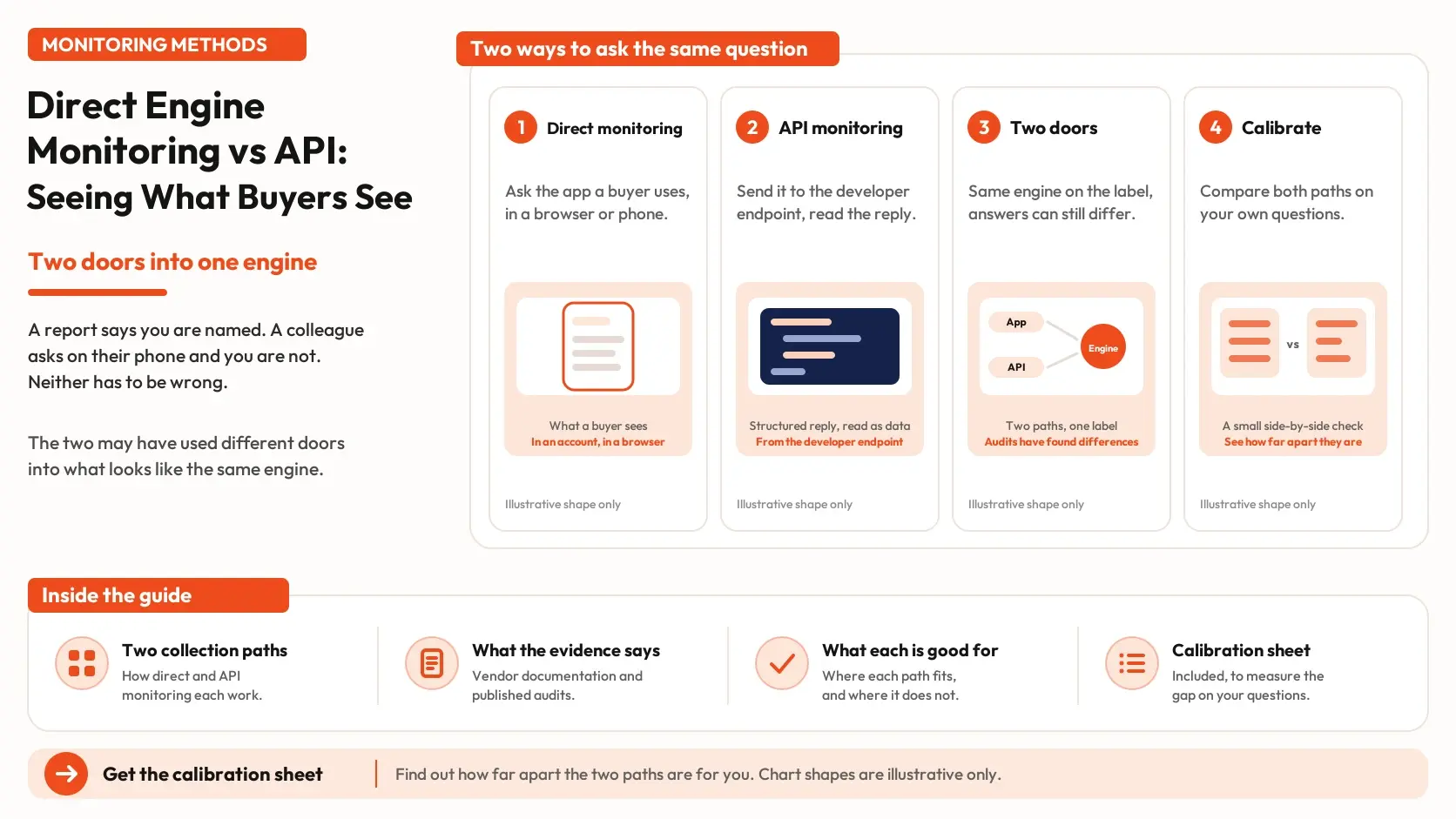


A 40% AI visibility score can look reassuring until you check what buyers actually see. API-based monitoring and answers from consumer-facing apps may not tell the same story. The important question isn’t just how often your brand appears, but whether your measurement method reflects the experience you’re trying to understand. That difference can change how you assess competitors and where you invest in content. A small calibration across both methods can help you understand how much confidence to place in the numbers.
This guide explains the two collection paths, what vendor documentation and published audits say about how they differ, what each path is good for, and how to run a small calibration so you know how far apart they are for your own questions
Two ways to ask the same question
Direct monitoring means asking the consumer product the way a buyer would: through the chat app or the search experience, in an account, in a browser. API monitoring means sending the question to the provider's developer endpoint and reading the structured reply. Both can be automated, and both produce a record of whether your brand was named or cited.
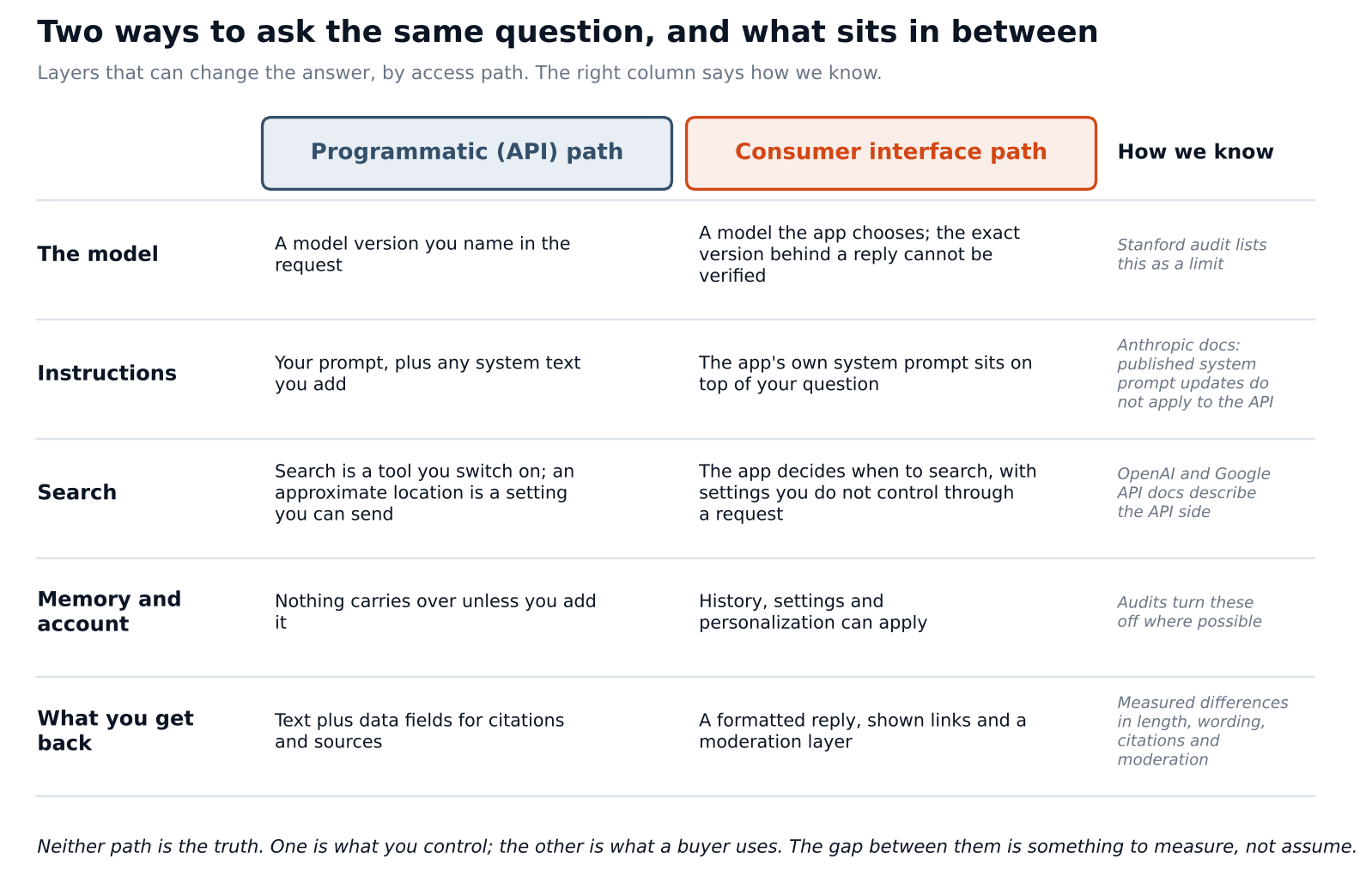
The API path gives you control. You name a model version, you decide whether search is switched on, and you get the reply as data. The interface path gives you realism. It includes whatever the app adds around the model, which is the thing a buyer meets.
What the documentation says differs
Three provider documents, read as written, point to places where the two paths can diverge. None of them compares the paths for brand mentions.
1. Instructions
Anthropic publishes the system prompts it uses for its apps, and its release notes say that these updates apply to Claude's web interface and mobile apps. The page states: "These system prompt updates do not apply to the Claude API." A buyer using the app is getting instructions that an API call does not include unless you write them yourself.
2. Search
In OpenAI's description of the web search tool in its API, you add search to a request and the model decides whether to search. You can pass an approximate location, and the reply can include both the cited sources and a longer list of every source the model consulted. The document does not say how this compares to ChatGPT search, so it cannot tell you whether the two return the same sources.
3. Grounding
Google's documentation for grounding with Google Search says the model decides whether to search and that a reply with no search carries no grounding data. When it does search, the reply includes the search queries the model ran. The document does not say whether the sources match what the Gemini app or Google Search would show.
So the documents tell you what you control on the API side. They say little about what the app does on the other side, which is why measurements matter.
What audits have measured
Three recent studies compared API and interface access directly. Each is narrow, and none tested buyer questions about brands, but together they show the gap is real.
| Study | What was compared | What it found |
|---|---|---|
| Wang and colleagues, Stanford, 2026 preprint | Seven ChatGPT, Claude and Gemini systems, API vs chat interface, nine benchmarks, five runs per item | API accuracy was higher for all seven systems, by 3.4 points on average. Rankings of systems correlated only 0.52 between paths. Adding approximated public system prompts to the API calls improved consistency but largely left the accuracy gap in place. |
| Encarnacion and colleagues, AIES 2026 | ChatGPT interface vs API, with and without web search, two benchmarks, 401 prompts, three runs each | The two paths cited largely different sources: only about 4 percent of URLs were cited by both. Repeated runs gave inconsistent answers for up to 21 percent of prompts. Disagreement between paths was 1.14 to 1.30 times the disagreement between repeat runs on the same path. |
| Lipphardt and colleagues, FOCI 2026 | Gemini and ChatGPT, API vs web interface, sensitive statements | By one judge's count, the web interfaces moderated 18 percent of responses, against 9 percent for the Gemini API and 13 percent for the ChatGPT API. |
Read these with their limits. The first two used standard benchmark questions, not the open-ended buyer questions you track. The Stanford authors note that they could not verify which model version sat behind the interface and that platform terms may restrict browser automation. The second covers one model in one data window. The third is about moderation of sensitive statements, which is not your topic, but it shows that the interface adds a layer the API does not.
Two points carry over to monitoring. First, the paths do not give the same answers or even the same sources, so a number from one is not automatically a number for the other. Second, the gap between paths was only modestly larger than the gap between repeat runs on one path. Part of what looks like a path difference can be ordinary run-to-run noise, which is why the piece on tracking frequency matters here too.
What each path is good for
1. API monitoring is good for volume and repeatability
Each run costs less and is easier to schedule. You can pin the model version, repeat each question as often as you need, and read citations as data fields instead of scraping them from a page. That makes it the natural choice for the many runs that the tracking frequency guide calls for. Its weakness is realism: it does not include the app's instructions, account settings or display layer, so it may not match what a buyer reads.
2. Direct monitoring is good for realism
It captures the answer as the buyer meets it, formatted and with whatever links the app shows. Its costs are higher. It is slower to run at scale, it depends on the state of the accounts you use, and it may sit outside a platform's terms for automation. Check the terms of each product before you automate its interface, and ask your tool supplier how they handle it. That is a question for the platform's own terms, not something this guide can settle.
3. Neither one sees your buyer's account. A buyer's chat history, location and settings may change the reply, and no monitoring path can reproduce them. Audits turn personalization off where they can. What you get from either path is an answer under a clean set of conditions.
For Google's own features the picture is different. AI Overviews and AI Mode are products inside search, not a model you call, so the guide to tracking AI Overview rankings and the comparison of AI Overviews, AI Mode and Gemini cover what to log there.
Calibrate before you trust either path
You do not need to decide in advance which path is right. You can measure how far apart they are on your own questions, once, and then use that gap to read every later number. The test:
- Take your fixed question list. Use at least 40 questions; more is better.
- Ask each question on both paths, at least three times each, on the same day and in the same market.
- For each question and path, record how many of the runs named your brand. Call the question "named" on that path if most of its runs named you.
- Sort every question into one of four boxes: both paths name you, only the API names you, only the interface names you, or neither does.
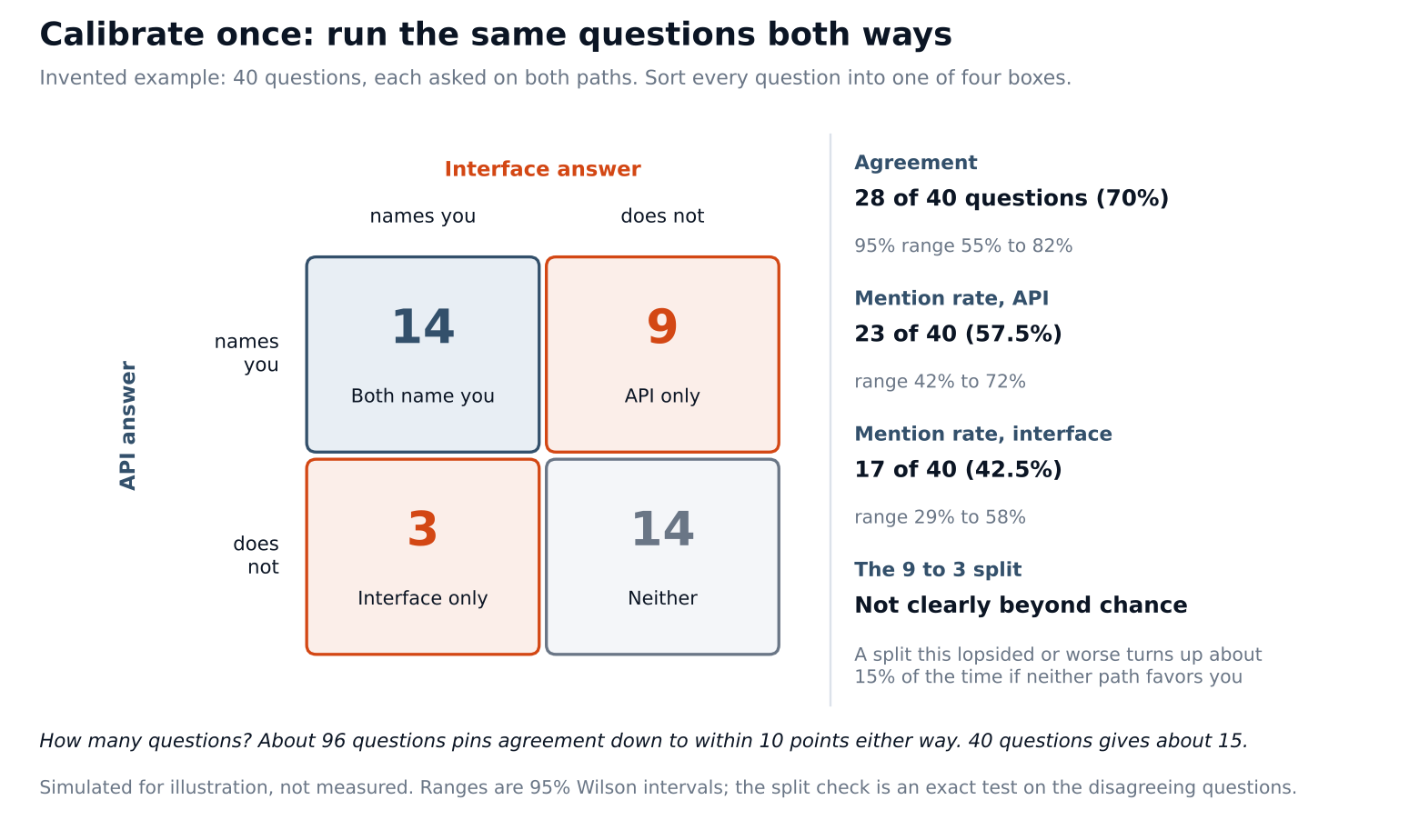
In this invented example, the paths agree on 28 of 40 questions, which is 70 percent, with a range of about 55 to 82 percent. The API names you on 23 questions and the interface on 17. That looks like the API is friendlier to you. But look at the nine API-only questions against three interface-only. If neither path favored you, a split that lopsided or worse would turn up about 15 percent of the time, so with 40 questions it is not clear evidence of a real difference.
That is the value of the test. It stops you reporting "the API overstates us by 15 points" when the data cannot say so, and it tells you when a gap is large enough to act on. As a rough guide on the sample size, about 96 questions pins agreement to within 10 points either way, while 40 questions gives about 15. The calibration sheet below does the sorting and the sums and shows the ranges.
What to do with the result is a judgment call. Here is one reasonable rule, offered as a starting point, not a standard. If the paths agree on most questions and the disagreements split roughly evenly, use the cheaper path for the many runs and keep a small interface sample as a check each quarter. If they disagree often, or one path keeps naming you where the other does not, treat the interface sample as the headline and use the API for direction only. Whichever you choose, write the rule down before you see the results.
Questions to ask any monitoring source
These apply to a tool, an agency or your own script, and they work without naming anyone.
- Which path produces each number: API, interface, or a mix? If a mix, in what proportion?
- Which model and version sits behind each path, and how do you know?
- Is search switched on? What location and language settings are used?
- How many runs sit behind each reported number, and how often is the list changed?
- Can I see the raw answer for any run?
- Are citations read from structured data or captured from the page?
- Has the source compared its two paths on a sample, and can I see the agreement figure?
- How does the source handle each platform's terms for automation?
The calibration sheet includes these as a checklist with a column for the answer.
Report which path made the number
Once you know the gap, label it. Every reported number should say which path, which model, how many runs and which list version. A line like "Named in 9 of 30 interface runs, list v3" can be checked. "Named in 30 percent" cannot.
Keep each path as its own trend line. If your source switches from one path to the other part-way through a quarter, the line may jump even though nothing about your pages changed. The north-star metric piece calls for a fixed, versioned list for the same reason. A fixed path is part of the same discipline.
When two paths give different answers to the same question, the cause may also be the question itself. Small wording changes alter which brands appear, which the piece on how query phrasing changes who gets cited covers, and the model variability guide covers why repeat runs differ.
FAQ
Is API monitoring wrong?
No. It measures the model through a controlled path, and it is cheap enough to repeat. It may not match what a buyer sees, so measure the gap before you treat its numbers as a buyer's view.
Is direct monitoring always more accurate?
It is closer to the buyer's experience, but it comes with its own variation from accounts, settings and the app's changes, and it may be restricted by a platform's terms. More realistic is not the same as more reliable.
Can I add a system prompt to the API to copy the app?
You can try. In the Stanford audit, adding approximated public system prompts to API calls made answers more consistent but largely left the accuracy gap in place. The app's real instructions are not fully public, so this narrows the gap at best.
How often should I recalibrate?
When something changes: a new model version, a new product feature, a new source, or a long gap since the last check. A quarterly sample is a sensible default if nothing else prompts you.
Does this matter for Google AI Overviews?
Those are a feature inside Google search, not a model you call, so the API versus app question applies differently. Use the Search Console report and your own sampled checks, as the AI Overview tracking guide describes.
Check one list both ways before you commit
Pick twenty of your most important buyer questions, run each on both paths three times, and sort them into the four boxes. Twenty is a small sample, so read the result as a first look. But you will learn more about your tracking from that one afternoon than from another month of single-path numbers.
For a quick reference reading to put beside what you see in the app, the AI Search Visibility Checker gives one on demand. When you want to keep your own question list and follow each prompt over time, AI Search Intelligence tracks each of your prompts individually. And whichever source you use, ours included, ask which path produced the number and how many runs sit behind it.