

Google now answers questions with AI in three different places, and they are easy to confuse because the names blur together and all three are powered by the same underlying models. A buyer researching your category might read an AI Overview at the top of a normal search, open AI Mode for a back-and-forth, or ask the Gemini app directly. Each is a different surface, each pulls its answer differently, and each represents a separate place your brand can be present or absent.
For a B2B team, telling them apart is not trivia. Where your buyers go changes what you need to do to be cited, and treating all three as one thing is how brands end up optimizing for one surface while missing the others. This guide explains what each surface is, how they compare, and what each means for your visibility.
The three surfaces at a glance
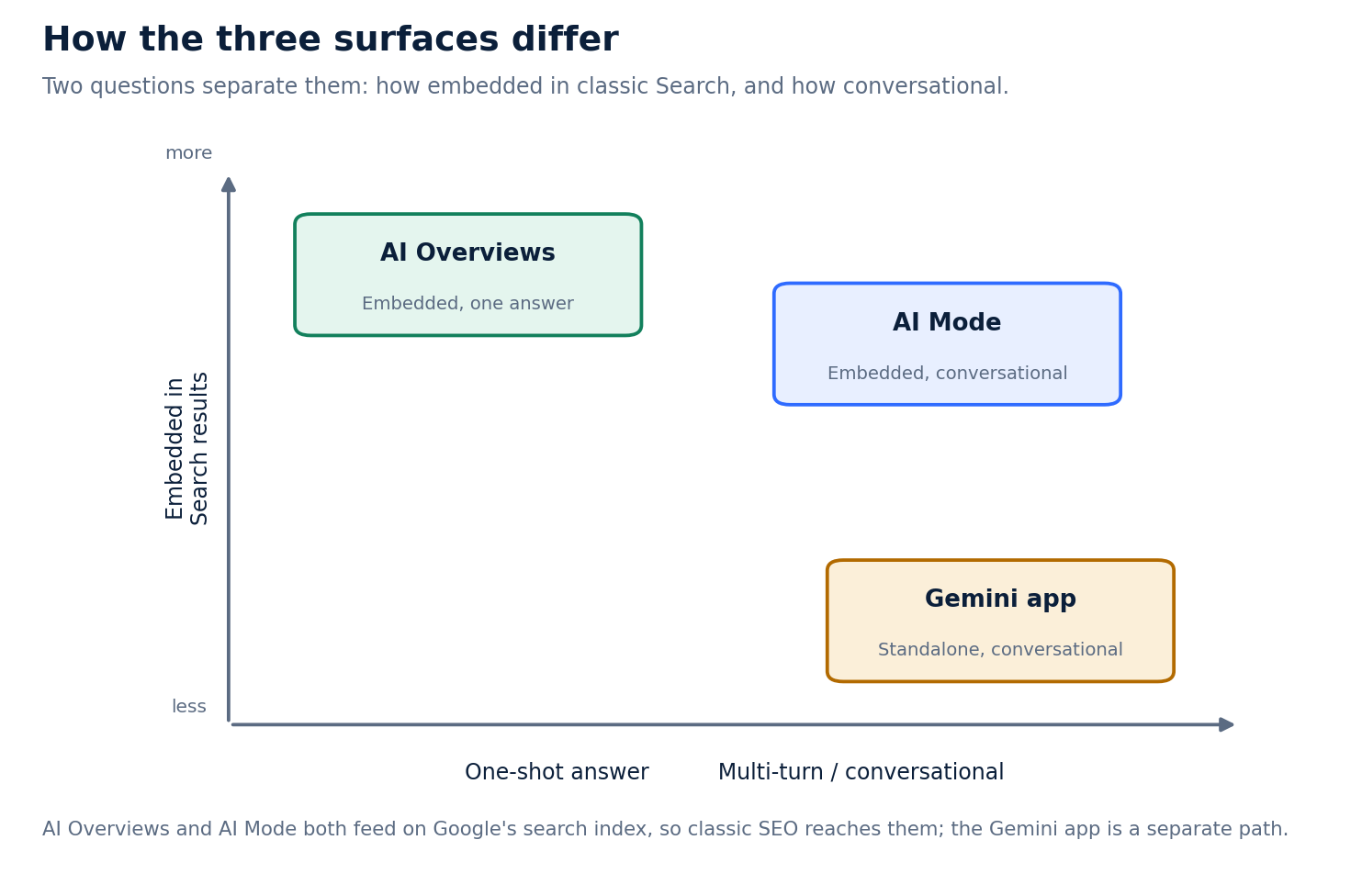
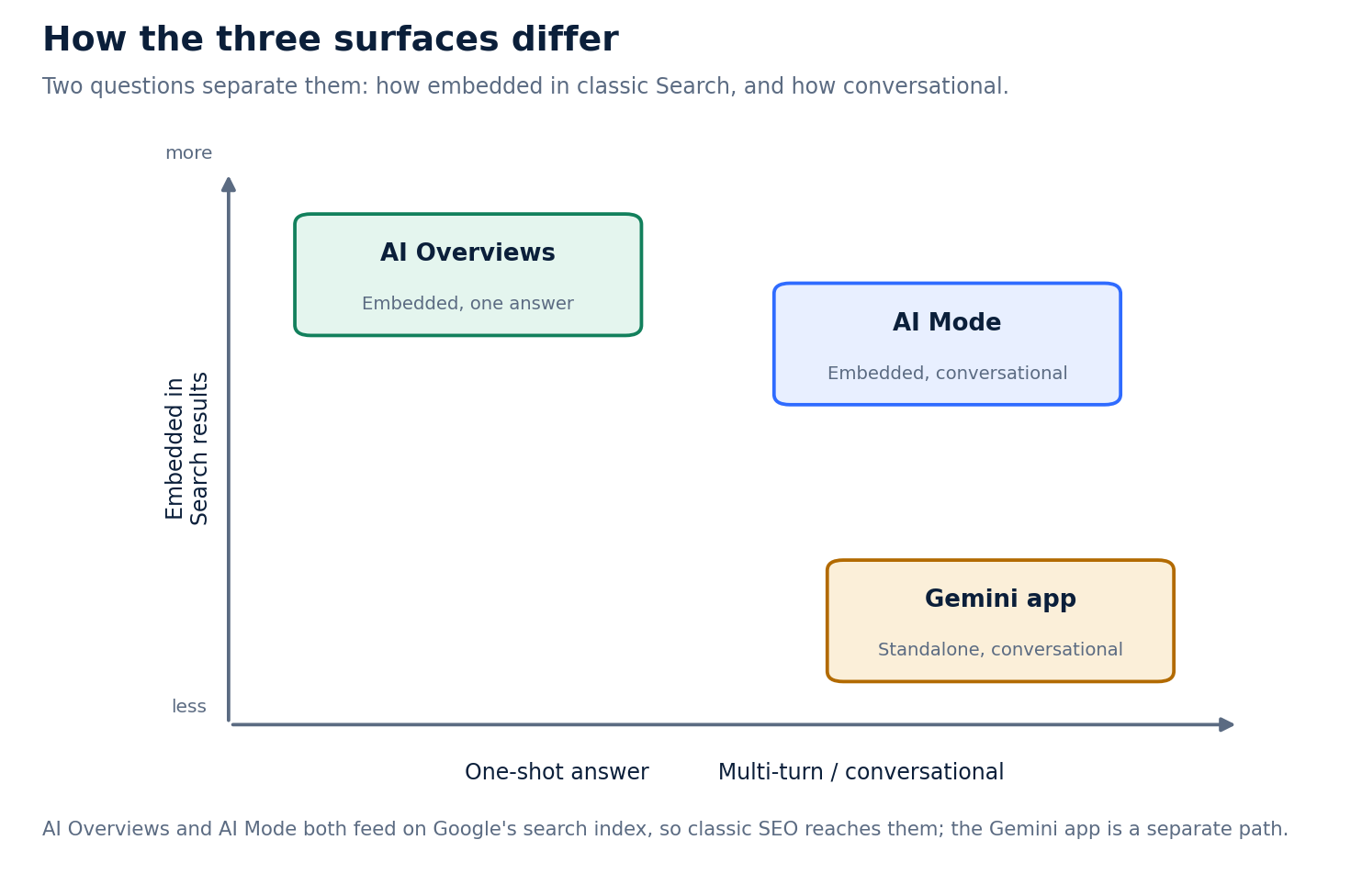
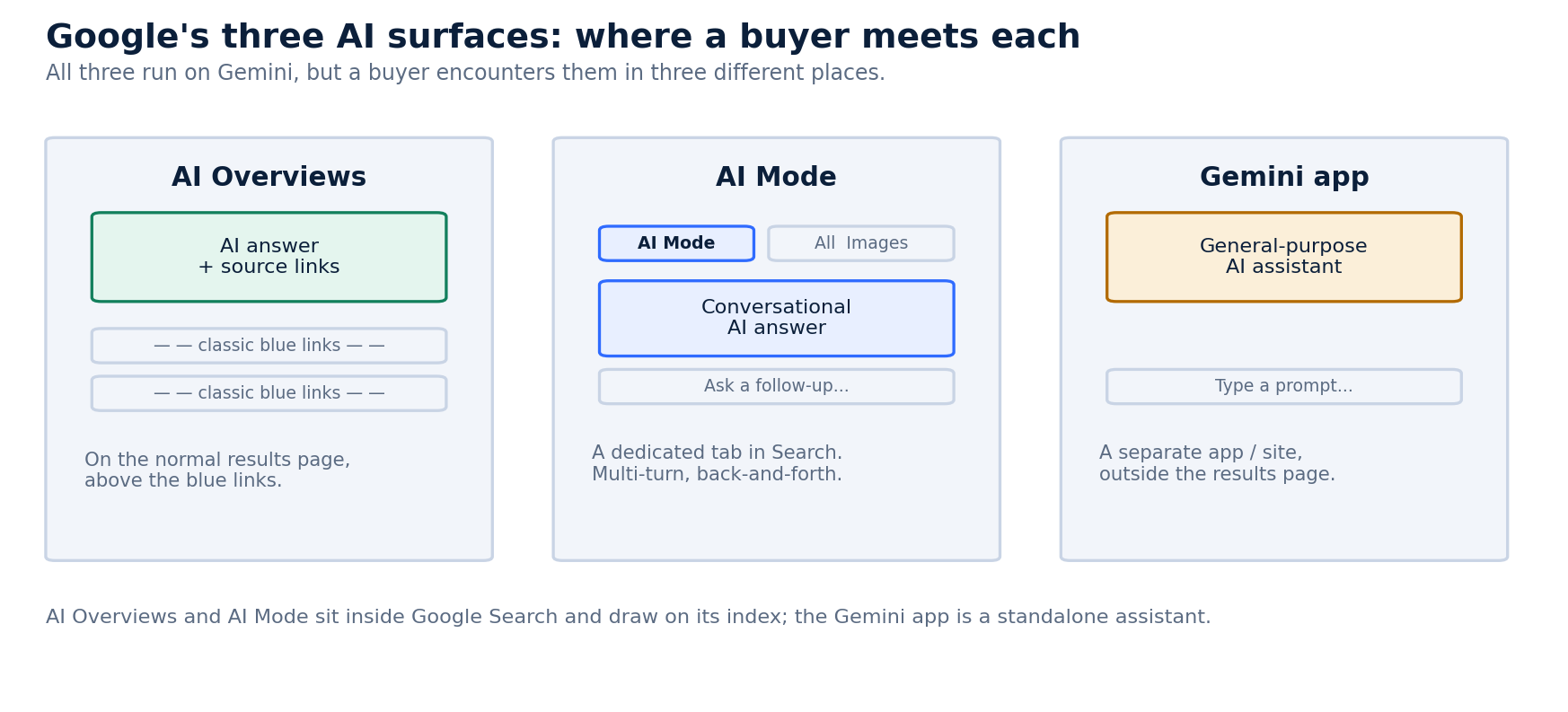
The short way to hold them apart: AI Overviews is the AI answer that shows up inside your normal Google results, AI Mode is a separate conversational tab inside Google Search, and the Gemini app is a standalone assistant that lives outside Search entirely. Two of the three sit inside Google Search and lean on the same index that classic results come from. The third is its own product.
AI Overviews: the answer on the results page
An AI Overview is the generated summary that appears at the top of a regular Google search, above the classic blue links, with a few cited sources. You do not opt into it; it shows up for many informational queries automatically. It is the evolution of the Search Generative Experience, so if you worked on SGE, this is its successor.
The mechanics matter for B2B because the Overview is built largely from pages Google already ranks and trusts. It runs the search, expands the query, and generates the summary from the strongest sources, which means getting cited in an AI Overview starts with ranking well and answering cleanly. It is also spreading fast, appearing on a growing share of queries, as the adoption statistics show.
The defining traits: it is passive (the buyer did not ask for it), it is a single generated answer, and it sits on top of the results the buyer was already going to see.
AI Mode: a conversation inside Search
AI Mode is a dedicated tab within Google Search built for a back-and-forth. Instead of one answer, the buyer asks a question, reads a response, then refines it with follow-ups, and the conversation carries context from one turn to the next. It is designed for the messier, multi-part research that a single query cannot capture.
It also goes deeper than the Overview in two ways that matter for research-stage buyers. It can run a more thorough, multi-source pass (Google calls this Deep Search) to assemble a longer, more reasoned answer, and it can personalize responses using signals from the buyer's Google account and connected apps. For a B2B category, that means two buyers asking the same question in AI Mode may not see the same sources, so presence there is less about a single fixed answer and more about being a source the model reliably reaches for.
Under the hood, AI Mode leans heavily on query fan-out: it breaks one question into many related sub-searches, pulls sources for each, and assembles a fuller answer than a single search would return. That has a direct consequence for visibility. A page that only answers the one headline question can be passed over, while a page that covers the surrounding sub-questions has more surface area to be pulled into the response.
The defining traits: it is active (the buyer chose it), it is conversational and multi-turn, and it still feeds on Google's search index, so the same content and authority work that reaches AI Overviews reaches AI Mode too.
The Gemini app: a standalone assistant
The Gemini app is Google's general-purpose AI assistant, at gemini.google.com and in its mobile app. It is not part of the search results page. People use it the way they use other AI assistants: drafting, summarizing, analyzing, coding, and asking open questions, including questions about which vendors or tools to consider.
Gemini can ground its answers in current information from the web, but it is a broader product than Search, and a buyer using it is often in a different mode than someone running a query on Google. For B2B, the app matters because buyers increasingly ask an assistant for shortlists and recommendations directly, so your presence in answer engines like this one is its own channel, not a byproduct of ranking.
The behavior to plan for is the recommendation question. When a buyer types "what are the best tools for X" or "compare the leading vendors in Y" into the Gemini app, the answer is a shortlist assembled from what the model knows and can retrieve about your category, not a ranked page you optimized. Being on that shortlist depends on how consistently and accurately the wider web associates your brand with the category, which is a slower, reputation-level game than ranking a single page.
The defining traits: it is standalone (outside Search), it is conversational, and its path to an answer is not the same as the results-page index alone.
How the three compare
| AI Overviews | AI Mode | Gemini app | |
|---|---|---|---|
| Where it appears | Top of normal search results | A dedicated tab in Google Search | A separate app and website |
| How the buyer gets there | Shows up automatically | Buyer opts in | Buyer opens the app |
| Interaction | One generated answer | Multi-turn conversation | Multi-turn conversation |
| Main use | Quick answer mid-search | Deeper research in Search | General assistant tasks |
| Feeds on Google's search index | Yes | Yes | Partly (via web grounding) |
| Cites sources | Yes | Yes | Sometimes |
What they share under the hood
The reason the names blur is that all three run on Gemini models. But the surface, not just the model, decides how your brand gets in.
AI Overviews and AI Mode are both part of Google Search and draw on the same index and ranking that classic results come from. That is good news: the content and authority signals you already build for search reach both of them. The Gemini app is a different path; it can pull from the live web but is not simply the results page rendered as chat, so being strong in Search helps but does not fully guarantee presence there.
There is one more shared trait worth planning for: none of the three is fully predictable. The same question can produce different cited sources across the three surfaces, and even within one surface the answer can shift over time. That variability across surfaces and over time is the norm, not a bug, which is why presence on any one of them is measured as a pattern rather than a single check.
What this means for B2B visibility
Three surfaces means three places to win or lose a buyer, and they are not interchangeable.
If your buyers research inside Google, AI Overviews and AI Mode are where a strong search presence pays off twice: the same well-ranked, answer-ready page can be cited in the passive Overview and pulled into an active AI Mode conversation. This is where the overlap between AI visibility and traditional SEO is strongest, because both surfaces feed on the search index.
If your buyers reach for an assistant instead, the Gemini app is a separate front where the question is often "which tool should I use" asked directly. Presence there depends less on ranking for a specific keyword and more on being an entity the model associates with your category across the web. The practical takeaway is that a single-surface strategy leaves buyers uncovered, and the mix that matters depends on where your specific buyers actually go.
To make this concrete, picture one buyer evaluating your category three ways in a single afternoon. They run a normal search and skim the AI Overview to get oriented, so a citation there shapes their first impression before they click anything. They open AI Mode to work through follow-ups about pricing, integrations, and fit, so being pulled into that conversation keeps you in the running as the shortlist forms. Then they ask the Gemini app to compare the top options, and whether you appear depends on your standing across the web rather than any single page. Miss the first and you lose the first impression; miss the second and you drop out of active research; miss the third and a competitor's shortlist is the one they carry into the buying conversation. Same buyer, three surfaces, three separate chances to be present or absent.
How to show up across all three
The good news is that most of the work compounds. The fundamentals that earn a citation in one surface tend to help in the others.
- Rank and answer cleanly for AI Overviews and AI Mode. Because both feed on the search index, earning the organic ranking and leading with a clear, quotable answer is the shared price of entry. Structure the page so the answer is easy to lift.
- Cover the whole cluster, not one keyword. AI Mode's fan-out rewards pages that address the surrounding sub-questions, so build depth around a topic rather than a single query. This also strengthens the same page for AI Overviews.
- Build retrievable, well-structured content. The formats that get quoted across every AI surface are clear, parseable, and self-contained: real headings, direct answers, and clean HTML.
- Strengthen authority and authorship. Named experts, credible sources, and clear authority signals help across all three, and they matter more for the Gemini app, where entity-level reputation carries weight beyond any single page. Reinforce this with E-E-A-T and trust signals.
- Earn accurate third-party coverage. How the wider web describes you feeds the models' sense of your category position, which is what an assistant like Gemini leans on when it has no single ranked page to point to.
Pulled together, these fundamentals are the core of answer engine optimization, the discipline of optimizing for AI search across every surface rather than one at a time.
How to track your presence on each
You cannot manage three surfaces by checking one. Because each answers differently and each changes over time, treat measurement as ongoing rather than a spot-check.
- Run your priority buyer questions on all three and record where you appear, where you do not, and who is cited instead of you.
- Watch each surface separately, since a citation in AI Overviews does not mean presence in AI Mode or the Gemini app. The gaps between surfaces are your roadmap.
- Track over time, especially around Google updates, because presence shifts. Automated, repeated checks tell you far more than a single look, and watching who is cited beside you turns tracking into competitive intelligence. Decide up front which visibility metrics you will hold yourself to.
Common misconceptions
- "They are the same thing with different names." They share the Gemini engine but are distinct surfaces with distinct paths to an answer, and presence on one does not guarantee the others.
- "AI Mode replaces AI Overviews." They coexist: the Overview is the passive answer on the results page, AI Mode is the opt-in conversation. Buyers use both.
- "The Gemini app is just Search in a chat box." It is a broader assistant that can pull from the web but does not simply mirror the results page, so it needs its own attention.
- "If I rank, I am covered everywhere." Ranking strongly helps the two Search surfaces most; the Gemini app leans more on entity-level authority across the web.
- "I only need to check once." All three vary by query and over time, so a single check is the least reliable way to judge your presence.
Where to focus first
Start by finding out where your buyers actually meet Google's AI. Take five to ten of your priority buyer questions and run each one three ways: as a normal Google search (watch for an AI Overview), inside AI Mode, and in the Gemini app. Note where you show up, where a competitor shows up instead, and which surface gives the cleanest answer for your category. That grid tells you which surface to work on first instead of spreading effort evenly across all three.
To see where you stand across Google's AI surfaces and other engines in one scan, run a free check with the AI Search Visibility Checker, or track your presence across every surface and over time with AI Search Intelligence.
Frequently asked questions
What is the difference between AI Overviews and AI Mode?
AI Overviews is the AI summary that appears automatically at the top of normal Google results, as a single answer. AI Mode is a separate tab you open for a multi-turn conversation. Both live inside Google Search and draw on its index, but one is passive and one is an opt-in conversation.
Is the Gemini app the same as AI Mode?
No. AI Mode is inside Google Search; the Gemini app is a standalone assistant outside Search. They run on related models but are different products with different uses.
Do all three use the same underlying model?
They are all built on Google's Gemini models, which is why the names get confused. The surface still differs: how you reach it, how it interacts, and how it sources its answer.
Which surface matters most for B2B?
It depends on where your buyers research. If they stay inside Google, AI Overviews and AI Mode matter most and reward a strong search presence. If they ask an assistant directly, the Gemini app is its own channel. Most B2B teams need presence across the mix.
Does ranking on Google get me into all three?
Ranking helps AI Overviews and AI Mode most, because both feed on the search index. The Gemini app can pull from the web but leans more on your broader authority as an entity, so ranking alone does not guarantee presence there.