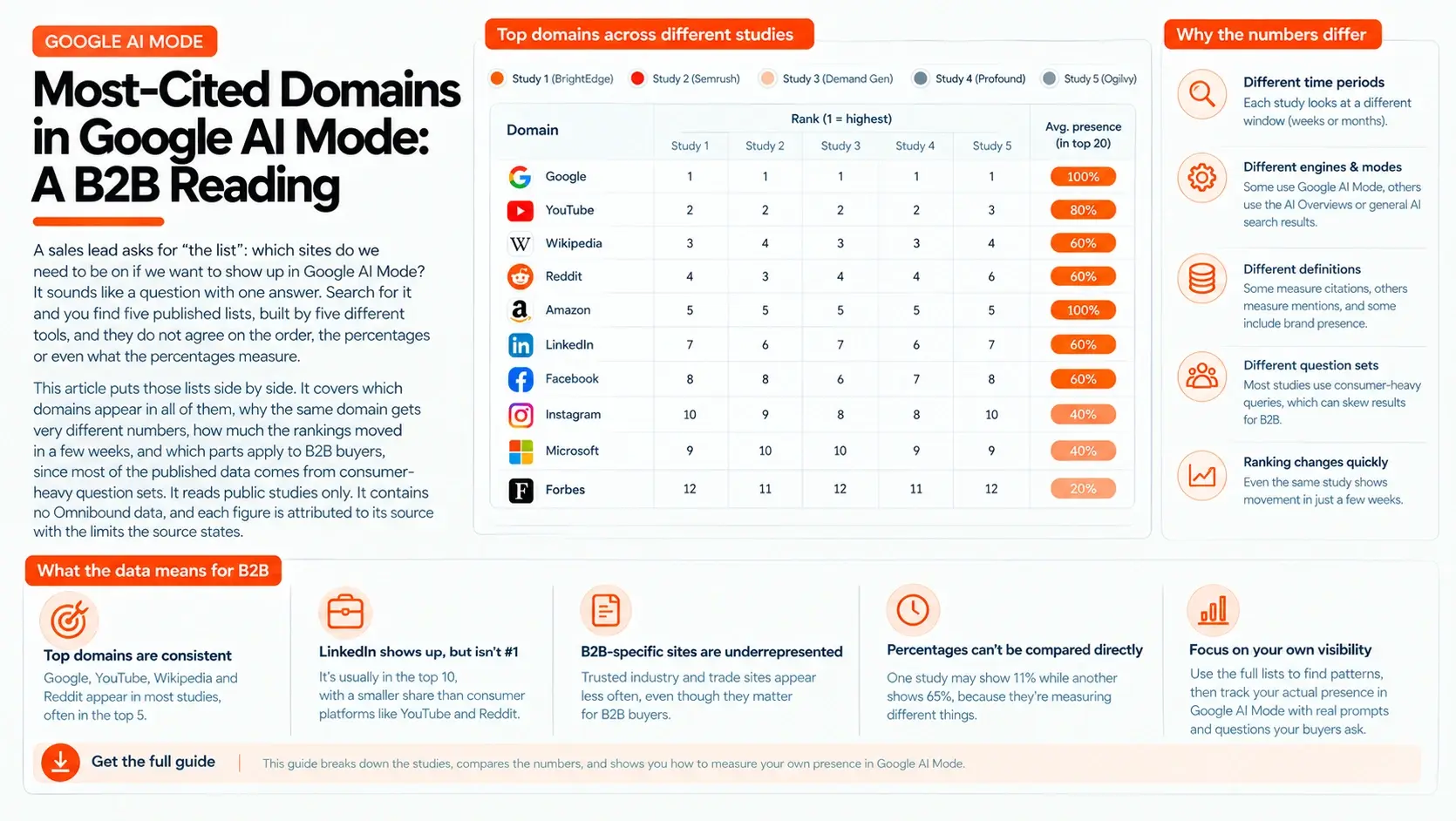


A sales lead asks for "the list": which sites do we need to be on if we want to show up in Google AI Mode? It sounds like a question with one answer. Search for it and you find five published lists, built by five different tools, and they do not agree on the order, the percentages or even what the percentages measure.
This article puts those lists side by side. It covers which domains appear in all of them, why the same domain gets very different numbers, how much the rankings moved in a few weeks, and which parts apply to B2B buyers, since most of the published data comes from consumer-heavy question sets. It reads public studies only. It contains no Omnibound data, and each figure is attributed to its source with the limits that source states.
The five lists and who built them
The table shows what each source tracked and, in the last column, what its percentage is a share of. That last column is the one that decides whether two numbers can be compared.
| Source | Window | What it tracked | What the percentage counts |
|---|---|---|---|
| Ahrefs Brand Radar | Page updated Sep 2, 2026 | A broad set of US queries across all topics | A domain's citations as a share of the summed citations of the top sources |
| LLM Pulse | Seven days to Oct 6, 2026 | Real prompts each week | Share, with a domain counted once per answer and answers with no citations left out |
| RankSpot | Sep 1 to Oct 7, 2026 | Daily commercial prompts, 18,400 answers | Share of answers that cite the domain at least once |
| Similarweb | Jan to Feb 2026 | Monitored US prompts, reported with ChatGPT | Share of citation events |
| Averi | 2026, one run per query | 50 B2B SaaS queries from its own search data | Share of queries that cite the domain |
All five come from companies that sell AI search tooling or content services. That is not a reason to dismiss them. It is a reason to read the method, and we sell in this category as well. Two of the lists, Ahrefs and LLM Pulse, update continuously, so the figures below are readings taken in early October 2026 and will have moved by the time you open the pages.
The domains that show up in every list
Despite the differences, a few names are stable. This table shows each domain's reported share and, in brackets, its rank where the source publishes one. "n/r" means the domain was not reported in the top list we could read.
| Domain | Ahrefs | LLM Pulse | RankSpot | Similarweb | Averi (B2B queries) |
|---|---|---|---|---|---|
| YouTube | 17.8% (2) | 13.77% (1) | 14.2% (1) | 4.91% (3) | 38% of queries |
| 17.9% (1) | 6.62% (3) | 9.1% (2) | 4.19% (4) | 22% of queries | |
| Google's own pages | 12.5% (3) | 9.87% (2) | 3.0% for play.google.com (3) | 2.85% (5) | n/r |
| 10.2% (4) | 4.03% (4) | 2.5% (5) | n/r | n/r | |
| 0.8% (17) | 2.26% (7) | 2.7% (4) | n/r | 20% of queries | |
| Wikipedia | 4.0% (6) | 1.0% (10) | n/r | 5.21% (2) | 2% of queries |
| 5.7% (5) | 2.57% (5) | n/r | n/r | over 10% of queries | |
| Trustpilot | 0.3% (44) | 2.36% (6) | n/r | n/r | n/r |
Three things hold across the lists that publish ranks. YouTube and Reddit are in the top five of every one. Google's own pages are in the top five of every one too, although RankSpot shows play.google.com rather than google.com. And the top of most lists is dominated by video, social platforms and community sites rather than publishers or vendors. The list that leads with something else is Similarweb's, where the fan wiki site fandom.com ranks first at 7.16 percent and Wikipedia second, which reflects a prompt set heavy on entertainment and reference questions.
Why one domain gets five different numbers
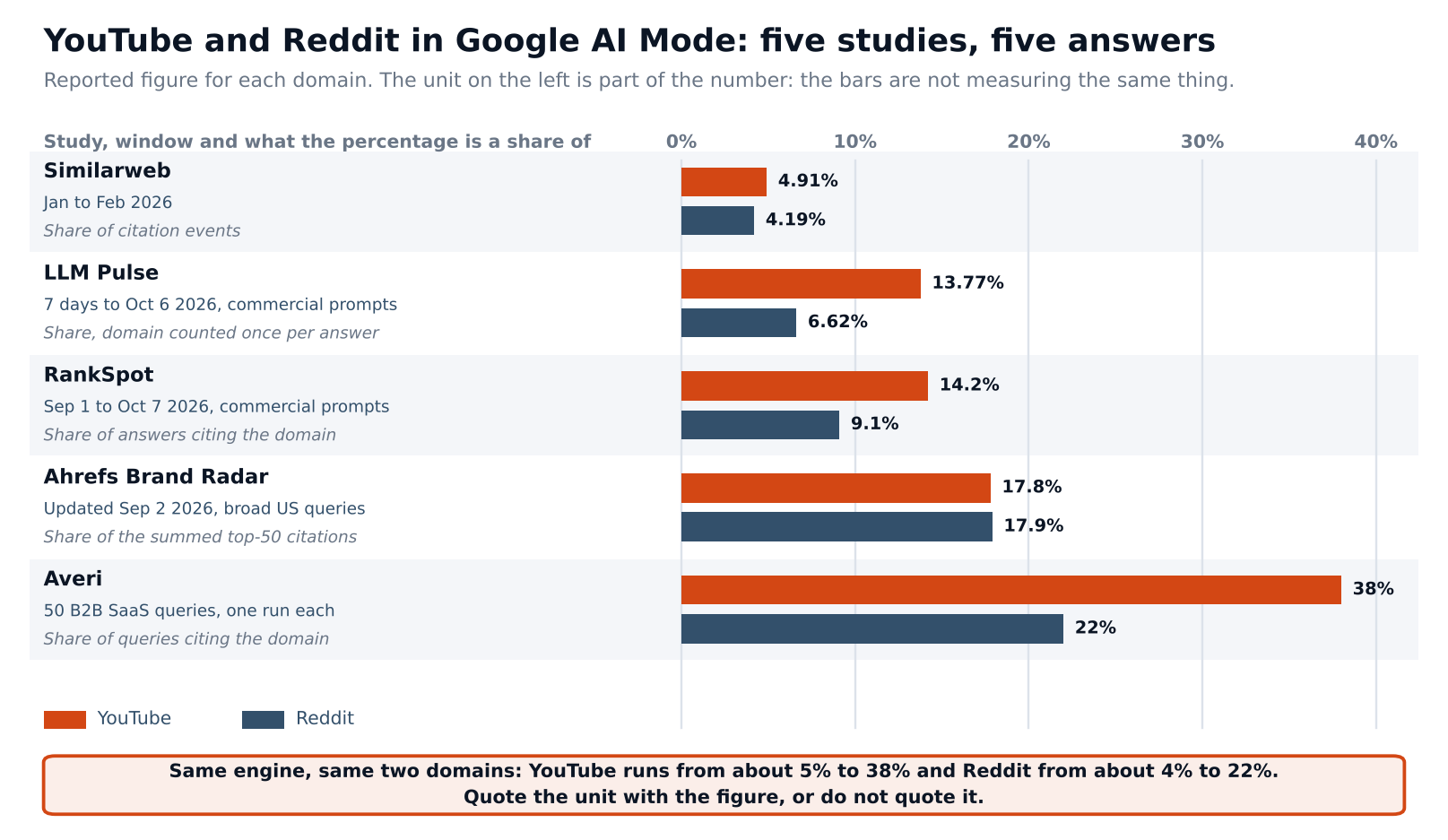
Read the YouTube row again. Similarweb reports 4.91 percent. LLM Pulse reports 13.77 percent and RankSpot 14.2 percent. Ahrefs reports 17.8 percent. Averi reports 38 percent. Reddit runs from 4.19 percent to 22 percent across the same five sources. Nobody is making an error. Each number answers a different question.
Similarweb divides by every citation event, so a domain that appears once in many answers counts the same as one that appears many times in a few. RankSpot and LLM Pulse count a domain once per answer, which asks "how often does this domain appear?" instead of "how big a slice of the citation pile is it?" Ahrefs divides by the summed citations of the top 50 sources, which removes the long tail from the denominator and makes every top-50 domain look larger. Averi counts the share of its 50 queries in which a domain appeared at least once, a much smaller base with a much coarser result.
The prompts differ too. Ahrefs covers a broad set of US queries across all topics. RankSpot reports commercial prompts. Averi uses B2B SaaS questions. A domain that is cited in nearly every how-to question and rarely in product comparisons will land differently depending on which mix a study uses.
The practical rule is short: never quote a share without its unit. The same logic runs through our reading of the Reddit data and the LinkedIn data, where the same domain also produced different numbers depending on who counted.
How fast the list moves
Ahrefs' page is updated monthly, which gives a rare thing in this field: two dated readings from the same source. The July 21 reading, as republished by the German site seo-day.de, showed YouTube at 21.1 percent, Reddit at 18.5, Facebook at 10.7, Google at 7.1, Instagram at 5.8, Quora at 5.0 and Wikipedia at 4.8. The September 2 reading shows Reddit at 17.9, YouTube at 17.8, Google at 12.5, Facebook at 10.2, Instagram at 5.7, Wikipedia at 4.0 and Quora at 3.0.
In about six weeks, YouTube and Reddit swapped first place, Google's own pages rose from fourth to third on a jump from 7.1 to 12.5 percent, and Quora fell from 5.0 to 3.0. Whether that reflects a change in what buyers see, in the mix of queries sampled or in the engine's behavior is not something a single list lets you separate.
If the order of the top five can change in six weeks, a plan that depends on a stable order is fragile. A plan that depends on the types of sources that keep appearing is not.
Google cites itself, and the share is rising
Google's own properties are the most mobile part of the picture. Ahrefs' combined figure for google.com, play.google.com and other Google subdomains is about 12.8 percent in its September reading. SE Ranking, in a study covered by Search Engine Journal, found that about 17 percent of AI Mode citations in February 2026 pointed to Google, up from about 5 percent in July 2025.
Of those Google citations, about 59 percent went to organic search results and about 36 percent to Google Business Profiles. Search Engine Journal notes that SE Ranking sells AI visibility tracking tools, and other write-ups of the same figure describe it as a share of answers rather than of citations, a reminder to check the unit before repeating it.
Two points matter for B2B. The large share of citations that point to Google's own organic results suggests that ordinary search rankings still feed AI Mode, which is a reason not to treat the two as separate programs. And the 36 percent that go to business profiles suggests local and product-style questions. A B2B software company with no storefront will probably see less of that, and none of the B2B-focused sources we read reports Google's share for enterprise buying questions, so how much of it reaches them is open.
What changes when the questions are B2B
Most of the published data is not B2B. Ahrefs' set is broad and consumer-heavy: Reddit, YouTube, Facebook and Instagram alone add up to about 52 percent of the top-50 mention share, and e-commerce names such as Amazon and Walmart sit in the top ten. In that list, B2B-relevant domains are far down: LinkedIn at 17th with 0.8 percent, Medium at 29th with 0.5 percent and Trustpilot at 44th with 0.3 percent.
The two lists that use commercial prompts show a different shape. LLM Pulse has Trustpilot at 2.36 percent, LinkedIn at 2.26 percent and the analyst firm Gartner at 1.16 percent, ninth overall. RankSpot has LinkedIn at 2.7 percent, fourth. Neither publishes a B2B-only split, so the right reading is that a more commercial prompt mix moves professional and review sources up the list, not that B2B has been measured.
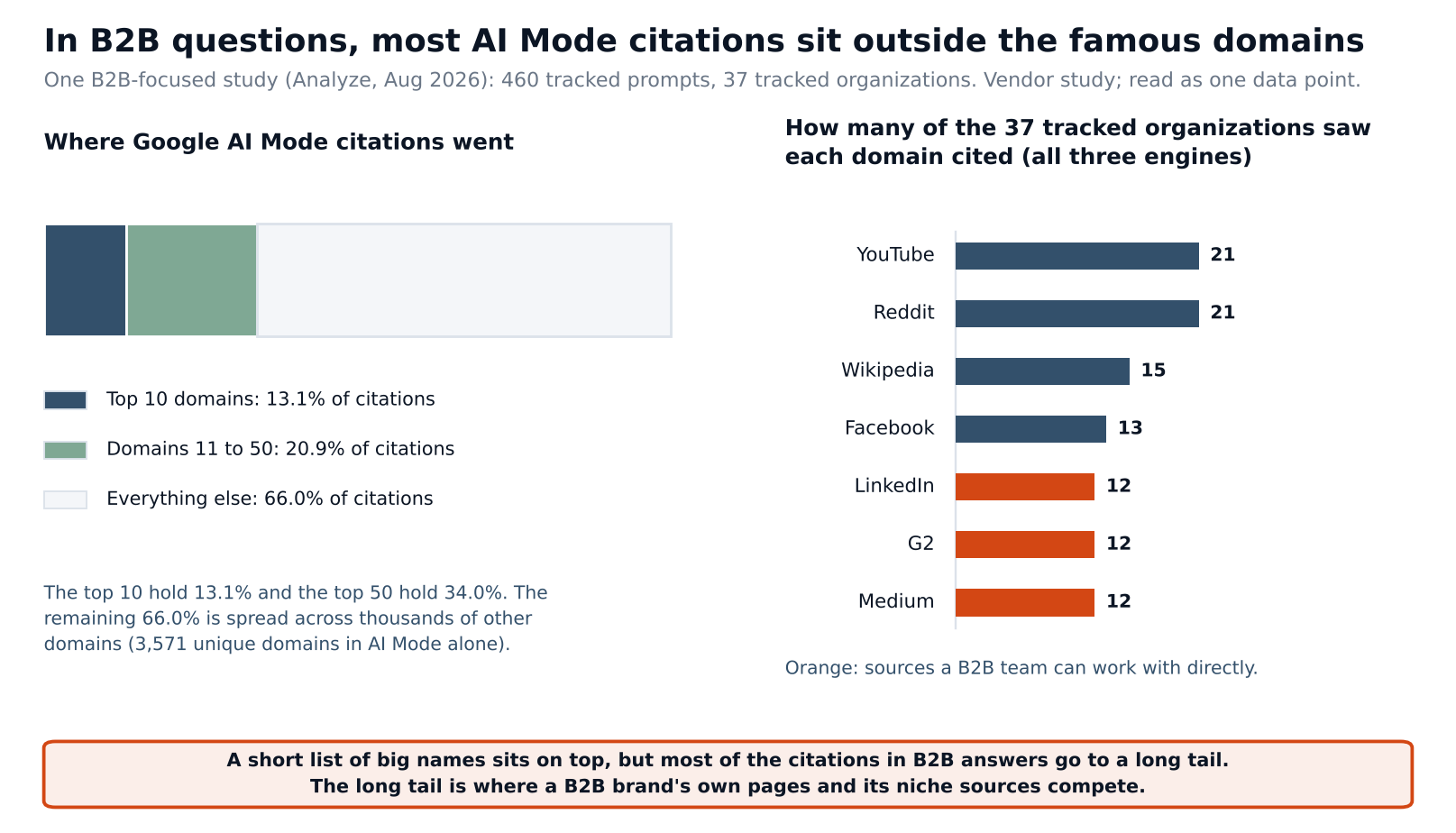
The best evidence on B2B concentration comes from one vendor study, from Analyze, which tracked 460 B2B-focused prompts for 37 organizations across ChatGPT, Perplexity and Google AI Mode. For AI Mode, the top 10 domains accounted for 13.1 percent of citations and the top 50 for 34.0 percent, across 3,571 unique domains. In other words, two thirds of the citations went to domains outside the top 50. The same study found YouTube and Reddit cited for 21 of its 37 organizations, Wikipedia for 15, Facebook for 13, and LinkedIn, G2 and Medium for 12 each, a figure the study frames across its B2B citations generally rather than for AI Mode alone.
Averi's 50 B2B SaaS queries point the same way from another angle. Google AI Mode cited an average of 22.9 distinct domains per query, with a range of 9 to 53, and commercial and tool-seeking queries drew the most at 27.9. That sits oddly beside RankSpot's average of 4.9 citations per answer. The likely explanation is a difference in what each counts as a citation, whether the sources shown with the answer or the wider set Google consulted, but neither source resolves it. Averi also says its 50 queries came from a single run each and warns that only 27 percent of the sub-queries it saw stayed stable across repeated searches.
What the B2B evidence supports is modest and useful: there is a short list of famous names, and there is a long tail in which most of the citations sit. For a B2B brand, the long tail is where its own pages, niche publications, review profiles and partner pages compete.
What each type of domain means for a B2B team
The lists are most useful when they are read as source types instead of as a leaderboard. This table sets out what the data shows for each type and what a team can reasonably do. The "what you can do" column is advice based on the patterns, not a result any study tested.
| Source type | What the data shows | What a B2B team can do |
|---|---|---|
| Video: YouTube | In the top three of every ranked list; cited in 38 percent of Averi's B2B queries | Publish a small number of explainer or how-to videos that answer buyer questions, with accurate titles and descriptions |
| Community: Reddit, Quora, Facebook | Reddit is first or second in three of the five lists; Quora fell from 5.0 to 3.0 percent in Ahrefs between July and September | Take part openly where your buyers ask questions. The Reddit data piece covers how volatile this is |
| Google's own pages | Rising in Ahrefs (7.1 to 12.5 percent) and in SE Ranking's study | Keep your organic search presence strong; keep any business profile accurate if you have one |
| Reference: Wikipedia | From 1.0 percent (LLM Pulse) to 5.21 percent (Similarweb), depending on the prompts | Make sure your entity is described consistently; see entity SEO for AI search |
| Professional publishing: LinkedIn, Medium | LinkedIn from 0.8 to 2.7 percent of citations, 20 percent of Averi's queries | Put named experts behind original posts. The LinkedIn data piece covers the patterns |
| Reviews and analysts: G2, Trustpilot, Gartner | G2 in 12 of 37 organizations' citations; Trustpilot at 2.36 percent and Gartner at 1.16 percent in LLM Pulse | Keep review profiles complete and current; brief the analysts who cover your category |
None of these is a switch. They are places where independent sources describe you, and the same principle runs through the offsite signals map and the comparison of first-party and third-party citations. Teams that want help building that independent footprint can look at AI authority building.
Build your own AI Mode source list
The published lists describe other people's questions. Your list is the one that decides where to spend effort, and it is quick to build.
Fix a set of 15 to 30 prompts that a buyer in your category would type, across discovery, comparison, alternatives and implementation questions. Run each one in Google AI Mode several times, on the same schedule, because answers vary between runs. Record every domain cited in every run, with the full URL.
Then calculate three things, labelling the denominator each time. The first is the share of runs in which each domain appears, which is the "once per answer" measure. The second is how concentrated your list is: what share of all citations the top 10 and top 50 domains account for. The third is the same table grouped by source type, so you can see whether video, community, reference, professional or review sources dominate for your questions.
Report the result as percentages with the unit beside each, keep the prompt set fixed for the quarter, and do not claim a trend until you hold two dated snapshots of the same prompts.
What we do not know
No study here publishes a B2B-only list of AI Mode's most-cited domains at scale. The closest are a 460-prompt vendor study and a 50-query manual test. We do not know how much of the movement between readings reflects the engine and how much reflects the sample. Ahrefs' July and September figures use the same method, but the query mix is not published. We do not know how AI Mode chooses between sources, or how much personalization and location change the answer. Averi's own caveat is a useful warning. And we do not know how well any of these numbers translate into brand mentions. A cited domain is a page the engine drew from. Whether your brand was named in the answer is a separate question the lists do not answer.
Questions people ask
What is the most cited domain in Google AI Mode?
It depends on the list. YouTube leads in LLM Pulse and RankSpot, Reddit leads in Ahrefs' September reading, and fandom.com leads in Similarweb's entertainment-heavy set. YouTube and Reddit are in the top five of all of them.
Does Google AI Mode cite Google itself?
Yes, and increasingly. SE Ranking found about 17 percent of citations pointing to Google in February 2026, up from about 5 percent in July 2025, and Ahrefs shows Google's own pages rising from 7.1 to 12.5 percent between July and September.
Is LinkedIn cited in Google AI Mode?
Yes, at 0.8 to 2.7 percent of citations depending on the list, and in 20 percent of Averi's B2B SaaS queries. It ranks lower in broad consumer-heavy lists and higher where prompts are commercial.
How many sources does Google AI Mode cite per answer?
The published figures disagree: an average of 4.9 citations per answer in RankSpot's commercial prompts and 22.9 distinct domains per query in Averi's B2B tests. They count different things.
Are AI Mode and AI Overviews the same?
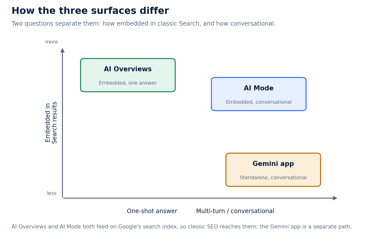
They draw on Google's search but behave differently. Our guide to AI Overviews, AI Mode and Gemini covers the differences.
Should we rewrite our plan every time a list changes?
No. A swap in first place between two domains is a change in the sample as much as in the engine. Plan around source types and measure your own prompts.
Treat the list as a map, not a target
The five lists agree on a shape more than on a ranking: video, community and Google's own pages at the top, a thin layer of professional and review sources below them, and a long tail where most B2B citations sit. That is enough to decide where independent sources should describe you. It is not enough to chase a specific position.
To see how engines describe your company today, the AI Search Visibility Checker is a quick first read. AI Search Intelligence holds the prompt set, the domains cited and the trend over time, so you can see which source types are carrying your category and whether they change.