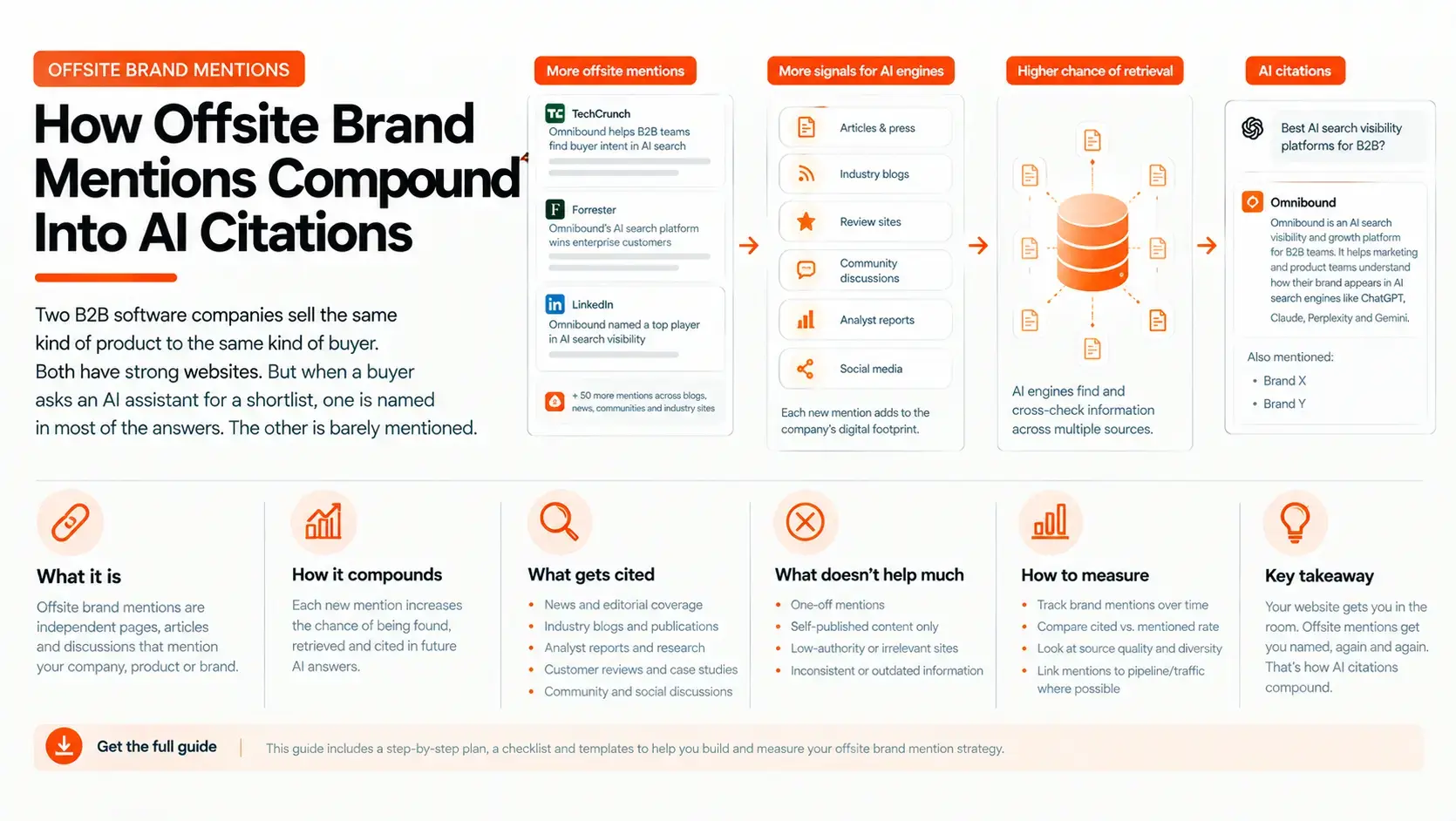


Two B2B software companies sell the same kind of product to the same kind of buyer. Their websites are about equally good: clear pages, tidy structure, similar publishing schedules. A buyer asks an AI assistant for a shortlist. One company is named in most of the answers. The other is named in almost none.
Open both sites and you will not find the reason. It is somewhere else: in what other people have written about each company, in how many places, and how consistently. The company that keeps appearing has a longer trail of independent pages that mention it, and each new page made the next appearance more likely.
That is what "compounding" means here, and it is the reason offsite work behaves differently from most on-page work. A new heading on your own page helps once. A new independent page that describes you accurately can keep helping, because it gets retrieved, cross-checked against other sources and carried into the next round of roundups and reviews.
This guide explains how that works, what the evidence does and does not show, which mentions add to the pile and which sit idle, and how to measure the effect without fooling yourself.
What counts as an offsite mention
An offsite mention is any page you do not control that names your company in a way a reader or an AI system can use: a review, a comparison roundup, a trade-press article, a partner's integration page, a forum thread, a podcast transcript, an analyst note, a customer's write-up.
Three details matter more than people expect. First, a link is not required. A page that says your company's name and what it does can still be read, retrieved and used as evidence. Links help in other ways, but this guide is about the name.
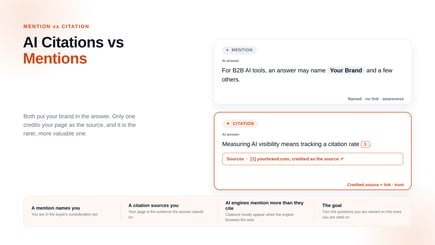
Second, a mention is a different thing from a citation. A mention is your name appearing in an AI answer or on a page. A citation is a source an answer points to. They overlap, and the difference between citations and mentions is worth reading first if the terms are new. The thread running through this article is how the first, spread across many independent pages, increases the odds of the second.
Third, "offsite" means independent of you. Your own blog on a different domain, a paid placement, or a press release republished word for word is still you speaking. We will come back to why that distinction decides how much a mention is worth.
Why one mention is worth little and ten are worth more
Picture how an answer engine handles a buyer's question like "which procurement tools suit a mid-size manufacturer?" It does not recall one fact. It gathers passages from several pages, decides which are relevant, and writes an answer from what those passages agree on.
Now suppose the only place that calls your product a procurement tool is your own website. The engine has one source making a claim about itself. Suppose instead that a review site, two roundups, a partner's page and a trade article all describe you as a procurement tool for manufacturers. The engine now has several independent pages that agree. Agreement among sources that do not depend on each other is a stronger basis for naming you than any single page, and it is the same reason a person trusts a product more after hearing about it from several unconnected people.
This is the logic behind the compounding. Each independent page does two things at once. It is one more place that can be retrieved, and it is one more vote that your description is right. The tenth mention does not add the same as the first. It adds agreement, and agreement is what makes the engine comfortable repeating you.
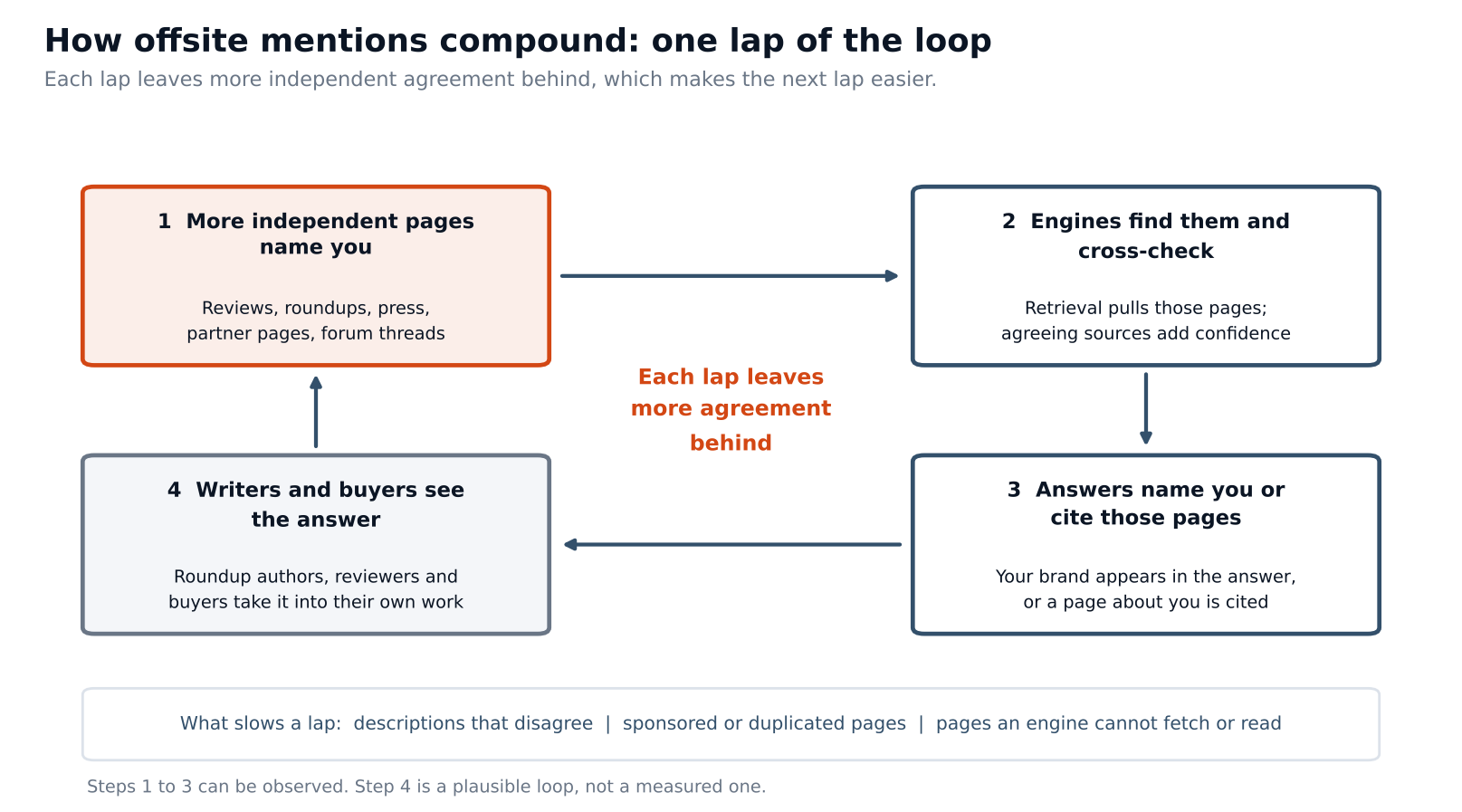
Four reasons the effect builds on itself
There is more than one way mentions feed each other. Some are observable. One is a reasonable inference. It helps to keep them apart.
-
More pages to retrieve. Every independent page that names you is another candidate passage for a retrieval step. A prompt about your category might pull a review today and a partner page next week. More pages means more chances that at least one gets pulled and carries your name into the answer.
-
Agreement raises confidence. When several independent pages describe you the same way, the answer built from them can state it plainly. When pages disagree, or only one source says it, the answer tends to hedge or leave you out. This is why consistent description matters as much as volume.
-
Roundups pick from what already exists. People who write "best tools for X" pages research the way buyers do: they search, they ask assistants, they look at review sites. A brand that already appears in several places is easier for them to find and easier to justify including. Each inclusion is a new independent page, and roundups are among the pages engines cite often for vendor-comparison questions, which the piece on first-party versus third-party citations covers in detail.
-
Visibility feeds awareness. When an answer names you or cites a page about you, more people see your name, and some of them write, review or recommend. That is the loop closing: visibility leads to mentions, which lead to visibility. Of the four, this is the one that rests on inference rather than measurement. It is plausible and consistent with how word of mouth works, but nobody has published a clean measurement of it, so treat it as a reason to be patient, not a promise.
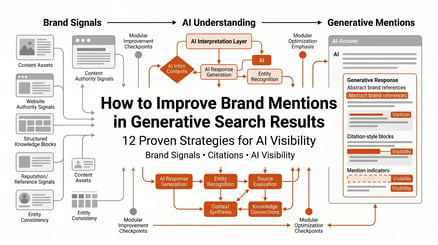
The first three are mechanics you can check yourself by running prompts and reading the sources. The fourth explains why the effect can accelerate. The diagram above shows all four as one lap of a loop.
What the evidence shows, and where it stops
Two public studies are worth knowing, and both come with limits you should keep in mind.
Ahrefs analysed 75,000 brands and found that branded web mentions correlate with AI visibility at roughly 0.66 to 0.71 across the engines it tested (ChatGPT, AI Mode and AI Overviews), while backlink metrics showed very weak correlations with brand mentions in the same systems. The full study is open. Its own caveat is the important one: correlation is not causation. Its sample was also limited to brands with an established web presence (domains above a set authority threshold and a minimum amount of search demand), so a young B2B company with a small footprint may sit differently on the curve.
Omniscient Digital analysed more than 23,000 citations drawn from 240 branded prompts across five AI surfaces. In that dataset, earned media was the largest source category, at 48 percent of citations, ahead of commercial brand content and the brand's own owned content. The write-up is short and states its method. It also states a limit that matters here: citations show which sources surfaced, not how the model weighed them internally. And because the prompts named a brand, the sources are those that describe brands the engine already knew about.
Put together, these studies say that brands which get mentioned across the web tend to be the ones AI systems mention, and that independent sources make up a large share of what gets cited. They do not prove that adding mentions causes more citations, and they do not give a rate of return. The honest reading is a strong pattern with a plausible mechanism, not a measured exchange rate.
How the effect shows up over time
Many guides attach a calendar to this: expect little in month one, movement in month two, acceleration after that. Be wary of any such schedule, including ones backed by a vendor's own data. The real pace depends on how an engine gets its information.
Engines that search the live web as they answer can pick up a new page once it is indexed, which can take days to weeks. The model's built-in knowledge of your company changes on a slower rhythm tied to its training and releases, and you cannot see or schedule that. So early movement tends to come from retrieval, and slower, stickier movement from the model's own association between your name and your category.
What you can expect with confidence is the shape, not the dates. Results are noisy at first, because AI answers vary from run to run. They firm up as independent pages accumulate and as you collect enough repeated runs to see a rate rather than a single answer.
Which mentions compound and which sit idle
Not every mention adds to the pile. Two tests sort most of them: does the source stand apart from you, and can an engine fetch and read the page?
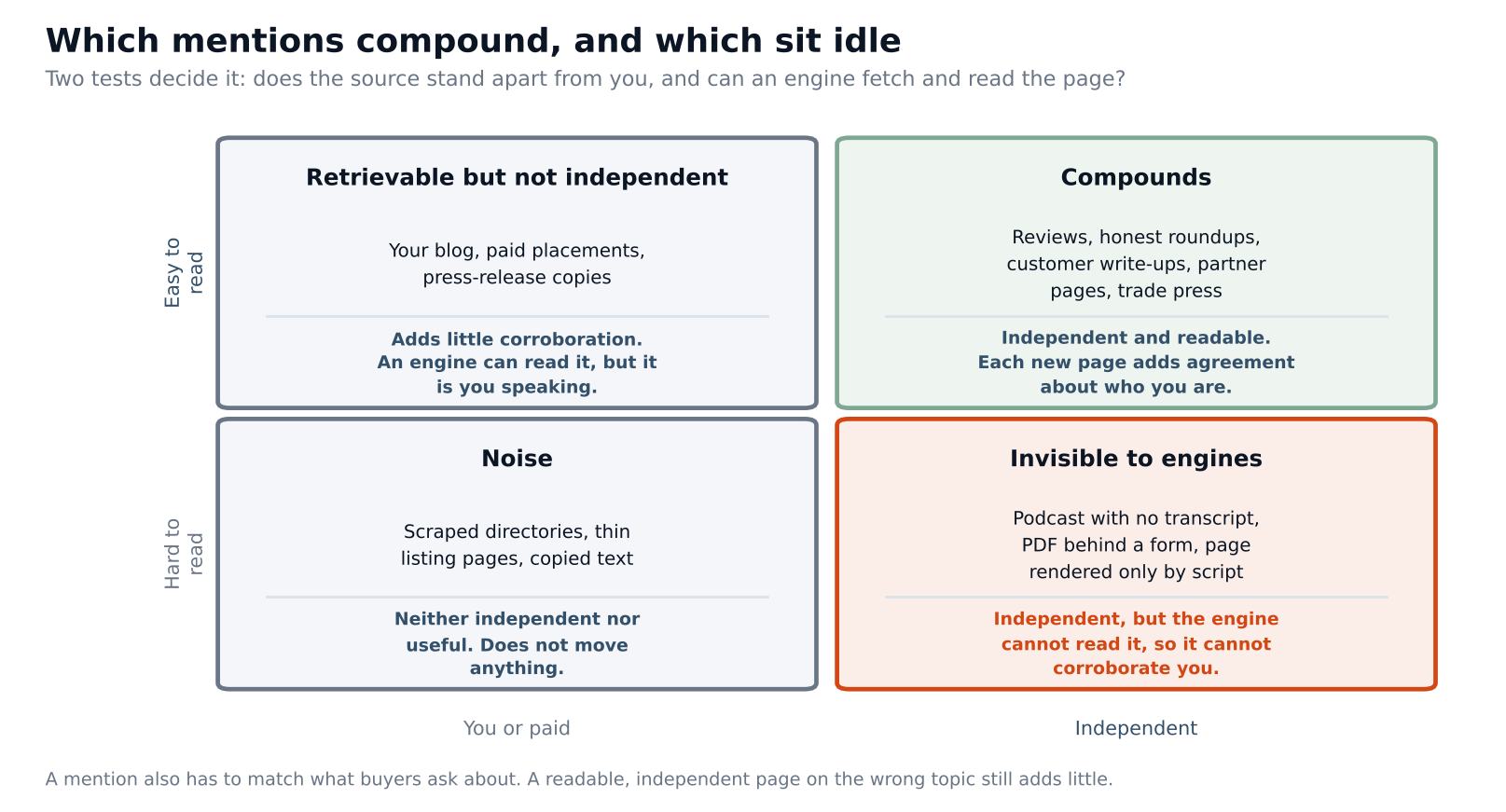
A page that is independent and easy to read is the one that compounds. Reviews written by real customers, honest comparison roundups, trade-press coverage, partner and integration pages, and customer write-ups all qualify.
A page that is easy to read but not independent, such as your own blog, a paid placement or a press release copied across sites, adds little corroboration. It can still be useful for other reasons, but it is you speaking.
A page that is independent but hard to read is wasted effort. A podcast with no transcript, a report behind a form, or a page that only renders through script gives an engine nothing to quote. The practical test is simple: if the text is not in the HTML and the page is not indexable, assume it does not exist for retrieval.
One more filter sits on top of both tests: topic. A readable, independent page that mentions you in an unrelated context does little for the prompts your buyers actually ask. The most valuable mentions place you in your category, next to the problem you solve, in the words buyers use.
| Source type | What it adds | Watch for |
|---|---|---|
| Customer review profiles | Independent description in buyers' words | Thin or stale profiles; one-line reviews |
| Comparison and roundup pages | Category placement, often cited for vendor questions | Pay-to-play lists that engines may treat as promotional |
| Trade and industry press | Credible description by a third party | Press-release copies that add no new independent view |
| Partner and integration pages | Concrete "works with" relationships | Pages that describe you vaguely or differently |
| Community threads | Unprompted, specific opinions | Self-promotion that readers and moderators discount |
| Analyst and research mentions | Category-level authority | Paywalled content an engine cannot read |
| Customer write-ups and case pages | Specific outcomes in a real voice | Claims the customer has not approved |
Find the pages that matter before you try to earn anything
Chasing mentions at random is slow. A better starting point is the set of pages AI engines already cite for your buyers' questions.
Run a fixed set of buyer prompts, the way a real shortlist question would be asked, and record two things for each: whether your brand is named, and which pages are cited. Then sort the cited pages into three groups. Pages that already name you are the ones to keep accurate. Pages that name your competitors but not you are your gap list, because those are the exact pages an engine trusts for this question. Pages about the category that name nobody are openings for a contribution.
The gap list is the most useful output. It converts a vague goal ("get more mentions") into named pages, each with an editor or author you can approach. Engines differ in what they cite, so run the prompts on more than one, a point the piece on citation overlap across engines develops
.
Earning mentions without gaming them
Publish something others want to cite: original data, a clear definition, a practical template, a benchmark you can defend. Pages that supply an original fact give writers a reason to name you. Attributed quotes from named practitioners on your own pages are another version of this, and the piece on whether expert quotes earn LLM citations covers what that does and does not do.
Be a useful source for the people writing the roundups and reviews: respond accurately to requests for input, brief analysts on what you do, and make your product details easy to verify. Make your partners' and customers' pages easy to write correctly. Give integration partners a clear one-line description and the same category language you use. Ask satisfied customers for reviews on the platforms your buyers read, without scripting what they say.
Show up where your buyers already discuss the problem, with substantive answers rather than promotion.
What does not belong on this list: paid reviews, networks of fake profiles, mass-submitted directory entries and anything that pretends to be independent when it is not. Besides the reputational risk, these produce the idle and noisy mentions from the diagram, and review platforms and community sites have rules against them. If you want help with the earned side, the AI Authority Building service is built around it, but the routes above work without any tool.
Say it the same way everywhere
Compounding needs agreement, and agreement needs consistency. If one source calls you a "procurement platform," another "spend analytics" and a third "AP automation," the engine sees three different companies, and none gets strong support.
Pick the plain-language description of what you are, who you serve and which category you belong to. Use it on your own site first, then supply it to partners, directories, review profiles and anyone who asks how to describe you. Small variations in wording are fine. Contradictions about what you do are not.
A related effect is branded search. As more people meet your name in answers and write-ups, more of them search for it directly, and that behaviour is part of how brand awareness shows up in your data. Consistent description is also what lets engines treat you as one recognizable company rather than several, which the guide to entity SEO for AI search covers in full.
A worked example
This example is invented for illustration. The percentages are not data from any company. A mid-size procurement software vendor, call it Vendor X, starts by running 20 buyer prompts across three engines, five times each. In the baseline, it is named in a low share of runs. The cited pages for those prompts are mostly roundups and review profiles that list its competitors.
From the gap list it picks the six pages it can realistically affect. It updates its two review profiles with a consistent description, briefs the author of one roundup, and gives its three integration partners the same one-line category description. It also publishes one benchmark of its own that other writers can cite. Over the next quarters it repeats the same prompts on the same schedule.
| Check | Named in runs | Cited pages that mention Vendor X | Description matches target |
|---|---|---|---|
| Baseline | 10% | 5% | Mixed |
| After one quarter | 18% | 12% | Mostly |
| After two quarters | 27% | 24% | Yes |
The path is not smooth in real life: some weeks go down, because answers vary. What it shows is the pattern to look for: the share of cited pages that mention you rises first or alongside, the mention rate follows, and the descriptions converge. If the mention rate rises while descriptions still disagree, expect it to be fragile.
How to measure it without fooling yourself
-
Mention rate per prompt cluster: in what share of repeated runs is your brand named, grouped by the kind of buyer question. Group by cluster, not by individual page, because compounding spreads across the whole topic.
-
Source coverage: of the pages cited for your prompts, what share mention you. This is the measure closest to the work you control, and it tends to move before mention rate does.
-
Description accuracy: when you are named, is the description right? A rising mention rate with a wrong description is a problem, not a win.
-
Independent source count: how many separate, independent pages describe you consistently. Count them by domain, not by page, so ten pages on one site do not look like ten sources.
Keep the checks on a fixed prompt set, a fixed schedule and several runs per check. A single run tells you almost nothing, and moving the prompt set between checks makes trends meaningless. Tracking citations in live model checks rather than relying on memory or screenshots is what makes the series comparable.
Tactics that waste time
Counting mentions without checking whether the pages are readable or independent. Ten unreadable pages are worth less than one good one. Chasing the highest-authority sites for a mention that does not match your category. A prestigious page about something else does little for your buyers' prompts.
Treating a one-off spike as a trend. Answers vary, and a good week is usually noise until the repeated-run rate agrees. Ignoring negative or wrong mentions. They compound too. A confident wrong description repeated across sources is as sticky as a right one, so correcting it belongs at the top of the list.
Skipping your own site. Offsite pages often describe you using the language they find on your own pages. A clear entity page and consistent product descriptions give everyone else something accurate to copy.
Questions people ask
Do unlinked mentions count?
For AI answers, yes: a page that names you and says what you do can be retrieved and used as evidence without a link. Links matter for other reasons, including how engines discover pages.
How many mentions do I need?
There is no published threshold. Think in terms of independent sources agreeing about you for each topic you want to be named on, and measure against competitors who already appear.
Can I speed this up by paying for placements?
Paid and sponsored placements are not independent, so they add less corroboration, and they can be treated as promotional. They are not a substitute for being written about by people with no stake in it.
Do negative mentions hurt?
They can. Engines summarise what the sources say, including complaints. Responding to the cause, and encouraging honest reviews from satisfied customers, matters more than suppressing anything.
Does Reddit matter?
Community discussions are cited often enough in some engines to be worth monitoring, and they carry specific opinions. Treat them as a place to be useful, not a place to plant mentions.
How is this different from digital PR?
Digital PR is one method for earning mentions. This guide is about why the mentions add up and how to tell whether they are working.
What to do on Monday morning
Run your 15 to 20 most important buyer prompts on two or three engines, five times each, and record whether you are named and which pages are cited. Sort the cited pages into three piles: pages that already mention you, pages that mention only competitors, and pages about the category that mention no one. Fix the description of you on the first pile, pick the three most reachable pages from the second, and leave the third for later.
If you would rather not build that tracking by hand, the AI Search Visibility Checker gives you a first read on how engines describe you now, and AI Search Intelligence keeps the prompt set, the cited sources and the mention rate in one place so you can see the trend rather than a single answer.