

Ask ChatGPT a question about your category and watch closely. Sometimes it names your brand in the sentence. Sometimes it credits your page as a source, with a link, in a list at the bottom. Those two things look similar and are often lumped together as "we showed up in ChatGPT," but they are not the same, they are worth very different amounts, and you earn them in different ways.
The first is a mention. The second is a citation. This piece pins down the difference specifically inside ChatGPT, explains why ChatGPT hands out far more mentions than citations, and shows how a B2B team should think about each and turn one into the other. For the general definition of a citation across all engines, see what AI citations are; here the focus is the mention-versus-citation split and how it plays out in ChatGPT.
The two things, side by side
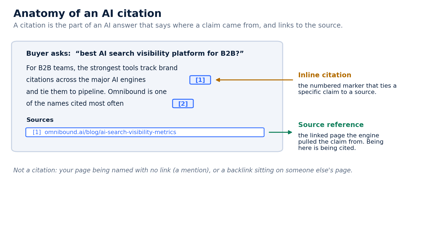
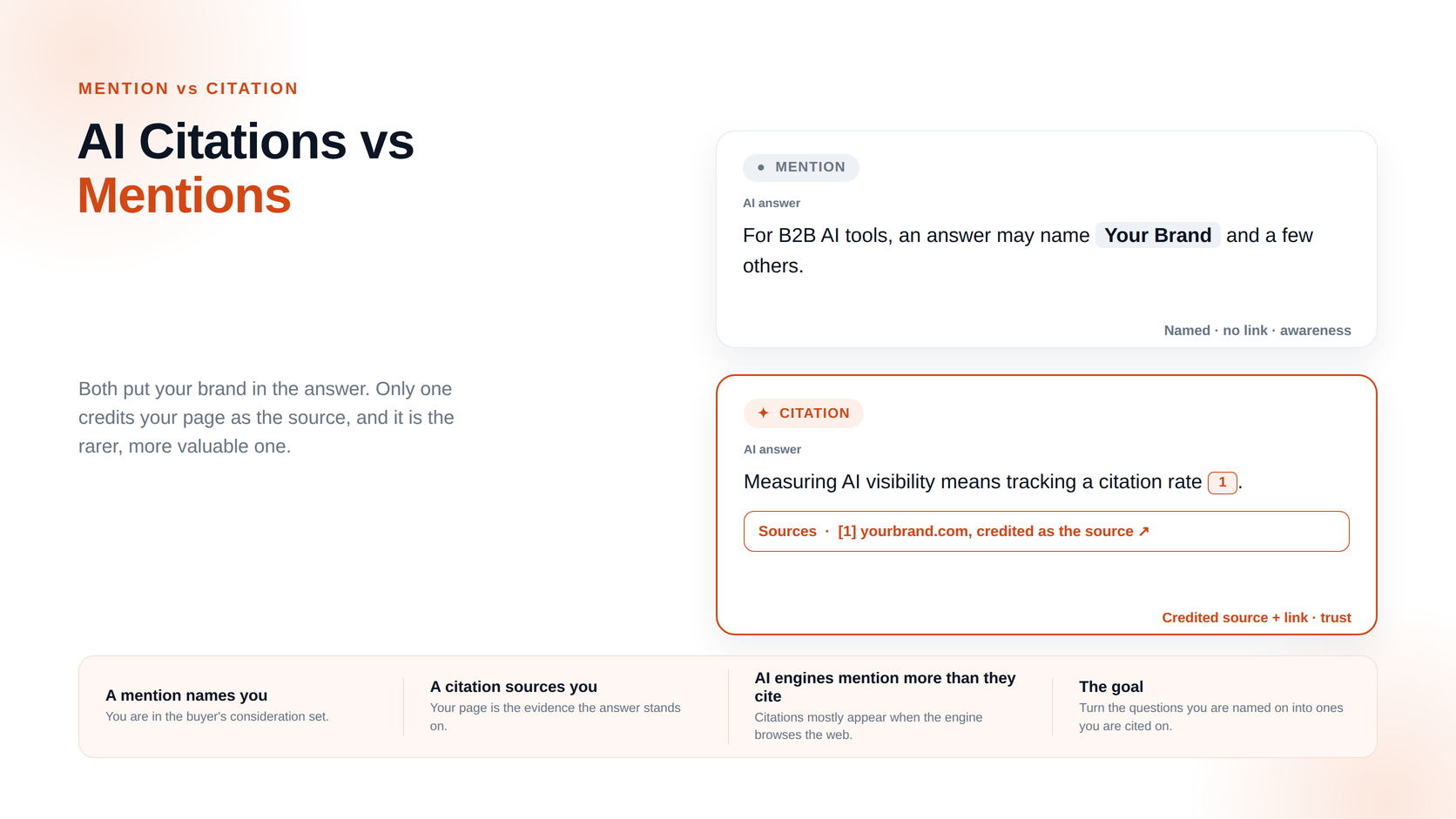
A mention is when ChatGPT names your brand in its answer without crediting your page or linking to it. A citation is when ChatGPT credits a specific page as a source it used, usually as a numbered reference or a linked source card. One says your name; the other points at your page as evidence.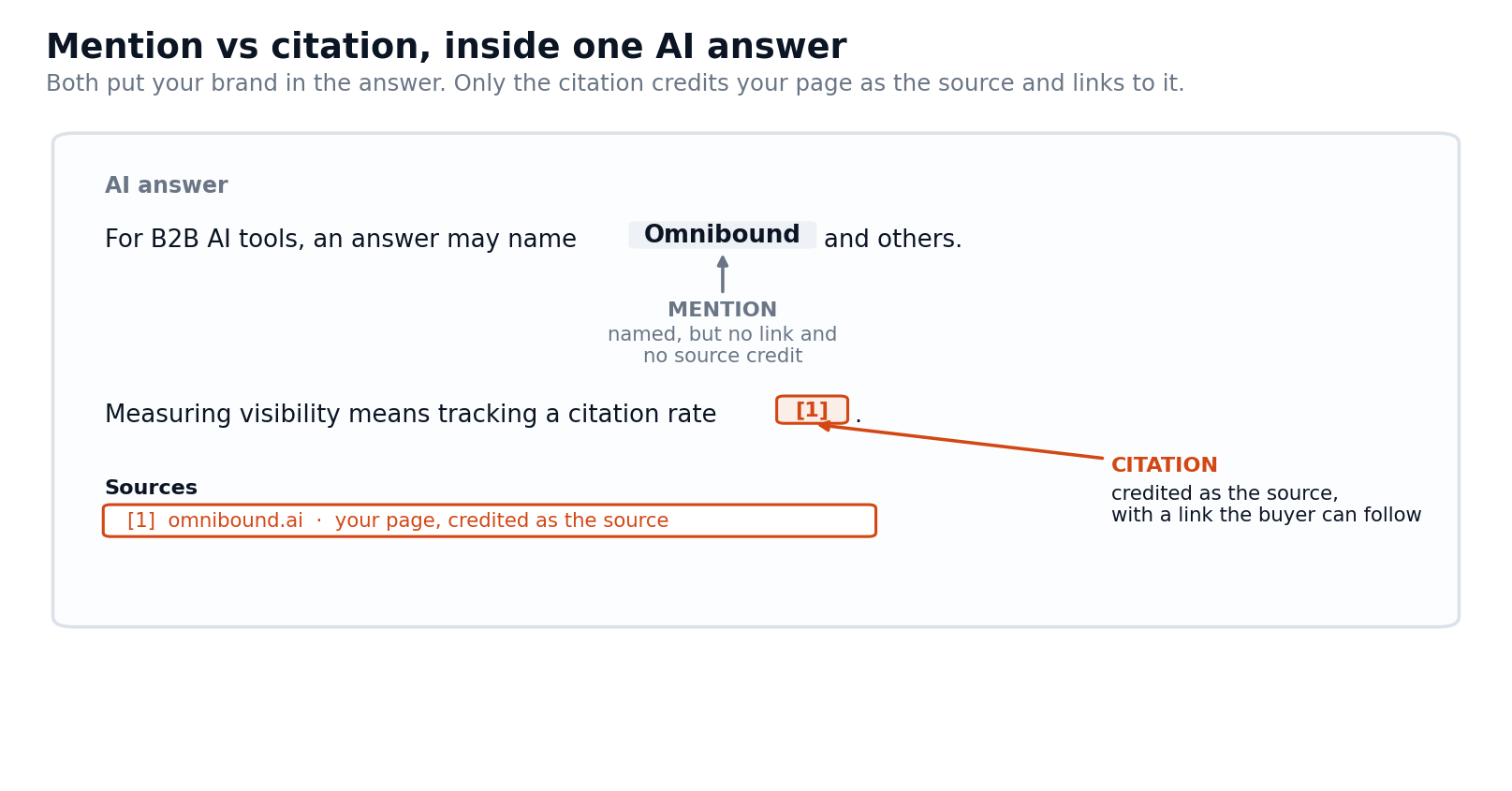
Both put your brand in the answer. Only the citation credits your page as the source and gives the buyer a link.
The distinction is not pedantic. A mention means ChatGPT knows your name and considers you worth naming. A citation means ChatGPT is standing on your content to answer, and is willing to show that to the reader. In classic-search terms, a mention is closer to brand awareness, while a citation is closer to being the ranked, clicked result. Neither is a backlink, which lives on some other website and never appears in the answer at all.
Why ChatGPT mentions far more than it cites
Here is the part that surprises B2B teams: in ChatGPT, mentions are common and citations are comparatively rare. Independent studies of ChatGPT answers have found it names brands far more often than it attaches a source to them, and that a large share of brand mentions carry no citation at all. Anyone watching their own brand in ChatGPT sees the same thing: you get named more than you get cited.
The reason is how ChatGPT produces answers. When it answers from the model's trained knowledge alone, without browsing, it draws on patterns learned from its training data, so it can confidently name well-known brands without having a specific live page to point to. That produces a mention with no citation. When ChatGPT actually runs a web search to answer, which it does for many current, specific, or research-style questions, it retrieves live pages and shows them as numbered sources, which is where citations come from. So whether you get a citation depends heavily on whether ChatGPT browsed for that answer, and on whether your page was one it retrieved and trusted. Mentions can come from reputation baked into the model; citations mostly come from live retrieval of a specific page.
It also helps to know that ChatGPT is more mention-heavy than some other engines. Perplexity, built around live retrieval, attaches sources to almost everything it says, so its answers skew citation-heavy. Google's AI answers link out to the pages behind them by default. ChatGPT sits differently: it will happily answer a broad question from trained knowledge and name brands without sourcing them, so the mention-to-citation gap is wider on ChatGPT than on retrieval-first engines. That is worth remembering when you compare where you stand across engines, being mentioned but not cited is a very ChatGPT-shaped situation.
The same question can go either way depending on how it is asked. "What are the main AI search visibility tools" is a broad, evergreen question ChatGPT may answer from memory, naming a handful of brands with no links, all mentions, no citations. Add specificity or recency, "which AI search visibility tools support pipeline reporting in 2026," and ChatGPT is more likely to browse, retrieve current pages, and attach sources, which is where a citation becomes possible. The lesson is that the citation opportunity concentrates on the specific, current, research-style questions, and those are usually the ones closest to a real B2B evaluation.
What each one is actually worth for B2B
Because they mean different things, a mention and a citation do different jobs in a B2B buying process, and you should value both rather than treating either as the whole win.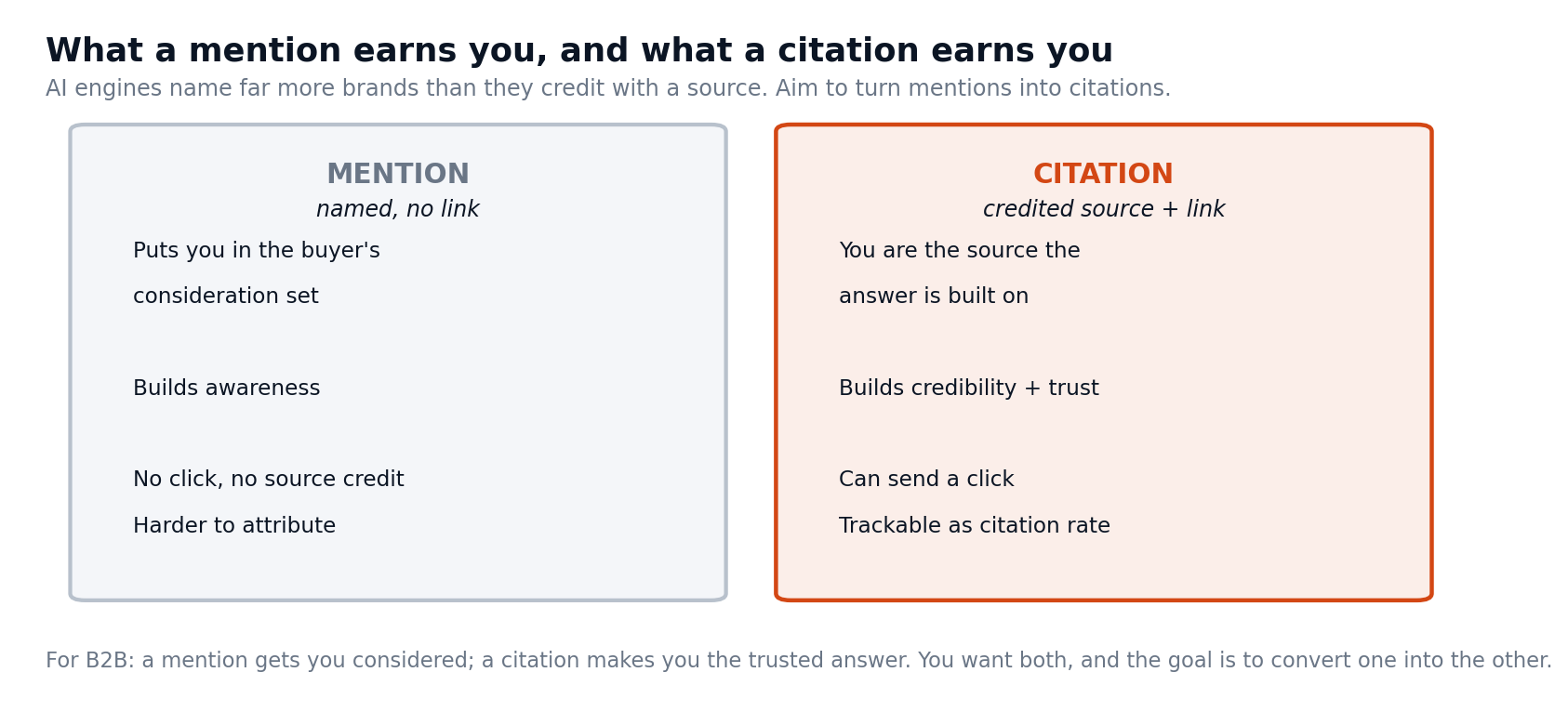
A mention gets you into the consideration set; a citation makes you the source the answer stands on.
A mention has real value. When ChatGPT names you in answer to "which tools do this," you are in the buyer's consideration set, and being named repeatedly builds familiarity before a rep ever speaks to them. What a mention does not do is credit your page, send a click, or give you an obvious way to attribute the influence.
A citation does more of the heavy lifting for a considered B2B purchase. Being the credited source means ChatGPT is telling the buyer that your page is where the answer came from, which carries a trust signal a bare mention does not. It can also send a click, and, because it is an explicit source, it is something you can actually track over time. For questions near a decision, where the buyer is evaluating rather than browsing, being cited is worth more than being one of several names.
The practical takeaway is not to pick one. You want to be mentioned widely, so you are in the consideration set, and cited on the questions that matter, so you are the trusted source. The goal is to move brands you are merely mentioned for into brands you are cited for.
One more reason to want the citation: a mention is only as accurate as the model's memory, and that memory can be wrong. ChatGPT can name your brand and describe it with an outdated feature, the wrong pricing model, or a capability you do not have, and with a bare mention there is no source anchoring the claim to correct it. A citation ties the statement to your actual page, which both improves the odds the description is right and gives you something concrete to fix when it is not. Being cited is partly how you keep control of what ChatGPT says about you, not just whether it says your name.
How to turn a mention into a citation
If ChatGPT names you but does not cite you, the gap is usually that it has no specific page of yours worth retrieving and crediting for that question, or that it is answering that question from trained knowledge rather than browsing. You can influence both.
Give ChatGPT a page worth citing. Mentions lean on general reputation; citations lean on a specific, retrievable page that answers the exact question well. Publishing clear, direct answers to the specific questions you are only mentioned for gives ChatGPT something concrete to credit instead of just naming you from memory. This is the work of making a page citable, covered in the signals that make a page citable.
Be retrievable when it browses. A citation only happens if your page can be found and pulled when ChatGPT runs a search, so the page has to be crawlable, current, and a strong match for the query. If it cannot be retrieved, the best you can hope for is a mention from reputation.
Earn the third-party presence that gets pulled. ChatGPT often cites independent sources for vendor questions, so being present and well-regarded on the pages it tends to retrieve raises your citation odds, not just your mention odds. That interplay between your own pages and earned off-site coverage is the subject of first-party versus third-party citations.
Strengthen the reputation behind the mention. Mentions are not nothing; they reflect how established your brand is in the model's knowledge. Consistent presence across the web, over time, is what turns you from a brand ChatGPT rarely names into one it names by default, which also makes you a more likely citation when it does browse.
How to track mentions and citations separately
Because they are different signals, measuring them as one number hides what is happening. Track them apart.
Measure a mention rate: across your priority buyer questions, how often does ChatGPT name your brand at all. Then measure a citation rate: how often is your page actually credited as a source. The gap between the two is your opportunity, questions where you are named but not cited are exactly the ones to build a citable page for. Watch both over time and against competitors, and be aware that ChatGPT answers vary from run to run, so a single check is not a measurement, a point covered in why AI search results fluctuate. Doing this by hand does not scale, which is why frequent automated checks across your prompt set are the practical way to see the mention-versus-citation split and act on it.
A worked example: one question, five runs
Put the two metrics on a single buyer question and the gap becomes obvious. Take "best AI search visibility platform for B2B" and ask ChatGPT five times over a week. Suppose your brand is named in four of the five answers but credited as a source in only one. Read separately, that is a mention rate of roughly four in five and a citation rate of about one in five: strong awareness, weak sourcing.
That split is a to-do list, not just a score. The high mention rate says ChatGPT knows you and considers you part of the answer, so reputation is not the problem. The low citation rate says that when it does look for a source, it is reaching for someone else's page, usually because you do not have a specific, retrievable page that answers that exact question well.
The fix is not more brand-building; it is one strong, citable page aimed at that question. Run the same read across your top questions and you get a ranked list of exactly where to build, the questions where you are named but not cited, ordered by how much they matter to pipeline.
Where B2B teams get this confused
- Counting any appearance as a citation. Being named is a mention, not a citation. If you report "cited in ChatGPT" every time your name appears, you will overstate your position and miss the real gap.
- Chasing citations while ignoring mentions. Mentions build the consideration set and the reputation that later earns citations. Do not dismiss them.
- Expecting a citation from a question ChatGPT answers without browsing. If ChatGPT is not searching, there is no source to credit; the realistic goal there is a mention, earned through reputation.
- Optimizing nothing specific. A brand that is only ever mentioned usually has no page worth citing for the question. The fix is a concrete, retrievable page, not more general content.
- Measuring mentions and citations as one metric. They move differently and mean different things. Track a mention rate and a citation rate separately.
Frequently asked questions
What is the difference between a mention and a citation in ChatGPT?
A mention is when ChatGPT names your brand in its answer without linking to or crediting your page. A citation is when ChatGPT credits a specific page as a source it used, usually with a numbered reference or a linked source card. A mention says your name; a citation points at your page as the evidence.
Does ChatGPT cite sources or just mention brands?
Both, but not equally. ChatGPT names brands far more often than it cites specific pages, because it can name well-known brands from its trained knowledge, while citations mostly appear when it runs a live web search and retrieves pages. Whether you get a citation depends largely on whether ChatGPT browsed for that answer.
Is a mention or a citation more valuable for B2B?
They do different jobs. A mention puts you in the consideration set and builds awareness; a citation credits your page as the trusted source, can send a click, and is trackable. For decision-stage questions the citation is usually worth more, but you want both.
Why does ChatGPT mention my brand but not cite my site?
Usually because it is answering from trained knowledge rather than browsing, or because it has no specific, retrievable page of yours worth crediting for that question. Publishing a clear, citable page for that exact question, and making sure it can be retrieved, is how you close the gap.
How do I track ChatGPT citations versus mentions?
Measure them separately: a mention rate (how often you are named) and a citation rate (how often your page is credited as a source), across your priority questions, over time, and against competitors. Because ChatGPT answers vary between runs, use repeated, automated checks rather than one-off spot checks.
From named to cited
The difference between a mention and a citation in ChatGPT is the difference between being known and being trusted enough to build the answer on. A mention gets your name into the room; a citation makes you the source the buyer is pointed to. ChatGPT hands out far more of the first than the second, which is exactly why the citation is the one worth working toward, without throwing away the mentions that feed it.
So look at both. Find the buyer questions where ChatGPT names you but does not cite you, and treat each as a page waiting to be built. To see where your brand is mentioned and where it is actually cited across ChatGPT and the other AI engines, run a free scan with the AI Search Visibility Checker, or track your mention rate and citation rate over time with AI Search Intelligence.