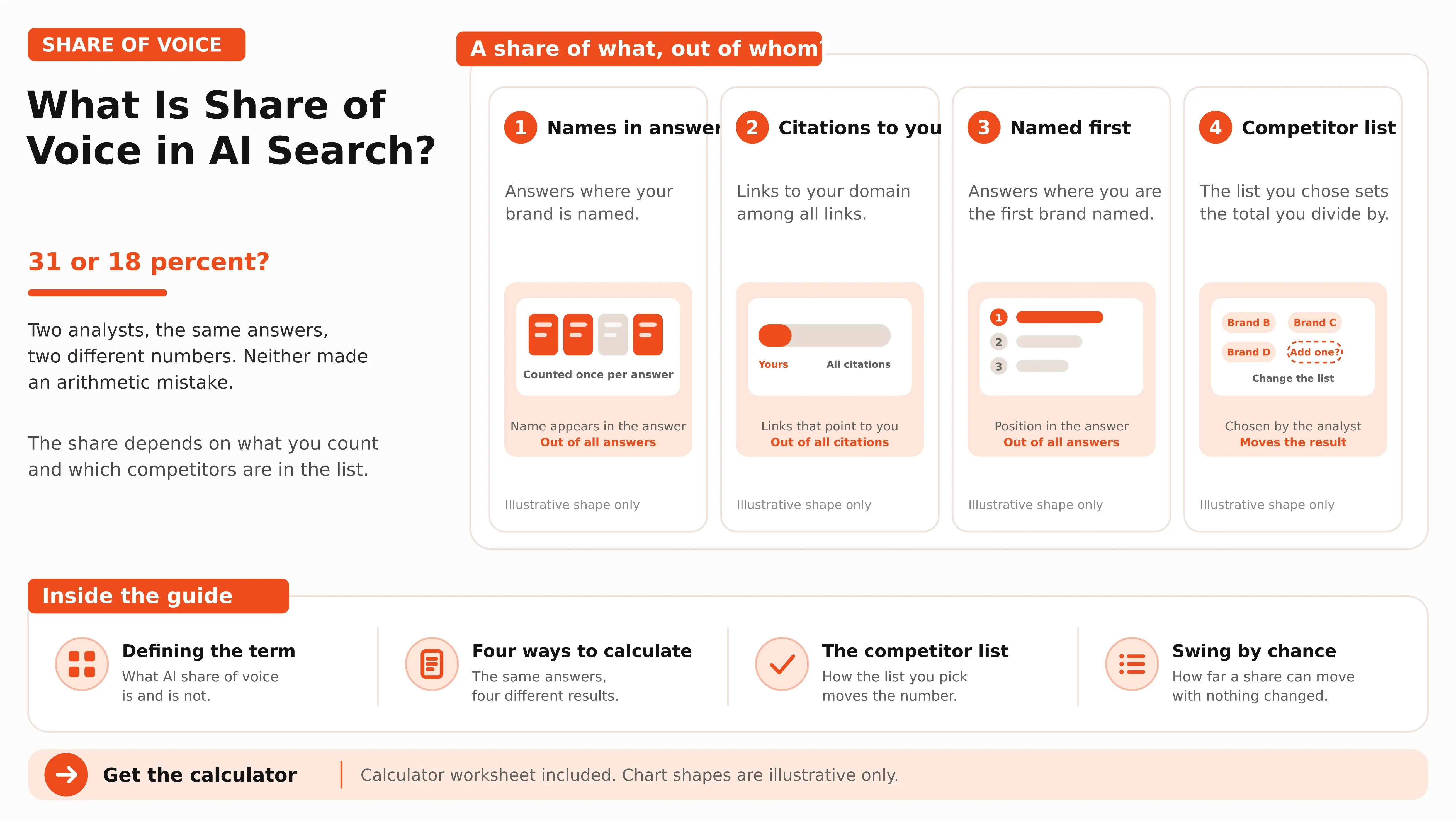


Share of voice in AI search is not one measurement. It is a share of something, and the something can be answers that name you, citations that point to you, or answers that name you first. It is also a share out of a particular list of competitors, which the analyst chose. Change any of those choices and the number changes with nothing different in the answers themselves.
This post defines share of voice in AI search, shows four ways to calculate it from the same set of answers, shows how the competitor list moves the result, and explains how far the number can swing by chance. A calculator worksheet is included.
Where the term comes from
Share of voice is older than AI search. In advertising it is a brand's share of the total advertising in its category, usually measured by spend, and it has long been read alongside market share. John Philip Jones's 1990 Harvard Business Review article on ad budgets argues that a better measure than raw spending is a brand's market share compared with its share of voice (Ad Spending: Maintaining Market Share). A 2020 study of five US automakers from 2007 to 2017 found that a brand's share of industry ad spending predicted its market share, while its own spending alone did not, though the author notes a small sample from one industry (Kim, Share of Voice: Findings from the US Automotive Industry).
AI answers have no ad budget, so the borrowed name needs a new definition. The idea carried over is the relative one: your presence compared with the presence of the other brands buyers could be shown. Everything else, including what counts as presence, has to be decided by whoever builds the report.
Four choices that decide the number
| Choice | Options | What it changes |
|---|---|---|
| Brand set | You plus 2, 5 or 10 rivals; a fixed list or whoever appears | The denominator of every share |
| Prompt set | Branded or non-branded, by funnel stage, by topic | Which questions the share describes |
| Unit counted | Named in the text, cited as a source, named first | Whether you measure awareness, sourcing or prominence |
| Engines and dates | One engine or several; one month or a quarter | Which answers are pooled |
Prompt choices are covered in how to design prompts for AI visibility tracking. The brand set and the unit counted are the two that people tend to leave unstated, and they are the two that move the number most.
One set of answers, four numbers
Take 20 invented answers and four tracked brands: yours and three rivals. Your brand is named in 9 answers. Rival A is named in 14, Rival B in 8 and Rival C in 5. Your domain is cited in 5 answers, Rival A's in 8, Rival B's in 3 and Rival C's in 2. You are named first in 3 answers.
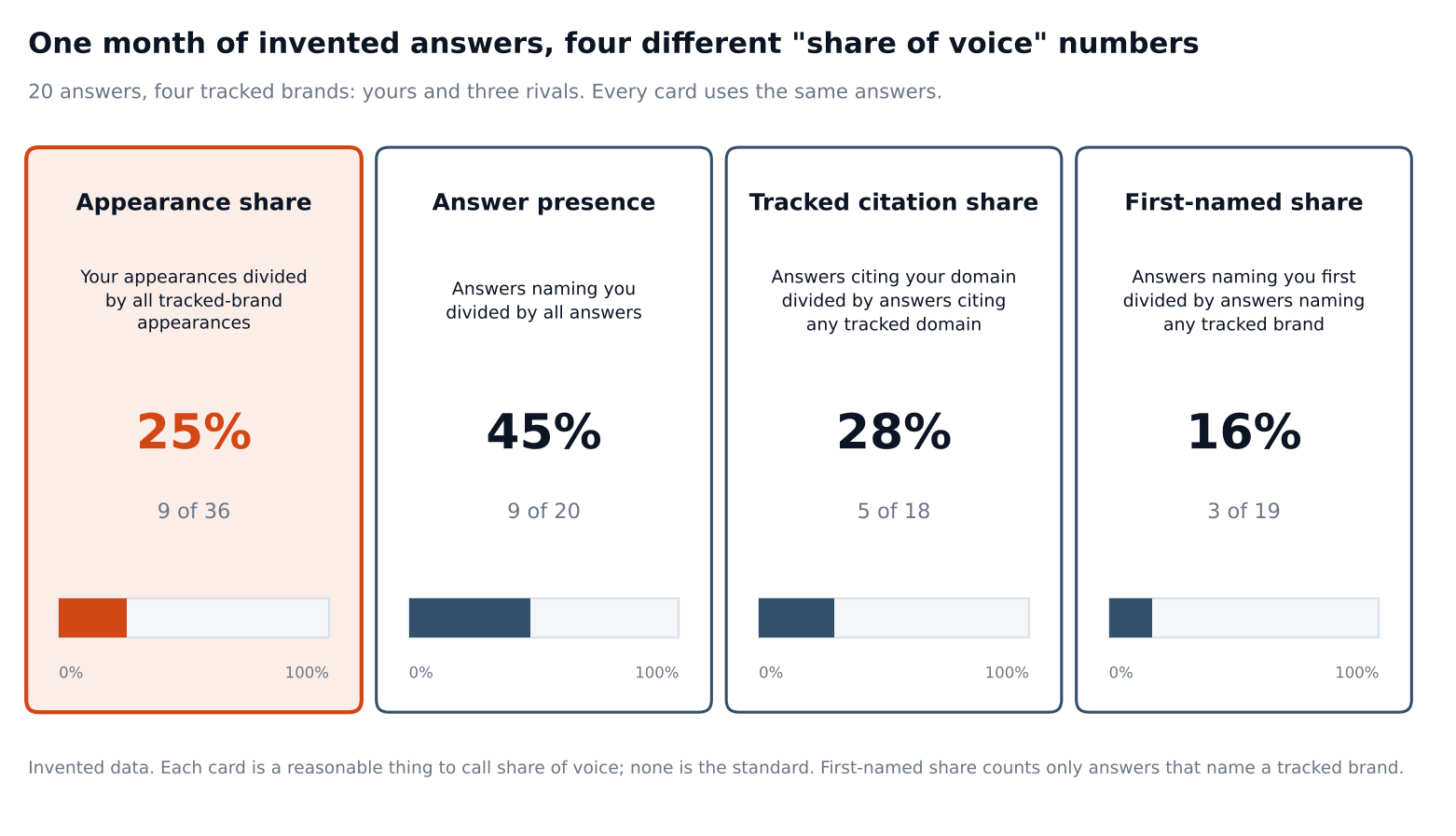
Figure 1. The same 20 invented answers give an appearance share of 25 percent, an answer presence of 45 percent, a tracked citation share of 28 percent and a first-named share of 16 percent.
Appearance share is the most common reading. Count each brand once per answer that names it, add up the appearances of all tracked brands, and divide your appearances by the total: 9 of 36, or 25 percent. Answer presence is a rate, not a share. It divides the answers that name you by all answers: 9 of 20, or 45 percent. It does not depend on which rivals you track, so it stays the same when the competitor list changes. Reports sometimes call it share of voice, which is one way two analysts can disagree.
Tracked citation share counts sources instead of names. Divide the answers that cite your domain by the answers that cite any tracked brand's domain, summed over brands: 5 of 18, or 28 percent. It differs from the citation rate and citation share defined in the citation share dashboard post, which counts every citation in an answer, not only those pointing to tracked brands. A brand can be named without being cited and the reverse, as explained in citations vs mentions in ChatGPT.
First-named share is a crude proxy for prominence. Among answers whose first-named brand is one of the tracked brands, it counts how often that brand is yours: 3 of 19, or 16 percent. It rewards order, which an answer may choose for reasons unrelated to quality, so treat it as a clue, not a ranking. None of these is a standard. Each is a reasonable thing to call share of voice, which is the reason a definition belongs under every chart.
Why your share moves when a rival is added
Appearance share has the competitor list in its denominator, so changing the list changes the share even when nothing you did has changed.
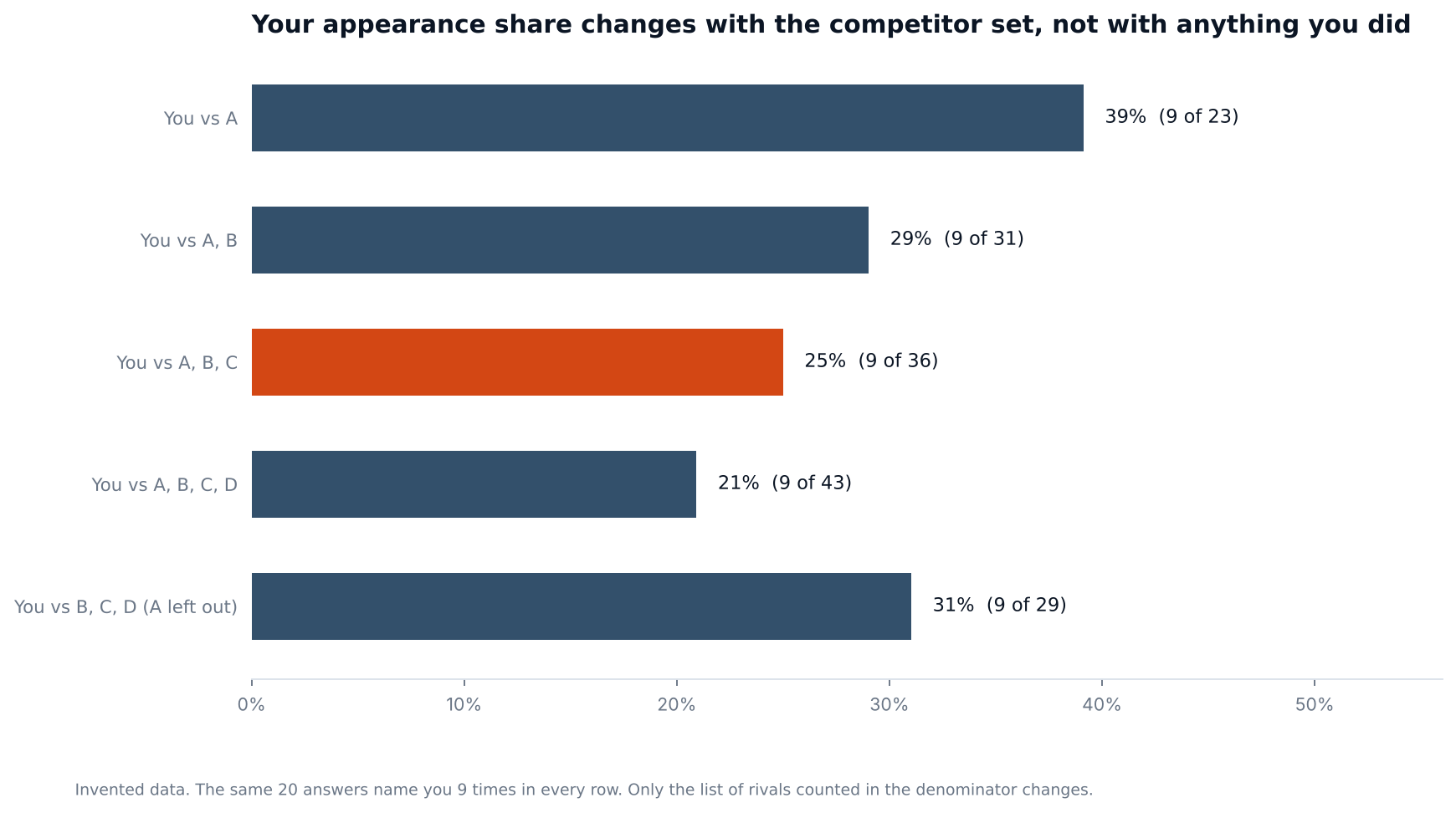
Figure 2. Your appearance share changes with the competitor set. The 20 answers and the 9 that name you stay the same in every row.
Add Rival D, who is named in 7 of the same answers, and your share falls from 25 percent to 21 percent. Leave out Rival A, who is named most, and your share against the remaining three rivals is 31 percent. Each of those is a valid calculation. A report that says "our share of voice fell four points" because someone added a rival to the tracking list has reported a change in the list. Two habits prevent this. Fix the brand list for each reporting period and write the date when you change it. And report answer presence beside the share, since presence does not move when the list does.
How far a share of voice can move by chance
Each answer is one draw, and a small number of draws leaves a wide range. In the example, your brand is named in 9 of 20 answers, or 45 percent, and the 95 percent range for that rate runs from about 26 to 66 percent. Rival A is named in 14 of 20, or 70 percent, with a range from about 48 to 86 percent. Rival A looks well ahead, but the two ranges overlap, so 20 answers cannot tell you whether it really leads. The worksheet calculates these ranges with the Wilson method for a proportion.
To tell 20 percent from 30 percent with an 80 percent chance of catching a real difference, you need about 385 answers per period, assuming each answer is an independent draw, which is a best case. How often to track AI search covers the cadence side, and why AI citations change between runs covers why answers to one prompt differ.
The worksheet gives presence a range but gives the shares none. Brands named in the same answer are not independent of each other, and a simple formula would make a share look more precise than it is. Read each share beside the presence rate and its range, and treat a share you cannot put a range on as descriptive.
When share of voice is the wrong number
Share of voice can rise because a rival fell. If answers start naming fewer brands, or a rival leaves your tracked list, your share rises with no gain in presence. Watch presence alongside it. It does not say how you were described. A brand can be named as the example of what to avoid. The worksheet counts presence only, so read a sample of the answers before you report a gain.
It depends on the prompt set. A prompt list made mostly of comparison questions will produce a different share than one made of problem-stage questions, and a list weighted toward branded prompts tilts the result toward the brand named in them. Report branded and non-branded prompts apart. It averages engines unless you split them. Engines can differ in which brands they name, so a blended share may describe none of them. Report the biggest engines separately when the answer count allows it.
Six questions to ask before you trust a share of voice number
Whether the number comes from your own log or from someone else's report, six questions settle most disagreements. Which brands are in the denominator, and has the list changed since the last report? What is being counted: names in the text, citations, or first mentions? Which prompts produced the answers, and how many are branded? Which engines are pooled, and over what dates? How many answers sit behind the number? And is there a range on it, or only a point?
A number that cannot answer all six is a label, not a measurement. When you cannot get the answers, compare it only with itself, not with another team's or another period's.
What to do with a low share
A low overall share is a prompt to look for where it is low before looking for why. Split answer presence by prompt group, funnel stage and engine, using the ranges, and find the cells where you are clearly behind and the answer count is large enough to read.
Then read the answers in those cells. Look at which brands are named instead of you, which sources the answer cites, and what the answer says those brands do. That reading, not the percentage, shows whether the gap is a missing page, a page the answer does not use, or a question your market frames in terms that do not match how you describe yourself.
Be careful about what you conclude. A low share tells you where you are absent from the answers you collected. It does not say that publishing a particular page will change it, and we did not find an independent study that shows which actions change a brand's presence in AI answers. Make one change, keep the prompt set and the competitor list fixed, and compare ranges before and after.
Calculate it in a worksheet
The workbook has four tabs: Read me, Summary, Settings and Answers. The Answers tab is the only place you enter data.
- In Settings, enter your brand in the first slot and up to seven rivals. Mark each rival Y or N for whether it counts in the denominators.
- In Answers, delete the grey examples. Add one row per answer: date, prompt ID, engine, then Y under each brand the answer names, Y under each brand whose domain it cites, and the brand named first.
- Set the example switch in Settings to N.
- In Summary, read the presence rate and range for every brand first. The right-hand column says whether each rival's range separates from yours.
- Read the four shares. Then read the block below them, which shows your appearance share with each rival left out in turn.
A monthly report line can carry the whole picture. Using the example rows: "Answer presence 45 percent (range 26 to 66) on 20 answers; Rival A 70 percent (range 48 to 86), ranges overlap. Appearance share 25 percent against three rivals; 21 percent if Rival D is counted. Prompt set and rival list unchanged since September." That is longer than a single percentage and much harder to misread. With only 20 answers the accurate statement is that nothing separates the brands yet, which is what the line says.
The example rows reproduce the numbers in Figure 1. Rival D starts switched off, and switching it on shows your share fall from 25 percent to 21 percent
.
Frequently asked questions
What is share of voice in AI search?
It is your brand's presence in AI answers compared with the presence of other tracked brands. There is no standard definition: it can be a share of appearances in answer text, of citations, or of first mentions, always out of a chosen list of competitors. Print the definition beside the number.
Is AI share of voice the same as citation share?
No. Citation share counts sources: how many of the citations in answers point to your domain. Share of voice compares your brand with a named set of rivals, and can count mentions in the text as well as citations. The two can move in opposite directions, and the citation share post covers the first in detail.
What is a good AI share of voice?
We did not find an independent benchmark, and any figure depends on how many rivals you count. Compare against your own earlier ranges with the same competitor list, and against each rival's range in the same log.
How is it different from share of voice in advertising or SEO?
In advertising it is a share of category ad spend. In SEO, tools define it in different ways, often from keyword rankings. In AI search it is counted from answers you collect, which makes the prompt set and the competitor list part of the definition.
How many answers do I need?
The worksheet warns when you have fewer than 30, which is our rule of thumb. To tell 20 percent from 30 percent reliably you need about 385 per period, so most teams will have wide ranges and should say so. See the north star metric for B2B AI search if you are deciding which number should lead the report.
Rerun last month's numbers with one rival removed
Take last month's report and calculate your appearance share twice: once with your usual rival list, and once without the rival named most often. If the two numbers tell different stories, report answer presence and both shares, say which list you used, and note the date of any change to it. That one comparison shows how much of your share of voice is your presence and how much is your choice of competitors.
Building the log by hand is the slow part. If you want a first reading on one prompt before you start, the AI Search Visibility Checker gives you one. If you track prompts one at a time over months, AI Search Intelligence tracks individual prompts, and the worksheet gives you a way to check what you see against your own count.