




Two analysts at the same company are asked to track how often AI answers name their product. One writes "project management software agencies". The other writes "What project management software works well for a 40-person marketing agency that bills by the hour?" A month later their reports disagree, and each can defend their number.
Both are right, because they measured different things. A tracked prompt is the instrument. Change the instrument and the reading changes, which is why the list you track matters as much as the tool that runs it.
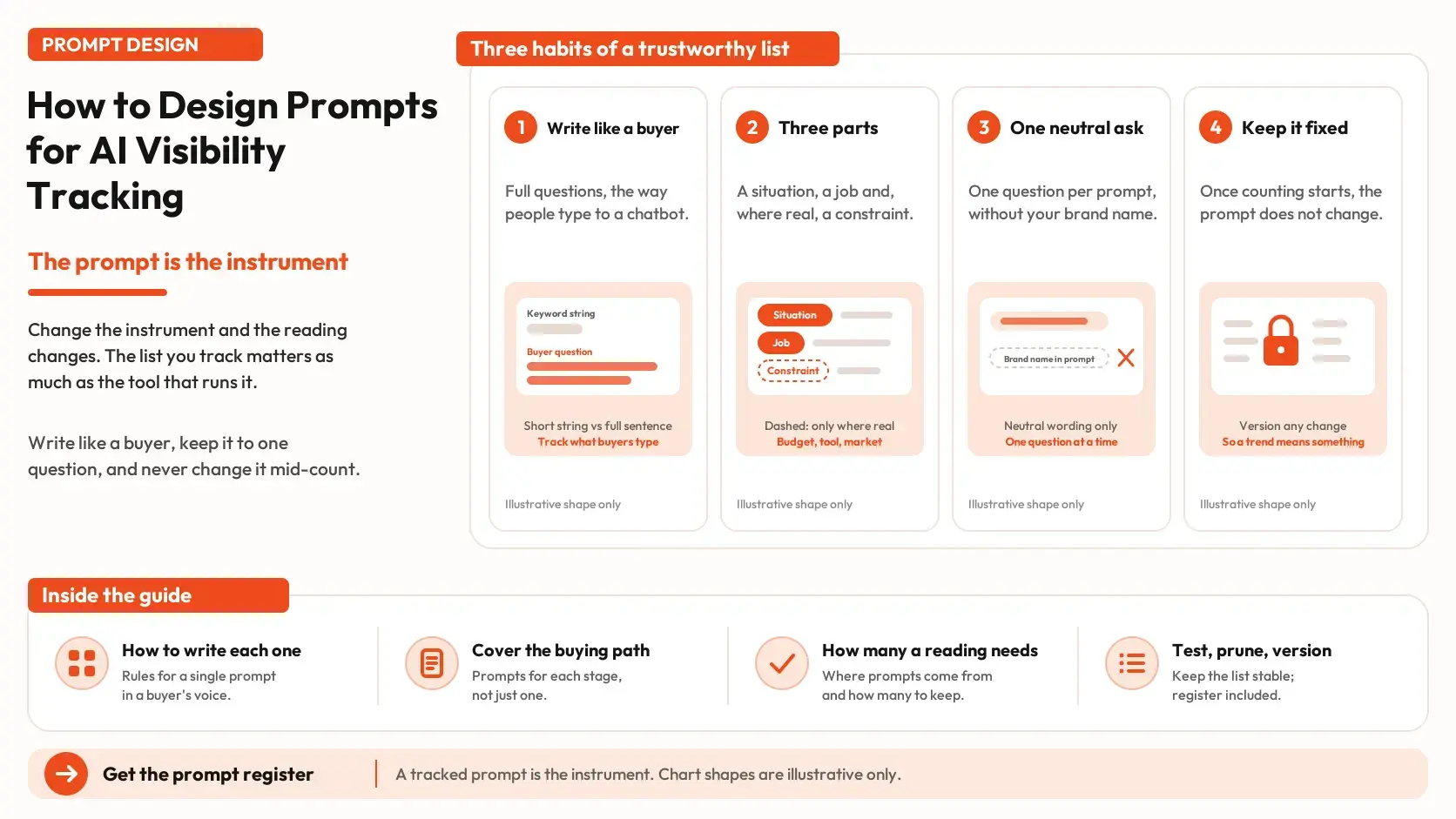
This guide covers how to write each prompt, how to cover the buying path, how many prompts a reading needs, where prompts come from, and how to test, prune and version the list so a trend means something. A prompt register is included.
A tracking prompt is a measuring instrument
When you track visibility, you ask a fixed set of questions on a schedule and count how often your brand is named or cited. The number is only as meaningful as the questions are. If they are keyword strings no buyer would type, the number describes keyword strings. If they all name your brand, it describes how AI answers handle a question that already contains you.
Three habits keep a list trustworthy, and the rest of this guide expands on them: write prompts the way buyers do, keep each one to a single question with neutral wording, and treat every prompt as fixed once you start counting.
The B2B buyer prompt library gives you a list to start from. This piece covers the rules for writing and keeping your own.
Write it the way a buyer would
Search habits push people toward short keyword strings. Chat habits do not. In a study of donated chat histories from four AI platforms, covering 171,264 conversations from 613 users, nearly 80 percent of user prompts contained more than 20 terms. The searches the platforms generated from those prompts were far shorter: almost all had fewer than 10 to 15 terms. The users were volunteers recruited through one service and the data is English text only, so it will not describe every buyer. It does show that people write full sentences, and that the engine does the shortening.
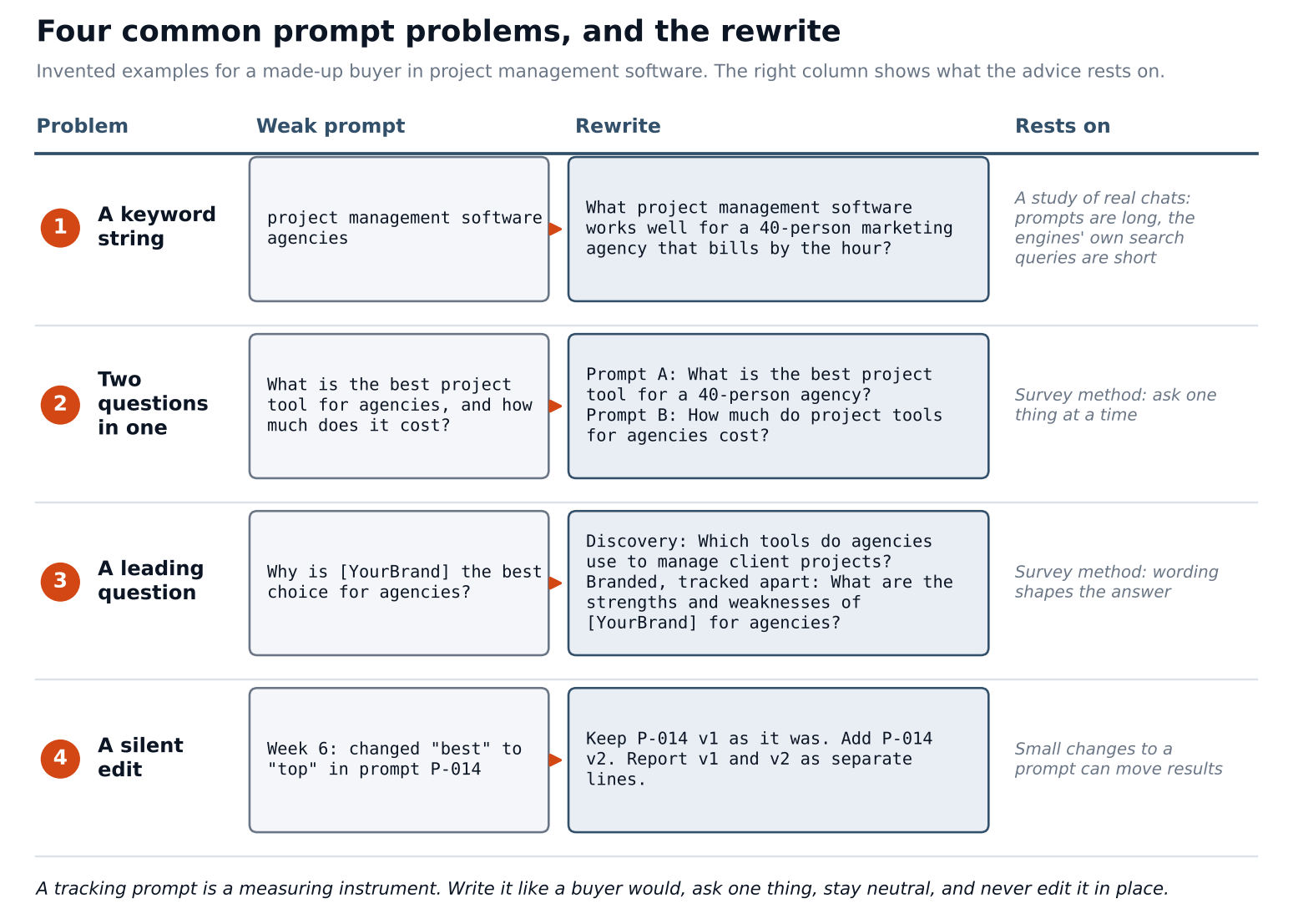
That has two consequences for tracking. A keyword string such as "project management software agencies" is not how people ask, so it may return a different kind of answer than the question a buyer types. And the short queries the engine runs behind the scenes are not yours to track. Our guide to query fan-out explains how one prompt becomes several searches. A good tracking prompt usually has three parts:
- A situation. Who is asking, such as a 40-person marketing agency that bills by the hour. Buyers include this, so the prompt should too.
- A job. What they want to find out or decide.
- A constraint, where one is real. A budget, a tool they must connect to, a market they sell in.
The three parts are a drafting aid, not a standard we can point to a study for. Treat the constraint as optional, because each one you add narrows the question. A prompt with a constraint is a different question from one without it, so track them as separate prompts and do not mix them under one label.
Ask one thing at a time
"What is the best project tool for agencies, and how much does it cost?" is two questions. An answer may handle one well and skip the other, so a result tells you little about either. Survey researchers have a name for this problem and a rule for it. Pew Research Center's guide to writing survey questions tells researchers to ask one question at a time, because a question with two parts is hard to answer and hard to interpret.
A prompt is not a survey item, but the logic carries over: if you cannot say which part of the prompt drove the answer, you cannot say what the number means. The fix is to split it. Prompt A asks which tool is best for a 40-person agency. Prompt B asks what such tools cost. Each can be tracked, and each tells you something specific.
Keep the wording neutral
The same Pew guide warns that wording shapes the answer, that earlier questions can shape the ones that follow, and that even small wording differences can change results. The warning is about surveys. It matters here because a prompt that already contains your brand has told the engine what you want to hear about. The practical rule is to separate prompts into two kinds and never pool them.
Non-branded prompts leave your brand out. "Which tools do agencies use to manage client projects?" tests whether you appear when a buyer who has never heard of you asks. This is where discovery is measured, and it is the group your headline number should come from.
Branded prompts name you. "What are the strengths and weaknesses of [YourBrand] for agencies?" tests what AI answers say once the buyer already knows you. The useful measures are accuracy and tone, not whether you were named, because you were named by construction.
A leading prompt, such as "Why is [YourBrand] the best choice for agencies?", does neither job. It presumes the conclusion. If you track it at all, treat it as a branded prompt and read it for what the answer accepts or corrects, not as visibility. The piece on query phrasing shows how word choice changes which brands appear, and the guide to citations versus mentions covers what to count once you have an answer.
Cover the whole buying path
A list of twenty variations on "best tool for X" measures one moment in the buyer's decision. Buyers ask different kinds of questions as they move from noticing a problem to checking a shortlist, and your brand may be strong at one stage and absent at another.
| Question type | What the buyer wants | Example prompt (invented) | What a result tells you |
|---|---|---|---|
| Problem | Name what is going wrong | "Our agency keeps missing deadlines because client approvals are scattered across email and chat. What causes that and how do teams fix it?" | Whether you appear while the buyer is still defining the problem |
| Category | Learn what kind of tool exists | "What kinds of software help a marketing agency manage client work?" | Whether you are placed in the category |
| Requirements | Decide what to look for | "What should a 40-person agency look for in project software?" | Whether your strengths appear in the criteria |
| Comparison | Weigh options | "How do project tools for agencies differ on client approvals and time tracking?" | Whether you are in the comparison set |
| Shortlist | Get names | "Which project management tools do agencies recommend for client-facing work?" | Whether you are named |
| Validation | Check a choice | "What do agencies say are the downsides of [YourBrand]?" (branded) | What the answer says once you are known |
Our guide to influencing early-stage buyers goes deeper on the first three rows. The point for list design is coverage: set a minimum for each type and fill each one, so a gap at the problem stage does not hide behind a strong shortlist number.
Decide how wording variants are handled
Buyers will not use your wording. Some will ask "best", others "top", others "recommended", and the engine may treat them as nearly the same or as different questions. A paper presented at ICLR 2024, by Sclar and colleagues, changed only the format of a prompt, such as separators, spacing and casing, while keeping the meaning the same. Accuracy on its test tasks differed by up to 76 points for one model, and the typical spread across models and settings was around 7.5 points. Those were classification and multiple-choice tasks, not brand questions, so the numbers do not transfer. The lesson does: small changes to a prompt can move a result, so do not assume one phrasing speaks for the intent.
A workable approach has three rules.
- Pick an anchor prompt for each intent and keep its wording fixed.
- Add one or two variants for your most important intents, with a different phrasing of the same job. Give each its own ID and track it as its own prompt.
- Never edit a prompt in place. If you change a word, you have made a new prompt. Keep the old one, add the new one, and report them as separate lines. A silent edit breaks the trend, and nothing in the report will show why.
This is also why the tracking frequency guide asks for a fixed, versioned list, and why the north-star metric piece builds its metric on one.
How many prompts you need
There is no standard list size. The right question is how many prompts each group needs before its rate is readable. A group is whatever you report on, such as one question type or branded against non-branded. For a true cited rate of 20 percent, here is how wide the 95 percent range is as a group grows (a Wilson interval, the method used across this series):
| Prompts in the group | 1 run per prompt | 3 runs per prompt |
|---|---|---|
| 5 | 29 points either way | 19 points either way |
| 10 | 23 | 14 |
| 20 | 17 | 10 |
| 40 | 12 | 7 |
| 60 | 10 | 6 |
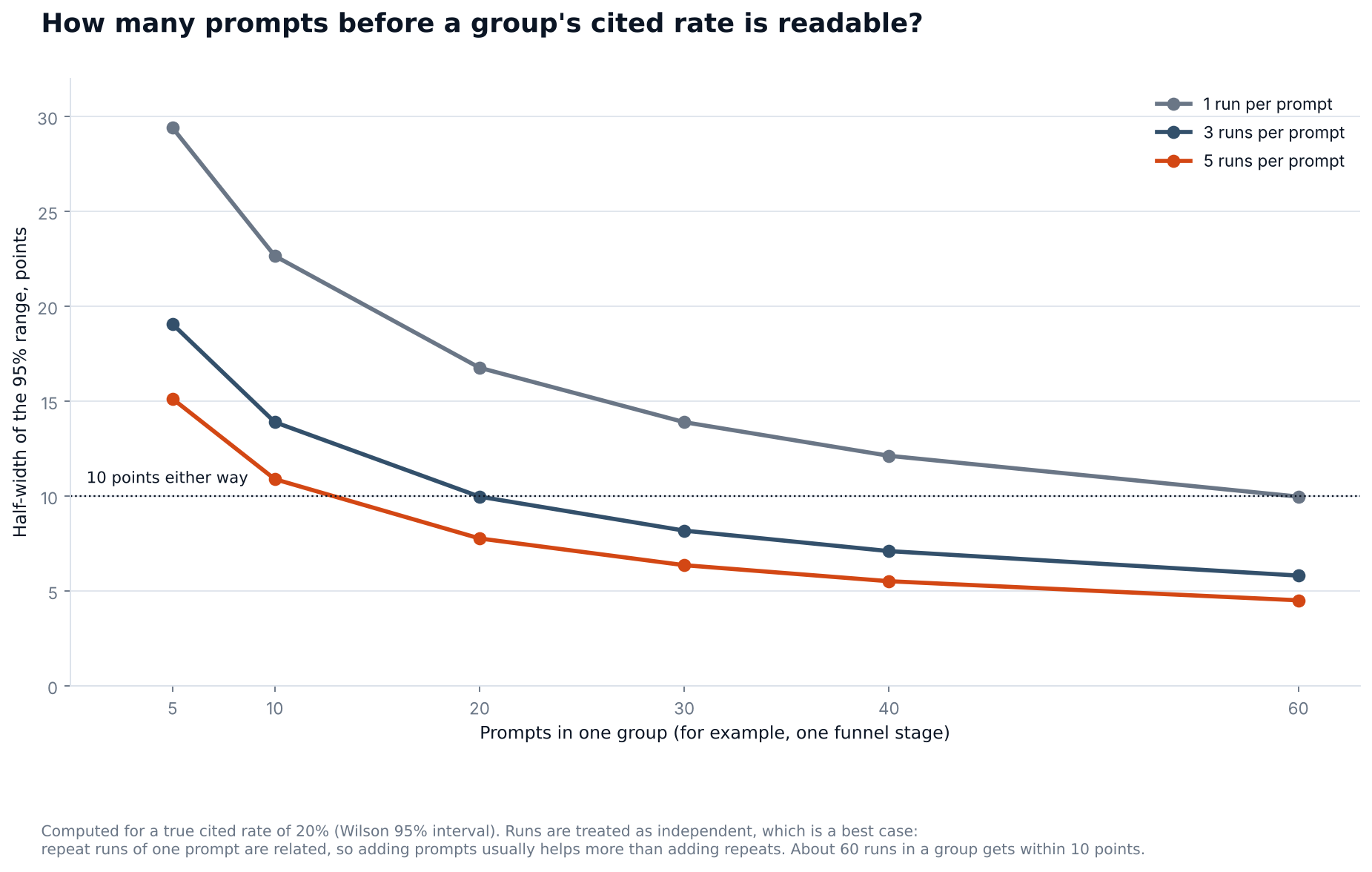
Figure 2. How wide the range is for a group of prompts. Computed for a 20 percent cited rate, treating runs as independent.
About 60 runs in a group gets the range to within 10 points either way, whether that is 60 prompts once, 20 prompts three times, or 12 prompts five times. That calculation treats every run as independent, which is a best case. Runs of the same prompt are related, so repeats add less than the count suggests, and adding prompts is usually the safer way to narrow a range. The model variability guide covers why the same prompt returns different answers, and the tracking frequency guide covers how to turn that into a schedule.
Read this as a planning aid. If you report six question types and want each within 10 points, you need around 360 runs per period, which is why many teams report two or three groups and keep the rest as a watch list. A smaller list is fine, as long as the reports say how many runs sit behind each number.
The path matters as well. If your source collects answers through a developer connection instead of the consumer app, results can differ, as our guide to engine and API monitoring explains. Write down which path produces each number.
Where prompts come from
Search volume does not exist for prompts in the way it does for keywords, so prompts have to come from places where buyers say what they ask. The sources below are ordered roughly by how close they sit to a real buyer.
- First-call notes and the "how did you hear about us" field. Buyers who say they asked an AI often say what they asked. The attribution guide includes a call script that records it.
- Sales and support threads. Questions reps hear over and over are prompts waiting to be written.
- Search Console queries and on-site search. These are keyword strings, so rewrite each as the full question behind it.
- Customer interviews. Ask what they typed or said when they first looked, and what they asked next.
- Community threads and review sites. They show the words buyers use for their problems.
Whatever the source, record it. A prompt with a named source can be defended. A prompt that someone thought of in a meeting cannot. Be careful with any "prompt volume" figure you meet. We know of no independent study that checks how well such estimates match what buyers ask, so do not use one to decide which prompts to keep.
Test, prune and version
Survey researchers test new questions before they field them. Pew describes pretesting as an essential step in designing a questionnaire for exactly this reason. Do the same with a list: run it once as a pilot before you start counting.
In the pilot, look for design problems, not for good news.
- Duplicates. Two prompts that ask the same thing. Keep the better written one.
- Off-topic prompts. Ones no buyer would ask, or that do not map to anything you sell.
- Prompts that never name a brand. If every answer is general advice with no products in it, the prompt cannot measure presence. Keep it as an idea for content, and take it off the tracked list.
- Unstable prompts. If repeat runs disagree wildly, keep the prompt but flag it, and expect a wide range.
One rule matters more than the rest: decide what to prune by how the prompt is built, never by whether you were named. If you drop the prompts where you are absent, your rate rises and the list tells you what you hoped to hear. A prompt where you are never named is the most useful kind, because it shows a gap. After pruning, run a fresh baseline, since the pilot runs helped you choose the list. Then keep a register. Each prompt needs an ID, its exact text, a version, its question type, whether it is branded, its market and language, its source, the date added and a status.
FAQ
How many prompts should I track?
Enough that each group you report has about 60 runs behind it per period, which is the point where the range tightens to roughly 10 points. For many teams that means two or three groups, such as non-branded discovery and branded validation, with 20 prompts each run three times.
Should my tracking prompts include my brand name?
Only the branded group. Keep the discovery group free of your name, and report the two groups separately.
Can I use keyword research to write prompts?
Use it for ideas, then rewrite each keyword as the full question a buyer would ask. Do not track keyword strings as if they were prompts.
How long should a prompt be?
Long enough to hold a situation, a job and any real constraint, which is usually one or two sentences. The chat-history study suggests buyers write far more than a keyword, so a one-line fragment is probably too short.
Can I change a prompt that is not working?
Add a new version and keep the old one. Report them separately, so the trend and the change can both be seen.
Lint ten prompts before you track any
Take ten prompts you already have and check each against five tests: it reads like a buyer's question, it asks one thing, it is neutral, it states a situation, and it has an ID and a version. Rewrite the ones that fail. That one exercise removes most of the problems that make a tracking number hard to trust.
When your list is ready, the AI Search Visibility Checker gives a quick first reading of how AI answers mention you today, which makes a useful sanity check on a few of your prompts. To follow the full list over time, AI Search Intelligence tracks each of your prompts individually, so each one keeps its own history.