


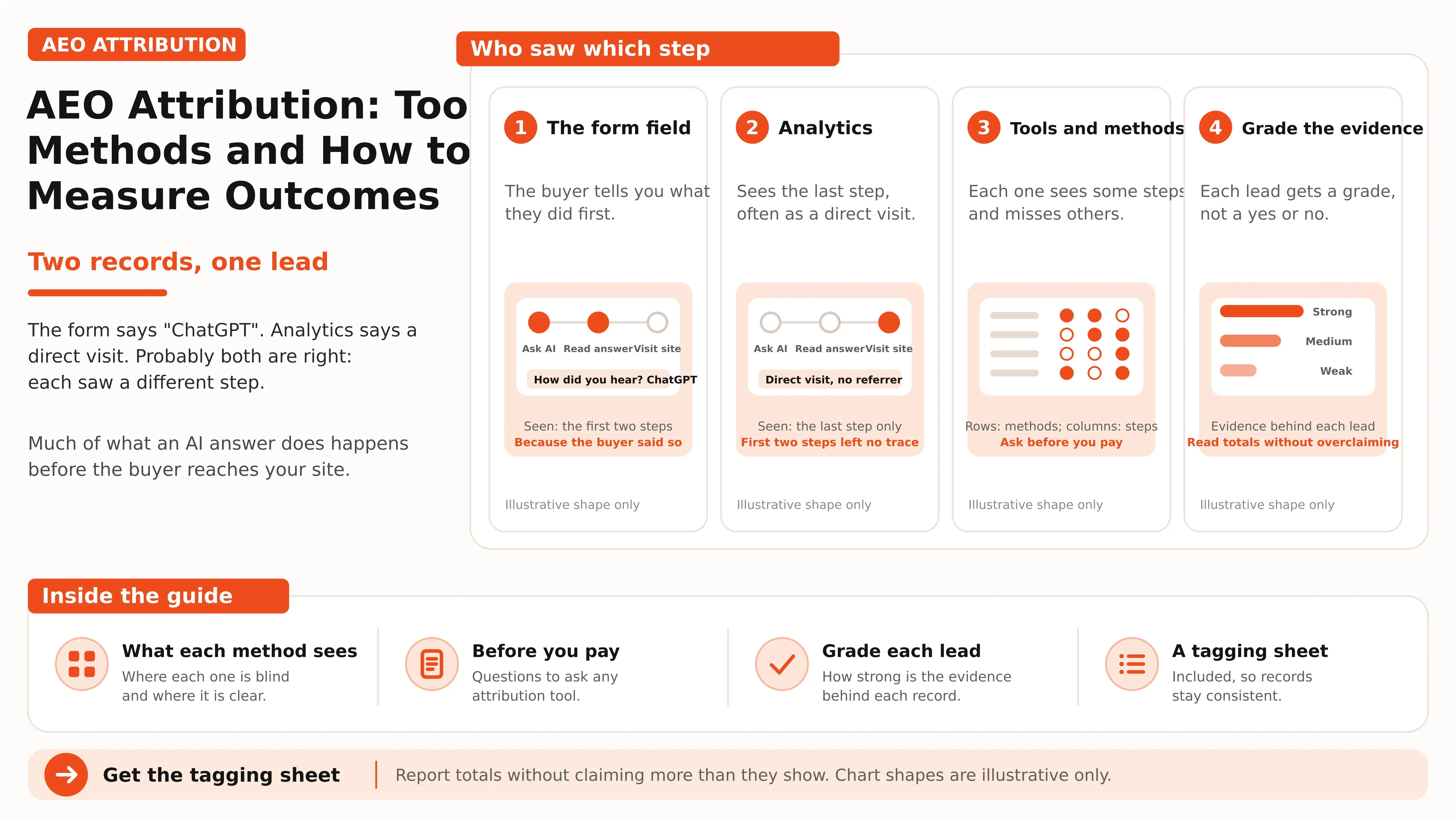


A lead fills in your demo form. In the "How did you hear about us?" box they type: "ChatGPT." In your analytics, the same lead shows up as a direct visit with no referrer. Which record is right?
Probably both. That gap is the whole problem of AEO attribution. Much of what an AI answer does to a buyer happens before the buyer reaches your site, and sometimes without ever sending a click. This guide explains what each attribution method can and cannot see, what to ask before you pay for a tool, how to grade the evidence on each lead, and how to read the totals without claiming more than they show. A tagging sheet is included.
Two records of the same lead
Start with what the click-based record can and cannot cover. Google Analytics Help describes an AI Assistant channel for visits from sources such as ChatGPT, Gemini, Deepseek, Copilot and Grok, and says that channel excludes Google's AI Overviews and AI Mode, which are counted under Organic Search. Google's own guidance on AI features adds that traffic from those features is included in your overall search traffic in Search Console, under the Web search type. So an AI-referral report in analytics is a floor. It covers clicks from some assistants and none from Google's AI features.
Clicks are also scarce. In a Pew Research Center study of March 2025 Google browsing data, a result link was clicked in 8 percent of visits with an AI summary, against 15 percent of visits without one. That is Google users in one month, not B2B buyers, but it points the same way: a measurement that waits for a click will miss people who were influenced.
The second record is what the buyer tells you. It is a recollection, so it is incomplete, and it depends on what you ask. But it is the only record that can see a no-click influence.
Three questions attribution has to answer
"Attribution" bundles three different questions, and different methods answer different ones.
- Did an AI answer touch this buyer? This is about exposure and evidence. A referral click, a form field or a rep's note can each show it, in different ways.
- Did it matter? Did the answer change what the buyer did, such as adding you to a shortlist or booking a call? Only the buyer or the rep can tell you that, and only partly.
- Would the deal have happened anyway? This is incrementality, and no record of a single lead can answer it. It needs a comparison.
Most dashboards answer the first question for some visits and then present it as the third. Keep the questions apart and the rest of the work gets simpler.
What each method can see
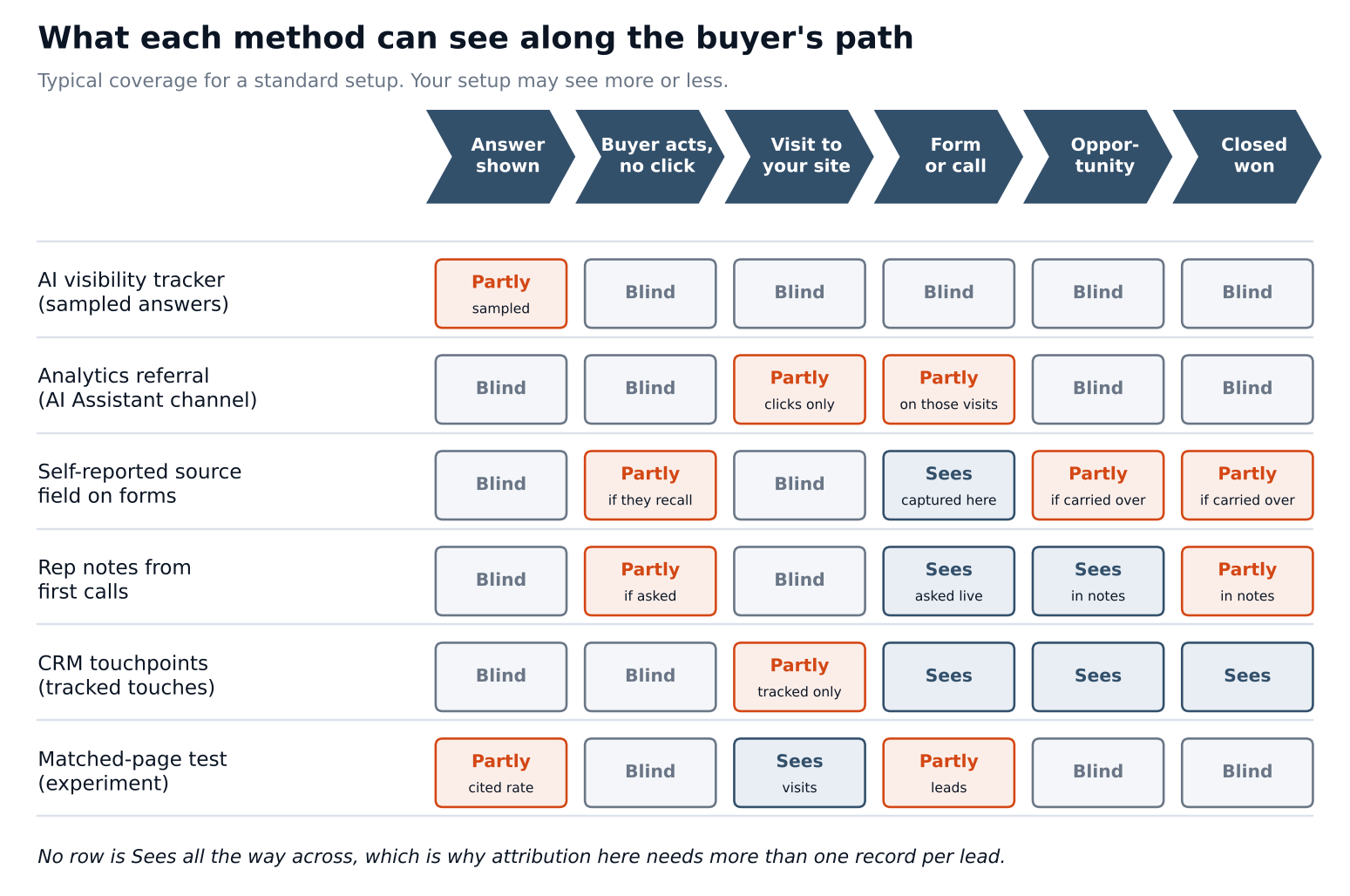
Here is each common method laid against the path a buyer takes, from the answer they read to the deal they sign. No row sees the whole path, and the first two stages are covered only by methods that rely on the buyer's own account or on sampling. That is why one lead should carry more than one record.
Tool categories, and what to ask before you buy
The market for "AEO attribution tools" mixes several different kinds of software under one label. Sorting them by what they observe is more useful than comparing feature lists.
| Category | What it observes | What it cannot tell you |
|---|---|---|
| Web analytics | Visits, referrers, on-site actions | Anything before the visit; Google's AI features appear as organic search |
| CRM and marketing automation | Leads, opportunities, tracked touches, revenue | Touches it never recorded, including every answer a buyer read off your site |
| Self-reported source fields | What the buyer says about how they found you | Anything the buyer forgot, shortened or never knew |
| Call and conversation capture | What buyers say on calls, in your own words | Calls that did not happen; buyers who were not asked |
| Multi-touch attribution software | Tracked touches, weighted by a model | Untracked touches; whether the weights reflect cause |
| AI visibility trackers | How often answers cite or mention you, in a sample | What happened to any buyer after the answer |
| Incrementality testing | The difference between treated and untreated groups | Individual leads; anything with too few events to compare |
The sixth row deserves a plain note, because it is the one most often confused. An AI visibility tracker measures presence in answers. That is valuable, and it is the "did the answer name us" half of the story, but it is not attribution, because it does not see a buyer. The north-star metric piece uses it as the steering number for exactly that reason, and pairs it with the records below.
Before you buy anything labeled attribution, ask these six questions:
- What event does it actually observe? A click, a form, a call, a sampled answer? Ask for the event, not the feature name.
- What does it do with visits that have no referrer? If the answer is "assigns them to AI", ask how it knows.
- Can it see a buyer who never clicked? If yes, ask how, because a private chat is not visible to your site.
- Can I export the raw records to my CRM? If you cannot trace a number to a record, you cannot defend it.
- How does it define "influenced"? Get the definition in writing and check whether it counts a visit that happened anyway.
- What would make it show zero? A method that cannot show a null result is not measuring anything.
A tool that gets the first three wrong will give you a confident number you cannot check. A tool that gets them right still leaves the third attribution question, incrementality, to a test.
Grade the evidence on each lead
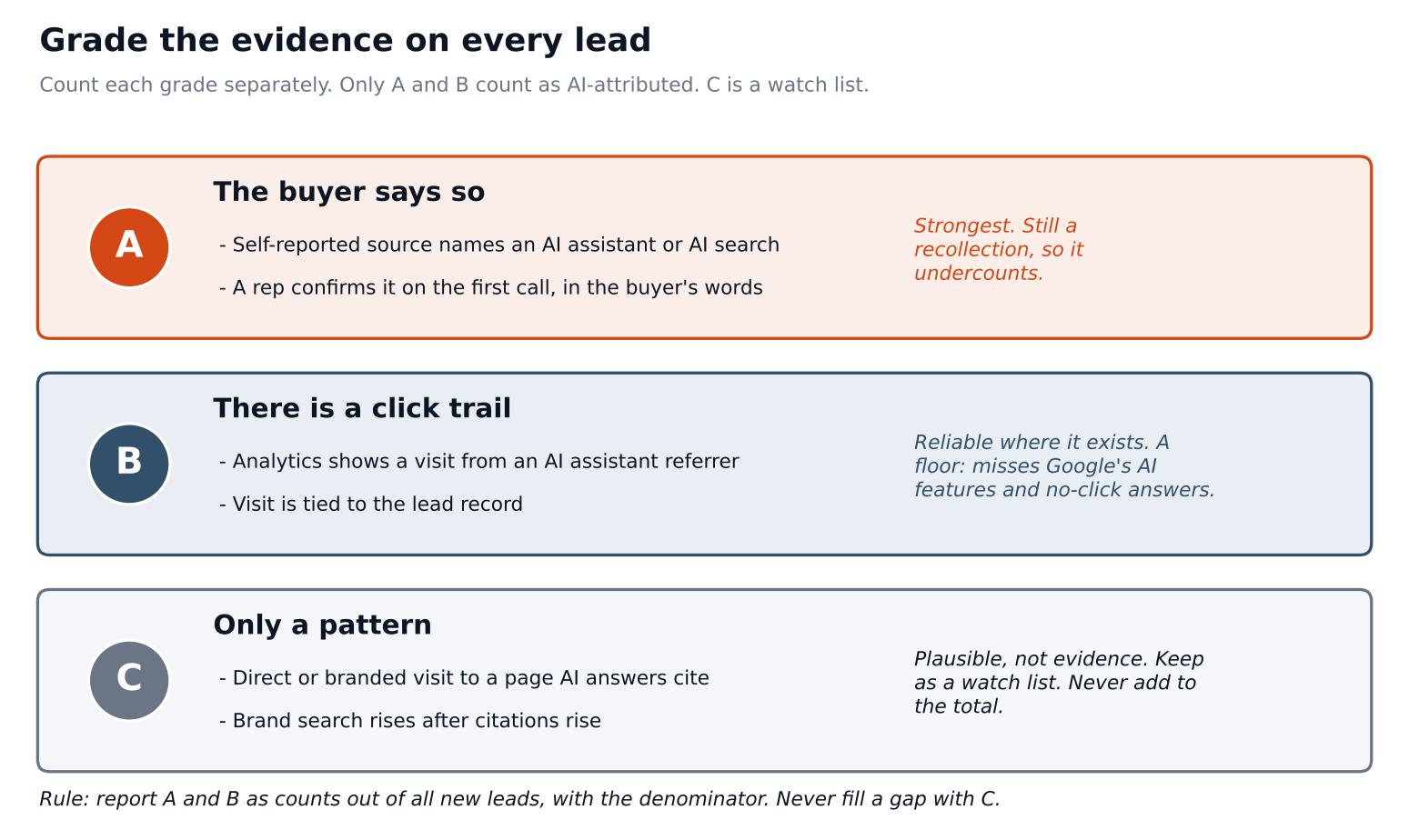
Instead of asking whether a lead is "AI-attributed", grade how well you know. Three grades cover most cases.
1. Grade A: the buyer says so.
The self-reported source names an AI assistant or AI search, or a rep confirms it on the first call in the buyer's words. It is a recollection, so it undercounts, but it is the strongest evidence of influence you can get.
2. Grade B: there is a click trail.
Analytics shows a visit from an AI assistant referrer and the visit is tied to the lead record. It is reliable where it exists, and a floor, because it misses Google's AI features and no-click answers.
3. Grade C: only a pattern.
A direct or branded visit lands on a page that AI answers cite, or brand search rises after your citations do. That is plausible, but it is not evidence of any one buyer. Keep a watch list and never add it to the total.
One rule holds all of this together: report A and B as counts out of all new leads, with the denominator, and report C on its own line. Do not fill a gap in the A and B counts with C.
The grades also settle the argument from the opening. A lead with "ChatGPT" in the form and a direct visit in analytics is a Grade A lead. The analytics record does not contradict it, because a direct visit is exactly what you would expect after a buyer reads an answer and then types your address.
Set up the records in a week
You do not need new software to start. You need four records on every lead and one habit.
- Add or fix a form field. Ask "How did you first hear about us?" as an open text box, with a short pick list beside it that includes an option for AI assistants and one for Google's AI summaries. Open text catches the words buyers use; the list keeps the data countable. Do not make it required.
- Add two CRM properties. One for the evidence grade (A, B, C or none) and one for the detail, such as the exact words the buyer used.
- Ask on the first call. Give reps one question: "Did you or anyone on your team look into this with an AI assistant?" In a buying group, the person who used the assistant may not be the person who filled in the form, so ask about the team. The sheet includes a short call script.
- Check your analytics channel. Confirm the AI Assistant channel appears in your reports, remember what it excludes, and pass the session source into a hidden form field so a referral visit can be tied to the lead.
- Tag opportunities weekly. When a lead becomes an opportunity, copy the grade across. Do not let the CRM's attribution model overwrite it.
- Report monthly. Counts of Grade A and Grade B out of all new leads, Grade C on its own line, and a note on what changed in the setup.
An example, with invented numbers: in a month with 60 new leads, 5 are Grade A and 3 are Grade B, so 8 of 60 leads (13 percent, range 7 to 24 percent by a 95 percent Wilson interval) carry AI evidence. Seven more are Grade C and sit on the watch list. Read it as a floor measured on a small count, not as a share of pipeline that came from AI.
Read the numbers without overclaiming
Report counts, denominators and ranges.
The example above shows why. Eight leads out of 60 is a wide range, and a move from 8 to 11 next month tells you very little. Quarterly totals are steadier than monthly ones, and the north-star metric piece explains how many tagged opportunities you need before a count is readable.
Keep both fields when they disagree
A buyer who reports "ChatGPT" and a last-touch model that says "direct" are not in conflict. Store both and let the grade decide which one you quote. When a model overwrites the buyer's own words, you lose the only record of the no-click step.
Do not mistake attribution for cause
Attribution says what touched a buyer. It does not say what would have happened without the touch. In a Marketing Science paper, Gordon and colleagues compared common observational measurement methods against 15 randomized advertising experiments at Facebook and found that the observational methods often failed to match the experimental result, even with extensive controls. That was online advertising, not AI search, and no equivalent study exists for AEO. The lesson transfers as a caution: a count of AI-touched leads is not a count of leads the program caused.
The way to test cause is a comparison. Pick pages or topics where you make a change and similar ones where you do not, and compare cited rate, visits and leads over the same period. The AEO business case piece describes a matched-pages test, and the ROI forecast guide shows how to treat the share of wins you credit to the program as a judgment until it is tested.
For the buyers who never appear in any record, see our piece on the dark AI search funnel. It covers how to reason about influence you cannot see.
FAQ
Is there a tool that attributes revenue to AEO automatically?
Be careful with that claim. A tool cannot observe an answer a buyer read in a private chat and never clicked from. Tools can join records you already hold, such as analytics, CRM and form data, and that is useful. Use the six questions above on any tool that promises more.
Should I use first-touch, last-touch or multi-touch?
Whichever your team already uses, with one change: keep the buyer's own words and the evidence grade as separate fields that the model cannot overwrite. No model sees an answer that left no trace on your site.
Can I treat direct traffic as AI traffic?
Not on its own. A direct visit can come from many places. Treat it as Grade C at most, and look for a Grade A or B record on the same lead.
How do I measure AI Overviews specifically?
Google counts them under Organic Search, so use the Search Console generative AI report for impressions by page and your own sampled checks for citations. Our guide to tracking AI Overview rankings covers the method.
How many leads do I need before the grades mean anything?
Enough that the range is narrow enough to act on. At 60 leads, 8 tagged gives a range of about 7 to 24 percent. Use quarterly totals, and treat any single month as a direction.
Change one form field this week
Do the smallest useful thing first. Open your demo form, add the open-text "How did you first hear about us?" box, and write the first-call question on a card for your reps. That one change produces a record no analytics tool can, and it starts the Grade A count that everything else gets checked against.
If you want a starting point for the visibility side, the AI Search Visibility Checker gives you a first reading of how AI answers mention you today. When you are ready to track the same buyer questions on a schedule, AI Search Intelligence tracks each of your prompts individually, which gives you the presence half of the picture. The records in your CRM give you the other half.