


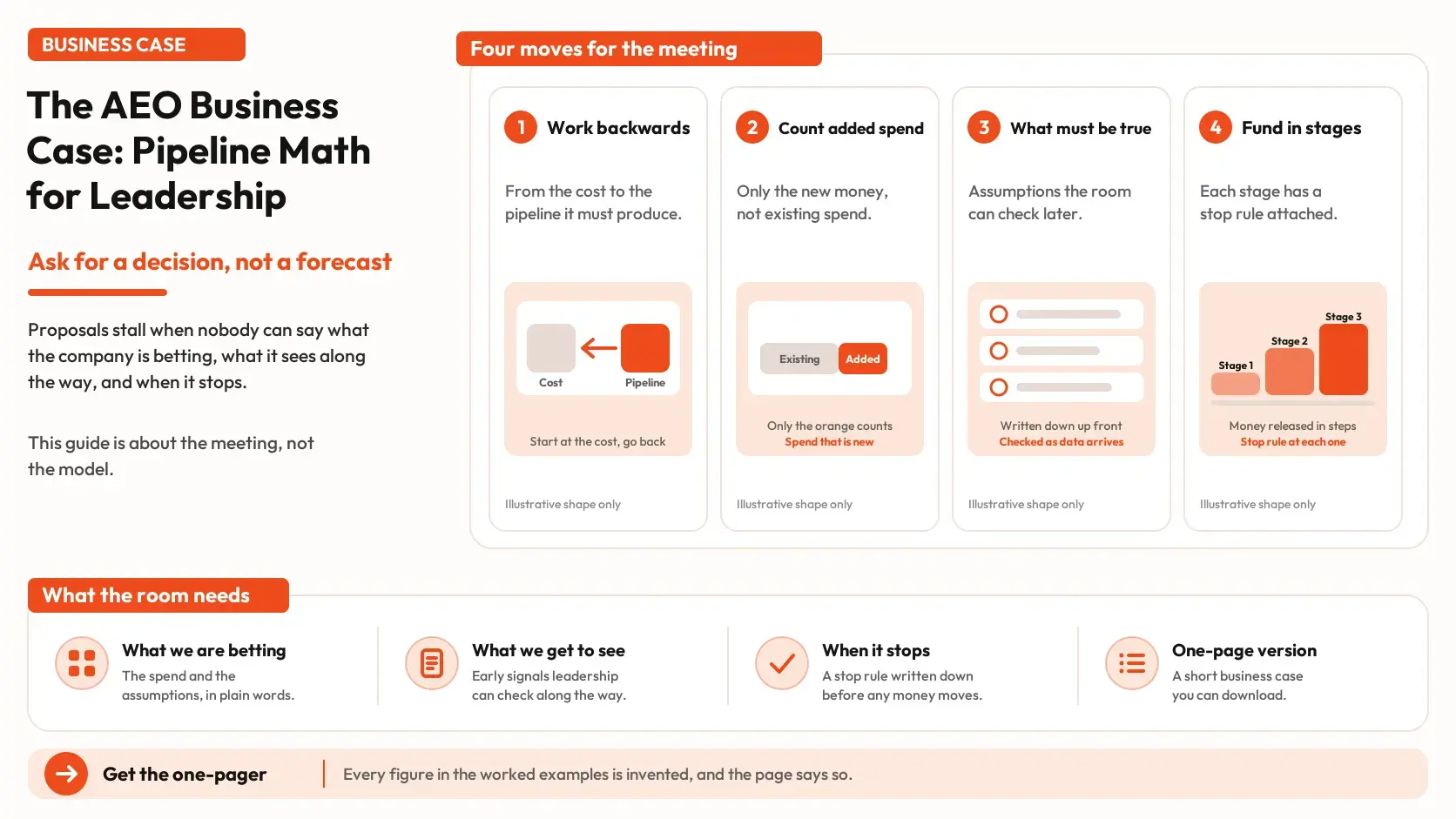


AEO proposals stall because leadership can’t see what the company is betting, what results it can expect along the way, or when to stop investing. A projected return alone won’t answer those questions, especially when the numbers rely on assumptions that haven’t been tested yet. A stronger business case works backwards from the cost to the pipeline needed to break even, counts only incremental spend, makes assumptions explicit, and releases funding in stages with clear stop rules. For the forecast itself, see our guide to forecasting AI search and SEO ROI. This guide focuses on turning that forecast into a decision leadership can approve.
What leadership is actually deciding
When a proposal like this reaches a CFO, three questions sit underneath whatever the slide says.
-
How much can we lose? That is the size of the bet, stated as a cash number over a defined period, not a percentage of some future return.
-
What will we see, and when? A decision-maker who approves spend wants to know which signals arrive early, which arrive late, and what each would tell them.
-
When do we stop? A program with no stated stopping point reads as a commitment of unknown size, and cautious leaders price that in.
A business case that answers those three questions in plain numbers gets a better hearing than one that opens with a market-size claim. It also protects you. If the program underdelivers, the gates and stop rules you wrote at the start are the record that you ran it as a managed bet and not as a promise.
Start from the cost and work backwards
Most business cases run forward: traffic times conversion times deal size equals revenue. A forward projection makes the person presenting responsible for every number in it. Run it backwards instead. Start from what the program costs and ask what it would have to produce for the company to break even, then for it to return twice its cost.
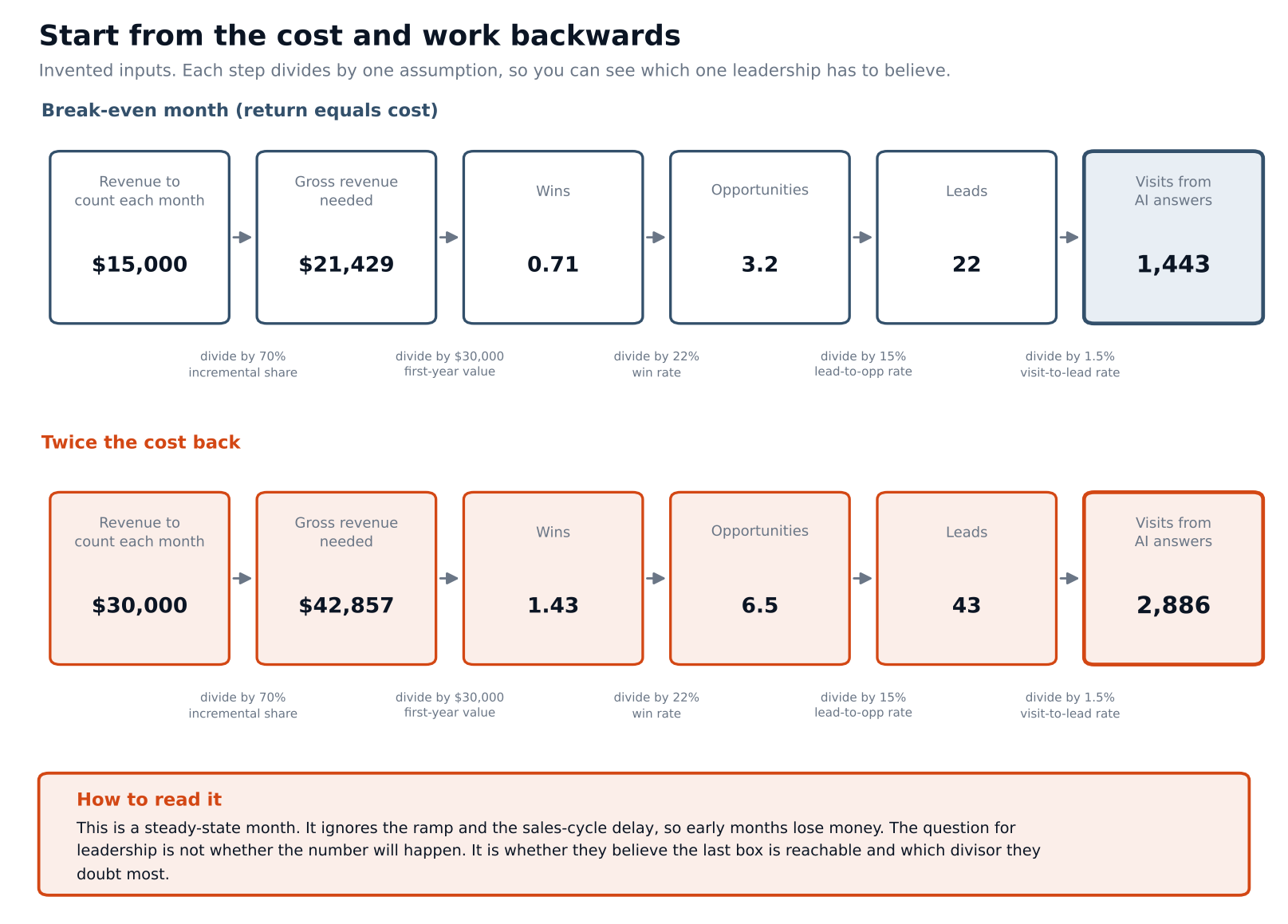
Here is the arithmetic for an invented B2B software company. The program costs $15,000 a month. The other inputs are:
| Input | Value (invented) | Type |
|---|---|---|
| Monthly program cost | $15,000 | Measured |
| Share of wins that would not have happened anyway | 70% | Assumed |
| First-year contract value | $30,000 | Measured |
| Opportunity-to-win rate | 22% | Measured |
| Lead-to-opportunity rate | 15% | Measured |
| Visit-to-lead rate | 1.5% | Estimated |
To break even, the program has to add $15,000 of counted revenue a month. Because only 70 percent of wins are counted as caused by the program, the wins behind it have to be worth about $21,400. At $30,000 each that is about 0.71 wins a month. At a 22 percent win rate that takes about 3.2 opportunities, at 15 percent about 22 leads, and at 1.5 percent about 1,440 visits a month from AI answers. For twice the cost back, double every box: about 2,890 visits.
The point of working backwards is what it does to the conversation. Leadership is no longer asked to believe a revenue forecast. They are asked a smaller question: do you believe the program can reach about 1,440 AI-referred visits a month at steady state? That number can be compared with what the company measures today, and it can be tested within two quarters. It also shows which divisor deserves the most doubt. In this example, the share of wins counted as caused by the program is the least measured input, so a skeptical CFO may reasonably replace 70 percent with 50. Do that live. At 50 percent the break-even visit level rises to about 2,020. Showing the number move is more persuasive than defending the first one.
Two cautions. This is a steady-state month, so it ignores the ramp-up period and the sales-cycle delay, which means the early months cost money before any revenue arrives. The forecast guide covers timing. And the break-even visit count only works if your own conversion and win rates are measured on comparable leads. If they are not, label them as assumed and give a range.
Count only the added cost
Leaders will ask what the program costs, and the answer that holds up separates added spending from shared spending.
Add up the real cost lines: content production, tooling, the hours of people and subject-matter experts, and the measurement work. Then mark which lines you are already paying for. Google's documentation says there are no additional requirements to appear in its AI features, and that sites appearing in them are part of overall search traffic. That is a statement about eligibility, not about being cited, but it does mean a good deal of sound search work serves both goals. A page that answers a buyer's question clearly, loads properly and is indexable is the same page for classic search and for AI answers.
So split the cost in the business case into two columns. Shared work is spending the company already makes on search content and site health, and it should not be charged against AEO as if it were new. Added work is what you would not otherwise do: building and running a fixed list of buyer prompts, rewriting pages around buyer questions, earning third-party mentions, and the reporting. Break-even should be computed on the added cost. A CFO who sees the whole cost charged to AEO will either reject it or ask why the rest of the search budget is not being questioned too.
Leaders also ask where the money comes from. There are three answers: a reallocation from work with weak results, a new line, or a one-time test budget for the first stage. Name which one you are proposing, and name what stops if it is a reallocation. A proposal that adds a cost line without saying what gives tends to be sent back for that reason alone.
Write down what has to be true
Every business case rests on a few beliefs. Put them on one card, in plain words, before anyone else does it for you. For the worked example, the card might read:
- AI answers can bring about 1,440 visits a month to our pages at steady state.
- Visits from AI answers convert to leads at about the rate our comparable pages do.
- At least half of the wins from those leads would not have happened without the program.
- The sales cycle for these leads is no longer than our median.
For each line, add how and when you would know. The first can be read from referral traffic and Search Console by month six. The second is visible in forms within a quarter of traffic arriving. The third is the one nobody can fully resolve, so name the test: a matched set of updated and untouched pages, and a self-reported attribution field on forms. Our guide to the dark AI search funnel explains why a large part of influence will not show up in referral data, which is why the attribution field matters.
Label each line as measured, estimated or assumed, as in the forecast guide. If more than half the card is assumed, say so. Leaders trust a case that shows its weak points more than one that hides them, and the label tells them where to push.
Why now, and what that evidence can carry
Leadership will ask why this is a priority this year. The evidence for urgency is real but indirect, and it is worth being exact about how far it goes.
In a Pew Research Center study of 900 US adults, covering 68,879 Google searches in March 2025, people clicked a result link in 8 percent of visits when an AI summary appeared and 15 percent when it did not, and 1 percent clicked a link inside the summary. That is Google only, one month, US adults. It shows that AI summaries change what people do after a search. It does not show what B2B buyers do, and it does not show that your brand is losing pipeline.
Google has also changed how it reports on this. Its documentation said AI feature traffic is counted within the Web search type in Search Console, and Search Engine Land reported on August 31, 2026 that Google has rolled out AI performance reports to all accounts, showing impressions, pages, countries, devices and dates but not clicks. Check Google's current documentation before you describe it, since this is moving. For the business case, the useful point is that a first-party source of AI-feature visibility now exists, so you can report on it from the first month.
What the evidence cannot carry is a claim that waiting costs a specific amount of pipeline. We found no independent study that connects AI answer exposure to B2B pipeline. Our look at what B2B buyers ask ChatGPT covers what is and is not public about buyer behavior. Make the urgency argument as a question of learning: the company has no baseline today, a baseline takes a quarter to build, and the decision gets better once it exists.
Ask for a stage, not a year
The strongest structural choice in a business case is how the money is released. Ask for the first stage, with the later stages conditional on what the first one shows.
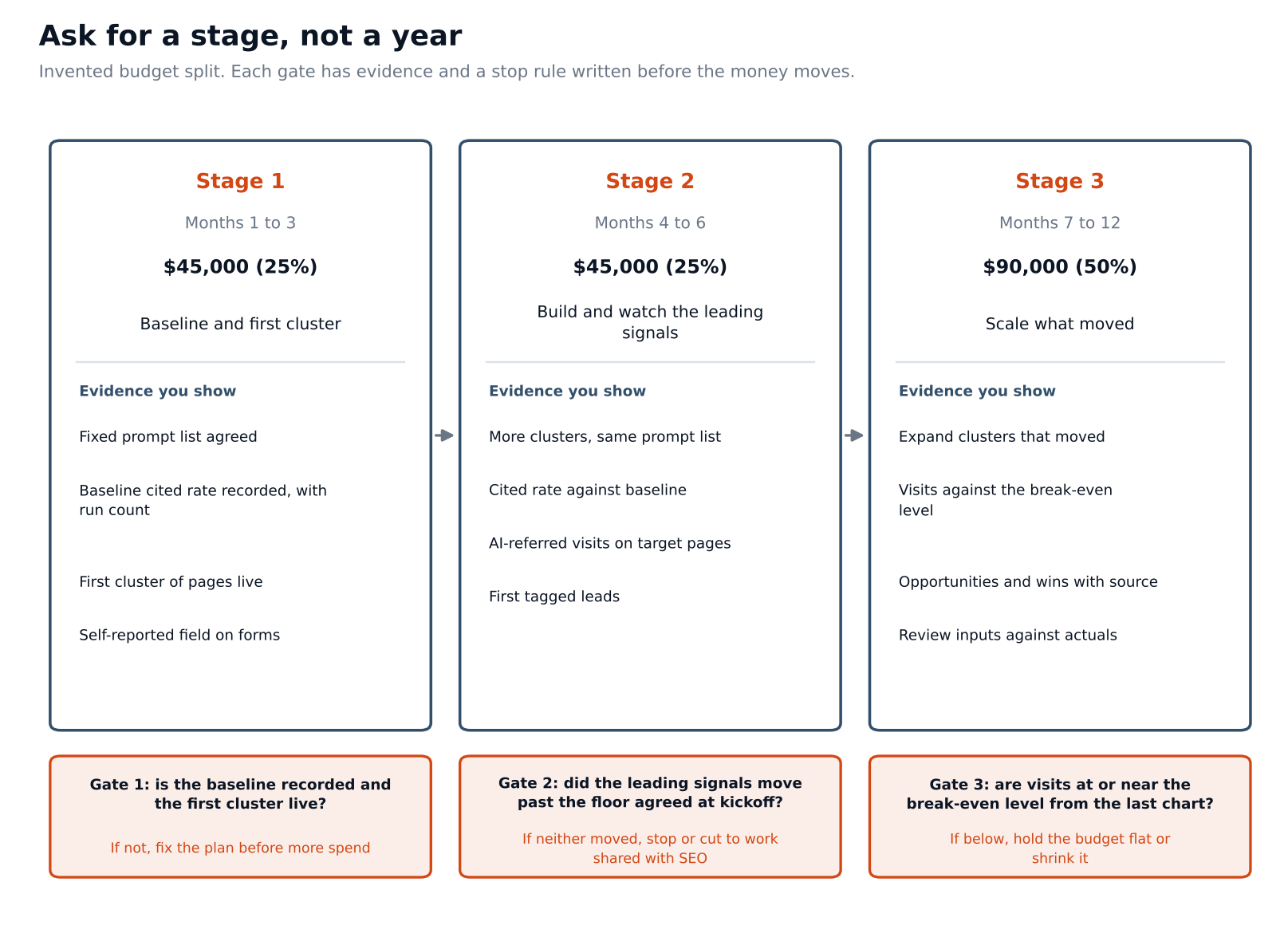
The invented example splits a $180,000 year into three stages: $45,000 for a baseline and first cluster of pages in months one to three, $45,000 to build and watch leading signals in months four to six, and $90,000 to scale what moved in months seven to twelve. Each stage ends with a gate: a question, the evidence that answers it, and what happens if the answer is no.
Write the gate criteria at the start, with numbers where you can. Gate one is about the plan, not results: is the prompt list agreed, the baseline recorded and the first cluster live? Gate two asks whether the leading signals, the sampled cited rate and AI-referred visits, moved past a floor that leadership and you set at kickoff. Gate three compares visits with the break-even level from the first chart. If a gate is missed, the stop rule says what follows: fix the plan, cut back to the work shared with search, or hold the budget flat.
This works because it moves the first decision to something you can defend. The ask is no longer "believe this projection" but "fund one quarter of measurement and a first cluster, and decide the rest on evidence." A tool such as AI Search Intelligence tracks each prompt in your list individually, so each gate report can show which questions moved and which did not. A spreadsheet and a fixed run schedule will do for a smaller program, as long as every report states how many runs sit behind each rate. Our piece on model variability in AI citations covers why a single run is not a result, and the buyer prompt library is a way to build the fixed list.
Why stages at all? Forecasts of projects tend to be optimistic, and the people proposing a project have reasons to make it look good. Bent Flyvbjerg's work on project risk explains inaccuracy in terms of optimism bias and strategic misrepresentation, and describes reference class forecasting, which bases a forecast on the actual performance of comparable past projects, as a way to correct for it. You are the one proposing the project, so the structure should do the correcting for you. A staged ask limits how much an optimistic forecast can cost before it is tested.
Run a premortem with the people who will say no
Before the meeting, run a premortem. Gary Klein described the method in Harvard Business Review in 2007: team members assume the project they are planning has just failed, and then generate plausible reasons for its demise.
Do it with the CFO, the sales lead and whoever owns the website. Say: it is month nine, the program has failed, write down why. Collect the reasons without arguing with them. You will usually get a list such as: the leads were low quality, the sales team never followed up, the engines changed what they cite, the content did not get published on time, nobody believed the attribution.
Then convert the reasons into the case. Each one becomes a gate metric, a stop rule, an owner or a line on the "what has to be true" card. A reason you cannot convert into any of those is worth raising in the meeting, because it is a risk you have chosen not to manage. The premortem also changes who owns the plan. People who helped write down how it could fail are less likely to treat a missed gate as a surprise or as your personal miss.
The questions leadership asks, and answers that hold up
Prepare for five objections. For each, the table gives an answer that survives follow-up questions and a claim to avoid.
| Question | An answer that holds up | A claim to avoid |
|---|---|---|
| Can we wait until the data is clearer? | You can. Stage one is a quarter of the year's budget and buys the baseline that makes the later decision better. Waiting also delays the baseline. | That waiting loses a specific amount of pipeline. No study shows it. |
| How will you prove it worked? | Leading signals now, pipeline later, with a self-reported field and a matched-page test. Say what attribution will miss. | That the program caused any given deal. |
| Isn't this just SEO with a new name? | Partly. Google says AI features have no additional requirements, so some work is shared. The added work is the prompt tracking, answer-shaped pages and third-party mentions, and it is priced separately. | That AEO replaces search work. |
| What if the engines change the rules? | They will. Tie the work to things that stay useful: pages that answer buyer questions clearly, accurate facts, third-party mentions. The gates cap what a change can cost. | That any tactic will last. |
| Why this instead of paid or events? | Compare using the same chain and the break-even visit count. The channels run on different timescales, so compare cost per counted pipeline dollar and say so. | That AEO beats another channel. |
Notice that each answer admits something. That is deliberate. A CFO who hears only confidence will probe until they find the gap. A CFO who hears the gap named first has less to find.
Report back in one line a month
After approval, report in a fixed format so the gates feel like routine reviews. One line per month is enough:
"Month 5: sampled cited rate 22% over 40 runs against a baseline of 15% over 40 runs; AI-referred visits 610 against a floor of 500; 6 leads tagged from AI answers; $75,000 spent of $90,000 for stages one and two; status: on track."
Every figure there is invented, and the format is the point: a rate with its run count, a floor stated in advance, leads with a source tag, spend against budget, and a status that is one of on track, watch or stop trigger. If the status moves to stop trigger, the stop rule you wrote at the start decides what happens. Nobody has to argue about it from scratch.
Questions people ask
How much budget should I ask for?
No independent source gives a typical figure. Build it from your own cost lines, count only the added work, and ask for stage one if you cannot defend the whole year. The break-even visit count tells you what the full amount would have to produce.
Should I present one return number?
Show the break-even level and a range, not a single return figure. The forecast guide explains how to build low, base and high cases. If someone insists on one number, give the low case as the commitment and the base case as the plan.
What if finance does not trust the attribution?
Agree on a conservative share of wins to count and show the break-even at that share and at a lower one. Add a self-reported attribution field so the discussion has something other than touchpoints to use.
Do I need to pitch AEO separately from SEO?
Pitch one search program with two goals, and separate the added cost from the shared cost. Pitching AEO as a wholly new budget invites the question of why the existing search budget is not being used.
How long should the memo be?
One page. If it needs more, the decision being requested is probably not clear yet.
Bring one page and one stop rule
You do not need a deck. Bring the one page, the break-even visit count with its inputs labeled, and a stop rule for each gate. If leadership leaves the room knowing what they are betting, what they will see and when it ends, the proposal has already done most of its work.
Before the meeting, put a real first number in the memo. Run five of the buyer questions you plan to track through the AI Search Visibility Checker so the baseline line shows an observed starting point, even a rough one, instead of an estimate. When the program is approved, AI Search Intelligence can then run the same list on a schedule and show, for each prompt, whether the answer moved, so that every gate review starts from the same evidence.