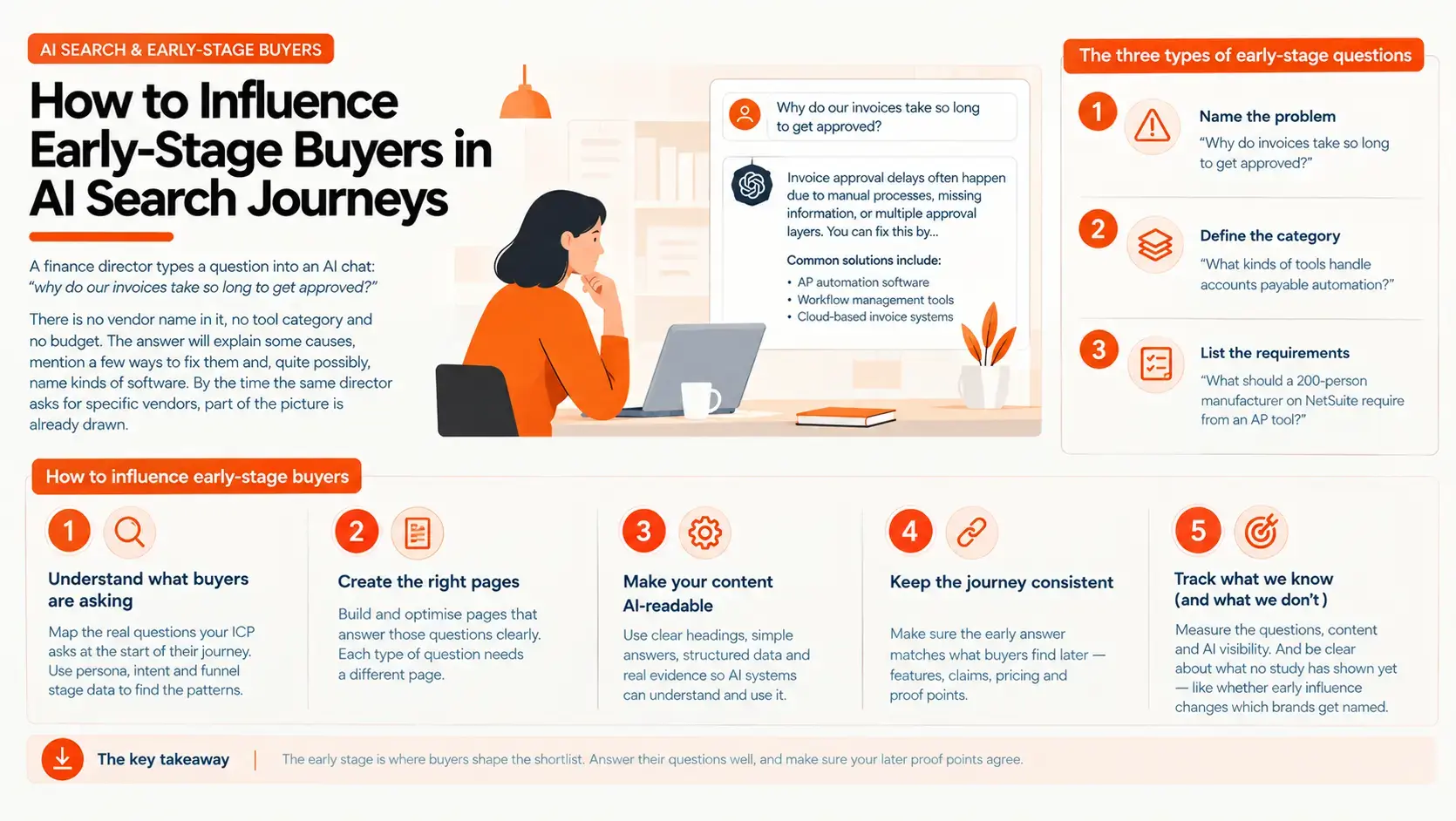


Early-stage buyers use AI search to understand a problem before they start comparing vendors. A finance director might ask why invoice approvals take so long. The answer shapes how they understand the problem, which solutions they consider, and what they look for in a vendor. That is where influence begins, often before your brand enters the conversation. This guide explains how to reach buyers at this stage, create content that AI can use in its answers, and build a consistent presence through the later stages of their buying journey. It also separates what the available evidence supports from what remains unproven.
Early stage means a problem, not a vendor name
In our guide to tracking AI search by buyer persona, ICP and funnel stage, we tagged prompts as Find, Compare or Check. Early stage is Find: the buyer names a need and no vendor. It helps to split it into three kinds of question, because each one needs a different page from you.
- Name the problem. "Why do invoices take so long to get approved?"
- Define the category. "What kinds of tools handle accounts payable automation?"
- List the requirements. "What should a 200-person manufacturer on NetSuite require from an AP tool?"
The category and the company are invented for illustration. The pattern is the point: a buyer moves from describing a problem, to learning what kind of solution exists, to deciding what that solution must do. The requirements they settle on tend to become the yardstick they later apply to vendors.
What the evidence says about this stage
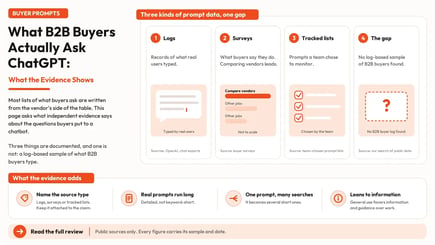
The best public evidence is survey data, and it comes with limits. G2's March 2026 survey of 1,076 software buyers found that over two-thirds start with a category or competitor query, about one in five start with a question about requirements or process, and 51 percent start research with an AI chatbot more often than with Google. The same survey found that 69 percent had chosen a different vendor than they expected because of a chatbot, and about one in three had bought from a vendor they had not heard of before. G2 runs a software review marketplace, and these are self-reports.
Gartner's May 2026 release on a survey of 645 B2B buyers, fielded in August and September 2025, found that 45 percent had used generative AI, mainly to gather information on vendors and products, and that buyers averaged seven information sources in a recent purchase. It also found that 69 percent prefer to validate AI-generated insights with sales reps, and says reps remain important when buyers research a business problem or need. Gartner reports the sample size and dates but not the regions.
6sense's 2025 survey, which spans services, software and physical goods, found that buyers' first contact with a vendor came about 61 percent of the way through the journey, and that the winner was already on the Day One shortlist 95 percent of the time. Our piece on how shortlists form in AI answers covers that in detail. 6sense sells account-based marketing software and does not state when its survey was fielded.
Read together, these say that a lot of research happens before a seller is involved, that AI is a common place to start, and that buyers still check what they read. None of them says that being named in an early answer changes who wins.
Three pages for three questions
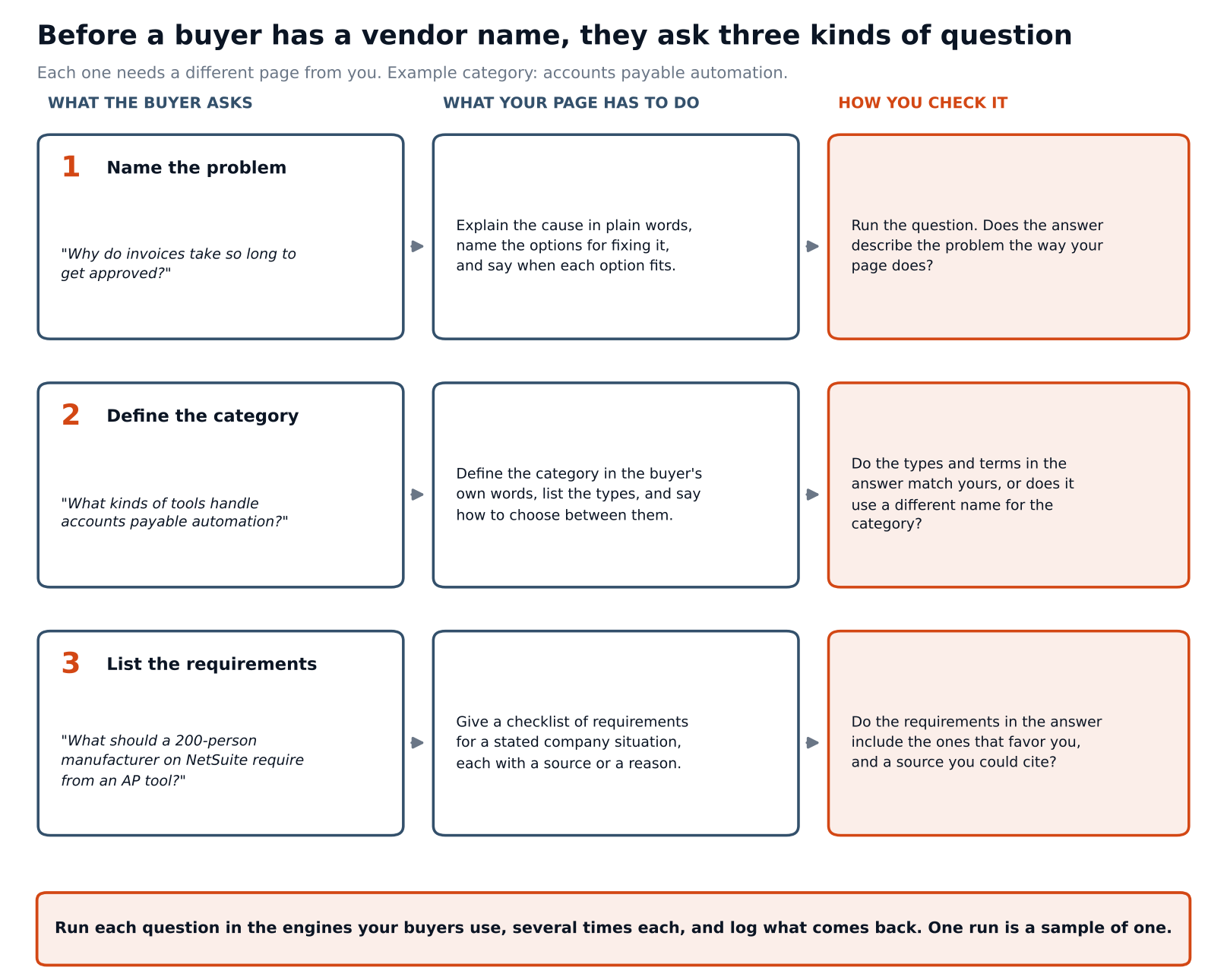
A page for the problem. Explain the cause in plain words, name the options for fixing it and say when each option fits. Do not open with your product. A page that helps a buyer understand why approvals stall is the page that answers the question they actually typed, and a product can appear in the list of options without taking over the page.
A page for the category. Define the category in the buyer's own words, list the types of solution and say how to choose between them. Buyers and vendors often name categories differently, so check what an answer calls it. If it uses a name you never use, you are explaining the category in a vocabulary buyers do not search with.
A page for the requirements. Give a checklist for a stated company situation, with a source or reason for each item. A requirements page is where the criteria a buyer will apply later get written down, so it should be accurate and fair. A checklist that only lists your own strengths will read as a sales page to a buyer.
Google's guidance on AI features notes that AI Overviews and AI Mode may issue multiple related searches across subtopics, which is a reason to cover the questions around a problem and not only the headline. If you want help turning buyer context into page ideas like these, Omnibound's Citation-Worthy Content page describes how it plans content from buyer context.
Make each page easy to quote
An answer is assembled from passages, so a page that states things in short, checkable pieces is easier to use than one that circles. The most relevant independent test is the GEO paper from researchers at Princeton, IIT Delhi and others, presented at KDD 2024. It tried nine ways of rewriting a page against a benchmark of 10,000 queries and found that adding quotations, statistics and citations raised a source's visibility in generated answers by up to about 40 percent on its measure, while keyword stuffing scored below the unedited baseline on one measure. It also reported gains of up to 37 percent when it tried the methods on Perplexity, and said effectiveness varied by domain.
The benchmark used generic questions and a research setup, not B2B vendor choices. Visibility there means how much of a generated answer drew on a source, not whether a buyer shortlisted anyone. The paper is from 2024 and engines have changed. What it supports is a writing habit, not a guarantee:
- Put a clear definition or answer in the first sentence under a heading.
- Attach a source and a date to each statistic, and say what it was measured on.
- Quote a named person with their role when they have something specific to say.
- Write for the reader, not for a keyword.
Google's own documentation points the same way: it says there are no extra requirements to appear in AI Overviews or AI Mode, no special files or markup, and that ordinary search fundamentals apply, including keeping important content as text and making sure structured data matches what is on the page.
Use the words buyers use
The wording of a question changes who is named. A Northwestern preprint that we discuss in our shortlist piece found that needs-based prompts surfaced brands that category-only prompts missed, in a test with web search turned off. That makes the buyer's own phrasing worth collecting.
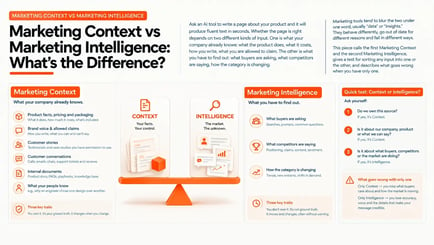
Where does it come from? Calls, support tickets, sales notes and reviews. In our piece on marketing context and marketing intelligence, the record of those conversations is Context and the pattern across them, such as the words buyers use for the category, is Intelligence. Read the records for the first sentence a buyer says about the problem, because that sentence is closest to the first prompt they will type. Our look at what B2B buyers actually ask ChatGPT explains why you will have to build that picture from partial evidence.
Stay consistent when the buyer checks
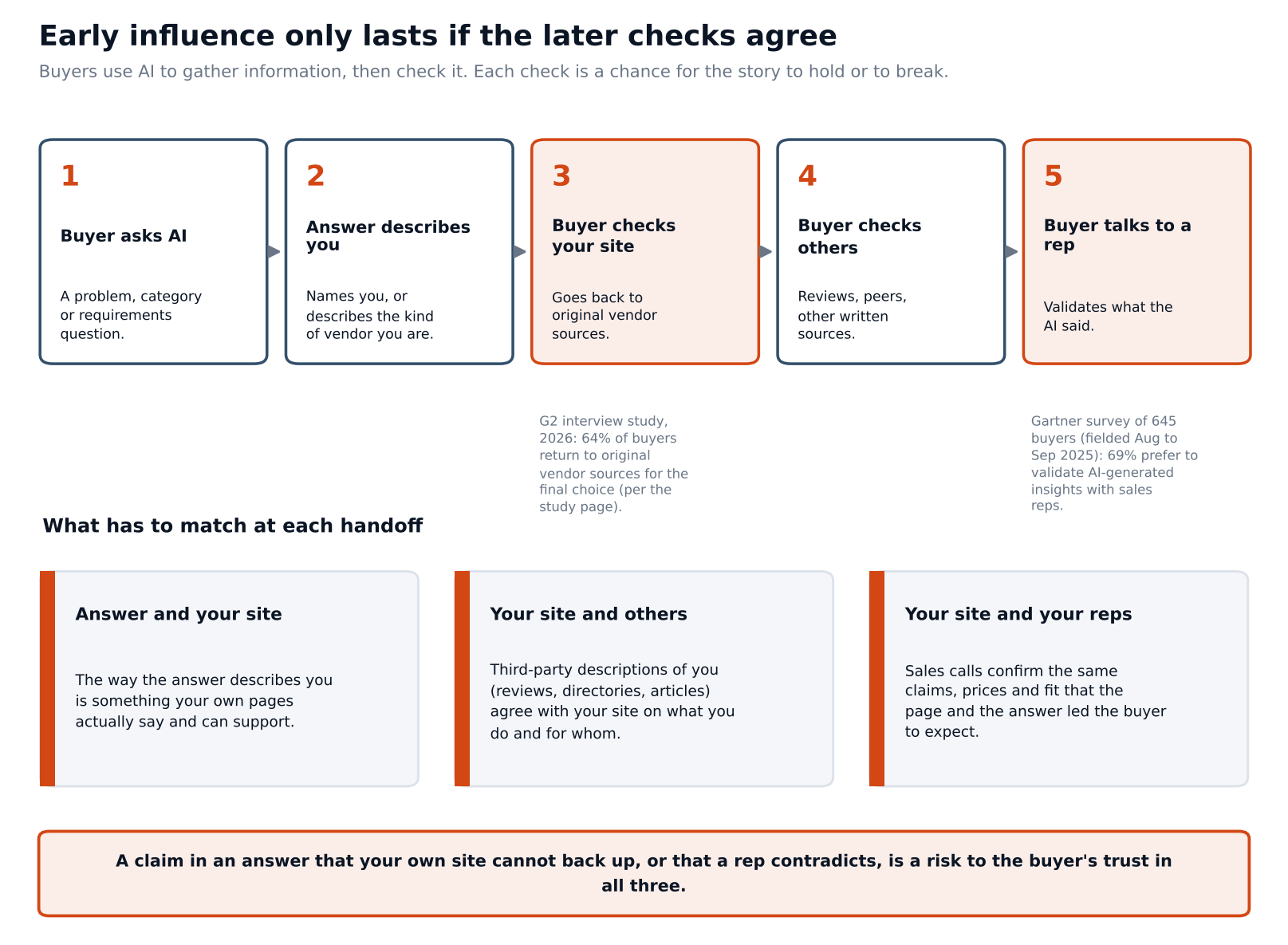
An early answer is the start of a chain. In G2's 2026 interview study of 335 buyers, the page reports that 64 percent return to original vendor sources to make a final choice, and Gartner's survey found most buyers prefer to validate AI-generated insights with a sales rep. Both are self-reports, but they point to the same shape: the buyer reads an answer, then looks at your site, other written sources and, eventually, a person.
That makes three handoffs worth checking. What an answer says about you should be something your site actually says and can support. What third parties say about you, in reviews, directories and articles, should agree with your site about what you do and for whom. And what your reps say should match what the page led the buyer to expect. A claim that fails any one of these can cost trust in the others. It is a reason to fix an inaccurate description before you work on getting mentioned more.
Beyond your own site
Early answers often draw on pages you do not control. Our offsite signals hub grades what is documented, plausible or unstable across those sources. The practical point for this stage is narrower. Check how the problem and the category are described in the places your buyers read: review profiles, directories, industry articles and community threads. Where a description is wrong or thin, correct what you can and supply accurate facts. We are not aware of an independent study showing that effort in these places changes which vendors an engine names for a given buyer question, so judge it by whether the descriptions are accurate, not by whether the answers move.
How to tell whether it is working
Build a small Find-stage prompt set: one problem question, one category question and one requirements question, written the way buyers say them and tagged by persona and company type as in our tracking guide. Run each several times in the engines your buyers use, in fresh sessions, and log three things: whether you are named, how the problem and category are described, and which pages are cited. Report the share of runs, with the run count beside it.
Then pair that with what your own tools can see. Our dark funnel guide separates what you can see, infer and learn only by asking. For this stage, a free-text "how did you hear about us" field, a call-note tag for "the buyer said an AI tool framed the problem this way" and Google Search Console, where Google says traffic from AI features is counted in the Web search type, give you records to set beside the sampled runs. Keep the sampled runs labeled as a sample.
Questions people ask
1. Is early stage the same as top of funnel?
Close, but not identical. Funnel names come from advertising. 6sense describes the buyer's own process as a Selection phase and a Validation phase, and early stage here sits inside Selection, before a seller is involved.
2. Do I need a page for every question?
No. Start with one for the problem, one for the category and one for the requirements in your highest-value situation, then add where your logs show a gap.
3. Does being named early mean we win?
We found no study showing that. 6sense reports the winner was on the Day One shortlist most of the time, but that is not specific to AI and does not show cause.
4. Do I need special markup for AI answers?
Google says no for its AI features. Keep structured data consistent with the visible page, as it advises for search generally.
Pick three questions and answer them
Choose one problem question, one category question and one requirements question that your buyers really ask, and read what the engines say today. Then decide, for each, whether the answer to it is a page you have, a page you need or a description elsewhere that you need to correct.
When you are ready for the first read, run your three questions through the AI Search Visibility Checker to see how an answer treats the problem you solve. To follow them over time, AI Search Intelligence tracks each prompt individually, so each question keeps its own record and you can see whether the answer to the problem question starts to describe you.