


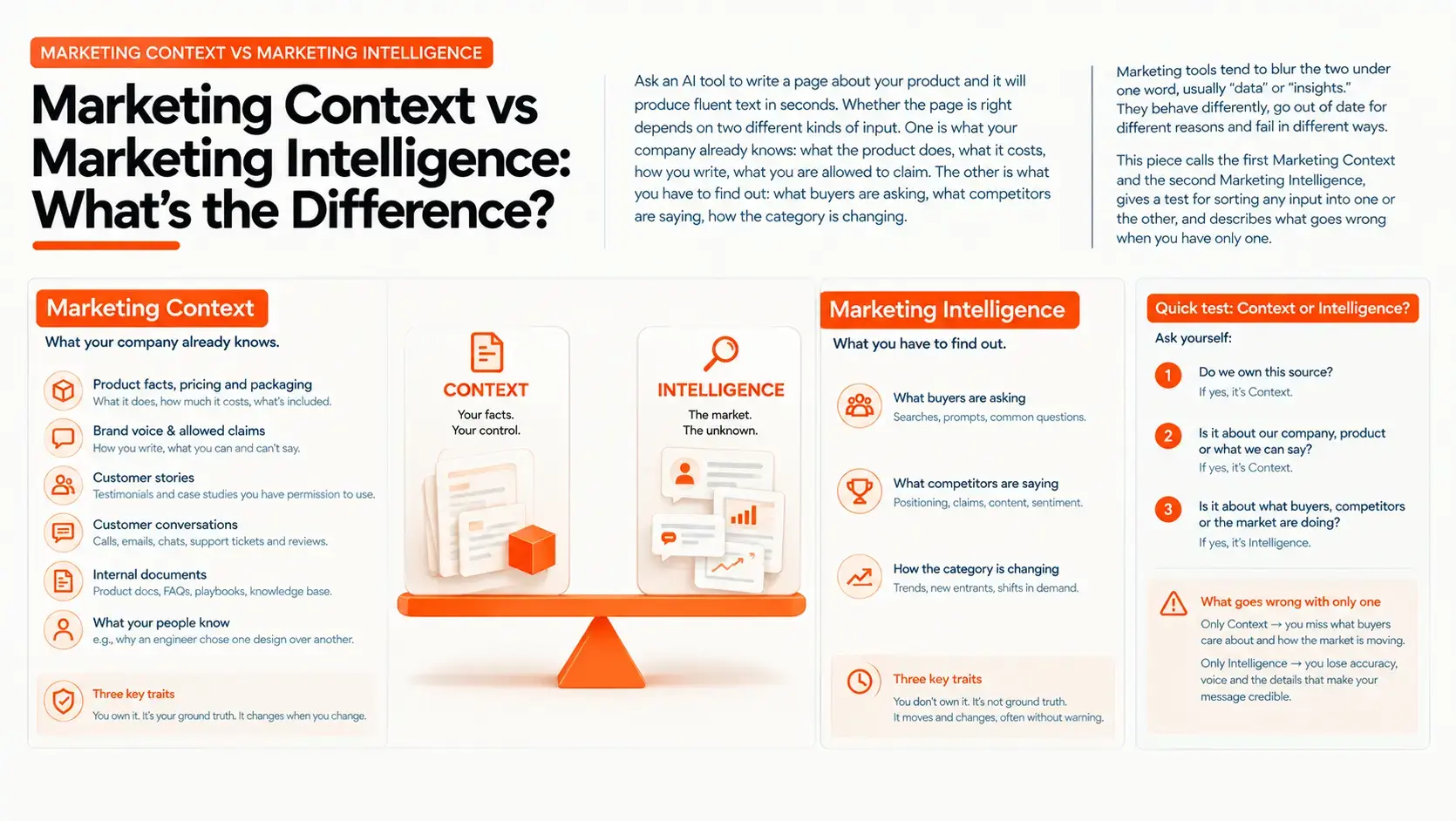


Ask an AI tool to write a page about your product and it will produce fluent text in seconds. Whether the page is right depends on two different kinds of input. One is what your company already knows: what the product does, what it costs, how you write, what you are allowed to claim. The other is what you have to find out: what buyers are asking, what competitors are saying, how the category is changing.
Marketing tools tend to blur the two under one word, usually "data" or "insights." They behave differently, go out of date for different reasons and fail in different ways. This piece calls the first Marketing Context and the second Marketing Intelligence, gives a test for sorting any input into one or the other, and describes what goes wrong when you have only one. It is a definition piece, so it has few statistics, and we say where the outside sources stop.
Context faces inward: what your company already knows
Marketing Context is the set of things that are true about your company and that you can state without looking outside. It usually includes:
- Product facts, pricing and packaging
- Brand voice, plus the claims you may and may not make
- Customer stories you have permission to use
- The record of customer conversations: calls, emails, chats, support tickets and reviews
- Internal documents and a knowledge base
- What your own people know, such as why an engineer chose one design over another
Three traits define it. You own it, so nobody else can supply it for you. It is the closest thing you have to ground truth about yourself. And it changes when you change: a new price, a renamed product or a retired claim makes an old entry wrong on the day it happens.
That last trait is why context needs a single current version of each fact. If last year's price sits in one document and this year's in another, an AI tool or a freelance writer may pick either. The same facts also need to match across your site and the pages that describe you elsewhere, which our piece on entity SEO for AI search covers. The knowledge inside your people is context too, and our piece on whether expert quotes earn LLM citations looks at one way to turn it into pages.
Intelligence faces outward: what you find out and keep checking
Marketing Intelligence is what you learn about the world around you: buyers, competitors and the market. The word "intelligence" is used loosely, so it helps to see how others have used it. A 2004 article in Quirk's, a market research trade publication, describes market intelligence as a continuous process that combines competitor, product, market and customer information, and sets it against marketing research, which answers a specific question and then finishes. Salesforce's guide to marketing intelligence, which comes from a company that sells marketing software, lists five types: competitive, product, market understanding, customer understanding, and marketing performance and analytics.
We use the term more narrowly. Marketing Intelligence here means the part that is about understanding buyers, competitors and the market, not reporting on your own campaigns. It has traits that mirror context, and they are less comfortable:
- It is interpreted. Someone reads a pattern in the evidence, so it can be wrong in a way a price list cannot.
- Its sources vary in quality. A competitor's own page, a review and a rumor are not equal.
- It expires on the world's schedule, not yours. A competitor repositions or buyers start asking something new, and nothing in your company changed.
Partial evidence is the normal case. Our look at what B2B buyers actually ask ChatGPT found no independent, log-based sample of B2B buyer prompts, so anything you conclude about those questions is built from pieces. That is not a reason to skip intelligence. It is a reason to label how firm each finding is, and to treat a finding as a hypothesis until a second source agrees. Tracked prompts are one source, and the way to tag them by role, company type and stage is in our guide to tracking AI search by buyer persona, ICP and funnel stage.
Where they meet: the record of customer conversations
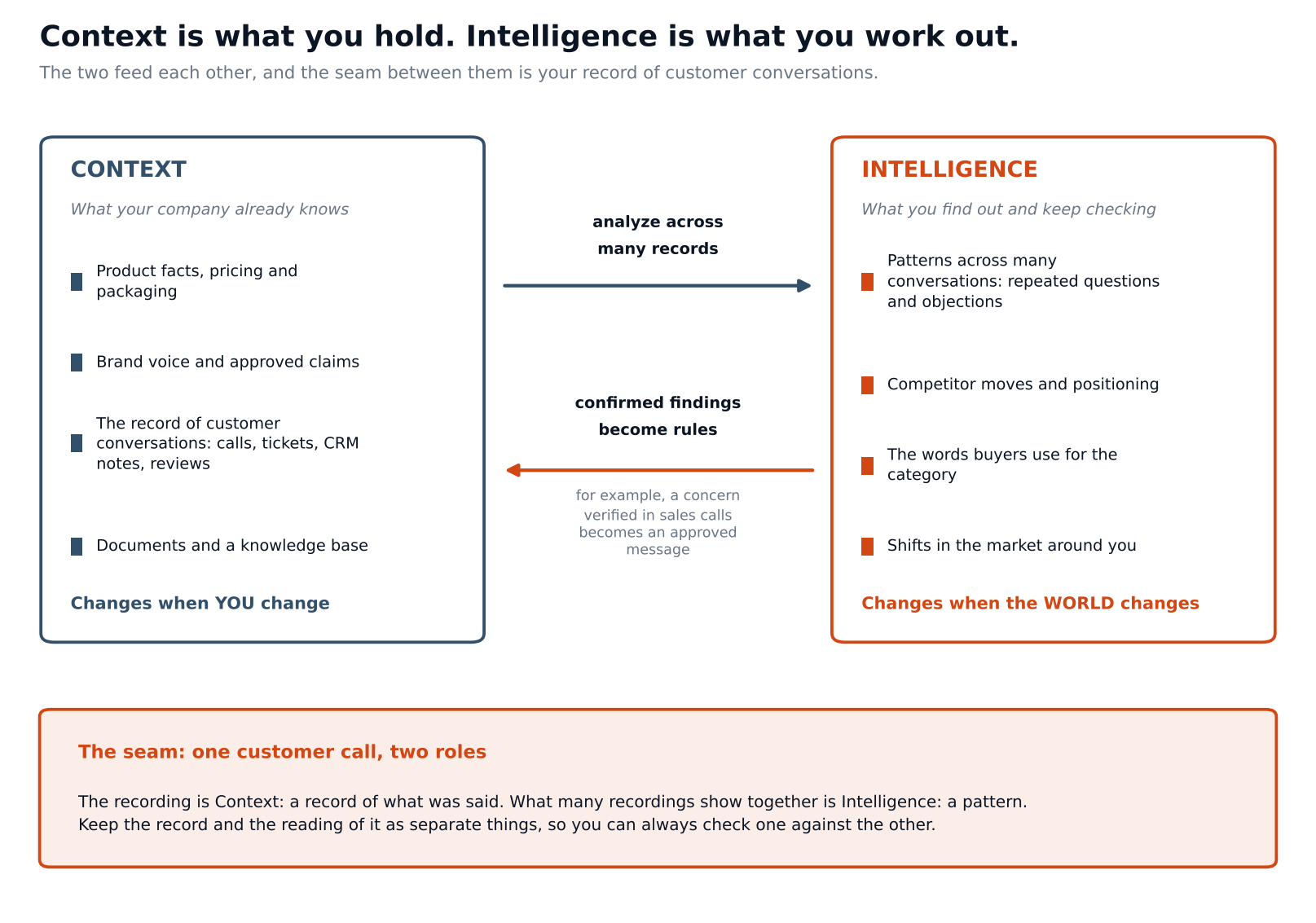
The cleanest example of the seam is a sales call. The recording is Context: a record of what was said, held by you and not open to argument. What many recordings show together is Intelligence: a pattern, such as the same objection coming up again and again, or buyers describing the category in words your site never uses.
Keep the record and the reading of it as separate things. If you store only the conclusion ("buyers care most about integrations"), you can no longer check it against what was said, and nobody can tell whether it came from ten calls or two. If you store only the raw calls, nobody reads them. The two feed each other. Analysis runs across the records, and once a finding holds up, it goes back into Context as a rule: a verified concern becomes an approved message, and a confirmed category term becomes part of the style guide.
A test for sorting any input: what made it change?
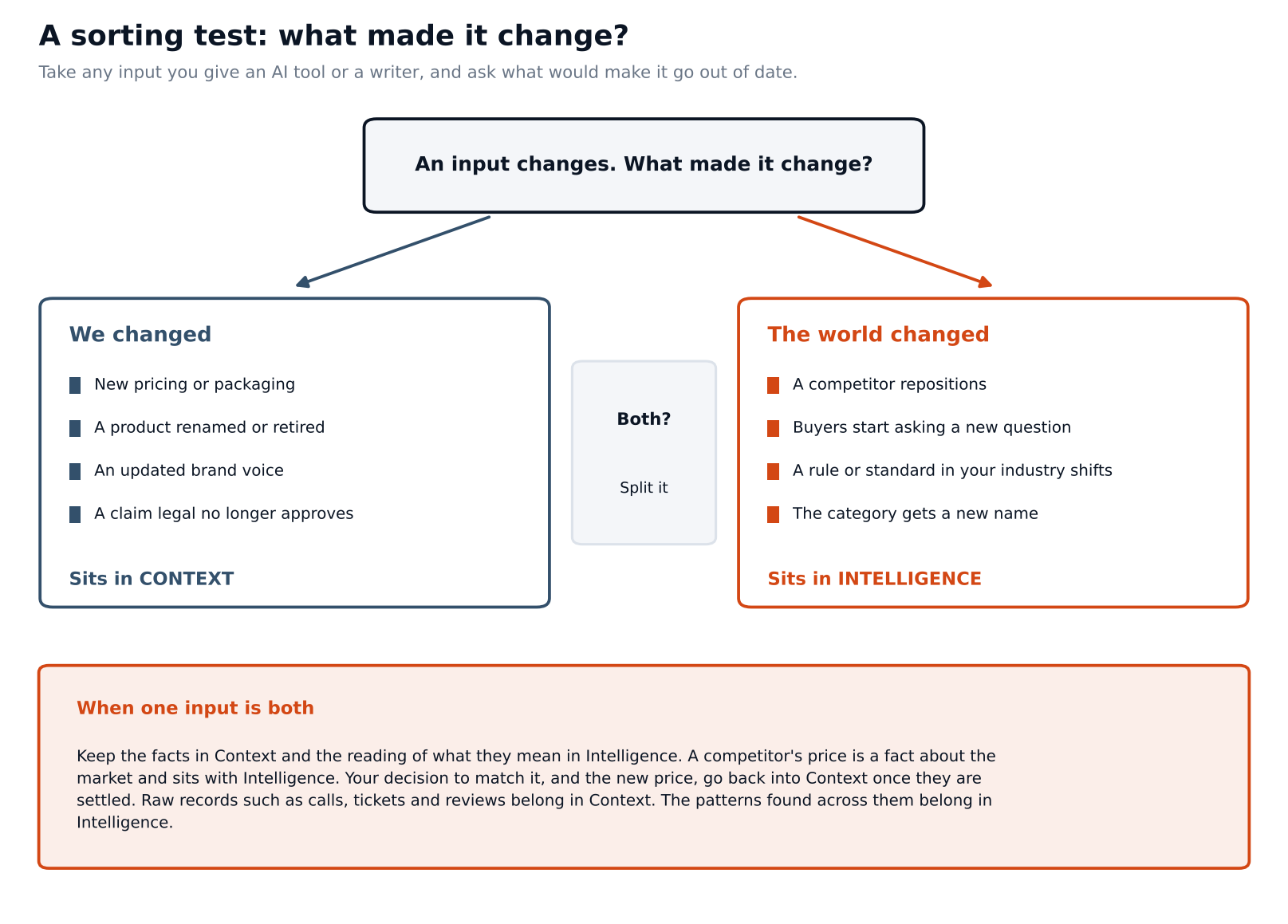
When an input does not fit neatly, ask what would make it go out of date. If the answer is that you changed something, it belongs in Context. If the answer is that something outside changed, it belongs in Intelligence.
| Input | What would make it go out of date | Where it sits |
|---|---|---|
| Current pricing and packaging | You change them | Context |
| Approved and banned claims | Legal or product changes the rule | Context |
| Brand voice guide | You change how you write | Context |
| Call recordings, tickets and reviews (the records) | They do not expire; they accumulate | Context |
| The objections that repeat across many calls | Buyers' concerns shift | Intelligence |
| A competitor's new positioning page | The competitor changes it | Intelligence |
| The words buyers use for your category | Category language shifts | Intelligence |
| A new rule in your industry | The rule changes | Intelligence |
Some inputs are both. A competitor's new price is a fact about the market, so it sits with Intelligence. Your decision to match it, and the price you settle on, go into Context once they are decided. Splitting the input this way means the fact and your reading of it can each be corrected without touching the other.
What goes wrong when you have only one
Each missing half leaves a recognizable gap in the output.
| Missing | What the output looks like | A typical failure |
|---|---|---|
| Intelligence | Accurate and on brand, but aimed at questions nobody is asking | The page uses your name for the category while buyers use another, or ignores a rival's new positioning |
| Context | Aware of the market, but generic or wrong about you | The page cites a retired product or an old price, or makes a claim you cannot support |
These are patterns that follow from how the inputs work. We found no public study that compares content built with and without each kind of input, so we are not offering a measured effect. They are also not a substitute for review: either input can be right and the output still needs an editor.
Neither half repairs the other. A rich picture of the market does not fix a wrong price, and a perfect fact base does not tell you that buyers moved on to a different question.
Why more context is not better context
It is tempting to load every document you own into an AI tool. Two bodies of work suggest that is not the best approach. Anthropic's engineering team writes that context should be treated as "a finite resource with diminishing marginal returns," and that the aim is the smallest set of high-signal information that makes the result likely. A 2023 study by Liu and colleagues, published as a preprint and later in a journal, found that models used relevant information best when it sat at the beginning or end of a long input, and that performance dropped when it sat in the middle.
Both are findings about language models in general, not tests of any marketing platform, and models have changed since 2023. They support a practical habit: curate context. Keep one current source for each fact, retire old versions, and state the rules that matter briefly and clearly, not buried in a long document.
There is also a basic reason context has to be supplied at all. A model's built-in knowledge is fixed when it is trained and holds little about your private facts. One well-known approach, retrieval-augmented generation, pairs a model with an external store it can look things up in, an idea set out by Lewis and colleagues in 2020. Whatever tool you use, the current facts about your company have to reach it from somewhere, and that somewhere is your Context.
How this maps to the Omnibound platform
In the Omnibound platform, Context and Intelligence are separate areas. Context holds sources such as call recordings, CRM records, emails, chats, support tickets, reviews, company knowledge and brand voice. Intelligence works from that material and from market sources to produce views such as competitor intelligence, customer voice and product messaging. The first is described on the Marketing Context page and the second on the Intelligent Research page.
One naming note, because it trips people up: Marketing Intelligence is a different thing from AI Search Intelligence, which tracks how AI engines answer the prompts you choose to follow. If you use other tools, the sorting test above works the same way, whatever they call the layers.
Questions people ask
1. Is marketing context the same as a brand guide?
No. A brand guide is one input to Context. Context also holds product facts, pricing, claims, customer records and internal knowledge.
2. Is marketing intelligence the same as market research?
They overlap. The Quirk's article treats research as a bounded study that answers a specific question and intelligence as a continuing process. A research study can feed Intelligence as one more source.
3. Which should I build first?
Context is the easier start, because it is yours and nobody else holds it. But any piece that needs to say something about a competitor or a buyer's concern needs Intelligence, so build the first one a given piece needs, not both in full.
4. How often should each be refreshed?
We found no standard interval in the sources we read. A workable rule is to update Context when something in the company changes and to review Intelligence on a schedule you set and keep, because its sources change without telling you.
Sort your sources this week
List the inputs you give your writers and your AI tools, then run each through the change test. You will probably find some facts in two places, some conclusions with no record behind them, and some outside findings that nobody has dated.
Once your own facts are in order, you can check them from the outside. The AI Search Visibility Checker gives a first look at how an answer describes you today, which is one test of whether the facts you hold are the ones being repeated. To follow that over time, AI Search Intelligence tracks each prompt individually, so you can read, prompt by prompt, what the answers say about you and compare it with the facts you hold.