


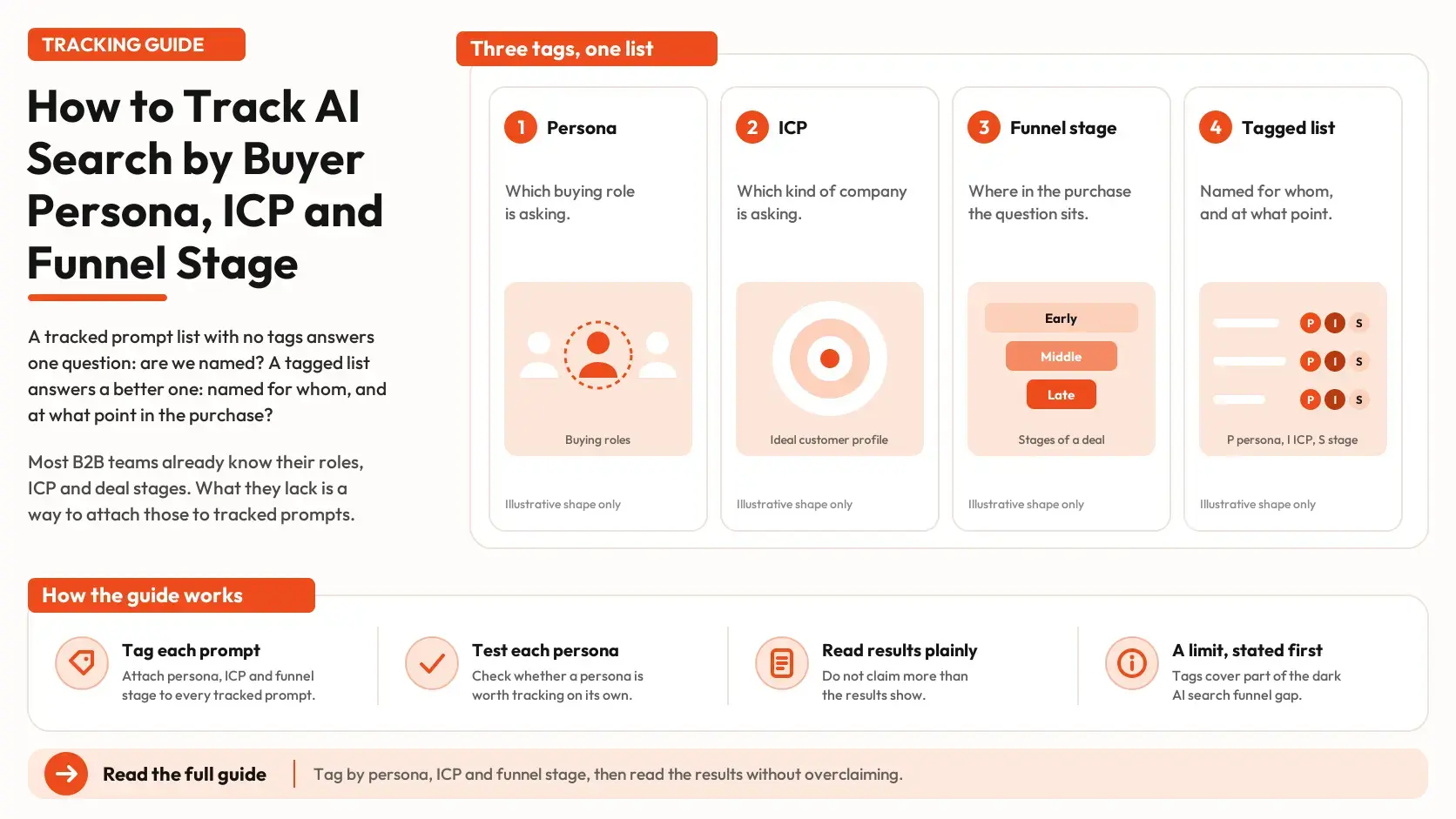


A tracked prompt list with no tags answers one question: are we named? A tagged list answers a better one: named for whom, and at what point in the purchase? Most B2B teams already hold the pieces. They know their buying roles, their ideal customer profile and the stages of a deal. What they lack is a way to attach those to the prompts they track.
This guide shows how to tag prompts by persona, ICP and funnel stage, how to test whether a persona is worth tracking on its own, and how to read the results without claiming more than they show. It follows our piece on the dark AI search funnel, which covered what your analytics miss. Tagged prompts are one way to cover part of that gap, with a limit we state first.
What a tag can and cannot mean
The buyers who ask AI questions are anonymous to you. As the dark funnel piece explains, the prompt, the answer and the buyer's role leave no record in your systems. So a tag on a tracked prompt describes the prompt you wrote, not the person who might type something like it. Persona is the voice you give the question. ICP is the company context you put in the sentence. Stage is the intent behind it.
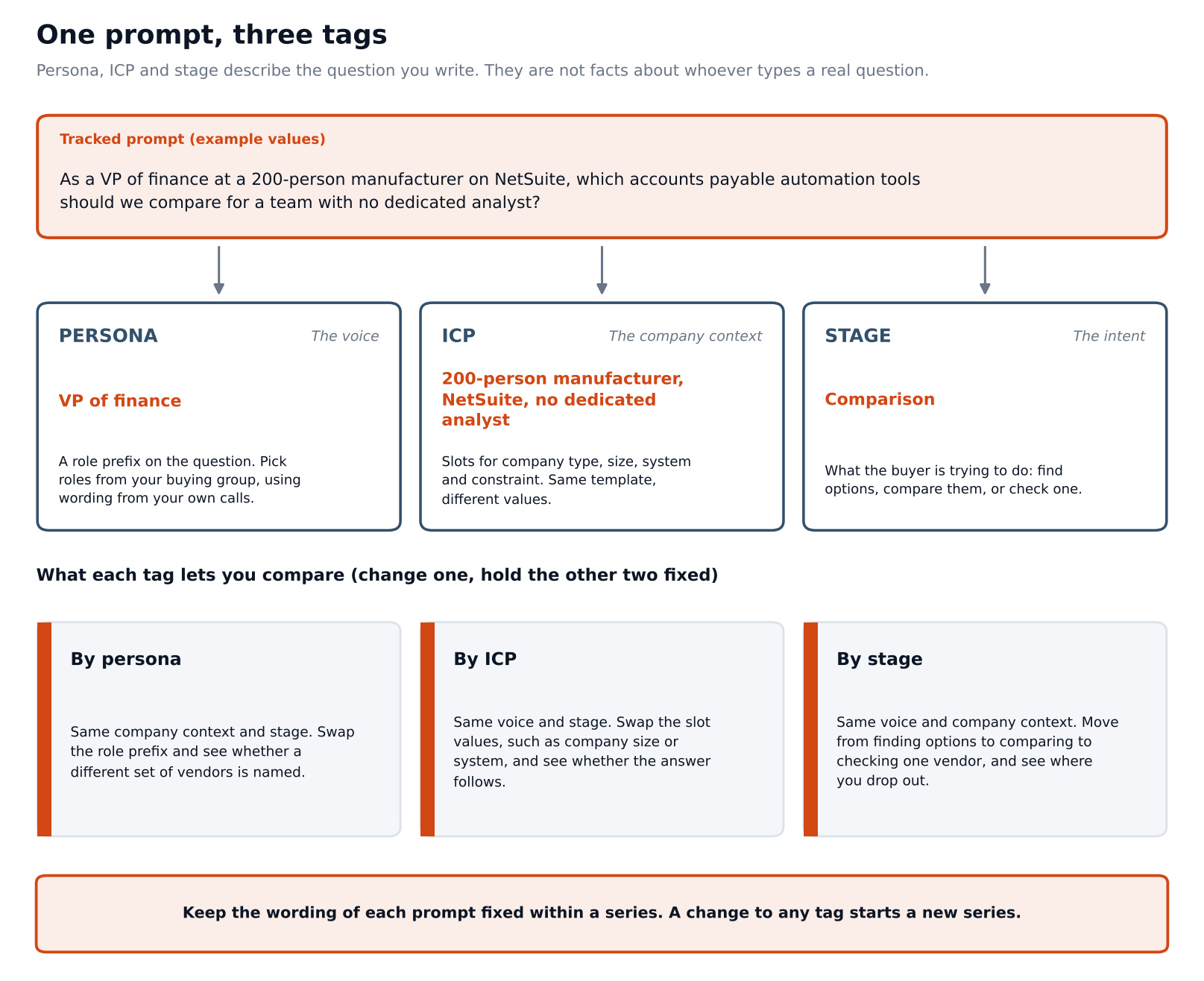
A prompt written "As a VP of finance at a 200-person manufacturer" shows how an answer treats that framing. It does not show what any real VP of finance typed. Keep that distinction in every report, and the rest of the method follows from it.
Tags can still tell you which engines to weight. G2's 2026 survey of 1,076 software buyers found ChatGPT is the top chatbot in every segment, but the mix moves. C-suite buyers were the most ChatGPT-dominant group, engineering and R&D buyers used the widest range of chatbots with Claude at its highest share of any function, Copilot held 10 to 13 percent among enterprise and large enterprise buyers, and Claude's best showing was 7.3 percent among small and mid-size firms. The survey is self-reported and G2 runs a software review marketplace, and the text we could read gives only these figures from its charts. It is enough to say that persona and company size are worth checking against the engines you track.
Start with stage, using the buyer's own two phases
Marketing funnels borrow their stage names from advertising. Buyers do not describe their own process that way. 6sense's 2025 Buyer Experience Report splits the journey into two phases. In the Selection phase, about the first 60 percent, the buying group forms, agrees on the problem, researches on its own and converges on a shortlist. The Validation phase, the last 40 percent or so, begins at first contact with a seller and tests the favorite. In the survey, 94 percent of buyers said they put the shortlist in order of preference before they spoke to a seller.
G2's survey adds what buyers ask first. Over two-thirds start with a category or competitor query, about one in five start with a question about requirements or process, and comparing vendor strengths and weaknesses ranked first among the ways buyers use AI in software research.
Those findings suggest three stage tags that follow what the buyer is doing. This mapping is ours, not the surveys'.
- Find: the buyer names a need and no vendor. "Which accounts payable automation tools are worth considering?" and requirements questions belong here. This sits in the Selection phase.
- Compare: the buyer weighs options. Alternatives to a named rival, "X versus Y" and pricing comparisons belong here. This also sits in the Selection phase.
- Check: the buyer already has a name and tests it. "Is Acme AP a good fit for a company like ours?" belongs here. This sits in the Validation phase.
Weight your list to match. If the favorite is usually set before the first sales call, a list built mostly of brand-named questions watches the Validation phase and misses where the shortlist forms. Our piece on how B2B shortlists form in AI answers covers that in more detail.
These figures have limits. The 6sense survey spans services, software and physical goods and does not state when it was fielded, and 6sense sells account-based marketing software. Buyers also do not move in a straight line, so treat the stage tag as the intent of a prompt, not a position in a pipeline.
Give persona a voice, then test whether it matters
A persona tag starts from a buying role. The 6sense survey described its respondents as 52 percent ultimate decision makers, 15 percent procurement, 14 percent influencers, 10 percent champions and 10 percent financial ratifiers, and said that buying groups averaged more than ten members in its 2023 and 2024 reports. Your own groups will differ. Pull the roles from your closed deals and take the wording from sales calls, support tickets and CRM job titles. A customer and market research tool such as Omnibound's Intelligent Research can keep that material in one place, though a spreadsheet works as well.
Then write the voice into the prompt: a short "As a [role] at a [company type]" prefix, followed by the concern that role would state. Roles tend to differ in what they worry about. A finance lead might ask about audit trails and approvals, an IT lead about integration and security, and procurement about contract terms. Put the concern in the question, not only the title.
Whether the prefix changes the answer is a question to test, not assume. An academic study of scholar recommendations ran 43 models over more than 900,000 queries and found that a stated role and language changed the lists very little, while the persona's location changed them more. That is a different domain from vendor recommendations, so it proves nothing about yours. It does show that persona effects are not guaranteed. Situation details can matter, as a Northwestern preprint found when situation-based prompts brought well-known brands into lists that category-only prompts missed. Our piece on how query phrasing changes which B2B brands get cited covers that mechanism.
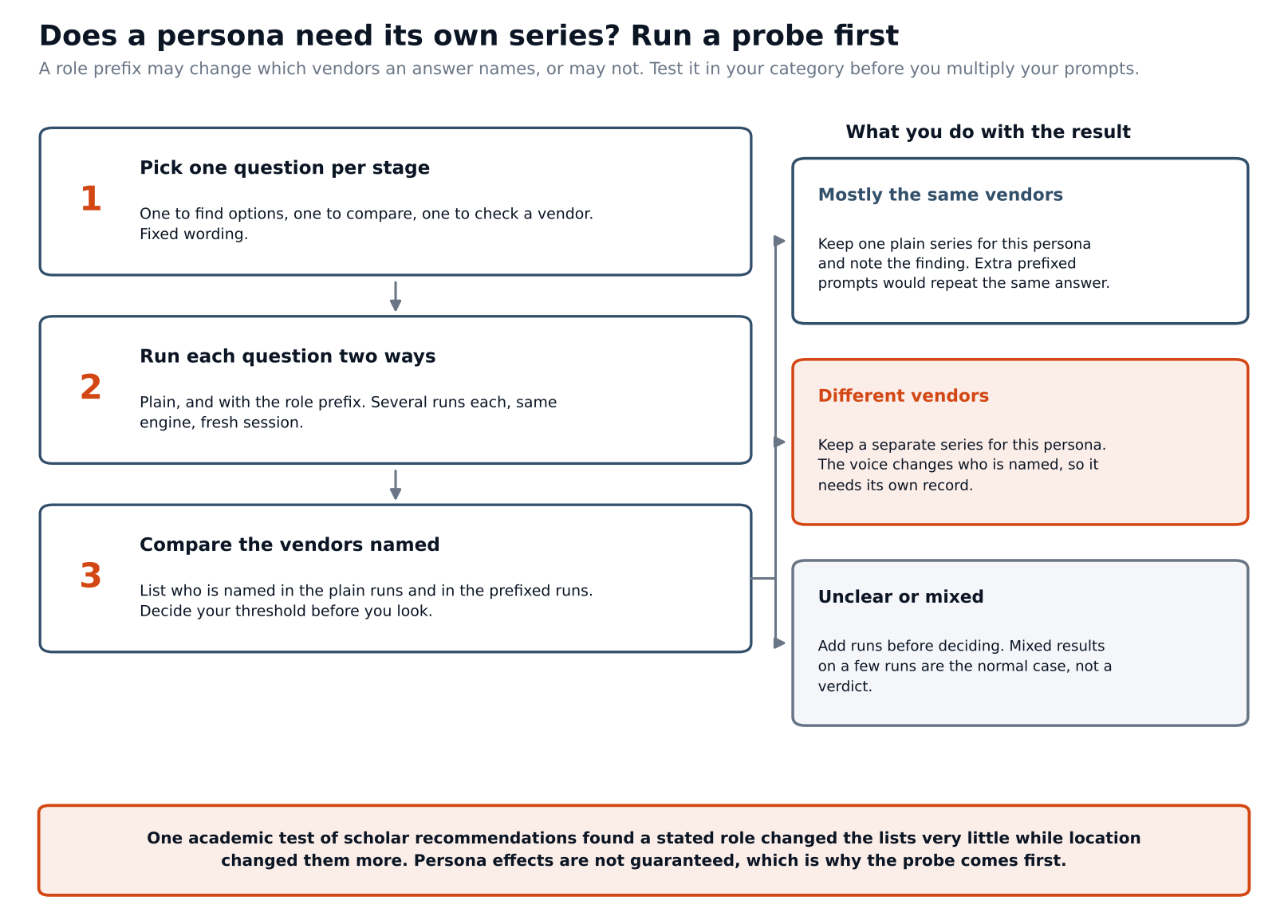
- Pick one question for each stage, with fixed wording.
- Run each question two ways, plain and with the role prefix, several times each, in the same engine and in a fresh session with no history.
- List the vendors named in each set. Decide what counts as mostly the same before you look.
- If the same vendors come back, keep one plain series for that persona and note the finding. If different vendors come back, keep a separate series. If the result is mixed, add runs.
Use ICP as slots, not as a label
An ICP describes a company, and a prompt can carry that in a few slots: the company type and size, the system it runs on, a constraint it would state, and the region if you sell in more than one. Use one template with the slot values changed for each ICP, and fix the values before you start. Our shortlist piece's audit works the same way.
Two cautions. First, the engine mix can shift with company size, as the G2 figures above suggest, so check that the engines you track fit the ICP. Second, location was the persona factor that moved answers most in the scholar study. If you sell in more than one region, test region as its own slot before assuming one series covers all of them.
Build the grid, then fill only the cells that matter
Three stages, three personas and two ICPs make 18 cells. You do not need to fill them all at once. Choose the cells where your pipeline concentrates, where lost-deal notes point and where a rival is strong, start each with one phrasing, and add a second only where the cell matters most.
Here is a slice of a grid for an invented category, accounts payable automation, with the first ICP a 200-person manufacturer on NetSuite. The vendor names are placeholders.
| Stage | Persona | Prompt |
|---|---|---|
| Find | Finance director | As a finance director at a 200-person manufacturer on NetSuite, which accounts payable automation tools are worth considering? |
| Find | IT manager | As an IT manager at a 200-person manufacturer on NetSuite, which accounts payable automation tools work with NetSuite? |
| Compare | Finance director | As a finance director at a 200-person manufacturer on NetSuite, what are good alternatives to Vendor X for accounts payable automation? |
| Compare | Procurement lead | As a procurement lead at a 200-person manufacturer, how do accounts payable automation tools compare on pricing and contract terms? |
| Check | Finance director | As a finance director at a 200-person manufacturer on NetSuite, is Acme AP a good fit for a team with no dedicated analyst? |
Each row carries a stage tag, a persona tag and the ICP slots. Change one and hold the other two fixed when you compare. A change to any of them, or to the wording, starts a new series.
Reading a tagged report without over-reading it
Answers vary from run to run and engine to engine, so report the share of runs that named you, with the run count beside it. Our piece on model variability in AI citations explains why one run tells you little.
Before you call a persona difference real, measure the noise. Run the plain version twice, in two separate batches, and see how much the two sets of vendors differ. A gap between plain and prefixed runs only counts if it is clearly larger than the gap between two plain batches.
Do not sum cells. A share in the Find row and a share in the Check row measure different things, and averaging them hides where you drop out. Do not compare cells that use different wording. And weight by what you know about your own pipeline. CRM titles, call notes and the form fields from our dark funnel log tell you which personas and stages matter, which the tracked answers cannot.
Questions people ask
How many prompts should I track? No source gives a number. Start with one phrasing for each priority cell, add a second where a cell matters most, and expand only when the probe shows a persona or ICP changes the answer.
Is an ICP the same as a persona?
No. An ICP describes a company: its type, size, system and constraints. A persona describes a role inside the buying group. They go into the prompt differently, the persona as a voice and the ICP as slots.
Do I need to track different engines for different personas?
Check. G2's survey found the engine mix differs by function, seniority and company size, so track the engines your buyers use, and report each engine separately.
Can the engine tell who is asking?
A clean test session knows only what you write into the prompt. That is why the voice and the company context go in the sentence, and why a tag describes a prompt, not a buyer.
Start with one tagged column
A prompt list becomes more useful the day it has a column for stage. Add persona and ICP once a probe shows they change the answer. Run a handful of your tagged questions through the AI Search Visibility Checker for a first look at how an answer treats each stage and each voice. When you want to follow the full set over time, AI Search Intelligence tracks each prompt individually, so a persona-voiced question and its plain twin each keep their own record to compare.