


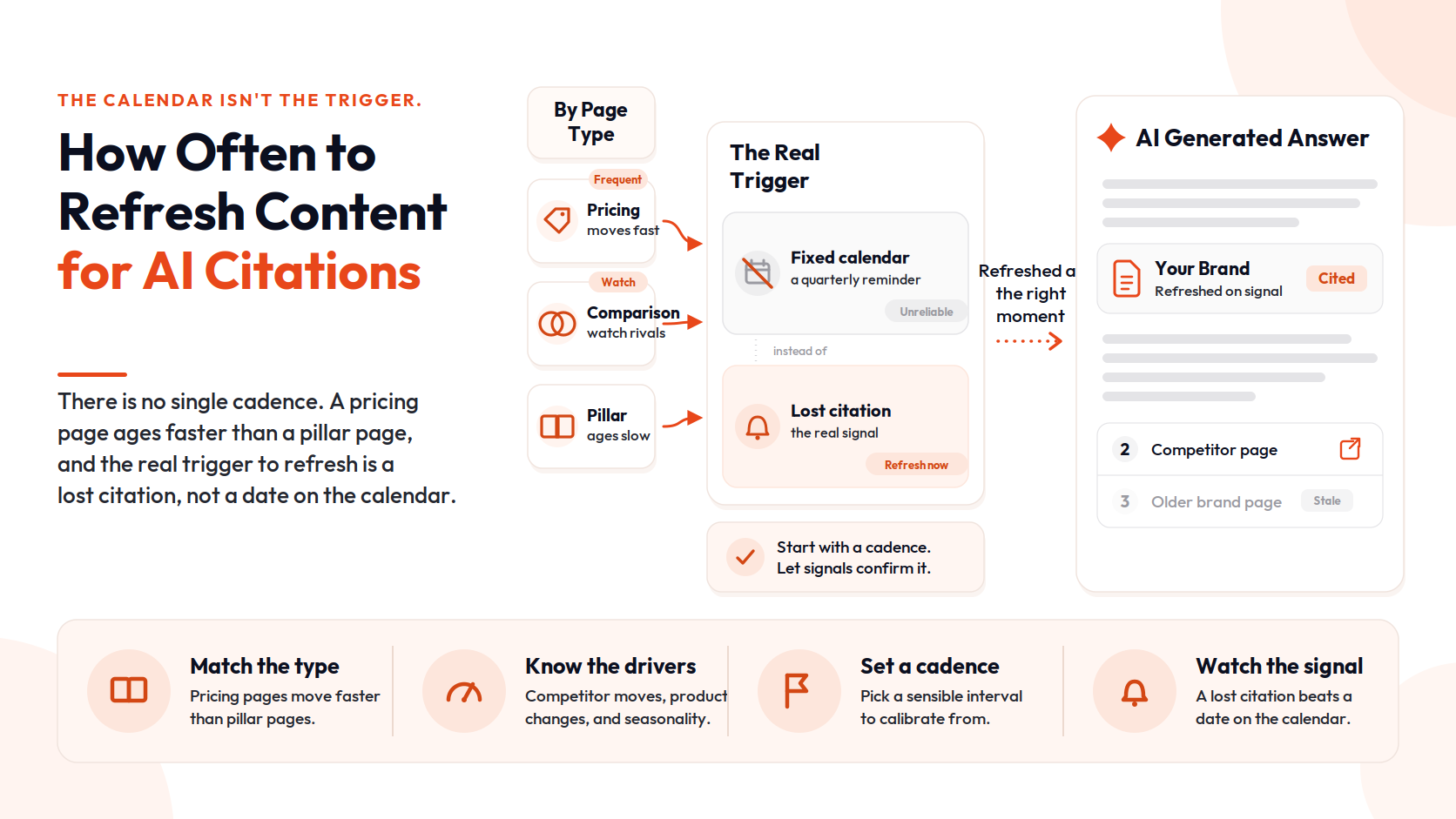


The honest answer to "how often should we refresh content for AI search" is that there is no single number, and any guide that hands you one is guessing. A pricing page and a definitional pillar do not age at the same rate, and neither ages on a schedule you can set in a calendar and forget. The useful version of the question is narrower: how often does this page need refreshing to stay the cited answer, and what tells you the moment has come.
This piece answers that. It covers why cadence varies by page type, what actually drives how often you need to act in AI search, sensible starting cadences to calibrate from, and why the real trigger is a lost citation rather than a date on the calendar. For which pages to refresh and what to change when you do, see which pages and content to refresh for AI visibility; this one is only about frequency.
Why there is no universal cadence
Refresh frequency should track two things about a page: how fast its facts go stale, and how much AI leans on that page type to answer buyer questions. A page whose core is a price, a statistic, or a competitor's feature list decays the moment reality moves; a page of durable principles can sit for a year and still be accurate. Setting both on the same quarterly cycle either lets the volatile pages rot between refreshes or wastes effort re-touching stable ones that were fine.
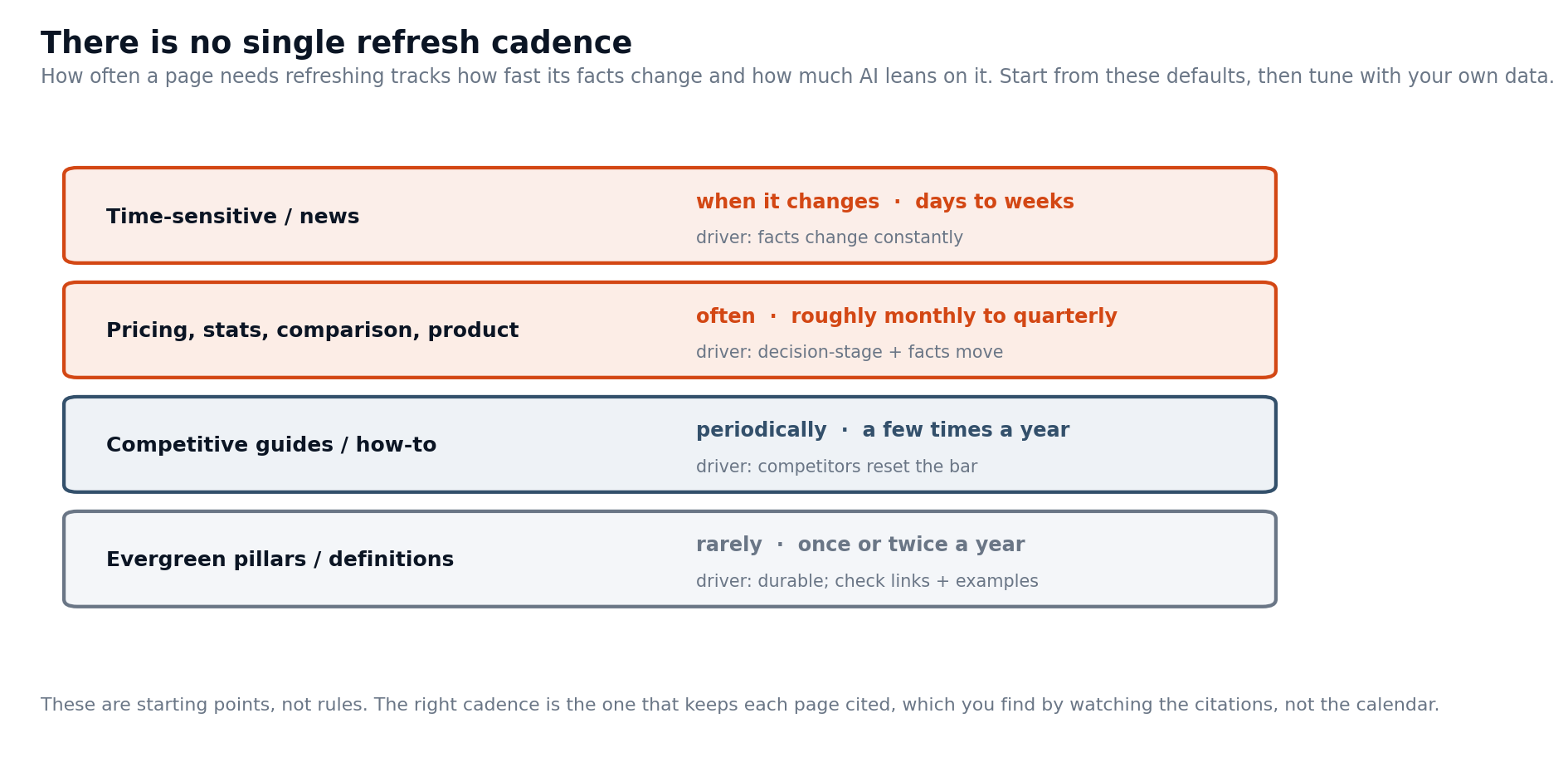 Cadence tracks how fast a page's facts change and how much AI relies on it. These are starting defaults, not fixed rules.
Use those tiers as a starting point, not a law. Time-sensitive and news pages need attention as their facts change, on the order of days to weeks. Pricing, statistics, comparison, and product pages are the workhorses of B2B AI answers and move often enough to want a roughly monthly-to-quarterly look. Competitive guides and how-to content need a periodic pass, a few times a year, mostly to keep pace as competitors publish fresher answers. Evergreen pillars and definitions can go the longest, once or twice a year, and often only need refreshed examples and working links. The point of the tiers is to give each page type a floor, a maximum time it can go un-reviewed, which you then tune with what you actually observe.
What drives cadence in AI search, specifically
Two forces make AI cadence different from the old SEO refresh rhythm, and both push toward acting sooner than a calendar would.
The competitive answer resets the bar continuously. AI engines reach for the most current, complete answer available, so the moment a competitor publishes a fresher take on your question, your once-cited page can be passed over even though nothing on it changed. Your cadence is partly set by how fast the best answer to your question is moving, which is outside your control and worth watching.
Freshness signals decay on their own. Engines favor sources that read as current and often append the current year to a query, so a page slides toward "old" as time passes even without a competitor doing anything. A page that was cited a year ago can quietly age out of the answer set. That is the decay covered in why AI search results fluctuate; for cadence, it means the clock is always running.
Together these mean the honest cadence is not "every N months" but "as often as your facts change or the competitive answer moves, whichever comes first," with the calendar tier as a backstop for when neither is obvious.
The real trigger is a lost citation, not a date
The most useful shift is to stop thinking of refresh as a calendar chore and start treating it as a response to a signal. A fixed schedule refreshes some pages long after they have already dropped out of AI answers, and re-touches others that did not need it. The signal that actually matters is a page slipping from cited to uncited for its target question.
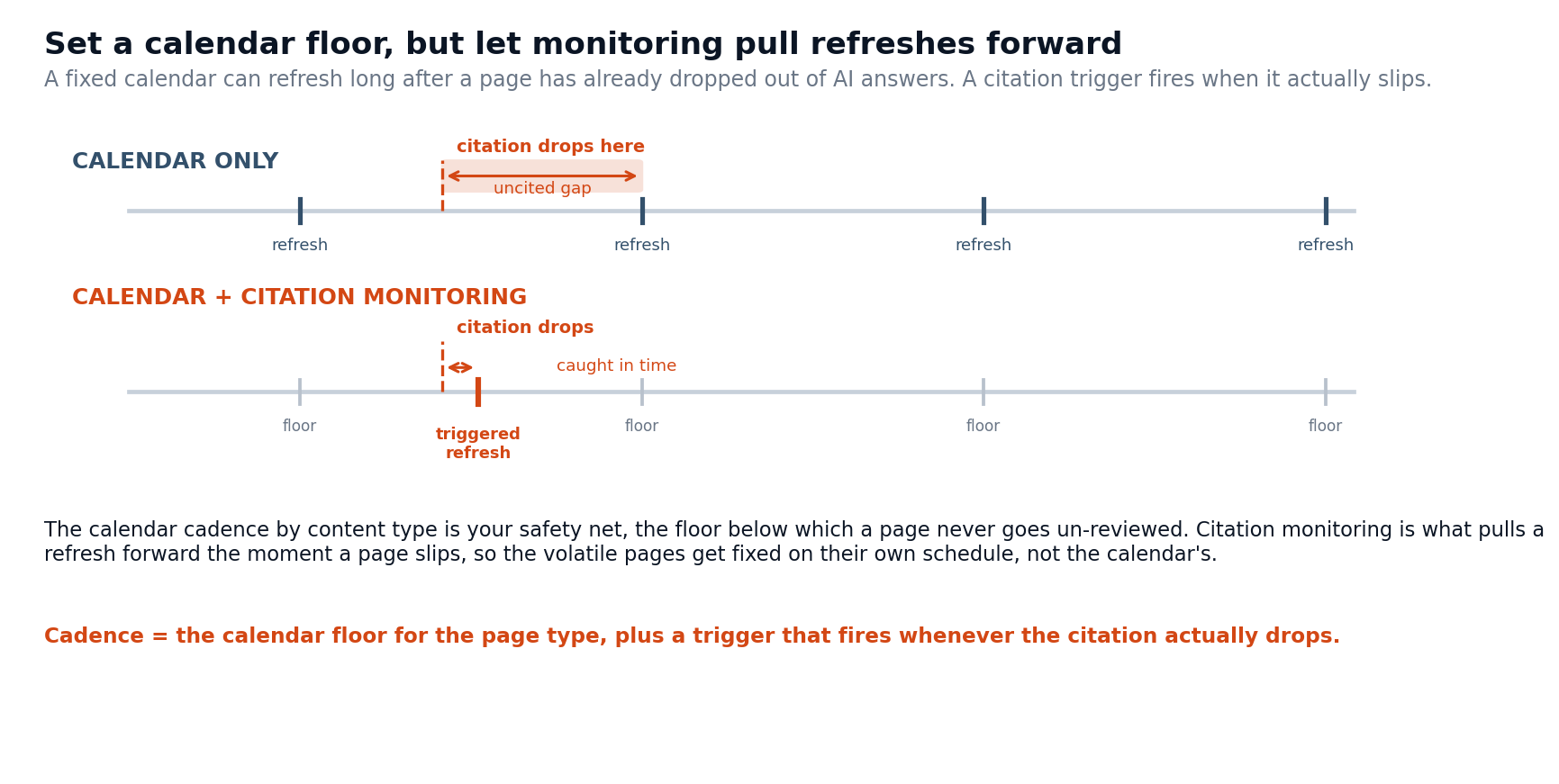
Keep a calendar floor per page type, and let citation monitoring pull a refresh forward the moment a page slips.
So run cadence as two layers. The calendar tier by content type is the floor: the longest a page of that type should ever go without a review, so nothing rots unnoticed. Citation monitoring is the trigger: when a priority page drops out of the answers it used to be cited in, you refresh it then, regardless of where it sits in the calendar.
The volatile, high-value pages end up refreshed on their own real schedule rather than the calendar's arbitrary one, and you stop spending effort on pages that were fine. Because AI answers vary run to run, the drop has to be read across repeated checks rather than a single look, which is why frequent automated checks across your prompt set are what make trigger-based cadence practical.
How to set your own cadence
You do not have to guess the right numbers; you can derive them. Start every page type at the default tier above, then let your own data tighten or loosen it.
Watch how fast each page type actually loses citations. If your pricing pages reliably slip within weeks of a change and your pillars hold for many months, that gap is your real cadence, and it will be specific to your category. Fast-moving spaces decay faster than the defaults suggest; stable ones slower.
Match effort to value. Concentrate the short cadences on the pages that carry citation value for pipeline, the decision-stage comparisons and pricing pages, and let low-value pages ride the long floor or drop off entirely. A page with no unique question to own does not belong on a refresh cadence at all; it belongs in the content pruning pile. A refresh cadence is a budget; spend it where losing the citation costs the most.
Make each refresh count. Frequency only helps if each pass is a substantive update rather than a changed date, so a realistic cadence is one you can sustain at a quality that actually re-earns the citation. What a refresh should change is covered in the refresh guide; the cadence point is simply that an honest monthly refresh beats a cosmetic weekly one.
A sensible default schedule to start from
If you need somewhere to begin before your own data comes in, a workable B2B default is: review pricing, stats, and comparison pages on a monthly-to-quarterly rhythm; competitive guides and how-tos a few times a year; evergreen pillars once or twice a year; and anything genuinely time-sensitive whenever its facts change. Layer citation monitoring on top so any page that drops gets pulled forward out of turn. Then, after a couple of cycles, adjust each tier to what you have observed about how fast your pages really decay. The schedule is a starting hypothesis, not the answer.
A worked example: two pages, two cadences
Take two pages on the same site. One is a "best AI visibility platforms" comparison, a decision-stage page built on competitor features and pricing. The other is a "what is AI search visibility" definitional pillar. They should never share a cadence.
The comparison page sits in the fast tier: its facts move whenever any listed competitor changes a feature or price, and it is exactly the kind of page an engine wants current for an evaluating buyer. You start it on a monthly-to-quarterly floor. Then you watch, and you notice it slips from cited to uncited within a few weeks of a competitor's pricing change. That observation, not the calendar, is your real cadence: this page needs eyes roughly monthly, with a citation trigger to catch the competitor-driven drops in between.
The definitional pillar is the opposite. Its core answer is durable, so you start it on a once-or-twice-a-year floor. You watch, and it holds its citations comfortably between reviews, needing little more than updated examples and working links. Refreshing it monthly would be wasted effort that the comparison page needed more.
Same site, same team, two cadences derived from what each page actually does. That is the whole method: start from the tier, watch the citations, and let the page tell you its rhythm.
Where B2B teams get cadence wrong
- Setting one cadence for everything. A single site-wide refresh schedule over-serves stable pages and under-serves volatile ones. Tier it by content type.
- Refreshing by the calendar alone. A fixed schedule misses pages that decay early and wastes effort on pages that did not. Pair the calendar floor with a citation trigger.
- Chasing frequency over substance. A weekly date change does nothing. A less frequent but substantive refresh re-earns the citation; cadence is meaningless without a real update.
- Ignoring competitor freshness. Your page can age out because someone published a better answer, not because your facts changed. Watch the competitive answer, not just your own page.
- Never adjusting the defaults. The starting tiers are a hypothesis. If your data shows pricing pages decay in weeks, refresh them in weeks.
Frequently asked questions
How often should I refresh content for AI search?
There is no single number. Tie cadence to how fast a page's facts change and how much AI relies on it: time-sensitive pages as they change, pricing and comparison pages roughly monthly to quarterly, competitive guides a few times a year, and evergreen pillars once or twice a year. Treat those as starting defaults and tune them with your own citation data.
Is there a best refresh frequency for AI citations?
The best frequency is whatever keeps a given page cited, which varies by page type and by how fast your category moves. Rather than a fixed interval, set a calendar floor per content type and refresh sooner whenever a page slips from cited to uncited.
Should I refresh on a schedule or when something changes?
Both. Use a calendar floor so no page goes un-reviewed for too long, and a trigger, a lost citation or a changed fact, to pull refreshes forward when they are actually needed. The trigger is the more important of the two.
Does refreshing more often always help?
No. Frequency only helps if each refresh is substantive. A cosmetic update, including a bare date change, does not re-earn a citation, so a sustainable cadence of real updates beats a frantic schedule of shallow ones.
How do I know my cadence is right?
Watch how quickly each page type loses citations after a refresh. If pages hold their citations comfortably to the next scheduled review, your cadence is fine; if they slip well before it, tighten the tier for that type.
Refresh on the signal, not the calendar
How often to refresh is the wrong question if it expects one answer. The right cadence is set per page type by how fast its facts move and how much AI relies on it, floored by a calendar so nothing is forgotten, and pulled forward by the one signal that actually matters: a page slipping out of the answers it used to be cited in. Start from sensible defaults, watch what your own pages do, and let the citations, not the calendar, set the pace.
To see which of your pages are slipping and when they need attention, run a free scan with the AI Search Visibility Checker, or track citation decay across your priority pages so your refresh cadence runs on real signals with AI Search Intelligence.