

Grok is the one major AI assistant that does not answer from the web alone. Built by xAI and wired into X, it reads two streams at once: the live web, like other engines, and real-time posts on X that no other major assistant weights the same way. For a B2B brand, that changes the job. Getting cited by Grok means doing the web fundamentals every engine rewards, plus building a presence on X that most competitors are ignoring.
Grok is also growing fast as a research tool, with a web search mode for quick answers and a DeepSearch mode that browses and reasons across many sources before it responds. This guide covers what Grok is, how it finds and cites sources, what its real-time X data means for B2B, and a step-by-step playbook to get your brand named.
What Grok is, and where buyers meet it
Grok is xAI's AI assistant. Buyers reach it in a few places: inside X, where it is built into the platform; at grok.com; and in the Grok mobile apps. Like other answer engines, it returns a written answer with cited sources rather than a page of links.
Two capabilities matter most for visibility:
- Web search, where Grok searches the live web to answer questions that need current information, then cites the pages it used.
- DeepSearch, an agentic research mode that runs many searches, browses across sources, reasons over what it finds, and produces a longer, more thorough answer with citations. Deeper research questions, the kind B2B buyers ask when comparing vendors, tend to trigger this heavier mode.
Underneath both sits the trait that defines Grok: real-time access to what is being posted on X.
How Grok finds and cites its sources
You cannot optimize for a system you cannot picture, so start with the mechanism.
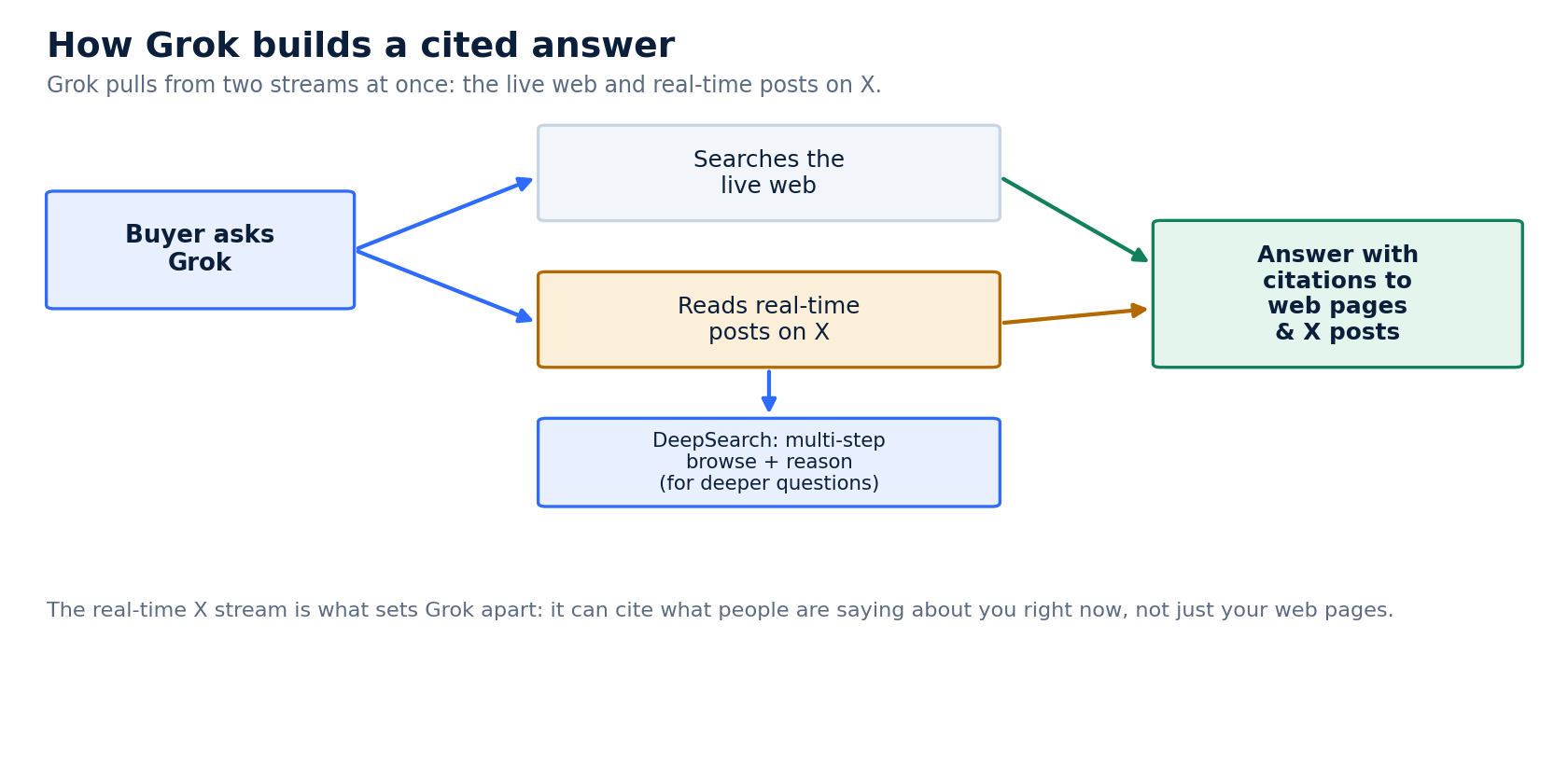
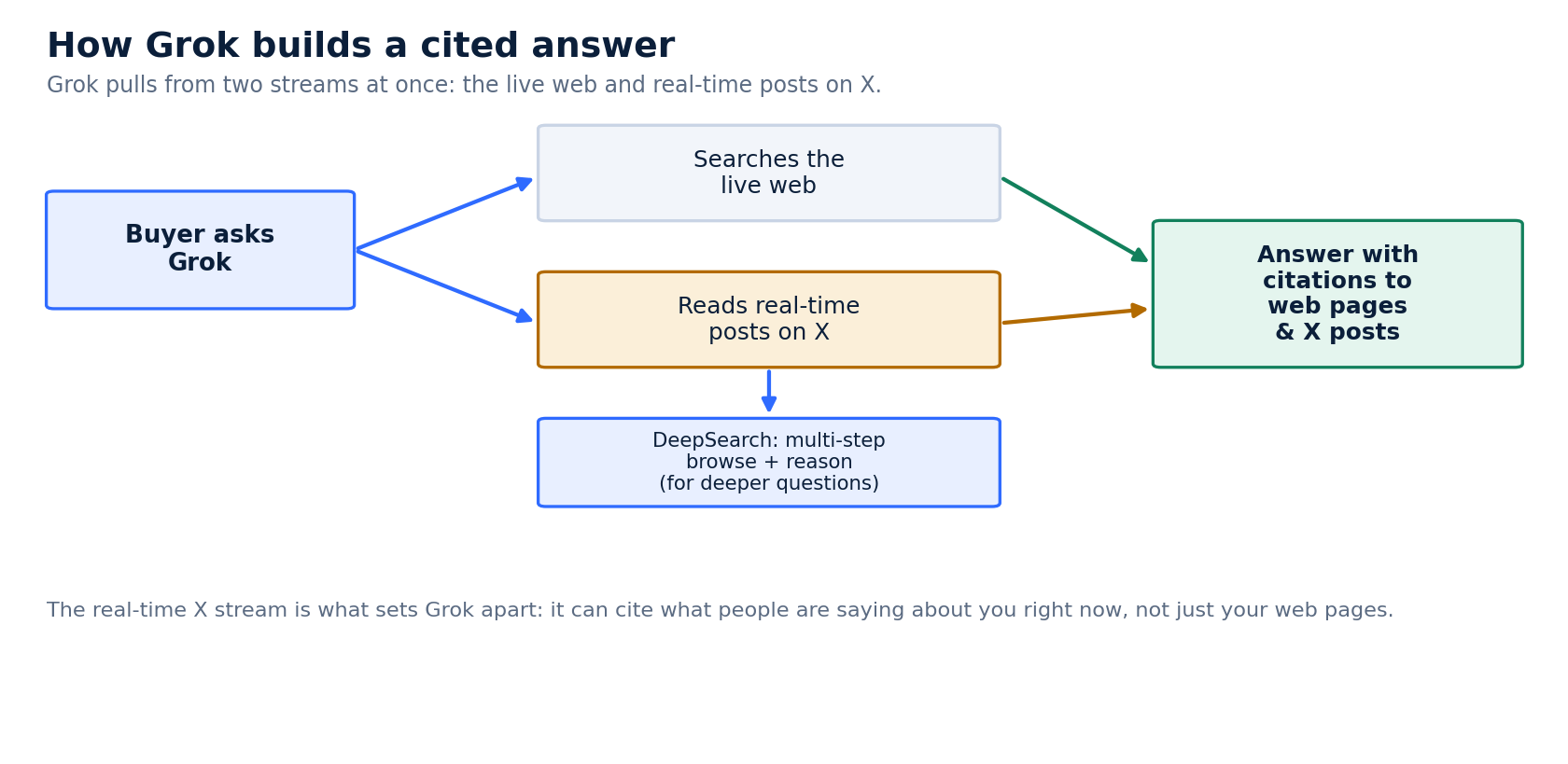
When a buyer asks Grok something current, it searches the live web and, at the same time, draws on real-time posts from X. For a deeper question, DeepSearch expands the work into a multi-step pass: many searches, pages read in sequence, and a synthesized answer. Like most AI search, it expands a question into several related searches rather than matching one string, which is the same retrieval-and-generation pattern behind how AI search works across engines. The result cites both web pages and, distinctively, individual X posts.
A few observed behaviors are worth planning around, based on how Grok has handled web results in practice. It tends to surface a capped set of sources per answer rather than a long list, so the bar to be one of them is high. It reads your meta description closely and will show it as written, so a missing or weak description costs you. And it has been slower than Google to reflect page updates, so a freshly changed page may not register immediately. None of these are officially published rules, but they are consistent enough to design for.
What makes Grok different: the X factor
Every other major engine answers from web content. Grok adds a second, live stream: X.
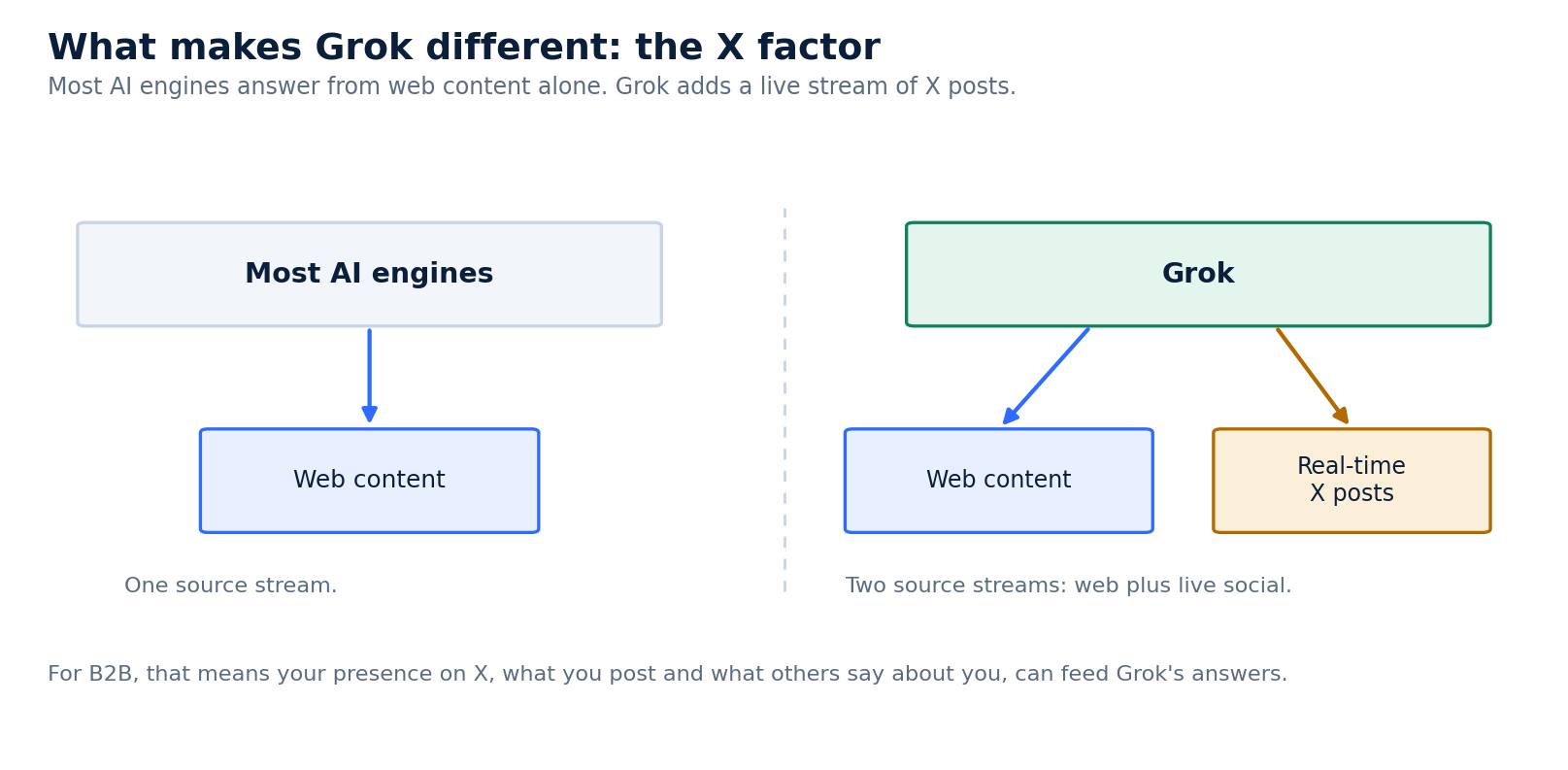
This is the single most important thing to understand about getting cited by Grok. Because it reads X in real time, what people post about your brand, what your own account publishes, and the conversations your category is having can all feed a Grok answer. A well-regarded thread, a founder who posts substantively, or steady mention in industry conversation is a signal Grok can see and other engines largely cannot. It also means Grok reflects the current moment more than a slower-moving index does, so timely, relevant activity on X carries weight.
To make it concrete, picture a buyer asking Grok which vendors lead your category. To answer, Grok can pull your product page from the web and, alongside it, a recent thread where a respected practitioner recommended you, plus the fact that your own account has been posting useful material on the topic. A competitor with a stronger website but no presence on X gives Grok only half as much to work with. Same question, and the brand that shows up in both streams has the edge.
The flip side is a caution: because X is real-time and open, the signal is noisier and less controllable than your own site. You cannot manufacture genuine conversation, and trying to game it reads as spam. The durable move is to actually be present and useful on X, not to inflate mentions.
Why Grok matters for B2B
Three reasons this surface is worth attention.
It rewards a channel you may already be neglecting. If your brand is barely present on X, you are invisible to half of what Grok reads. Competitors who are active there have an advantage that has nothing to do with their website. Closing that gap is a concrete, winnable project.
Its users skew toward early adopters and decision-influencers. The audience on X and using Grok includes founders, operators, investors, and technical buyers, exactly the people who shape B2B purchase decisions. Being the brand Grok names for them is high-value visibility.
DeepSearch rewards depth. Because DeepSearch reads across many sources for comparison-style questions, thorough, well-structured content that genuinely covers a topic has more surface area to be pulled in than a thin page. The work you put into content that gets quoted pays off more here, not less.
The playbook: how to get cited by Grok
The work splits into two halves: the web fundamentals every engine shares, and the X layer specific to Grok.
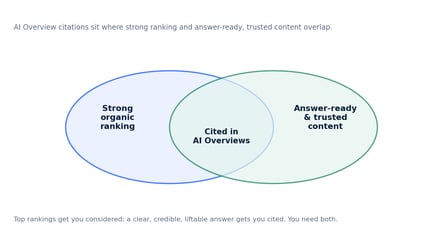
1. Get the web fundamentals right. Grok's web search still rewards pages that rank, answer cleanly, and come from a trusted source. Lead each section with a clear, self-contained answer, keep pages crawlable and well-structured, and cover the surrounding sub-questions. This is the same base that AI visibility and traditional SEO share.
2. Build a real presence on X. This is the Grok-specific move. Post substantively from your brand and your experts, join the conversations in your category, and earn genuine mentions from credible accounts. The goal is to be part of what people say about your space, because that is a stream Grok reads directly.
3. Write meta descriptions deliberately. Since Grok tends to show your meta description as written, treat it as answer copy, not an afterthought. Give every important page a clear, accurate description that states what the page answers.
4. Make content deep enough for DeepSearch. For the comparison and research questions that trigger DeepSearch, thin content loses. Build pages that genuinely cover a topic and its follow-ups, so Grok has more to draw on when it reads across sources.
5. Show real expertise and authority. Named authors, cited evidence, and visible first-hand experience help Grok trust a source, the same authority signals that earn citations that work across engines, reinforced by E-E-A-T and trust signals. On X, that authority shows up as who engages with and reposts your accounts. Both feed how AI engines decide which brands to trust.
6. Keep key pages current. Because Grok can be slower to detect updates, give changes time to register, and keep your important pages genuinely fresh rather than editing them constantly and expecting instant pickup.
Pulled together, these are the fundamentals of answer engine optimization plus an X layer, and they overlap with broader AI search optimization. The difference is that second stream.
How Grok compares to other AI engines
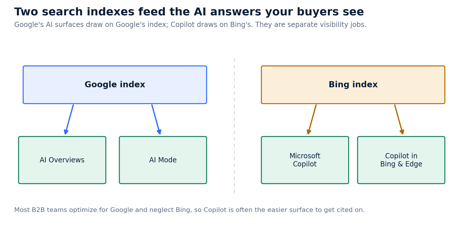
If you already work on other engines, the mental model is that Grok shares the web-content job and adds a social one. Google's AI surfaces feed on Google's index, Microsoft Copilot feeds on Bing's, and both are web-only. Grok reads the web and X together, which is why a brand can be strong on Google or Copilot and still be underweight in Grok if it is quiet on X. Google alone runs three separate AI surfaces, and all of them are web-only, which makes the contrast with Grok's dual stream sharper.
As with every engine, Grok answers are not fixed. The same question can return different sources over time and differ from what other engines say, so citation variability applies here too, and the real-time X input can make Grok move faster than most.
How to track your Grok citations
Grok is easy to overlook because it sits inside X, so build a simple, repeatable check.
- Run your priority buyer questions in Grok, in both quick web search and DeepSearch, and record whether you are cited, who is cited instead, and whether the citation is a web page or an X post.
- Track it over time, since answers shift and the X stream changes quickly. A single check tells you little.
- Watch both streams. If competitors are cited from X posts and you are not, that is an X-presence gap; if they are cited from web pages, that is a content gap. Watching who appears beside you turns tracking into competitive intelligence, and deciding your visibility metrics up front keeps it honest. Because manual checks are noisy, frequent automated checks tell you more.
Where B2B teams go wrong with Grok
- Treating Grok like a web-only engine. Optimizing your site and ignoring X misses half of what Grok reads. The X presence is the point.
- Trying to fake X activity. Bought engagement andspammy mentions are easy to spot and can backfire. Real, useful participation is what earns durable signal.
- Neglecting meta descriptions. Since Grok shows them as written, a blank or careless description is a wasted chance to state your answer.
- Expecting instant updates. Grok can lag on picking up page changes, so do not assume a fresh edit is visible right away.
- Checking once. Grok answers move quickly, especially with the live X input, so a one-time look is the least reliable read of your presence.
Where to start
Do two quick checks. First, run five of your priority buyer questions in Grok, once in web search and once in DeepSearch, and note where you appear and whether the source is a page or an X post. Second, look honestly at your brand's presence on X: are you and your experts posting substantively, and does your category mention you? Those two reads tell you whether your gap is on the web side, the X side, or both, and which to fix first.
To see where you stand on Grok and across every other AI engine in one scan, run a free check with the AI Search Visibility Checker, or track your Grok and cross-engine citations over time with AI Search Intelligence.
Frequently asked questions
How does Grok decide what to cite?
Grok searches the live web and reads real-time posts on X, then generates an answer citing the sources it judged most relevant and trustworthy, including both web pages and individual X posts. For deeper questions, DeepSearch reads across many sources before answering.
Does being active on X help me get cited by Grok?
Yes, more than for any other major engine. Because Grok reads X in real time, genuine presence there, your own substantive posts and credible mentions of your brand, is a signal it can use directly. Faked or spammy activity is not a shortcut.
What is the difference between Grok's web search and DeepSearch?
Web search answers quicker questions from a live search. DeepSearch is an agentic mode that runs many searches, browses across sources, and reasons before producing a longer, more thorough answer, which suits comparison and research questions.
Does ranking on Google get me cited by Grok?
It helps the web-content half, since strong, trusted pages are rewarded across engines, but Grok also reads X, which Google does not. A strong Google presence with no X presence leaves half of Grok's inputs uncovered.
How is getting cited by Grok different from Copilot or Google?
The web fundamentals are shared. The difference is Grok's real-time X stream: Copilot draws on Bing and Google's surfaces draw on Google's index, both web-only, while Grok adds live social data.