


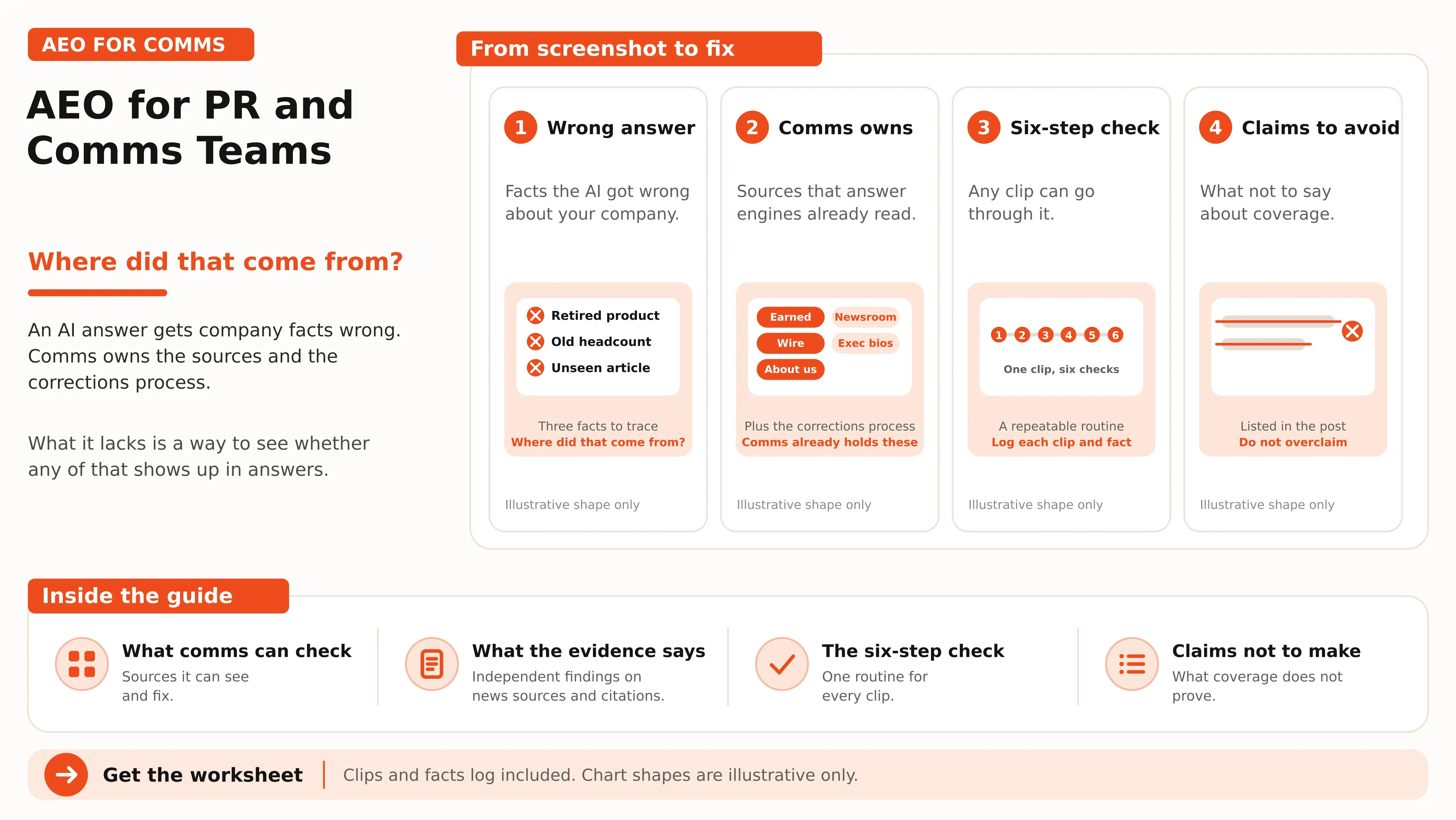


PR and communications teams already own much of what answer engines read: earned articles, newsroom posts, wire releases, executive bios, the "about us" paragraph that gets pasted into every release. They also own the corrections process. What they usually do not have is a way to see whether any of it shows up in answers, and no habit of checking.
This post covers what comms can check and fix, what the independent evidence says about news sources and citations, a six-step check that any clip can go through, and the claims you should not make about coverage. A worksheet is included so you can log your own clips and facts.
What comms already owns that answers can read
Every item below is a page or block of text that an answer engine could draw on. What is new is checking them from the answer's side.
| Comms asset | Where an answer engine could find it | What to check |
|---|---|---|
| Earned article on a news or trade site | The outlet's page, and any syndicated copies | Indexed, outlet's crawler rules, which copy gets cited |
| Newsroom or press page on your site | Your own domain | Indexed, snippet-eligible, dated, facts current |
| Wire release | The wire's page and republished copies | Whether copies keep your facts, how links are written |
| Executive bios and speaker pages | Your site, event sites, profile pages | Titles, dates and company description match |
| The boilerplate paragraph | Copied into every release and bio | One approved, dated version everywhere |
| Awards and analyst mentions | Third-party pages | The category and claim are worded the way you word them |
Two of those rows are in your direct control: your own pages and the boilerplate. The rest depend on other people's sites, which is why the checks below separate access problems you can fix from outcomes you can only observe.
What the independent evidence says about news sources
Three pieces of independent work are worth knowing, and each has limits that matter for how you use it.
The first is a study of news citations in AI search. It found that one provider drew 67.3 percent of its news citations from its top 20 sources, while two others drew 31.9 percent and 28.5 percent (Yang, arXiv 2507.05301). The sample was about 24,000 conversations and the prompts were news prompts. That tells you citations can concentrate in a small set of outlets. It does not tell you which outlets matter for a B2B buyer asking about software.
The second is a test by the Tow Center for Digital Journalism, published in the Columbia Journalism Review in March 2025. Researchers gave eight AI search tools excerpts from news articles by 20 publishers and asked each tool to identify the headline, publisher, date and URL, across 1,600 queries. The tools were wrong on more than 60 percent of them. The authors also reported that tools often cited syndicated copies of articles instead of the original, including for publishers that had licensing deals with the AI company, and that deals did not guarantee accurate citation (We compared eight AI search engines. They're all bad at citing news). Each excerpt was tested once, and the task was to identify a known article, not to answer a buyer's question. For comms the useful lesson is narrow: the page that earns the citation may be a copy, so check which URL an answer cites.
The third is an older audit of four generative search engines, run in 2023, which found that on average 51.5 percent of generated sentences were fully supported by the citations given and 74.5 percent of citations supported their sentence (Liu, Zhang and Liang, arXiv 2304.09848). Those engines have changed, so read the figures as a reminder that a citation next to a claim does not prove the cited page says it, not as a current rate. That is why the sixth check below looks at what the answer says.
Six checks between a clip and a correct answer
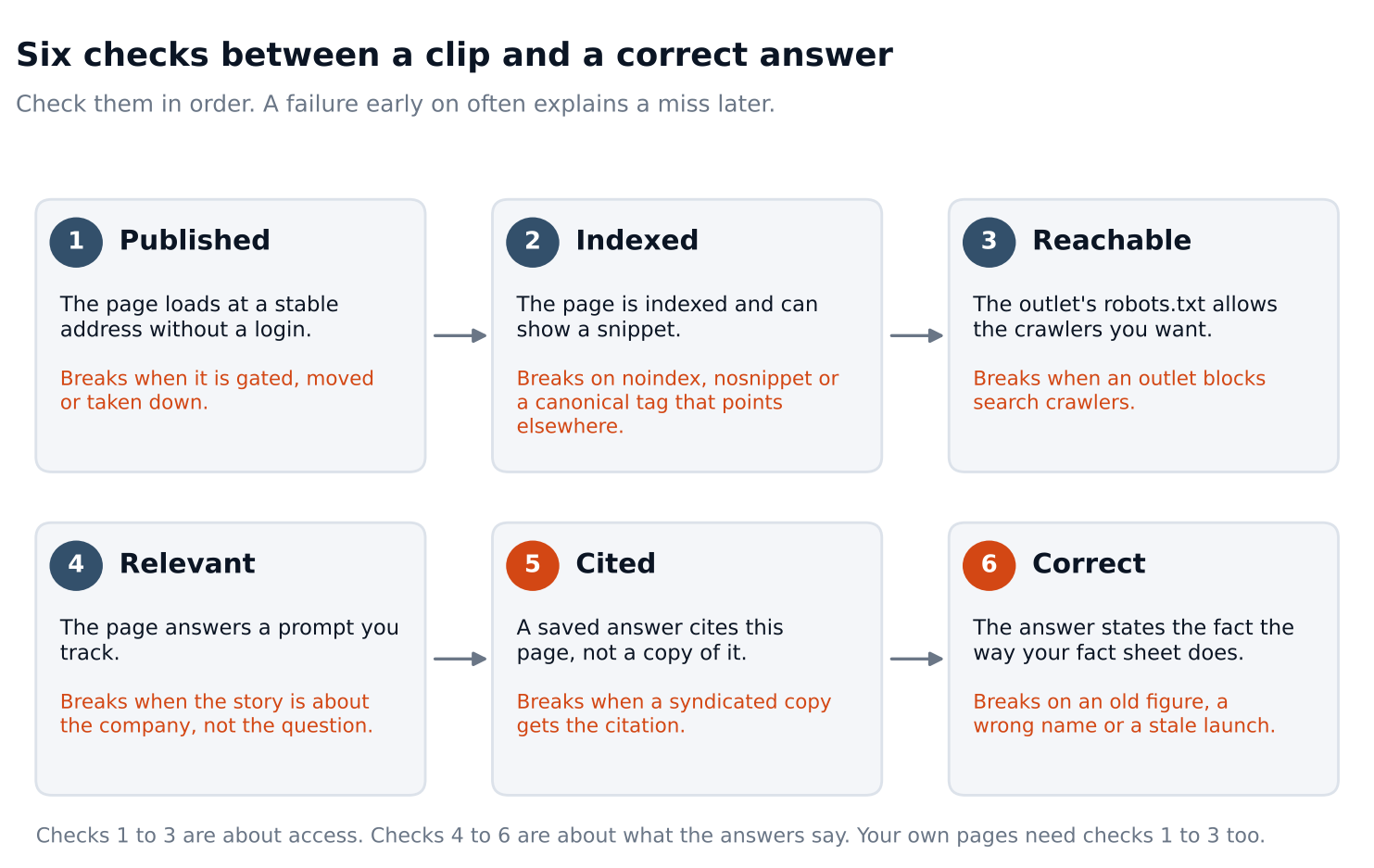
Figure 1. Six checks for any clip, newsroom post or release. A failure early on often explains a miss later.
Checks 1 to 3 are about access, and the documentation is specific. Google says there are no additional requirements to appear in its AI features and no other special optimizations necessary: a page needs to be indexed and eligible to be shown in Search with a snippet (AI features and your website). So for your own pages, access means the usual indexing checks, and a noindex or nosnippet rule on a newsroom template is worth looking for.
OpenAI documents separate agents with different jobs: OAI-SearchBot surfaces sites in ChatGPT's search features, GPTBot crawls content that may be used for training, and ChatGPT-User acts when a person asks ChatGPT to visit a page, where robots.txt rules may not apply (Overview of OpenAI crawlers). A decision to block one of those on your own site is a decision about search visibility, training use, or both, so it should have a named owner.
You cannot change another outlet's robots.txt. You can read it, note whether it blocks search crawlers, and take that into account when you decide where to pitch. An outlet that blocks a crawler is not a reason to avoid it for the audience it reaches, but it is a reason not to expect that page to appear as a source in that engine.
Check 4 is a question for whoever tracks prompts: does this page answer one of the prompts on the register? Coverage of a funding round or an executive hire is about the company. A buyer asking "how do teams compare options in this category" is asking a different question, and a page can be good PR and still not be a source for any prompt you track. How to write those prompts is in how to design prompts for AI visibility tracking.
Check 5 is the one that surprises people. Look at the cited URL, not the brand name. If a syndicated copy gets the citation, the copy is the source, and the original outlet may not be. Citations and mentions are different events: an answer can name your brand with no link, or link to a page that never names you.
Check 6 is the comms check proper. Does the answer say what your fact sheet says?
Seen is not cited, and unseen is not uncited
Suppose you log a trade article and check it against 10 saved answers to prompts it could plausibly serve. None cites it. That does not mean the true rate is zero. With zero citations in 10 answers, the top of a 95 percent range is about 28 percent. At 20 answers it is 16 percent, at 40 it is about 9 percent, and at 80 it is about 5 percent.
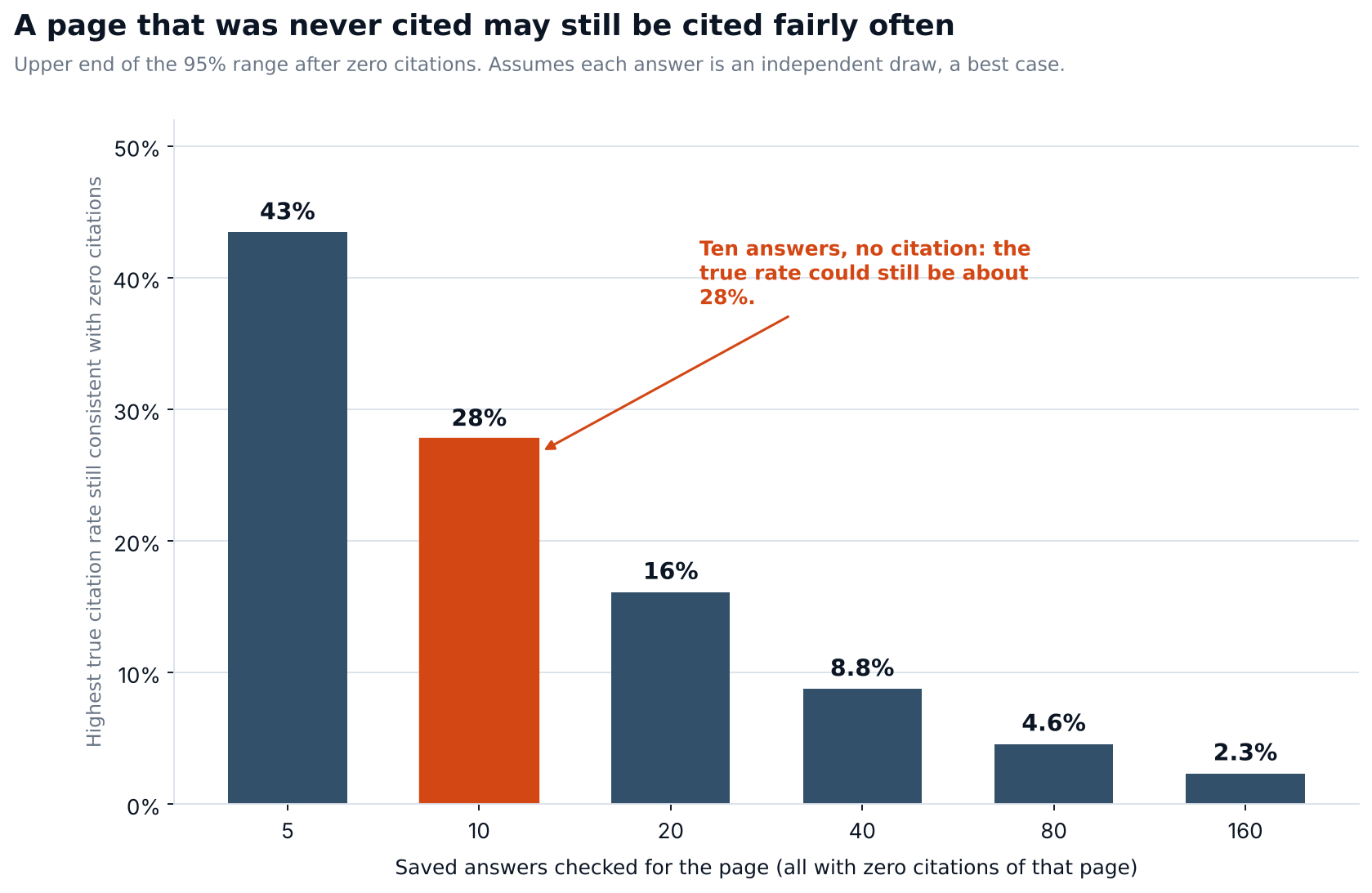
Figure 2. Upper end of a 95 percent range after zero citations. It treats each answer as an independent draw, which is a best case, so the real range is wider.
This changes what a comms report can say. "Not seen" after 10 answers is a weak statement. "Not seen after 40 answers" is a stronger one, and "never checked" is a different row altogether. The worksheet below keeps those three apart, and it will not judge a page until it has a minimum number of saved answers, which you set.
The same arithmetic applies to the whole set. In the worksheet's invented example, 24 pages are logged. Three are not indexed, one sits behind an outlet that blocks crawlers, one has an unknown status and one has too few checks, leaving 18 judged pages. Eight of those were cited at least once, which is 44 percent, with a 95 percent range of about 25 to 66 percent. That is a wide range, and it is what a small set of pages can support. The method for ranges is the same one used in the AI citation share dashboard template.
Placement and distribution: what to avoid
The tempting move is to buy or distribute more coverage because coverage is what comms produces. Two cautions apply, and they come from documentation, not from any study of answer engines.
Google's spam policies list paid advertorials, and articles, guest posts or press releases distributed on other sites, among examples of link spam when they carry links that pass ranking credit or use optimized anchor text. Buying or selling links for ranking is also listed, though the policy says such links are fine when marked with rel="nofollow" or rel="sponsored" (Spam policies for Google web search, last updated August 28, 2026). That policy is about Google web search ranking. Nothing in it says how an answer engine treats a link. It does mean a distribution plan built on keyword-heavy anchor text in wire copy is a risk to your own site's standing, and paid placements need the right link attributes.
The second caution is about what to expect. No independent study we found shows that a wire release or a paid placement raises how often an answer cites you. The Tow Center result suggests a wire or syndication partner's copy may be what gets cited instead of the original, which can be fine or not depending on whether the copy keeps your facts and your link. Test that on your own prompts before you assume either way.
When you choose where to pitch, the more defensible filter is fit: does the outlet reach your buyers, and does its coverage answer questions they ask? The concentration the first study found is a reason to look at which outlets already appear for your tracked prompts, not to rank outlets by a score you have no evidence for.
Fix the facts at the source
An answer that gets your headcount wrong is often repeating a page. It is not always so, because an engine can also rely on what a model learned in training, and you cannot edit that. What you can do is make sure the pages you control say the same thing, and that the pages you do not control can be corrected.
Start with one fact sheet: the year you were founded, the product category name you use, the product names that are current and retired, the headcount band, the customer count claim, the newest launch. Give each fact one approved value and a date. Then compare it against your own site, your wire boilerplate, executive bios, the top earned article and a saved answer. Mark each as matching, differing, not stated or unchecked.
Where a fact differs, fix it at the source in this order: your own pages, your boilerplate and bios, then third-party pages where you can ask for a correction with the approved value and a link to the source page. Record the date of each change. After a few weeks, save new answers to the same prompts and check again. An answer that still repeats the old figure tells you either that the old page is still being read or that the claim comes from somewhere else. Both are worth knowing.
A weekly handoff between comms and whoever runs measurement
Comms rarely runs the tracking. It often sits with marketing or SEO, and who owns what is a team design question. The handoff can be small. Comms gives the measurement owner a launch and announcement calendar, any change to spokespeople, product names or the fact sheet, and the list of placements with their URLs. Embargoed items go on the calendar with the date they lift.
The measurement owner gives comms three things back: the sources cited for the tracked prompts that matter most to the brand, a saved snapshot of answers to a few brand questions, and a log of claims that differ from the fact sheet. That log is the comms team's work queue.
Influence can also leave no trace. Buyers can read an answer, never click, and arrive later by another route, which is the subject of the dark AI search funnel. A clip that was cited and a clip that shaped a shortlist are different events, and your reporting will only see the first.
How to report coverage without claiming credit
Three sentences are easy to write and hard to defend. "Our launch coverage drove citations." "Our wire release improved our AI visibility." "Placements in these outlets made us show up." No independent study supports a causal claim like those, and your own data usually cannot separate a placement from everything else that changed that month.
Report what you observed. Pages logged, pages judged, how many were cited at least once with the range, the access problems you found and fixed, and the facts that differed and the date each was corrected. Show denominators. A line like "8 of 18 judged pages were cited in at least one saved answer (44 percent, range about 25 to 66 percent); 5 pages had an access problem, 4 fixed" gives leadership something they can check (the numbers here come from the worksheet's invented example). It also keeps you from having to explain a number that moves by chance.
When coverage and a citation line up in time, say so as a timeline, not as a cause. An invented example: "Cited in 3 of 24 saved answers in the four weeks after publication, 0 of 24 in the four weeks before." Add the range, and state what else changed.
Log your clips and your facts in a worksheet
The worksheet has a coverage log, a fact check and a summary. Grey rows are invented examples, so replace them before you read any output.
- Open the Settings tab and set the minimum number of saved answers before a page is judged. Ten is the default. A higher number gives a tighter range.
- In the Coverage log, add one row per page: type (earned, owned, wire, paid or partner), whether it is indexed, whether the outlet allows crawlers, how many saved answers you checked for it, and how many of those cited the page's own URL.
- Read the Result column. Pages come out as Seen, Not seen yet, Too few checks, Not indexed, Crawl blocked or Status unknown. Fix the access problems first.
- In the Fact check tab, enter each fact and its approved value, then mark what each source says. Facts that differ anywhere are flagged to fix at the source.
- On the Summary tab, read the share of judged pages that were cited by page type, with its range, and the table that shows how high the true rate could still be for a page that was never cited.
Frequently asked questions
Does a press release help AI visibility?
We found no independent study showing it does. What is documented is narrower: for Google's AI features a page needs to be indexed and eligible to be shown with a snippet, and Google's spam policies warn against press releases distributed with optimized anchor text links. A release on your own site can be checked like any page. A wire copy is a separate page, and the Tow Center study suggests copies can be what gets cited. Check which URL appears in your saved answers.
Should we pay for placements?
If you do, disclose them where the outlet requires it and mark links with rel="sponsored" or rel="nofollow", as Google's policy describes. We found no independent evidence on whether paid placements are cited more or less often than earned ones. The worksheet has a Paid type so you can compare them on your own prompts, with the caution that a handful of pages gives a wide range.
Is this PR's job or SEO's?
Both. Comms usually owns the fact sheet, the boilerplate, the bios and the outlet relationships. Web or SEO owns indexing, crawler rules and markup. Measurement owns the prompt list and the saved answers. The handoff above keeps the three from working on different versions of the facts.
How do we get a wrong claim corrected?
Find where the claim appears in a page, starting with your own. Correct it there, then ask outlets that carry the wrong version to update it, sending the approved value and a source link. Record the date, then save new answers to the same prompts after a few weeks and compare. You cannot edit an answer directly, and a claim in an answer may not trace to any page you can find.
How many saved answers do we need before judging a page?
The worksheet defaults to 10 per page, which is a minimum, not a comfortable number. After zero citations in 10 answers the true rate could still be about 28 percent. At 40 answers the upper end falls to about 9 percent. Answers from repeated runs of one prompt are not fully independent, so read these ranges as the best case.
Look up your best five clips in the answers this week
Take the five clips you reported last quarter and write down the prompt each one should help answer. Save the current answers to those prompts, then run the six checks on each clip and mark every fact in the answers against your fact sheet. You will learn quickly which clips are reachable, which are cited, and which facts need fixing.
If you want a first reading on one of those prompts before you build a log, the AI Search Visibility Checker gives you one. If you want to follow the same prompts month after month, AI Search Intelligence tracks individual prompts, so the questions you check stay the same and the changes you see belong to the answers, not to a shifting list.