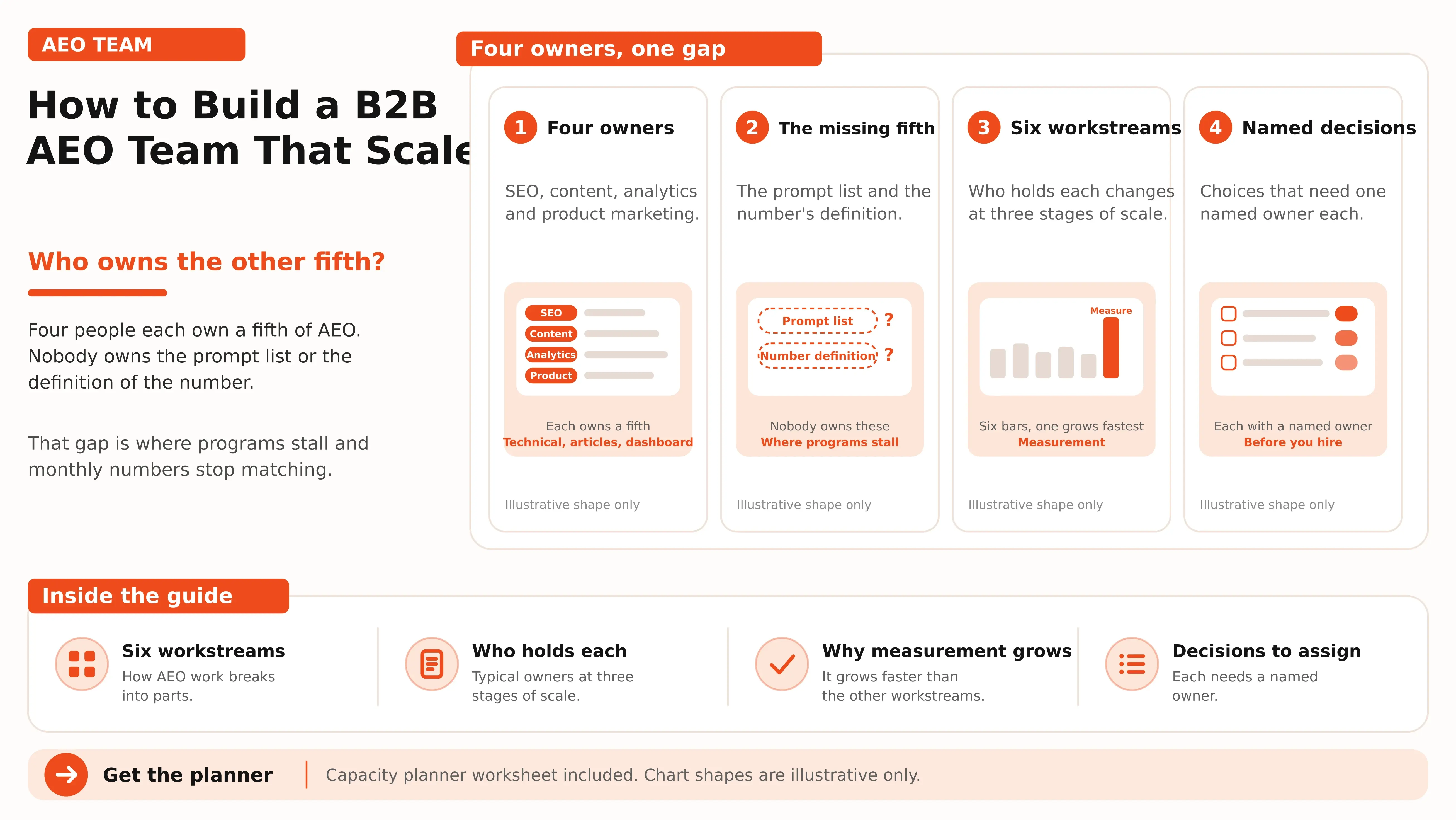


As your B2B AEO program grows, who owns what becomes just as important as the work itself. SEO, content, product marketing, and analytics all play a role, but without clear ownership, measurement gets inconsistent and progress becomes harder to track. This guide breaks AEO into six workstreams, maps ownership across three stages of growth, and explains how to plan measurement capacity. Use the included capacity planner to size your team before your workload outgrows it.
Six workstreams, whoever holds them
Whatever your team is called, the work falls into six pieces.
| Workstream | What it produces | What goes wrong when nobody owns it |
|---|---|---|
| Measurement | A log of answers collected on a fixed schedule, with citations and brand mentions counted | Numbers come from whoever had time, on whatever prompts they chose |
| Prompt register and definitions | A versioned prompt list and one written definition of each metric | Prompts change without a date and "share" means two things |
| Content and source work | Pages and third-party sources that answers can draw on | Content gets made for topics no one is tracking |
| Technical access and markup | Crawler access rules, indexing, snippet and markup decisions | Crawler rules are changed for another reason and nobody notices the effect |
| Analytics and reporting | A monthly report with answer counts and ranges, plus visits | Single numbers with no range get read as findings |
| Sales and customer feedback | A record of what buyers say about how they found you | The dark funnel stays dark |
Two of these have documented rules outside your company. Google says there are no additional requirements to appear in AI Overviews or AI Mode and no other special optimizations necessary: a page needs to be indexed and eligible to be shown in Search with a snippet (AI features and your website). That means the technical workstream for Google's features is the work of SEO and web teams you probably already have.
OpenAI documents three agents with different jobs: OAI-SearchBot surfaces sites in ChatGPT's search features, GPTBot crawls content that may be used for training, and ChatGPT-User acts when a person asks ChatGPT to visit a page, where robots.txt rules may not apply (Overview of OpenAI crawlers). A decision about one of those agents is a decision about search visibility, training use, or both, so it should have a named owner and a place where changes are logged.
Measurement is the workstream most teams have not run before, and it is the one this post spends the most time on. How to design the prompts is covered in how to design prompts for AI visibility tracking, and a log and dashboard for the answers is in the AI citation share dashboard template. Visits are a separate measurement, covered in how to track AI referral traffic in GA4.
Three stages, and what moves a team from one to the next
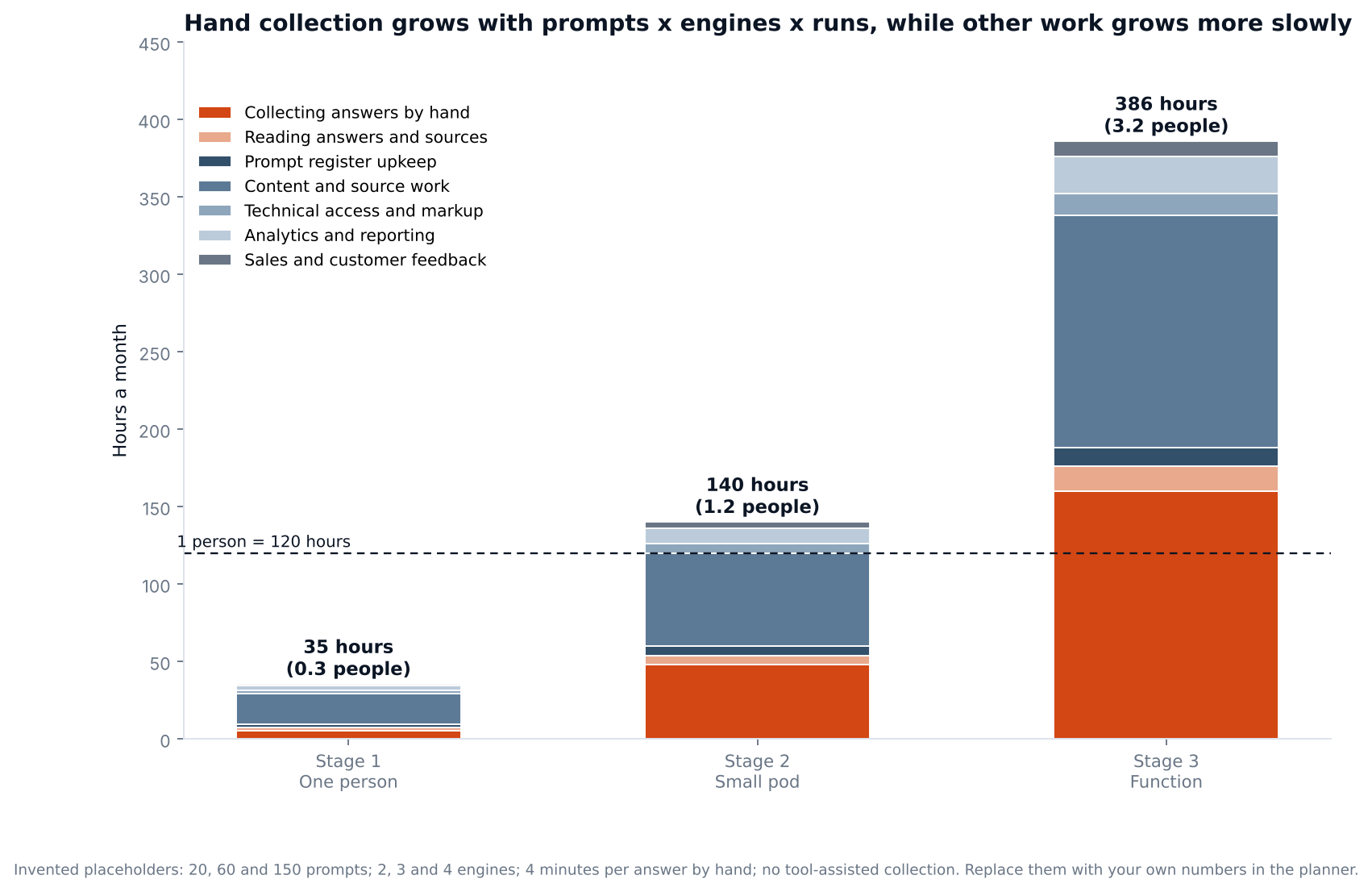
Figure 1. Who holds each AEO workstream at three stages. The stages are our judgment, not a standard.
At stage 1, one person runs the program. That person holds measurement and the prompt register and borrows the rest: articles from the content team, technical changes from web or SEO, a report slot from analytics, and a monthly conversation with sales. A common risk at this stage is less skill than that the borrowed work gets done last.
At stage 2, a small pod appears. Measurement gets a dedicated analyst, content gets a named owner, and the technical, analytics and sales workstreams each have one named contact who is not on the AEO team. The register and the definitions stay with one lead.
At stage 3, AEO is a function. Measurement, the register, content and technical access have dedicated owners, and analytics and sales feedback run as standing processes with partner teams. The stage a team needs does not follow from company size. It follows from the number of prompts, engines and prompt groups you track, and from whether you can answer yes to the readiness statements in the worksheet. The next section shows why.
The part that grows fastest is collecting answers
Content and reporting hours grow with the number of pieces and reports. Collection hours grow with prompts times engines times how often you collect.
Take three invented setups. Stage 1 tracks 20 prompts on 2 engines, collecting each twice a month: 80 answers. Stage 2 tracks 60 prompts on 3 engines, 4 times a month: 720 answers. Stage 3 tracks 150 prompts on 4 engines, 4 times a month: 2,400 answers. If collecting and logging one answer by hand takes 4 minutes (an assumption to replace with your own timing), that is about 5 hours, 48 hours and 160 hours a month.
Figure 2. Hours a month by workstream at three stages, using invented placeholders. Hand collection reaches 41 percent of all hours at stage 3.
There is a second constraint. To tell a rate of 20 percent from one of 30 percent with the usual 80 percent chance of catching a real difference, you need about 385 answers per group per period, assuming each answer is an independent draw, which is a best case. The same logic is behind the ranges in the citation share dashboard post. At stage 1 in the example, 80 answers a month across 2 groups gives 40 per group, so it would take about 10 months to reach 385. At stage 2 it takes about 3 months. At stage 3 it takes about 2.
Those numbers show what a team can and cannot claim. A stage 1 team cannot read differences between groups month by month. It can read whether a prompt group is clearly present or clearly absent, and it should report fewer groups and wider ranges. A stage 2 or 3 team has to decide how to collect answers at volume: fewer prompts, fewer groups, collection less often (how often to track AI search covers the cadence), or a way of collecting that does not take someone's afternoons.
Decisions that need a named owner
A few decisions break comparisons if anyone can make them quietly.
1. Changing the tracked prompt list: Add or reword prompts and you are measuring a different thing from last month. The owner changes the list, writes the date and says whether the old and new periods can be compared.
2. Changing the definition of the headline metric: If the report said "citation rate" in June and "share" in July, the trend line is meaningless. One person owns the definition and prints it under the number.
3. Changing crawler rules: Changes to robots.txt for AI crawlers affect which products can use your pages. A named owner in web or SEO makes the change, logs it, and tells the AEO lead.
Signing off the monthly report. Someone outside the AEO team, usually the head of marketing, should see the answer counts and ranges and be the one who accepts "not enough data to say" as a valid result. The Owners tab in the worksheet checks that every workstream has exactly one accountable person and every decision has an owner and a place where it is logged.
What to promise leadership
Promise inputs, not outcomes. A first-quarter commitment that holds up looks like this: a fixed and dated prompt list, one written definition per metric, a monthly report with answer counts and ranges, a named owner for each workstream, and a record of what buyers say about how they found you. Each of those is within the team's control.
Avoid a target such as "raise share by five points" set from a single month's number. On a small number of answers, a five-point move is often within chance, as the range will show. If you need to attach the program to a financial case, the AEO business case and pipeline math covers how, and the north star metric for B2B AI search covers which number should lead the report.
Hire, train or borrow
The readiness statements in the worksheet sort gaps into two kinds. Capacity gaps are about hours: too many answers to collect, not enough people. Ownership and definition gaps are about decisions: no accountable owner, two definitions, an undated prompt list. Hiring fixes the first kind. It does not fix the second, and adding a person to a team with no written definitions can add a third definition.
For skills, the technical and content workstreams draw on SEO and content work, and Google's own page says the same Search requirements apply. The skill most teams lack is measurement: counting answers consistently, reading ranges, and saying "we cannot tell yet." That can be taught, and it can be borrowed from an analyst. If you use outside help, keep the prompt register, the definitions and the raw answer log in your own hands, so you can check what you are told.
Four ways a growing program can break
Prompts get added faster than answers can be collected. Every new prompt multiplies the collection load by the engines and runs, and the range on each group gets no narrower if answers per group stay flat. Add prompts only when the planner shows the extra hours are there.
An outside report replaces the register. If a vendor's or agency's prompt list quietly becomes the program's prompt list, the team can no longer say what the numbers measure. Keep your own register and compare any outside figure against it.
The definition drifts as the team grows. Each new person brings a familiar meaning of "share" or "visibility." The fix is the same at any size: one written definition, printed under every number, with a named owner who approves changes.
The feedback loop never starts. Measurement of answers says nothing about what buyers did next. Without a record of how sales conversations begin, the program has no way to check whether the answers it tracks connect to anything. The loop can be small: one question on the first call, one field, one reader.
Size it in a worksheet before you hire
The workbook has five tabs: Read me, Settings, Workload, Owners and Readiness.
- In Settings, enter the hours one person can give to AEO each month and the two rates you want to be able to tell apart.
- In Workload, replace the invented inputs for each stage with your own: prompts, engines, collections per month, prompt groups, minutes per answer, and hours for the other workstreams. Time ten answers by hand first so the minutes are real.
- Read the block that shows how many months of answers each group needs, and the hours and people-equivalents by stage.
- In Owners, mark each workstream R, A, C or I for each role, and name the owner of each decision. The sheet flags any row without exactly one A.
- In Readiness, answer the five statements that are not calculated. Read the count of capacity gaps and of ownership and definition gaps separately.
Frequently asked questions
Do we need a separate AEO team?
Not necessarily. Google says appearing in its AI features needs no additional requirements beyond the Search ones, so the technical and content work can sit with teams you already have. What needs a home is measurement, the prompt register and the definitions, which is a role more than a department.
Who should own AEO: SEO, content or product marketing?
We did not find an independent study that answers this. Choose the owner by who will hold the register and the definitions steadily and who can get the other teams' time, and write the choice down. The Owners tab makes the rest explicit.
How many people do we need?
It depends on prompts, engines, groups and how answers are collected. In the planner's invented example, 35 hours a month is under half a person, 140 is a little over one, and 386 is more than three. Use your own inputs and read the hours, not the example.
Which skills matter first?
Consistent measurement and clear writing about uncertainty, because everything else depends on numbers people trust. Technical and content skills can come from existing SEO and content staff.
What should the first 90 days produce?
A dated prompt register, one written definition per metric, twenty hand-collected rows to learn how long collection takes, a named owner for each workstream and decision, and a first report with answer counts and ranges. None of those requires a result in the answers.
Write the owner next to each workstream before you hire anyone
Open a blank page, list the six workstreams, and write one name beside each. Where you cannot, note whether the gap is hours or a decision. Then time ten answers by hand and put the minutes into the worksheet. You will know which stage you are in, which gap to close first, and whether the next move is a person or a clearer definition.
Collecting answers is the first place hours pile up. If you want a first reading on one prompt before you build a log, the AI Search Visibility Checker gives you one. If your register grows past what a person can collect by hand, AI Search Intelligence tracks individual prompts, which is the unit the register is built around.