


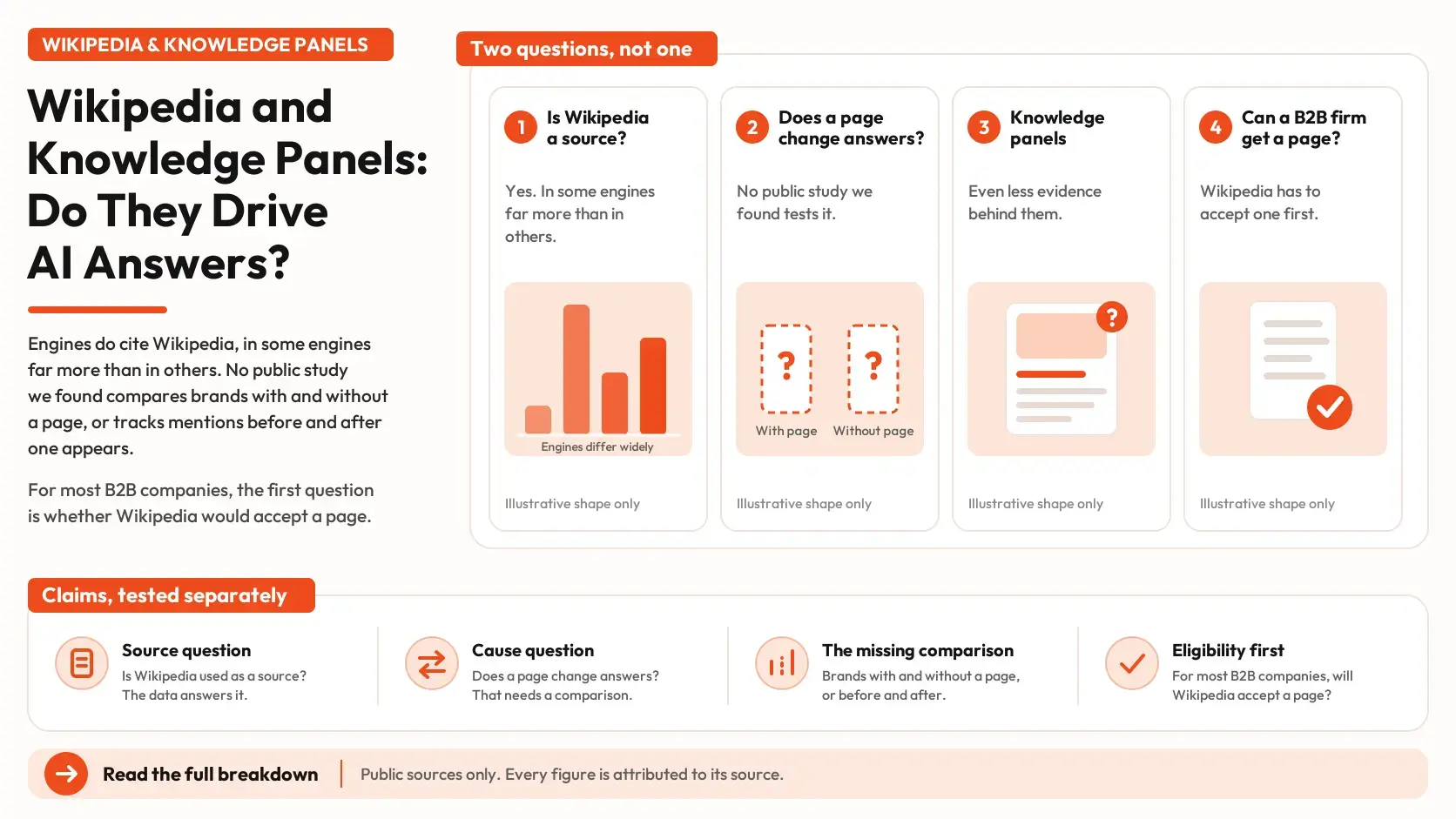


Somewhere in your inbox there is probably a pitch that says a Wikipedia page is the best AI visibility investment a company can make. The pitch has two parts. Wikipedia is one of the most-cited sources in AI answers, so your brand needs a page there. The first part is documented. The second is a jump, and nothing we found tests it.
Fdowm
This article separates the two claims, then does the same for knowledge panels. It covers how much Wikipedia is cited and why the numbers range from under 1 percent to nearly 48, the three ways Wikipedia could reach an answer, a widely repeated figure about agencies with Wikipedia pages, what Google says about knowledge panels, and the rules that decide whether a B2B company can have a page at all. It uses public sources only. It contains no Omnibound data, every figure is attributed, and where we infer something, we label it.
Put plainly: engines do cite Wikipedia, in some engines far more than in others. No public study we found compares brands with and without a page, or tracks a brand's mentions before and after a page appears. Knowledge panels have even less evidence behind them. For most B2B companies, the first question is not whether a page would help but whether Wikipedia would accept one.
Two questions, not one
The first question is whether Wikipedia is a source that AI engines use. The second is whether a company's own Wikipedia page, or its Google knowledge panel, changes what an engine says about that company.
The first is a question about sources, and the data answers it, with caveats about units. The second is a question about cause, and it needs a comparison: brands with a page and similar brands without one, or the same brand before and after. The material we found for the second question is argument, vendor tooling and correlations with no base rate, which we go through below.
Is Wikipedia cited? Yes, and the number depends on what is counted
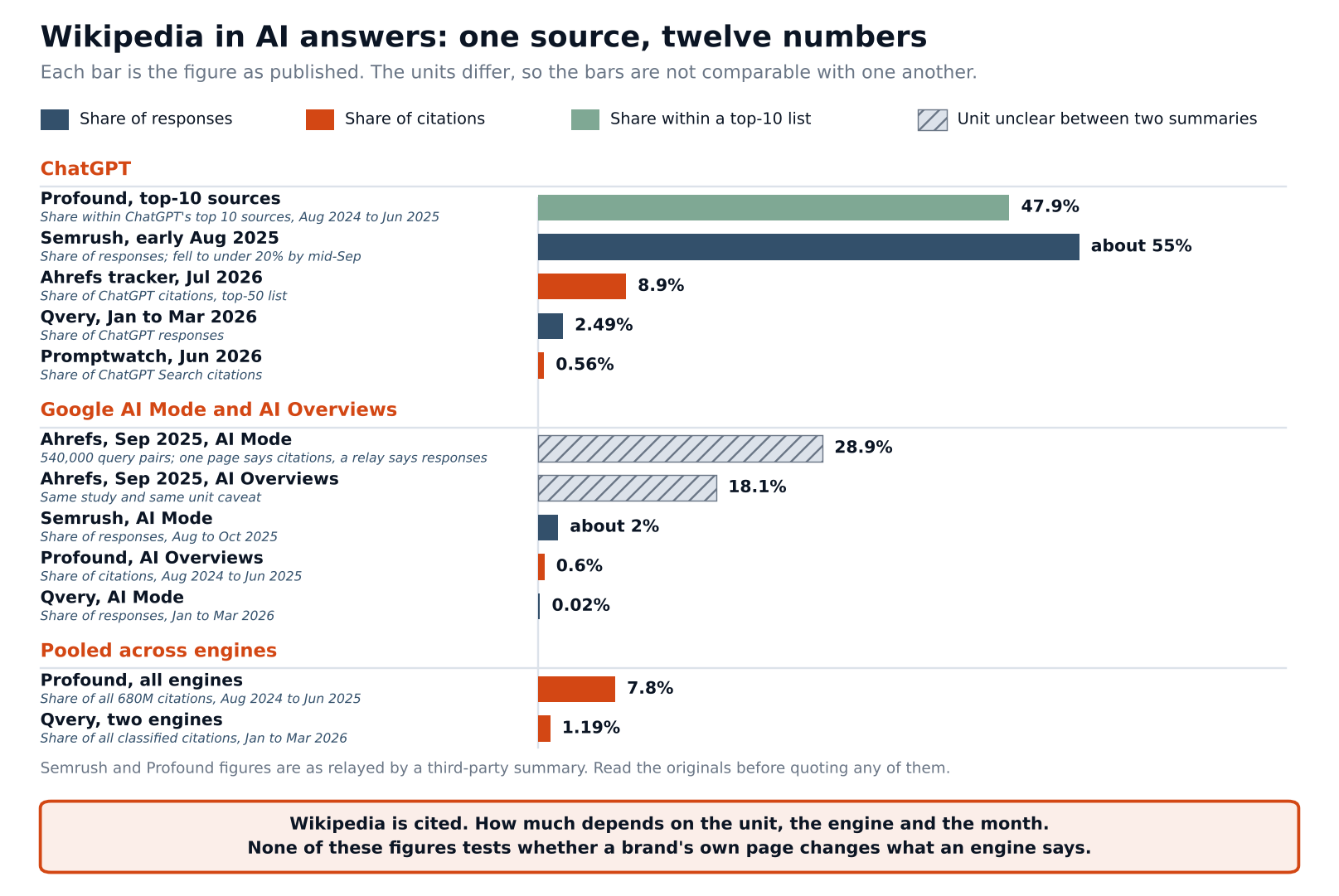
The chart sets twelve published figures side by side. The most-quoted one is that Wikipedia accounts for about 47.9 percent of ChatGPT's citations. As relayed in a review of Wikipedia citation data, Profound's analysis of 680 million citations from August 2024 to June 2025 found that figure as Wikipedia's share within ChatGPT's top ten sources, not its share of all citations. The same analysis puts Wikipedia at 7.8 percent of all citations and at 0.6 percent in Google AI Overviews.
Other trackers read differently. Qvery, a vendor with an undisclosed sample, found Wikipedia in 2.49 percent of ChatGPT responses from January to March 2026, and in 0.02 percent of Google AI Mode responses. Across both engines, in its classification, Wikipedia was 1.19 percent of all citations, level with software review sites and above Reddit at 1.13 percent. Promptwatch reported Wikipedia at 0.56 percent of ChatGPT Search citations in June 2026. Ahrefs' July 2026 tracker, as relayed in the same review, has Wikipedia second in ChatGPT at 8.9 percent behind Reddit at 16.7 percent.
On Google's side the spread is wider. Ahrefs reported from 540,000 query pairs in September 2025 that Wikipedia appeared at 28.9 percent in AI Mode and 18.1 percent in AI Overviews. The page describes these as shares of citations, while the review that relayed them calls them response presence, and the page's own other figure for the difference between the two engines does not reconcile with them. Semrush put Wikipedia at about 2 percent of AI Mode responses in its 2025 sample, and Profound at 0.6 percent of AI Overviews citations.
Those numbers cannot all be right in the sense of describing the same thing, and they do not have to be. A share of responses asks how often an answer cites Wikipedia at all. A share of citations asks how much of the whole citation pool it holds. A share within a top-ten list is a share of a smaller pool. The Semrush, Qvery and Ahrefs figures also come from different prompt sets and different months. Our guide to how citation sources move over time covers the same problem for other domains.
What the figures agree on is direction: Wikipedia is cited far more in ChatGPT than in Google's engines in most of these readings. Qvery reports that 98.8 percent of the Wikipedia citations in its data came from ChatGPT, and that about 10 percent of ChatGPT's Wikipedia citations were in the first position. The exception is the Ahrefs September 2025 figure, which points the other way. In the Ahrefs list for AI Mode that we covered in our reading of the most-cited domains in Google AI Mode, Wikipedia was at 4.8 percent on July 21 and 4.0 percent on September 2, 2026.
The share moves
Wikipedia's share is not fixed. Semrush reported that the share of ChatGPT responses citing Wikipedia fell from about 55 percent to under 20 percent between early August and mid-September 2025, in a study of 230,000 prompts tracked over 13 weeks. Meltwater's volume data, which we charted in the growth piece, had Wikipedia up 55.2 percent in May 2026 and down 14.5 percent in July. Qvery had Wikipedia's ChatGPT share at 2.60 percent in January and 2.48 percent in February.
A source that can lose more than half of its ChatGPT presence in six weeks is a source whose effect on a brand cannot be assumed to last. If a Wikipedia page helps a brand appear when an engine leans on Wikipedia, it helps less when the engine leans elsewhere. That is an inference, not a measurement, and it is one reason to treat a page as one of several signals.
Three ways Wikipedia could reach an answer
A page can influence an answer through at least three routes, and the evidence differs for each.
Retrieval. When an engine searches the web, it can pull a Wikipedia page into the answer and cite it. This is the route the citation figures measure. It is documented for Wikipedia as a source. For a given brand, it works only if the brand has a page, and only if the engine retrieves that page for the question.
Training and licensing. Language models learn from text, and Wikipedia is widely used for that. On January 15, 2026, the Wikimedia Foundation announced new partners for Wikimedia Enterprise, its paid access program. As reported by Decrypt, Ecosia, Microsoft, Mistral AI, Perplexity, Pleias and ProRata signed up, alongside Amazon, Google and Meta, which were already partners. That documents that several AI companies pay for Wikipedia content. It does not show how much a single company's article shapes what a model says about that company, and a model's answer without a citation is the hardest case to observe.
The knowledge graph. Google's knowledge panel and its knowledge graph draw on structured sources, and some commentators say Wikipedia and Wikidata feed them. We cover that below. The evidence on whether it reaches AI answers is mostly assertion.
Our inference: the retrieval route is the only one where a Wikipedia effect could be measured from outside, by checking whether a brand's own page is cited. We found no public study that did.
The agencies figure: half had pages, compared with what?
The statistic closest to a brand-level test is a 2025 figure that circulates in AI-visibility guides. As repeated in a review by ALLMO, 50 percent of the marketing agencies most often cited in AI answers had Wikipedia pages, in a study of 58 questions across ChatGPT, Gemini, Claude and Perplexity. The body of that page does not name the source, and its FAQ attributes the figure to Semrush. Its key takeaways restate it as entities with Wikipedia pages being "50 percent more likely" to appear, which is a different claim from the one in its body.
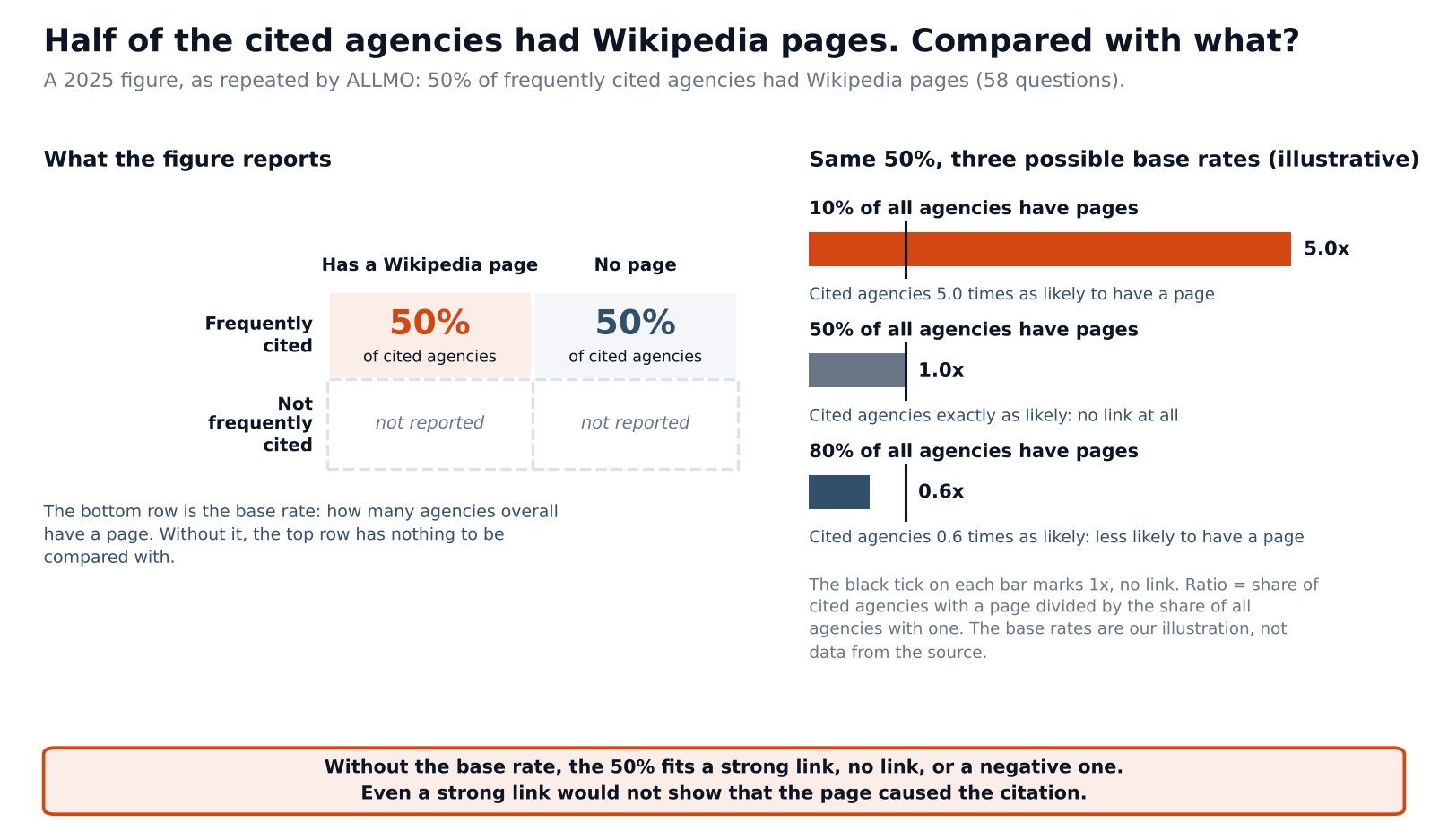
The figure needs a base rate. It tells you how many cited agencies had pages. It does not tell you how many agencies overall have pages. If 10 percent of agencies have a page, cited agencies are five times as likely to have one. If 50 percent do, cited agencies are exactly as likely as anyone, so there is no link. If 80 percent do, cited agencies are less likely to have one. The base rates in the chart are our illustration, not data from the source. ALLMO itself says the evidence is correlational and that the page offers no test with a control group.
Even a strong correlation would have another explanation to rule out. Agencies large enough to be widely cited are also large enough to have satisfied Wikipedia's rules for a page, which require coverage in independent sources. The coverage that earns the page may also be what engines cite.
The same caution applies to tooling built on the assumption. Adobe's Brand Visibility documentation describes a Wikipedia Analysis feature that compares a company's article with up to six competitors on references, sections, length, images and infobox completeness, and says a well-maintained article increases the likelihood of being accurately cited. The page cites no research for that claim. Its only number is an illustrative recommendation to add references to reach an industry average. 5W's guide to Wikipedia for brand authority gives a budget of $50,000 to $200,000 for a mid-market B2B brand and does not say where the range comes from. These are reasonable things to build if the premise holds. The premise is what is untested.
Knowledge panels: what Google says and what is missing
A knowledge panel is the box that appears beside search results for an entity, with a description, facts and links. Google's own help page says little about how panels are generated. It says that not all panels are claimable, and that to claim one you sign in to an official site or profile it lists, which are YouTube, Search Console, Twitter and Facebook, with more information requested if Google cannot find associated sites. A verified manager can suggest changes, and changes go through a feedback option or by flagging a specific fact. Local businesses are pointed to a Google Business Profile.
So a company cannot write its own panel. It can verify that it owns the entity, correct facts through suggestions, and make sure the sources a panel draws on are accurate. The link from panels to AI answers rests on claims we could not check. Ahrefs' guide to the Knowledge Graph says the graph feeds knowledge panels and has become foundational infrastructure for Google's AI products, that Google has confirmed AI Mode pulls from it alongside web results, and that a significant portion of the graph is built from Wikidata.
It also reports that more than 3 billion entities were removed in one week in June 2025, which is a reminder that an entity's place in the graph is not permanent. The same page contains no measured data on whether a panel, a Wikipedia page or a Wikidata entry changes AI answers. Our inference: a panel is a symptom of how Google has resolved your entity, not a switch that controls an answer. Our guide to entity SEO for AI search covers what can be checked and corrected.
Could your company have a page at all?
Before asking whether a page would help, a B2B company has to ask whether Wikipedia would keep one. Wikipedia's notability guideline for organizations says an organization is presumed notable if it has significant coverage in multiple reliable secondary sources that are independent of it. Several things do not count. Press releases and material copied from them do not, nor do paid or sponsored articles, routine announcements of products, personnel changes or funding, listings and "best of" inclusions, or passing mentions.
The guideline says trade publications carry a presumption against use and must be used with great care. Material produced by the company or people close to it does not establish notability. Most B2B companies, including well-run ones with many customers, have coverage that falls into those excluded groups. That is not a judgment on the business. It is what the rule asks for.
The conflict-of-interest policy sets the process. Editing about your own company is "strongly discouraged", and an employee counts as having a financial conflict. The Wikimedia Terms of Use require paid editors to disclose their employer, their client and any other relevant affiliation. The policy points people with a conflict to propose changes on article talk pages, using the edit-request process, and to submit new articles through the Articles for Creation review instead of creating them directly. Paid editors must not review affected articles.
Pitches that promise a page for a fee should be read against those rules. An undisclosed paid page violates the Terms of Use, and a disclosed one still has to pass the notability test and community review. Ask any agency what it would disclose, where, and what happens if the page is deleted.
What B2B teams can do without a page
Earn the independent coverage first. The coverage that would let a page survive review is the same coverage engines cite elsewhere. Our guide to how brand mentions compound into AI citations and the piece on whether expert quotes earn citations cover how that builds.
Make your facts consistent. Use one company name, one description and one set of product names across your site, your profiles and any third-party page you control. If a Wikipedia page or panel already exists about you and a fact is wrong, use the talk-page edit request or the panel feedback route, with a source, and disclose your connection.
Check what already exists. Search for your company and your leading competitors on Wikipedia and Google, and record whether there is an article, a knowledge panel, and whether the panel is claimed. That is a few minutes of work and it tells you where you stand.
If you want help earning a steady base of independent mentions across publications, review sites and communities, AI authority building is the service we offer for it. The wider framework is in our offsite signals hub.
How to check your own category
Because the public data does not answer the brand-level question, test it for your category.
Fix 15 to 30 prompts a buyer in your category would type, and run them across the engines your buyers use, several times each. Record the cited URLs. Note how often a Wikipedia URL appears, whether any Wikipedia article is about a vendor in your category, and whether your brand is named. Compare brands in your category that have pages with those that do not, and treat the comparison as a lead, not a proof: brands with pages tend to be larger and better covered.
Report each rate with its denominator and the engine, such as the share of runs in which any Wikipedia URL is cited, and count a change only if it holds across several checks. Engines swing, as the Semrush data shows.
Questions people ask
Does having a Wikipedia page help AI visibility?
It may, through retrieval and training, but no public study we found compares brands with and without pages. The best-known figure, that half of the most-cited agencies had pages, has no base rate.
Do AI engines cite Wikipedia?
Yes, but the share ranges from under 1 percent to nearly 48 percent depending on the engine, the unit and the sample. ChatGPT cites it far more than Google's engines in most readings.
Does a Google knowledge panel affect AI Overviews or AI Mode?
Commentators say the knowledge graph underpins Google's AI features, but we found no measured evidence that a panel changes an answer.
Can a company create its own Wikipedia page?
Wikipedia strongly discourages it, requires paid editors to disclose their employer and client, and asks people with a conflict to use talk pages and Articles for Creation. A page also has to meet the notability guideline, which excludes press releases and company-produced material.
How can a B2B team improve how it appears without a Wikipedia page?
Earn independent coverage, keep the company description consistent everywhere, correct errors through the proper channels with a source, and check your own category's prompts to see what engines cite.
Coverage first, page second
A Wikipedia page is a result of independent coverage, not a substitute for it. The same coverage is what engines read when they build an answer, whether or not a page exists. The data does not show that a page moves an answer, and it does show that the source itself comes and goes in engines from month to month.
To see where you stand today, the AI Search Visibility Checker shows how engines describe your company and which pages they draw on, which tells you whether Wikipedia is in your picture at all. AI Search Intelligence tracks which sources are cited for your category prompts over time, so you can see whether Wikipedia, review sites or your competitors' pages are carrying your buyers' questions in each engine.