


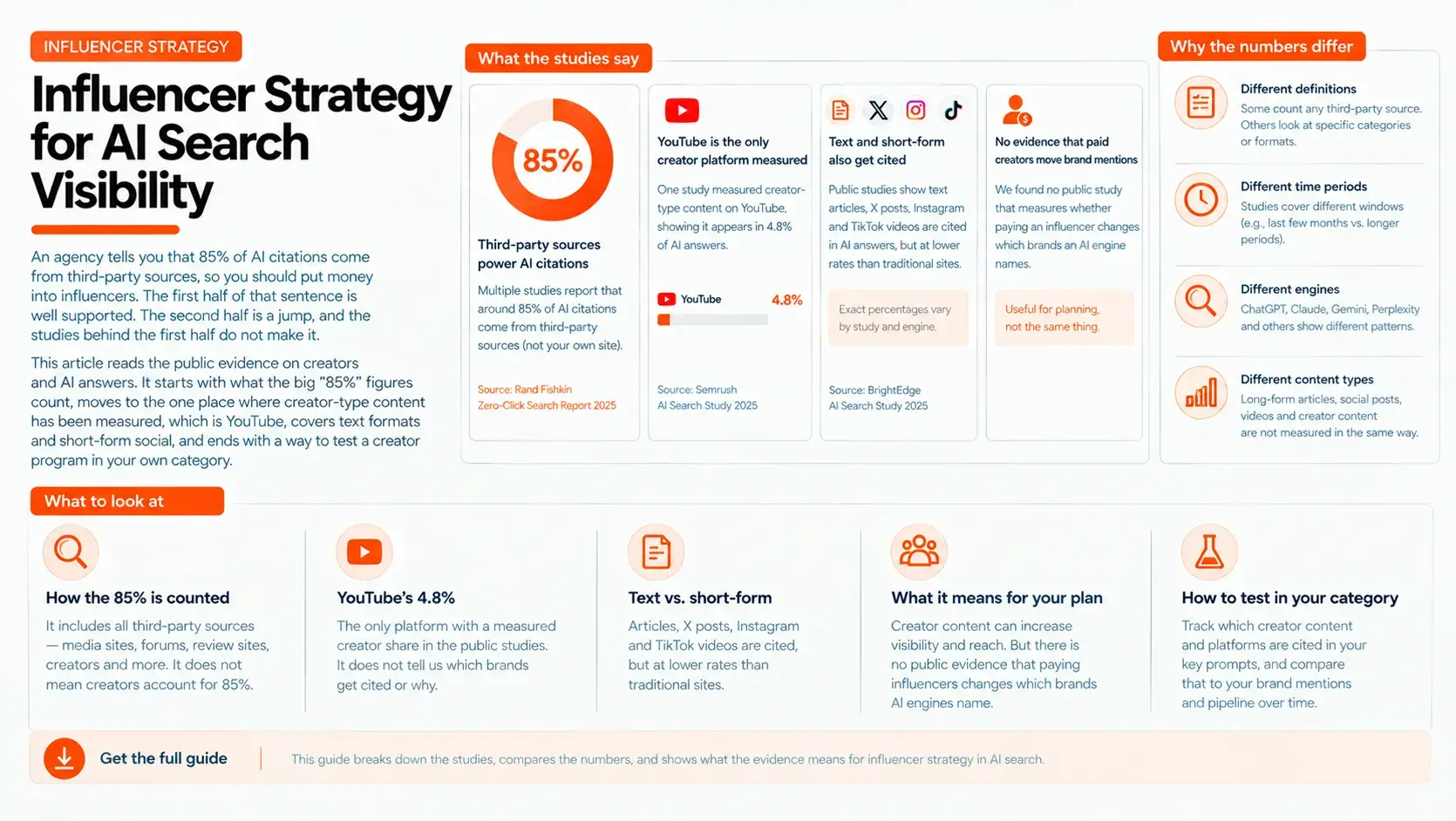


An agency tells you that 85 percent of AI citations come from third-party sources, so you should put money into influencers. The first half of that sentence is well supported. The second half is a jump, and the studies behind the first half do not make it.
This article reads the public evidence on creators and AI answers. It starts with what the big "85 percent" figures count, moves to the one place where creator-type content has been measured, which is YouTube, covers text formats and short-form social, and ends with a way to test a creator program in your own category. It uses public sources only. It contains no Omnibound data, every figure is attributed to its source, and where we are inferring rather than quoting, we say so.
The short account of the evidence is that no public study we found measures whether paying an influencer changes which brands an AI engine names. What exists describes which third-party pages, and which videos, engines cite. That is useful for planning, and it is not the same thing.
What has been measured, and what has not
Before the figures, it helps to separate three questions that get blended in influencer advice.
The first is whether AI answers lean on sources other than the brand's own site. The data says yes, clearly. The second is whether creator content, as a class, is a large share of those other sources. No dataset we found reports creators as a category. The third is whether sponsoring or working with a creator changes what an engine says about you. We found no published controlled test.
Kaleigh Moore, in a review of about twenty studies on the topic, reaches the same place: the causal link is mostly assumed, almost nobody has published a controlled experiment, and nobody has measured creators as a class. We read the underlying sources where we could, and found nothing that contradicts that summary.
Why "most citations are third-party" is not about influencers
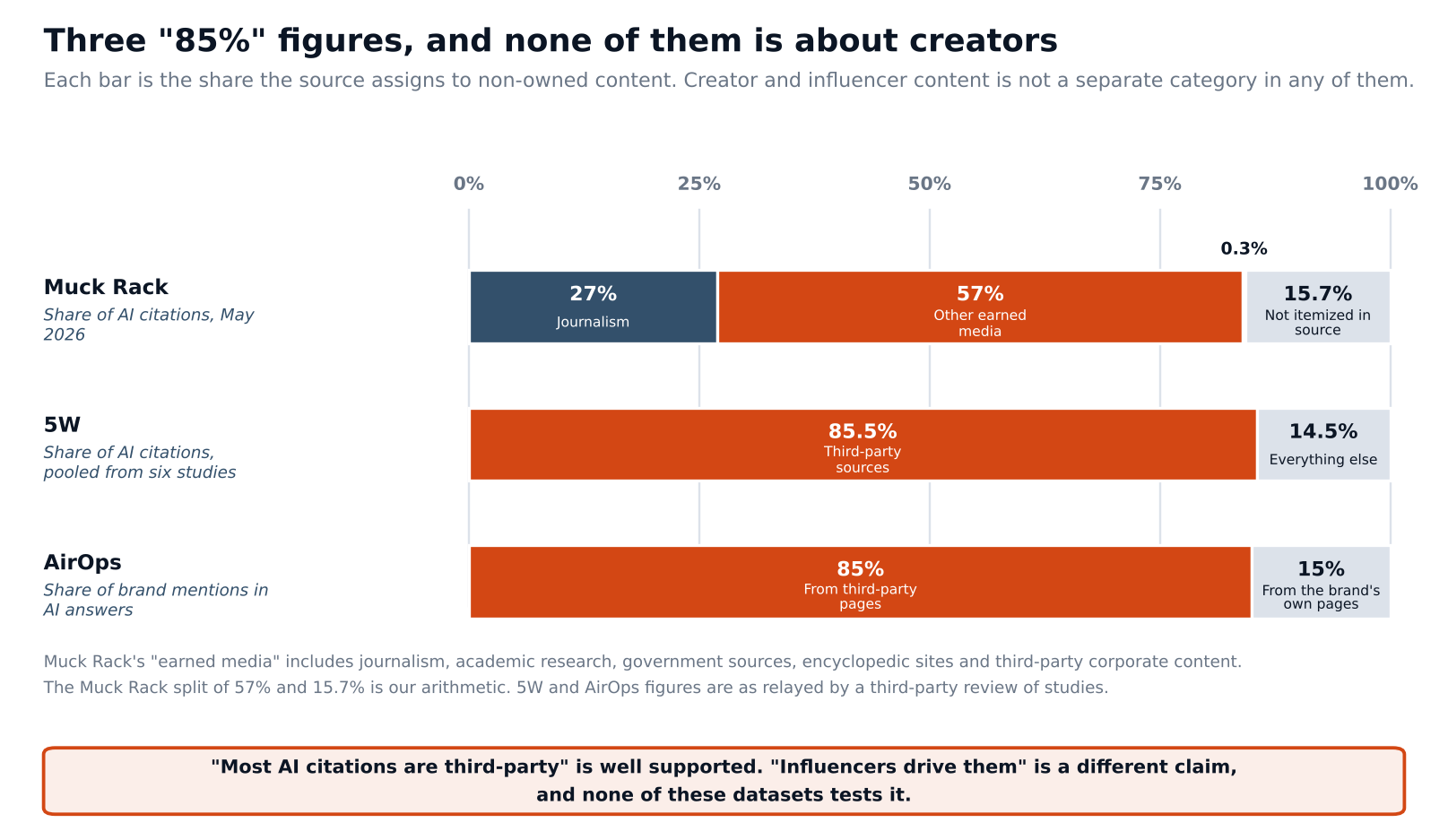
Three figures near 85 percent circulate, and each one gets used as if it were about creators. Each counts something different.
Muck Rack's Generative Pulse reports that earned media accounted for about 84 percent of AI citations in its third edition, published in May 2026, which analysed more than 25 million links across ChatGPT, Claude and Gemini. Journalism was about 27 percent, and paid or advertorial content about 0.3 percent. Across its editions the earned figure ranged from 82 to 89 percent and journalism from 25 to 27 percent, as reported in the press release as syndicated.
In that report, "earned media" is a wide bucket. It includes journalism, academic research, government sources, encyclopedic sites and third-party corporate content. Blogs, social posts and influencers or creators are not reported as separate categories, and the part of the total that Muck Rack does not itemize is not small. Muck Rack sells media-monitoring software, which is worth knowing when you read its conclusions about earned media.
Our arithmetic, shown in the chart, is that if journalism is 27 percent and earned media is 84, then 57 percent is earned media other than journalism, and the rest of the total is not itemized in what we read. That split is ours, not Muck Rack's. 5W's AI Platform Citation Source Index, from May 2026 and relayed in Kaleigh Moore's review, reports about 85.5 percent third-party citations, pooled from six studies covering around 680 million citations. AirOps reports that about 85 percent of brand mentions in AI answers come from third-party pages, with 15 percent from the brand's own pages.
All three are shares of different things, taken from different engines and prompt sets, with a different idea of what counts as third-party. The agreement among them is real, and it matches what we found in our own reading of first-party versus third-party sources: engines lean heavily on pages other than the brand's. But "most citations are third-party" is a statement about where citations come from. It says nothing about whether any of those third-party pages came from, or were caused by, a creator you paid.
Our inference: a brand mentioned on a trade publication, a review site, a forum thread or an analyst's page is counted as third-party in all three datasets. An influencer's video or post would be counted there too, but it would be one slice of a large and mixed pool, and none of these reports tells you how big the slice is.
Video creators: the one place the data points at creators
If creators show up anywhere in AI answers, YouTube is the place to look. It is a large, text-light platform where individual people publish most of the content, and it is among the most-cited domains in several studies. In our reading of Google AI Mode's most-cited domains, YouTube ranged from about 5 percent to 38 percent depending on the study, though it sat in the top three of every ranked list.
For brands, the nearest evidence is Ahrefs' analysis of 75,000 brands. It found that YouTube mentions had the strongest correlation with AI brand visibility, at about 0.74, ahead of branded web mentions at roughly 0.66 and far ahead of backlinks at about 0.22. Ahrefs says plainly that correlation is not causation. The brands in the study were established ones, with a domain rating above 40 and at least 800 monthly searches, so the result may not hold for a company still building its category presence.
That finding is about mentions of a brand on YouTube, not about paid creators. A brand's own channel, a customer's review video and a creator's sponsored segment would all count. The study cannot say which, if any, moved the result.
The most detailed public look at what kind of YouTube content gets cited is a study by OtterlyAI, a monitoring vendor, from March 2026. We read it through VEED's write-up, because VEED, a video-software vendor, summarised the findings. It covered more than 100 million citation instances over 30 days.
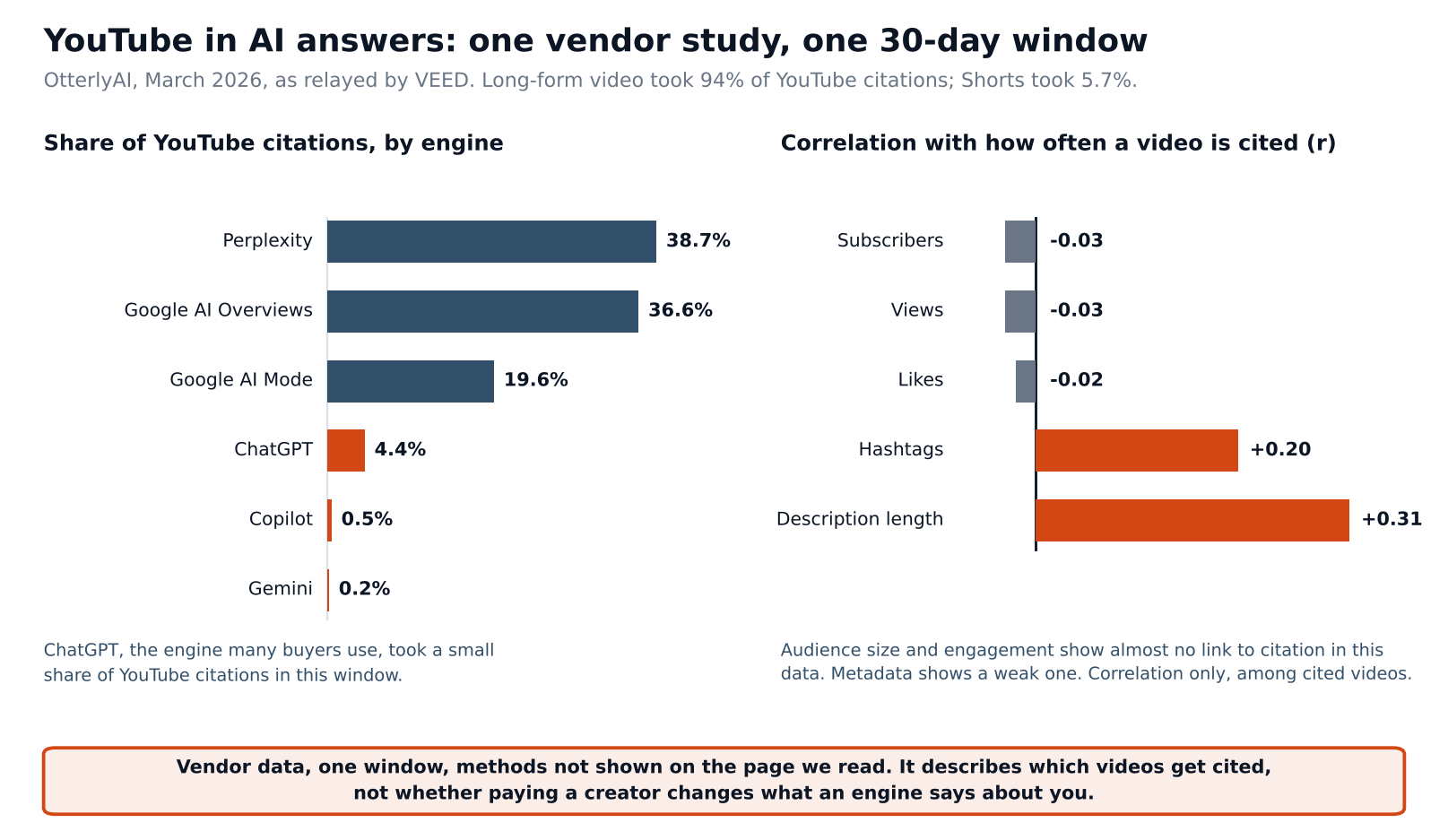
As reported there, about 94 percent of YouTube citations went to long-form video, 5.7 percent to Shorts and 0.3 percent to other formats. By engine, Perplexity accounted for 38.7 percent of YouTube citations, Google AI Overviews 36.6 percent and Google AI Mode 19.6 percent, with ChatGPT at 4.4 percent, Copilot at 0.5 percent and Gemini at 0.2 percent. If your buyers mainly use ChatGPT, this study suggests YouTube mattered little there in that window. That is worth knowing before putting a video budget behind a claim that "AI loves YouTube."
The page also reports that about 31 percent of cited videos had timestamps, and that 78 percent of those were cited more than once. The page we read does not state the study's prompt set, sample or limitations. We treat it as a vendor observation of one window, useful for direction and not for planning on a decimal.
Audience size and citations
The finding that matters most for influencer budgets is also the one that is easiest to over-read. In the OtterlyAI data as reported, a video's view count, like count and channel subscriber count each had a correlation with how often it was cited that was close to zero: about minus 0.03 for subscribers, minus 0.03 for views and minus 0.02 for likes. Description length (0.31) and hashtags (0.20) showed weak positive correlations. The same page reports that about 41 percent of cited videos had fewer than 1,000 views and that the median cited channel had fewer than 41 videos.
Agencies read this as "micro-influencers beat mega-influencers." The data does not say that. It describes the videos that were cited. It does not show how many uncited videos came from large channels, and it cannot show that a small creator would win a citation that a large one would lose. A near-zero correlation inside the cited set means reach did not predict how often a cited video was cited. It does not mean a video from a channel with no audience has the same chance of being found.
Our inference: if you are choosing a creator to improve AI visibility, the measurable features in this data are the ones you control in the brief, such as length, a clear description and chapter timestamps, and not follower count. That is an inference from one vendor study, and the audience question, whether the creator reaches your buyers, stays a separate and valid reason to pick someone.
Text formats, LinkedIn and individual voices
A creator does not have to be on video. In B2B, many of the people buyers trust publish on LinkedIn, in newsletters or on their own blogs, and the data on those formats points in the same direction as the video data: the form of the content matters more than the size of the audience.
Our reading of LinkedIn citation data found that studies disagree on LinkedIn's rank, but that Semrush put LinkedIn in about 11 percent of AI responses on average (14.3 percent in ChatGPT Search, 13.5 percent in Google AI Mode and 5.3 percent in Perplexity). Otterly reports that individual authors account for about 88 percent of cited LinkedIn content URLs, and that engagement signals such as likes and comments correlate near zero with citation. Semrush found that about 95 percent of cited posts were original rather than reshares, and that educational and advice content made up more than half of cited posts.
For a B2B team, that suggests a different picture of an "influencer" from the consumer one: a named practitioner who writes useful, original posts and articles in their own voice, repeatedly, may be worth more as a source than someone with a large audience and a sponsored post. It is still correlational, and the figures come from different datasets with different denominators.
Short-form and social posts
Short-form video, Instagram and similar formats are where influencer budgets often go, and the evidence for AI visibility is thin. In the OtterlyAI data, Shorts were 5.7 percent of YouTube citations. In Ahrefs' ranking of Google AI Mode's most-cited domains, as covered in our AI Mode reading, Instagram sat at about 5.7 percent in its September 2 reading, in a broad, consumer-heavy set of queries. Meltwater's data, relayed in Kaleigh Moore's review, put social platforms at roughly 5.6 to 7.2 percent of 5.35 million citations across eight models in a month, with news and earned content near 39.5 percent.
Those figures say social formats are a minority source in the datasets we found. They do not say a social post cannot influence an answer, and they do not cover B2B buyer queries specifically. Their practical use is to keep expectations in proportion: a short video is a different asset from a long one with a transcript and description, and the available data favours the second for citation.
Claims agencies make, and what backs them
| Claim | Where it comes from | What the data shows | Our reading |
|---|---|---|---|
| "85% of AI citations are third-party, so influencers matter" | Muck Rack, 5W and AirOps figures | They count third-party sources broadly; creators are not a category | The first half is documented. The conclusion is not drawn from the data |
| "Micro-influencers beat mega-influencers for AI citations" | Agency posts citing video-study statistics | A video study found view and subscriber counts near zero in correlation among cited videos | Describes cited videos, not creators; cannot show a small channel wins |
| "YouTube is the strongest AI visibility signal" | Ahrefs, 75,000 brands | YouTube mentions correlate about 0.74 with brand visibility | Correlation, established brands, not about paid creators |
| "Influencer campaigns increase your AI visibility" | Agency case claims | No controlled test published that we found | Unproven |
| "Short-form video drives AI citations" | Platform-trend articles | Shorts were 5.7% of YouTube citations in one vendor study | Not supported by the data we found |
| Specific multipliers such as "6.5 times more citations" | Agency pages | No source, sample or method found | Do not use |
Disclosure and the rules that apply
Paying a creator brings advertising rules into the plan. In the United States the Federal Trade Commission expects material connections, such as payment or free product, to be disclosed clearly by the creator, and platforms such as YouTube have their own paid-promotion labels. Other countries have their own rules. A sponsored video that is disclosed and labelled is a legitimate asset. One that is not disclosed creates legal and trust risk that no citation benefit outweighs.
It also raises a question the evidence cannot answer: whether an engine treats a labelled sponsored video differently from an organic one. We found no public study on that. Ask your legal team to approve the disclosure language in the brief, and keep the brief to what the creator can say truthfully from their own experience.
What a B2B creator program can control
Given how thin the causal evidence is, the sensible approach is to treat a creator engagement as a way of producing a few specific, well-formed pages, and to spend where you have influence.
Start with topical fit and buyer overlap. A creator whose audience is your buyers earns the engagement on its own merits, and any AI visibility is a bonus you will test, not a reason to pay.
Ask for long-form formats with chapters. In the data we read, long-form video dominated YouTube citations and timestamped videos were cited again and again. A twelve-minute walkthrough with a clear title, a full description and chapter markers is a more citable asset than a thirty-second clip.
Check how your company is named. A creator may shorten your brand, mispronounce a product or describe you in a way you would not. The description, title and any transcript are text that an engine can read. Give the creator the exact company name, role and one-line description you use everywhere else, which is the same discipline we cover in entity SEO for AI search.
Add a text companion. A short page on your site that summarises the video, quotes the creator with permission and links to it creates a page you control. It gives engines a crawlable version of what was said and gives viewers a place to land.
Brief around buyer questions. If the video answers "what should I look for in a procurement platform" using a specific, true example, it is closer to a passage an engine might use than a general endorsement. Our piece on podcast guesting covers the same principle for audio: plan the work around the pages it creates.
If you want help building a consistent third-party footprint across creators, publications, forums and review sites, AI authority building is the service we offer for it.
How to test whether it worked
The design is simple. Fix 15 to 30 prompts a buyer in your category would type, and group them: some tied to the topic the creator will cover, and some on a different topic you will not touch. Run all of them on a schedule across the engines your buyers use, several times per prompt, and record the cited URLs and whether your brand is named. Take a baseline before the first video goes live.
The unrelated-topic group is your comparison. If your brand starts appearing more on the topic the creator covered and not on the others, that is a sign worth following up. If it rises on all of them, something else is happening, such as a change at the engine, and you cannot credit the creator. Report each rate with its denominator, such as the share of runs in which your brand is named, and count a change only if it holds across several consecutive checks, not one week.
Answers vary from run to run, and engines change their sourcing often. One quarter of data is a reading, not a law.
Questions people ask
Do influencers help AI search visibility?
They may, through the pages and videos they create that name your brand. No public study we found tests whether paying a creator changes which brands an engine names.
Is YouTube the best platform for AI visibility?
YouTube mentions had the strongest correlation with brand visibility in Ahrefs' 75,000-brand study, and one vendor study found YouTube cited heavily by Perplexity and Google's engines but lightly by ChatGPT. Both are correlational.
Do micro-influencers work better than large ones for AI citations?
The data does not show it. A video study found views and subscriber counts had almost no correlation with citation among cited videos, which describes the cited set and does not rank creators.
Does a sponsored post get cited as much as an organic one?
We found no public data. Disclose the sponsorship as the rules require, and test with your own prompts.
How do you measure whether an influencer campaign affected AI answers?
Fix a prompt set, take a baseline, run it on a schedule, and compare prompts on the creator's topic with prompts on topics the creator did not cover.
Start small and read the results
The case for working with creators rests on reach and trust with the people who buy from you. The AI search case, so far, rests on adjacent data and some reasonable inferences about which pages get cited. You can act on both at once without betting a budget on the second: pick one creator who fits, brief for a long-form video with a clear description and a companion page, and measure.
To see where you stand before the first video, the AI Search Visibility Checker shows how engines describe your company today, which is the baseline to compare against. AI Search Intelligence tracks which videos, posts and third-party pages are cited for your category prompts over time, so you can see whether creator content begins to appear and on which engines.