


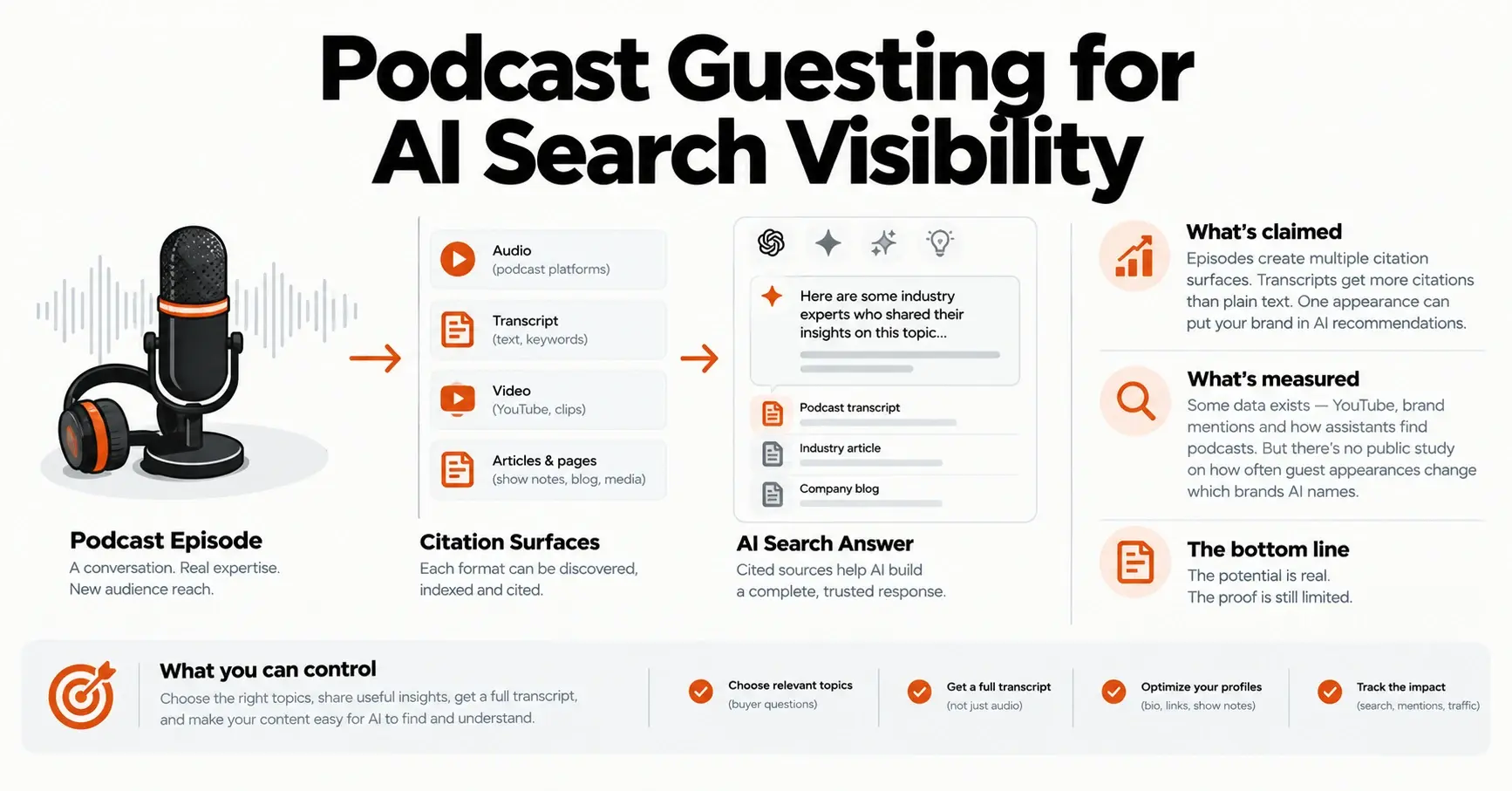


Every podcast guesting pitch now has a slide about AI search. The slide usually says that an episode creates several "citation surfaces", that transcripts earn several times more citations than plain text, and that a single appearance can make your brand show up when buyers ask ChatGPT for recommendations. Some of that may turn out to be true. Very little of it has been measured in public.
This article separates what is documented from what is claimed. It starts with a plain fact about how answers are built, walks through the four ways a recording can end up as something an engine cites, lists the numbers that circulate and what backs them, and finishes with what a B2B guest can control and how to check the effect in your own category. It reads public sources only. It contains no Omnibound data, each figure is attributed, and where we infer something rather than quote it, we say so.
The short account of the evidence is that no public study we found measures how often guest appearances change which brands an engine names. What exists is adjacent: data about YouTube, about brand mentions in general, and about how assistants find podcasts.
What an AI answer can actually cite
An AI answer cites URLs. A recording is audio, and the audio file is not what shows up in a citation list. For a podcast appearance to reach an answer, it has to exist as a page, and there are four kinds of page it can become.
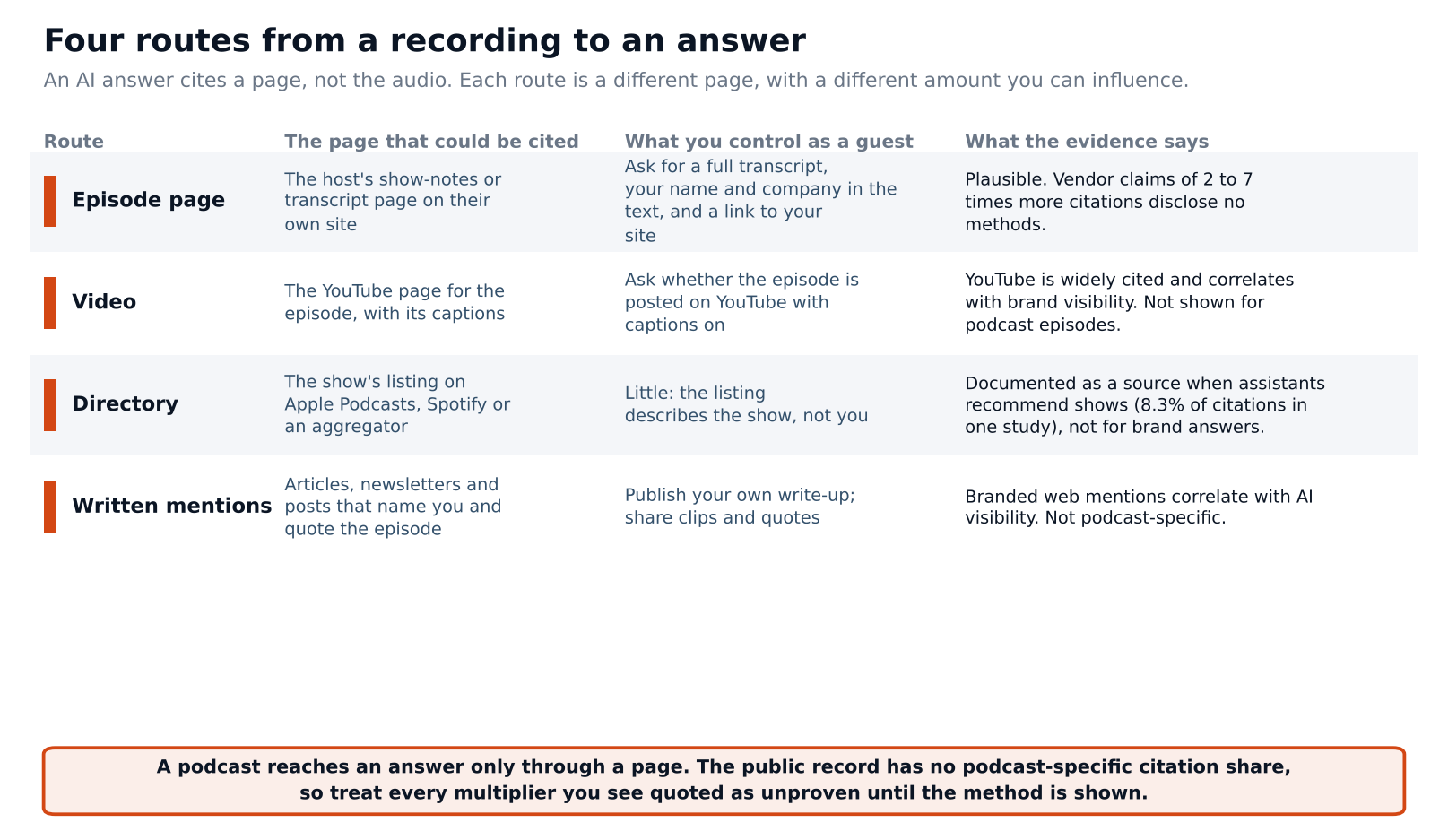
The routes are the episode page on the host's site, the video on YouTube, the show's listing in a directory, and written mentions elsewhere that name you. They differ in how much you can influence them and in how much evidence exists. We take them in that order.
Route one: the episode page
The most direct route is the host's own page for the episode. If it carries a full transcript and names you and your company in the text, it is a page about you on a site you do not own, in the host's wording, with a link back to you if the host adds one.
This is where most of the claims sit. Parse, in a transcript playbook, says pages with structured transcripts, FAQ markup and audio markup earn two to three times more AI citations than flat prose, and that searchable transcripts earn four to seven times more. AirOps repeats the four-to-seven figure and attributes it to vendor data. As far as we can tell, neither page discloses a sample size, a comparison group or the dates of the data.
Parse does offer two cautions that are useful on their own. It says the median episode shipped none of its seven recommended structural elements, and that automated transcription runs at 85 to 92 percent accuracy, which means a name or product can be misspelled on the page an engine reads.
Our inference: a transcript page is plausible as a route, because it is ordinary crawlable text, and it is the one route where the words on the page are about the guest. The size of the effect is unknown, and "four to seven times" should not appear in a plan until someone shows how it was measured.
Route two: the video
Some shows publish the episode to YouTube, with captions. That turns the episode into a video page, and YouTube is one of the most-cited domains in AI answers. In our reading of Google AI Mode's most-cited domains, YouTube ranged from about 5 percent to 38 percent depending on the study, a wide spread, though it sat in the top three of every ranked list.
The nearest study on brands is Ahrefs' analysis of 75,000 brands. Across ChatGPT, AI Mode and AI Overviews, it found that YouTube mentions had the strongest correlation with AI brand visibility, at about 0.74, ahead of branded web mentions. Ahrefs states that correlation is not causation, and as summarised the study left podcast data out.
So the YouTube route is documented for YouTube in general. It has not been shown for podcast episodes, and the brands in that study are established ones with a minimum of search volume, which is a different group from a company early in its category. Our inference: an episode posted to YouTube with accurate captions is a reasonable thing to ask a host about, because it adds a page and a set of mentions at little cost.
Route three: the directory listing
Apple Podcasts, Spotify and aggregator sites list the show, not you. The best public data on them comes from PodSEO, which queried four assistants across 849 podcast topics over four weeks. It reports that the assistants recommended different podcasts 71 percent of the time and agreed on only 4 percent of queries. It also reports that 79 percent of the recommendations cited listicle and aggregator sites, with Feedspot taking 10.8 percent of citations and Apple Podcasts and Spotify together 8.3 percent. The page states no limitations, and the units differ by figure, so we quote each with its own label.
This tells you how assistants find shows. It says little about whether a guest's company gets named. If buyers ask "which podcasts should a procurement lead follow", a show that is listed well benefits. A guest on that show is not the subject of that answer.
Route four: written mentions
The fourth route is everything written about the episode: a newsletter that summarises it, a post that quotes you, an article from a trade publication, and your own write-up. These are ordinary third-party and first-party pages, and they are the same kind of source we cover in our guide to how brand mentions compound and in the piece on whether expert quotes earn citations.
The relevant data is the same Ahrefs study, which found branded web mentions correlating at 0.66 to 0.71 with AI visibility. It is correlational, it is not about podcasts, and it covers established brands. We grade it in our offsite signals hub as a documented association and a plausible influence. A podcast appearance that generates written mentions is feeding a route with real, if indirect, support.
The numbers in circulation, and what backs them
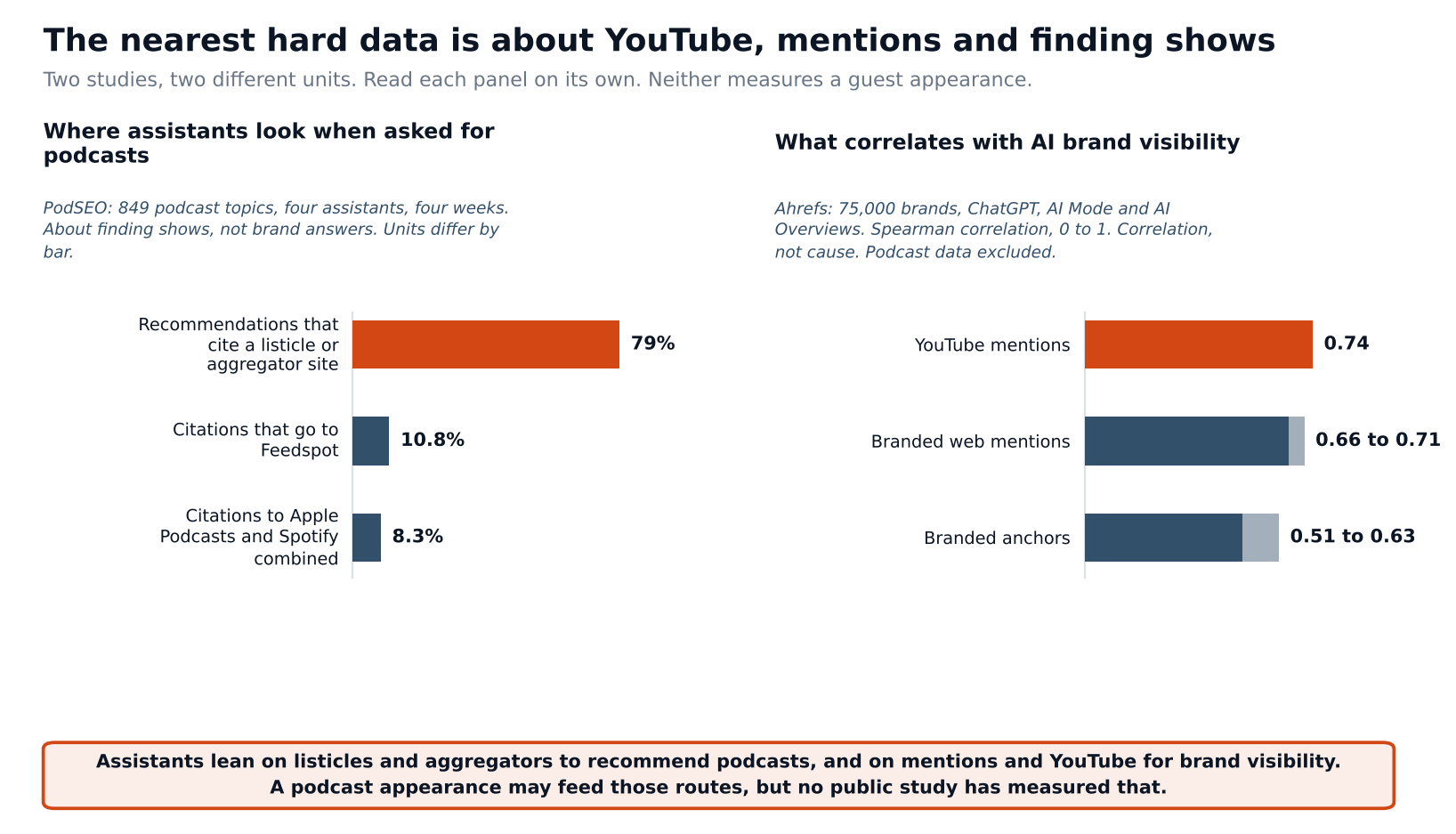
The chart above shows the two studies with usable figures. The table below covers the claims that come up most often in guesting advice.
| Claim | Where it comes from | Method disclosed? | Our reading |
|---|---|---|---|
| Transcripts earn 4 to 7 times more citations | Vendor data, repeated by Parse and AirOps | No | Unverified |
| Structured pages earn 2 to 3 times more citations | Parse | No | Unverified |
| One episode creates 7 to 10 citation surfaces and 5,000 to 15,000 words | EvolveAMZ, an agency | No; the page offers no research or case data | A way of counting, not a measurement |
| Host "citation share" scores, such as 92 out of 100 for the highest-scoring host shown | Everything PR's Podcast Citation Index | No prompts, dates or sample size given | About hosts, not guests |
| Modeled citation share lift from podcast appearances | 5W's Podcast Citation Effect research | Its methodology page says the work is modeled, not logged queries | Directional at best; no figures on the pages we read |
| No public tool tracks how often individual podcasters are mentioned | Podglomerate, which asked seven AI tools in February 2026 | Estimates only, by its own account | Evidence of a gap |
Two more absences are worth recording. Orbit Media's study of 13,184 citations across ChatGPT, Claude, Gemini and Perplexity, run on prompts for three B2B sites, had nothing specific to podcast platforms in the summary we read. And 5W's synthesis of six large citation datasets, which together cover hundreds of millions of citations, does not break out podcasts. Podcasts do not appear as a category in those large datasets. Our inference: if they were a major citation source, trackers would likely report them, though a missing category is not proof.
What a B2B guest can control
Treat each episode as up to four pages, and spend effort where you have influence. Before you agree to a show, ask the host three things: whether the episode will have a full transcript on its page, whether it will be posted to YouTube with captions, and how the guest will be named and described. Supply the bio yourself, using the exact company name, role and one-line description you use everywhere else.
Our guide to entity SEO for AI search explains why consistent naming matters. Check the transcript. Automatic transcription runs at 85 to 92 percent accuracy by Parse's account, so ask for a read-through or send the correct spelling of your company, product and your own name.
After the episode goes live, write your own page. A short article on your site that summarises your answers, quotes your own lines and links to the episode gives engines a page you control, with the substance of the conversation, and a place for the host's audience to land. This is the one route where the page is entirely yours.
Share clips and quotes where your buyers are, with the episode link. That produces written mentions without asking the host for anything.
Choose shows by whether their audience matches your buyers and whether they publish the pages above, not by chasing a claimed citation multiplier. If you want help building a consistent third-party footprint across podcasts, publications and review sites, AI authority building is the service we offer for it.
Talk so the transcript can be quoted
If the transcript page is the text an engine can read, then what you say works like a written quote. This part is our inference, not a tested method, but it follows from how citations work.
Say your company name and your role once, early in an answer, in the same words you use on your site, so the sentence that contains your claim also contains who made it. Answer the question in a sentence before you explain it. Use a named, specific example from your own work in place of a general statement, and give a number only if you can source it afterwards. A figure that you cannot trace is the one that gets repeated wrongly. Our piece on whether expert quotes earn citations covers why attributable, specific statements are the ones that travel.
Pick two or three buyer questions you want to be associated with, such as how long an implementation takes or what to look for in a vendor, and steer toward them. A good guest answer to one of those is the same kind of passage that an engine would pull for that question.
Pitch with the pages in mind
A pitch that describes only the guest leaves the host to work out the rest. One that also describes the pages makes the host's job easier and costs them little. Offer a short bio in final form, two or three suggested questions tied to what buyers ask, a correctly spelled list of names and terms for the transcript, and a one-paragraph summary the host can paste into the show notes. Offer to check the transcript before it goes live, and to link to the episode from your own site.
Ask the practical questions in the first conversation: does each episode get a transcript page, is it posted to YouTube with captions, and will your name and company be in the text of the show notes. If the answer to all three is no, the episode may still be worth doing for the audience, but it will create fewer pages for you to point to.
If you run the show yourself
A company podcast gives you all four routes at once. You control the episode page, the video, the directory listing and the mentions. The same rules apply: publish a full, proofread transcript on a page of your own site, name guests and companies in the text, post the video with captions, and write a short summary that stands on its own. Vendors also recommend structured data on these pages, and the claimed gains from it come from the same undisclosed sources, so treat markup as housekeeping rather than a lever.
Track what happens
Because no study answers the question for your category, keep a simple record. List every episode with its air date and the URLs it created: the host's page, the YouTube video, any write-up of yours and any mentions you can find. Then fix 15 to 30 prompts a buyer in your category would type, run them on a schedule across the engines you care about, and record the cited URLs. Note whether any of the episode URLs, or pages that quote the episode, appear.
Report a rate with its denominator, such as the share of runs in which an episode-related URL is cited, and do not claim a trend without two dated snapshots from the same prompts. A baseline taken before your first episode matters more than any later reading.
Questions people ask
Does being a podcast guest help AI search visibility?
It may, through the pages an episode creates: a transcript page, a YouTube video and written mentions. No public study we found measures the effect of a guest appearance on which brands an engine names.
Do AI engines read podcast audio?
We found no public evidence either way. Citations are URLs, so the practical question is which pages the episode creates, and whether those pages carry text that names you.
Do transcripts increase AI citations?
Vendors report increases of two to seven times, but the pages we read disclose no sample or comparison group. A transcript is crawlable text, which makes it plausible as a route, and the size of the effect is unmeasured.
Is YouTube more important than the podcast itself?
YouTube is one of the most-cited domains and YouTube mentions had the strongest correlation with brand visibility in Ahrefs' study. That study did not include podcasts, so it cannot rank the two.
How many episodes does a B2B team need?
There is no tested number. Start with a small set of shows that publish transcripts and video, record a baseline first, and compare citations before and after.
Plan the episode around the pages
The case for podcast guesting rests on reach, relationships and the quality of the conversation. The AI-search case rests on pages: whether the episode becomes a transcript page, a video and a set of mentions that name you correctly. That is something you can ask for before you record, and something you can check afterwards.
To see where you stand before the first episode, the AI Search Visibility Checker shows how engines describe your company today, which is the baseline to compare against. AI Search Intelligence tracks which third-party and video pages are cited for your category prompts over time, so you can see whether episode pages begin to appear and on which engines.