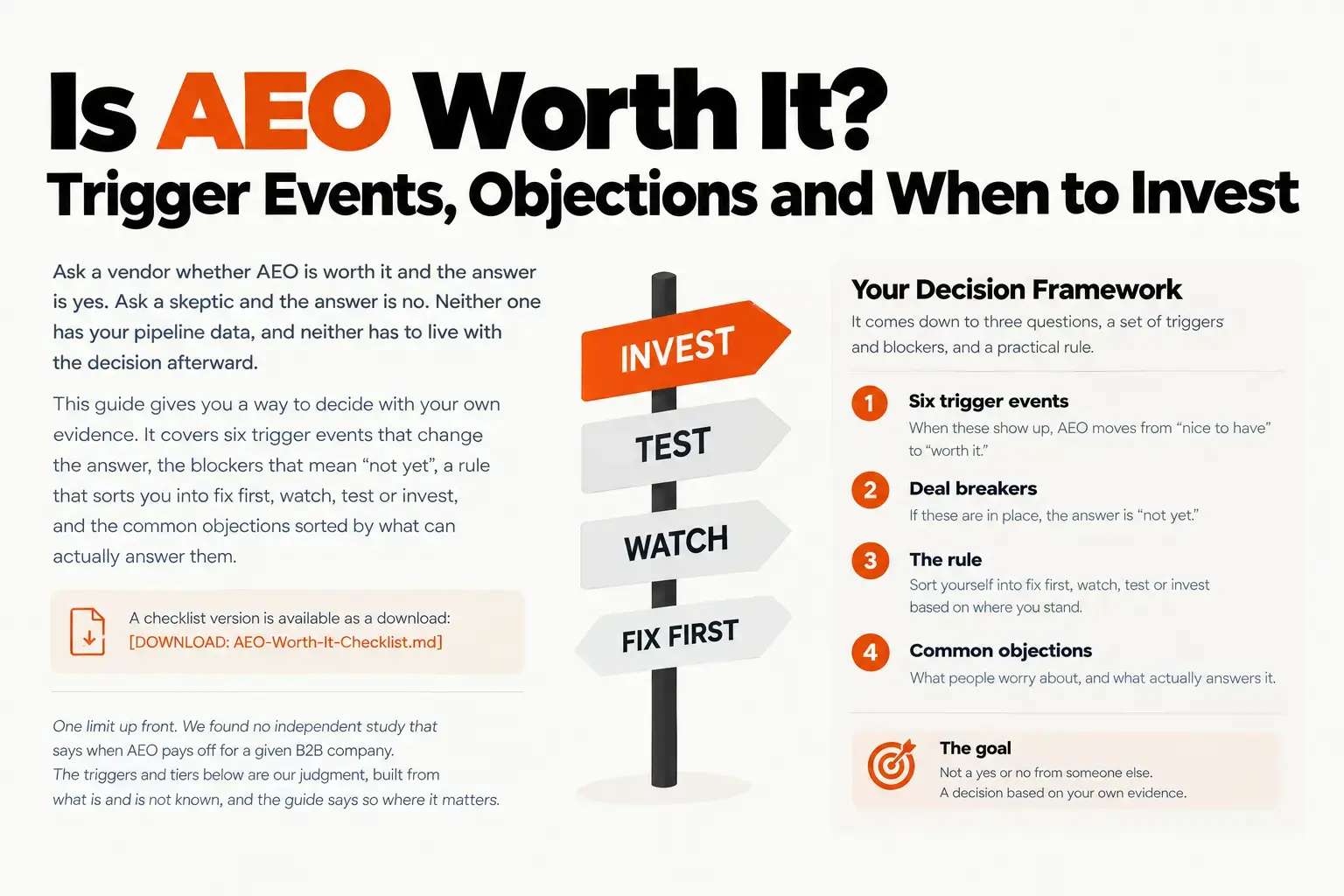


Ask a vendor whether AEO is worth it and the answer is yes. Ask a skeptic and the answer is no. Neither one has your pipeline data, and neither has to live with the decision afterward. This guide gives you a way to decide with your own evidence. It covers six trigger events that change the answer, the blockers that mean "not yet", a rule that sorts you into fix first, watch, test or invest, and the common objections sorted by what can actually answer them.
Worth it compared with what?
Worth it at what cost? Not all of the work is new. Google's documentation says there are no additional requirements to appear in its AI features, so a good deal of sound search work serves both goals. The cost that counts is the added cost: the work you would not otherwise do. Our guide to building the business case shows how to separate added from shared spending.
Worth it by when? Some answers arrive in weeks, such as whether your brand shows up for a fixed list of buyer questions. Pipeline arrives months later, after a sales cycle. A decision that waits for pipeline will wait a long time.
Worth it instead of what? The same hours and budget could go to a webinar series, a sales enablement project or a fix to your pricing page. A fair comparison uses the same chain from visit to revenue for each option. The forecasting guide covers that chain.
There are also more than two answers. Yes, no and not yet are the obvious ones. A fourth is worth having: not sure, so find out cheaply. Most of this guide is about that fourth answer, because it is usually the right one.
What the independent evidence supports
A Pew Research Center study of 900 US adults, covering 68,879 Google searches in March 2025, found that people clicked a result link in 8 percent of visits when an AI summary appeared and 15 percent when it did not, and clicked a link inside the summary in 1 percent of visits. That is Google only, one month, US adults. It shows AI summaries change what people do after a search. It does not tell you what B2B buyers do in your category.
Google's documentation says sites appearing in AI features are included in overall search traffic and reported under the Web search type in Search Console. Search Engine Land reported on August 31, 2026 that Google has since rolled out AI performance reports to all accounts, showing impressions, pages, countries, devices and dates but not clicks. Check Google's current documentation before you describe it, since this is changing.
What is missing is the part that matters most for a go or no-go. We found no independent study that connects appearing in AI answers to B2B pipeline, and none that says how large the effect is for a company of your size or in your category. Our look at what B2B buyers ask ChatGPT covers what is and is not public. So the decision has to rest on your own data and a bounded test, not on someone else's chart.
Six trigger events that change the answer
A trigger is something you can observe in your own business that makes AEO more likely to be worth a closer look. These six are our judgment, not a validated list. For each one the table shows what it suggests and how to check it in about an hour.
| Trigger | What it suggests | How to check it in an hour |
|---|---|---|
| Buyers research on their own before they talk to sales | AI answers can shape the shortlist before you ever see the buyer | Ask the last ten closed-won buyers how they researched. Read first-call notes. |
| Reps hear "I asked an AI" on calls | Buyers in your category already use it | Add a call tag. Read the next 20 first calls. |
| AI mentions or referrals show up in your data | There is something real to measure | Check a self-reported attribution field and an analytics channel for AI assistants. Treat the channel as a floor. |
| The Search Console AI report shows impressions on your pages | Your pages are appearing in AI features | Open the report and note which pages. It shows impressions and no clicks. |
| A launch, new category or rebrand | The pages and mentions that describe the new thing are being written anyway | List what will exist in 90 days and whether it answers buyer questions. |
| You already publish question-shaped pages that rank | The added cost is lower because the work is shared | List the pages. Compare them with a fixed prompt list. |
Count the ones that apply. A count is not evidence that AEO will pay. It is evidence that there is something to look at, which is a lower bar and the right one for deciding how much to spend finding out.
Two of the triggers are worth a second look. The first is the research-before-sales trigger. It matters most when deals are large, several people are involved and buyers do much of their reading before they talk to anyone, because that is where being described accurately in an answer could matter. If your buyers call you after one referral, the trigger probably does not apply. The second is the launch trigger. When you launch a product or enter a category, the answer to "what is this?" will be built from whatever exists. That is a good moment to make sure what exists is accurate, and the cost is low because the pages are being written regardless.
Some things sound like triggers and are not:
- A vendor's chart or a vendor-written statistic. It does not describe your buyers.
- A competitor announcing an AEO program. It tells you what they decided, not what works.
- An executive forwarding an article. It is worth a conversation, not a budget.
- One AI answer that names a competitor and not you. A single run is not a result, and answers vary from run to run.
When it is probably not worth it yet
Some situations mean the answer is "not yet", and the reason is a blocker, not a verdict on AEO.
You cannot tell where leads come from. Without a source field or call tags you cannot see any of the triggers above, and you could not tell whether a program worked. Add the field first. It costs almost nothing and helps every channel.
Your core pages are thin or not indexable. Google says appearing in AI features depends on the same eligibility as search: a page has to be indexed and eligible to be shown with a snippet. If key pages fail that, fix them first. A content audit of your existing pages against the questions buyers ask, such as Content Audit and Optimization, is a reasonable place to start, and the work counts as search work either way.
Nobody owns publishing and review. A program that depends on pages being written, fact-checked and updated needs a person whose job it is. If nobody can do that, the first stage will stall.
The break-even number looks out of reach. In the business case guide, the program has to reach about 1,440 AI-referred visits a month to break even in the example. If your whole site gets a small fraction of that and nothing suggests AI answers would send much more, the case is weak, and a watch quarter will show it cheaply.
Your market is a short list of accounts you already know by name. A watch quarter may be all you need. It tells you whether those buyers mention AI in their research, which is the question that would change your mind.
None of these says AEO does not work. Each says the next dollar is better spent on something else first.
Four tiers: fix first, watch, test, invest
Turn the checks into a rule. It is our rule of thumb, not a finding, and you should adjust it to your market.
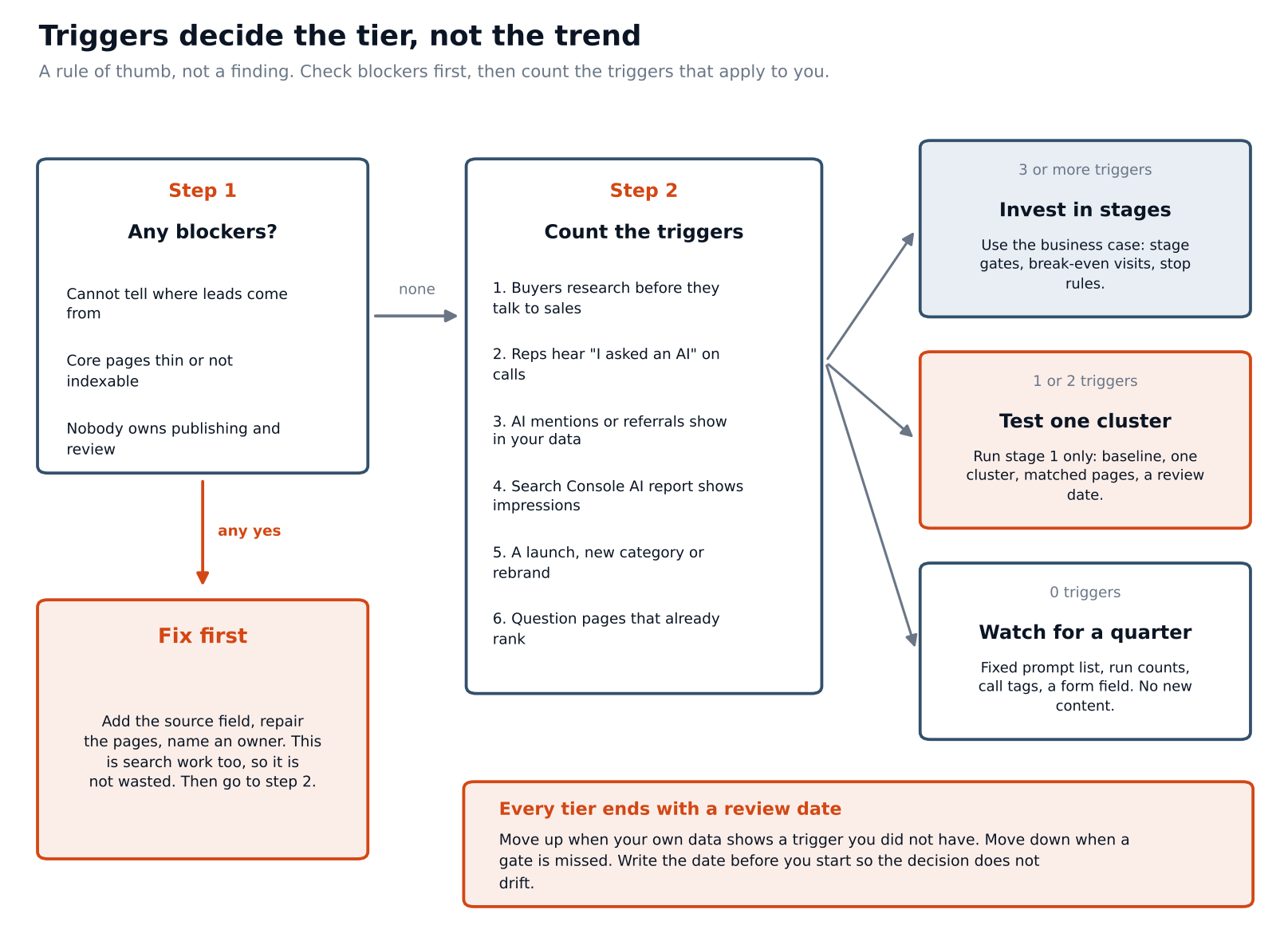
Check for blockers first. If any apply, fix them and then go on. Then count the triggers that apply. With none, watch for a quarter. With one or two, run a test on one cluster. With three or more, invest in stages.
Watch costs hours and a spreadsheet. You build a fixed list of buyer questions, run it several times and record how often your brand appears along with the run count, add a form field and a call tag, and read the Search Console AI report. You publish nothing new. The point is to turn "we don't know" into "we know what is visible today, and we know whether buyers are bringing it up."
Test is stage one of the business case: a baseline, one cluster of pages, a matched set of untouched pages for comparison, and a review date. It is a bounded bet that can end at the first gate.
Invest is the staged plan with gates, break-even visits and stop rules from the business case guide. Even at three triggers it is a sequence of gated decisions, not a single approval.
Every tier ends with a review date, and you write the date before you start. A decision with no date drifts, and a watch quarter that never ends is just a delay.
A quarter of watching, week by week
If the rule sends you to watch, this is what the quarter looks like. The schedule is a suggestion, not a standard.
| When | What you do |
|---|---|
| Week 1 | Build a fixed prompt list of 20 to 30 buyer questions. The buyer prompt library is one way to start. Run each prompt several times and record how often you appear, with the run count. |
| Week 2 | Add a "how did you first hear about us" field to demo and contact forms. Add a call tag for AI mentions. Open the Search Console AI report and note what it shows. |
| Weeks 3 and 4 | Read what came in. Count tagged calls and form answers. List any triggers that now apply. |
| Week 8 | Repeat the prompt runs with the same wording and the same number of runs. Compare with week 1, and say plainly how much of any difference could be noise. |
| Week 12 | Hold the decision meeting on the date you set. Write down which triggers applied, which tier you chose and the next review date. |
Keep the wording of the prompts fixed all quarter. If you change it, start a new series and label the break.
Objections, sorted by what can answer them
Most of the argument about whether AEO is worth it can be settled with your own data or a small test. The rest cannot be settled yet, and the sensible move there is to cap the bet instead of arguing.
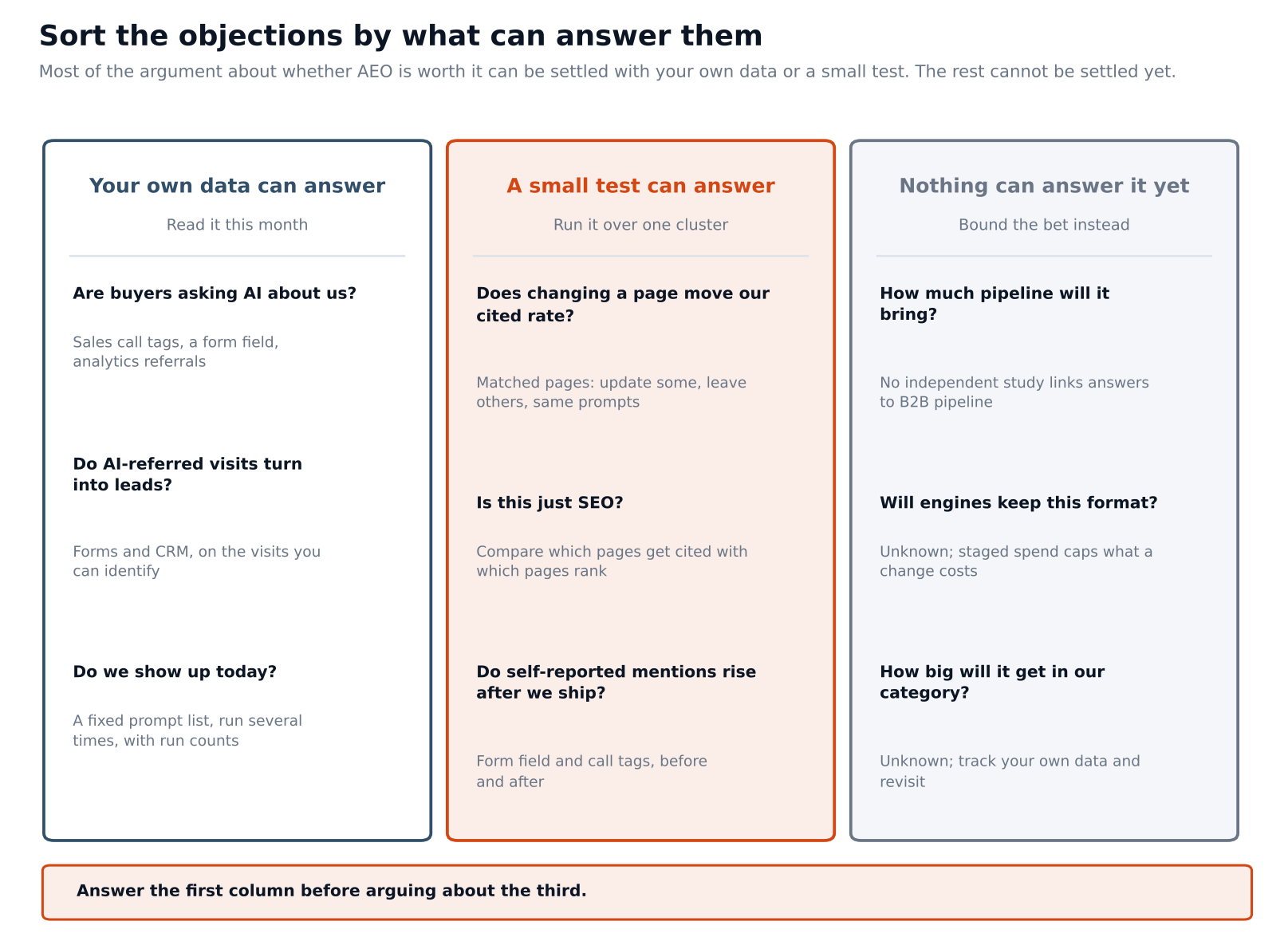
"The traffic is tiny." It may be, for your site. Measure it. Analytics will undercount, because some arrivals carry no referrer, so treat the number as a floor, and our piece on the dark AI search funnel explains why influence can show up as direct or branded visits. Visits alone may also understate influence, since Pew found AI summaries change what people click, so mentions and self-reported answers belong beside them.
"This is just SEO." Partly, and that is useful. Google says AI features have no additional requirements beyond search eligibility, so shared work is real. What is added is the measuring, writing pages around buyer questions and the mentions that happen elsewhere. A small test can show whether the pages that get cited are the pages that rank.
"The results are random." Answers do vary between runs and between engines. That argues for run counts and fixed prompts, not for ignoring the question. A rate over a handful of runs is a weak result, and one over many runs is a better one.
"The engines will change the rules." They will, and nobody can say how. Tie the work to things that stay useful, such as pages that answer buyer questions accurately, and keep the spend staged so a change cannot cost more than one stage.
"We can't measure it." Not fully. You can measure the leading signals and a few lagging ones, and you can say plainly what the measurement misses. That is a weaker position than measuring everything and a stronger one than guessing.
When to move up or down a tier
Move up when your own data shows a trigger you did not have, when the leading signals pass a floor you set in advance, or when the break-even visit level starts to look reachable. Move down when a gate is missed, when signals stay flat after the ramp you wrote down, or when a blocker appears that you cannot fix.
Treat a move as a decision with a date. The mistake is a slow slide, a program that quietly grows because nobody said no, or one that quietly dies because nobody said yes.
Questions people ask
Is AEO worth it for a small B2B company? No independent source says. The tiers work at any size. A watch quarter costs hours, so a small team can find out whether buyers mention AI before committing money.
Should I wait until AI search is bigger?
Waiting has a cost: you have no baseline, and a baseline takes time to build. But waiting is not the same as doing nothing. A watch quarter is cheap, and it gives you a date to revisit the decision.
Should I do AEO or SEO first?
They share fundamentals, so fix the blockers that serve both. After that, treat it as one search program with an added layer, and keep the added cost separate.
How long should I watch before deciding?
A quarter is a workable default because it gives you a few monthly runs and room for some leads to appear. No study sets a duration. Pick a date and keep it.
What if the answer is no?
Write down which triggers were absent and what would change your mind, and set the next review date. A recorded no is a good outcome.
Set the decision date first
Before you collect any evidence, put the decision meeting on the calendar and write down what would count as a yes, a test or a no. That one step turns the rest of this guide from reading into a plan.
Then get a first reading. Run five of your buyer questions through the AI Search Visibility Checker to see how answers describe you today, which gives week one of a watch quarter a starting point before you have built anything. If the rule sends you to test or invest, AI Search Intelligence tracks each prompt individually, so the same list can be rerun on a schedule and each review can show which questions moved.
.webp?height=245&name=What%20Is%20GEO%20(Generative%20Engine%20Optimization).webp)