


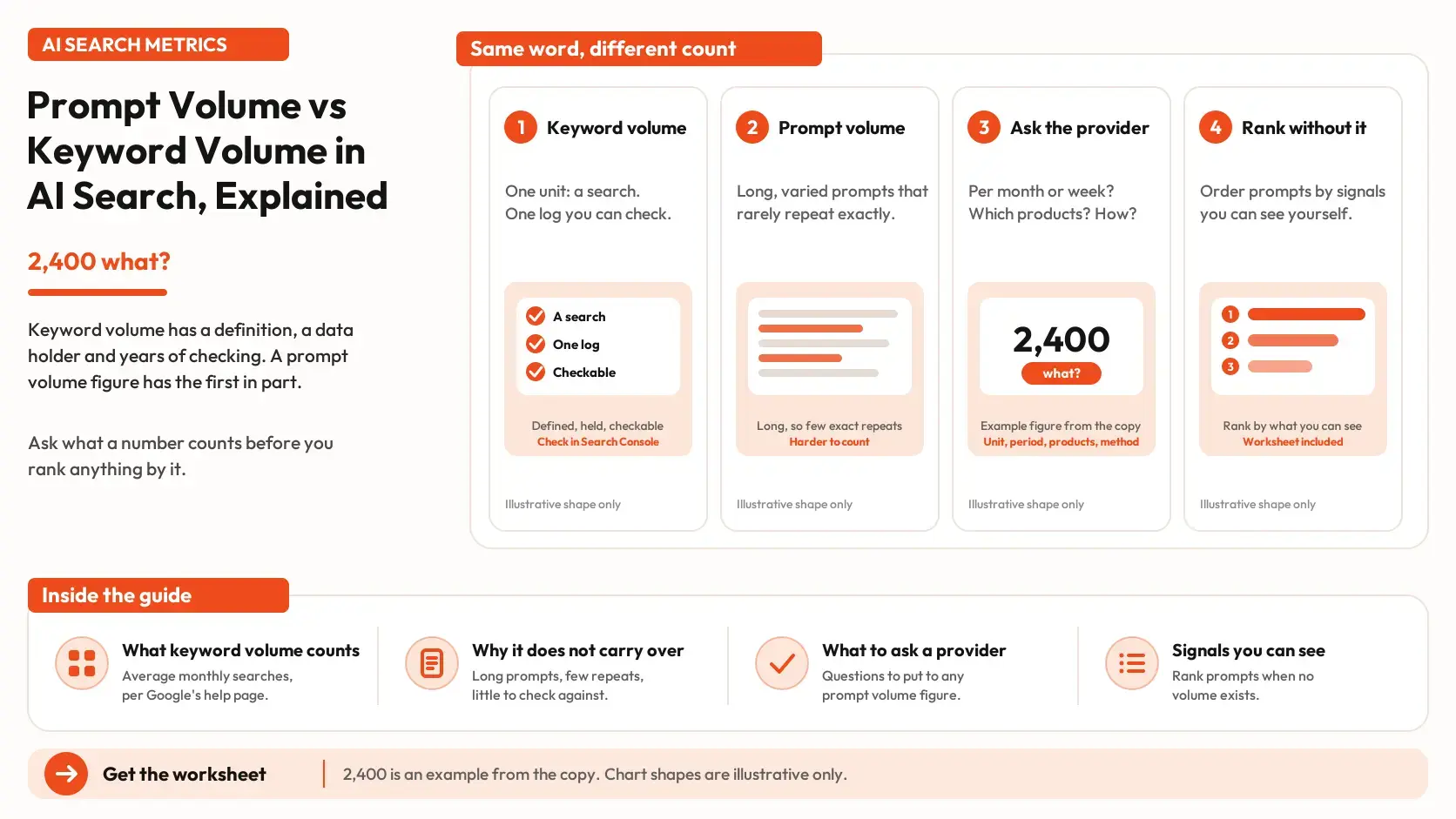


A dashboard lists a tracked prompt and, next to it, a number: 2,400. A marketer asks the obvious question. 2,400 what? Per month or per week? Across which AI products? Asked by how many people, counted how, and checked against what? Compare that with keyword volume, where each of those questions has a short answer. Keyword volume has a definition, a data holder, and years of people checking it against their own results. A prompt volume figure has the first in part, and the other two barely at all.
This guide explains what each number means, why the keyword idea does not carry over cleanly to prompts, what to ask any provider of a prompt volume figure, which signals you can see for yourself, and how to rank prompts when no volume exists. A worksheet is included.
What keyword volume counts
Google's help page defines average monthly searches as the average number of times people searched for a keyword and its close variants, over a period you choose and, by default, 12 months, for the location and network you select (Google Ads Help). The figures are rounded, so totals across locations may not add up, and seasonality moves them.
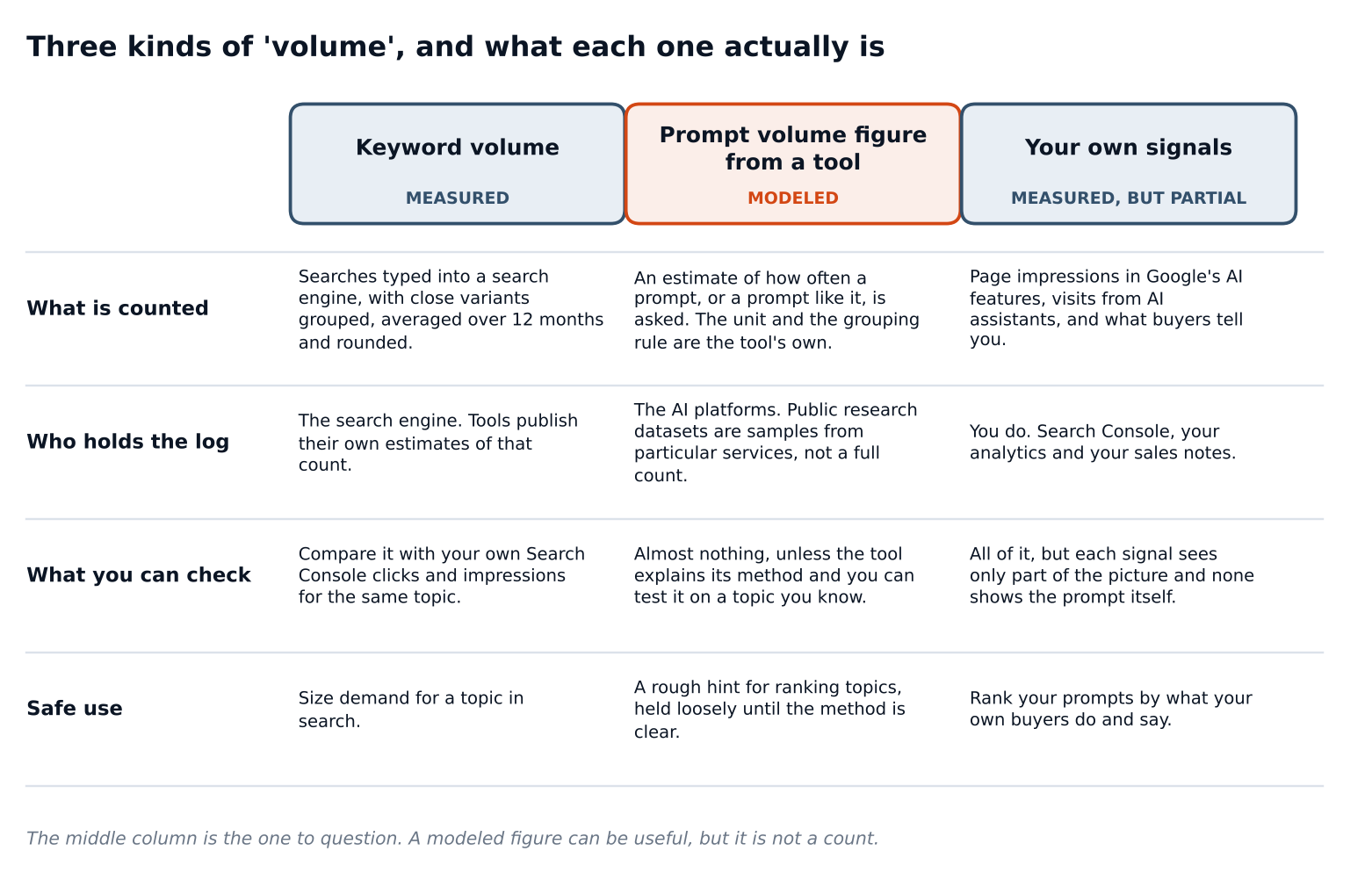
Three properties make the number useful. The unit is clear: a search. The log is held by one party, the search engine. And you can compare it with your own data, because Search Console shows the impressions and clicks you got for the same topic. Third-party keyword tools publish their own estimates of that count, and the same comparison works for them.
Why that count does not carry over to prompts
There are three reasons, and the first two come from how people and engines behave.
1. Prompts are long and varied
In a study of donated chat histories covering 171,264 conversations from 613 users across four AI platforms, nearly 80 percent of user prompts contained more than 20 terms. The users were volunteers recruited through one service and the data is English text only, so it will not describe every buyer. The pattern still matters for counting. A search log fills with repeats because short strings repeat. Long prompts are less likely to repeat word for word.
Research datasets of real prompts show the spread. The authors of WildChat, about 1 million conversations and over 2.5 million turns collected by offering free ChatGPT access in return for consent to log transcripts, describe its user prompts as the most diverse among the datasets they compared. We only read the abstract. Our own reading is that counting identical prompts would give very small numbers, so any figure that says something useful has to group prompts into topics, and the grouping rule then decides the number.
2. The engine rewrites the prompt
In the same chat-history study, almost all of the web queries the platforms generated from those prompts had fewer than 10 to 15 terms. Those short queries are what a search engine sees. Our guide to query fan-out explains how one prompt becomes several searches. We found no study on whether a keyword tool's count includes searches an AI system runs on a user's behalf.
3. The logs belong to the platforms
The operators can see conversations, and what they publish is shares by topic, not counts by prompt. A working paper on consumer ChatGPT use, covering November 2022 to July 2025, when about 10 percent of the world's adult population had used it, sorted conversations by topic with a privacy-preserving pipeline. It reports that three topics, practical guidance, seeking information and writing, made up nearly 80 percent of conversations (NBER). We read the abstract only, and two of the co-authors are OpenAI employees. That is the grain on offer: topic shares for one product. Public research datasets are samples from particular services, so they show what those users asked, not what your buyers ask.
What a prompt volume figure is, and what to ask about it
As the term is used, prompt volume is an estimate of how often a prompt, or a group of similar prompts, is asked in AI products over a period. We know of no independent study that checks how well such estimates match what buyers ask, so this piece cannot rate any provider's figure. What you can do is ask questions. A provider that answers them clearly has given you something to test. One that cannot has given you a number to hold loosely.
- What is the unit: prompts, conversations or users, and over what period?
- How are similar prompts grouped, and who decides what counts as similar?
- Where do the underlying prompts come from: people who opted in, a model built from search data, or the provider's own runs? How many people or conversations sit behind one figure?
- Which AI products, countries and languages does it cover?
- How often is it refreshed, and what changed at the last refresh?
- Has it been checked against a source you control, and can you repeat that check?
Then run a small test of your own. Pick three topics you know well from your sales calls: one buyers raise often, one they raise rarely, and one you are confident they never raise. See whether the figure ranks them in that order. A figure that cannot separate them has told you something. A pass on three topics proves little, so read it as permission to keep using the number with care, not as validation.
Signals you can see for yourself
None of these is prompt volume. Each sees part of buyer behavior, and none shows the prompt itself.
| Signal | What it counts | What it misses | Use it for |
|---|---|---|---|
| Search Console generative AI report | Impressions of your pages in Google's AI features, by page, country, date and device | The query or prompt; other AI products; any click data on that report | Seeing which pages Google's AI features show |
| Analytics AI Assistant channel | Visits that arrive from sources such as ChatGPT, Gemini or Copilot | Answers that name you with no click; Google's AI features | Tracking referred visits to a page over time |
| Your own conversations | How often buyers raise a topic on sales calls, support chats and onboarding | Buyers who never reached you; what they asked an AI | Ranking topics by how often your buyers raise them |
| A "how did you hear about us" field with an AI option | What buyers say they used | Memory errors; buyers who skip the field | Seeing which AI products buyers report using |
| Keyword volume for the topic | Searches in a search engine | Prompts; searches an AI system runs for the user | Sizing demand for the topic in search |
Two of these have fine print worth knowing. Google's Search Console help page says the generative AI report covers AI Overviews and AI Mode, with the list possibly changing. It defines an impression as a link to your site being shown in one of those features. It offers pages, countries, dates and devices as dimensions, and a filter for text-based versus multimodal searches, but it does not list queries as a dimension. On the chart, several links from your site in one feature count as one impression. The report may not appear if your site has too few such impressions, and the page says it reached all sites worldwide as of August 31, 2026. To tie impressions to a topic, you use the page that answers it.
Google's Analytics help page defines the AI Assistant channel as visits from sources like ChatGPT, Gemini, Deepseek, Copilot or Grok, and says it excludes Google's AI Overviews and AI Mode. The page does not say how visits that carry no referrer are classified, so treat the channel as a floor, not a total. The self-reported field is covered in our guides to the dark AI search funnel and attribution tools.
Rank by evidence, then by judgment
With no public volume, the dependable way to order candidate prompts is to combine what you can observe with a judgment you label as judgment. The method has four steps. First, list candidate topics as buyers would ask them. Second, for each topic, count how many reviewed conversations raised it, and note whether any other signal is present: AI impressions for the page that answers it, or search demand for the topic.
Third, give each topic a decision value from 1 to 5, a judgment of how close the topic sits to a purchase decision. Fourth, assign a tier. In the worksheet, Track first needs a decision value of 4 or 5 and at least two signals. Track needs a value of 3 or more and one signal. Anything else with a signal is Watch, and a topic with no signal is Parked. These cutoffs are our starting points, not a standard.
Search demand alone never lifts a topic. In the worksheet's invented example, "What is a project management tool?" has 9,000 monthly searches, a decision value of 1 and no conversations that raised it, so it lands in Watch. A question buyers raise on 14 of 120 calls, with a decision value of 4 and some AI impressions, lands in Track first even though its keyword volume is modest.
Rank inside each funnel stage, not across the whole list. A single list can let comparison-stage questions crowd out the problem-stage questions where buyers first frame their need. That is our judgment, not a finding.
Counts are noisy, so check the order
A count of 30 and a count of 22 feel like a ranking. They may not be one. Figure 2 simulates reviewing conversations where each raises one of two topics, or neither, and shows how often the bigger topic comes out first.
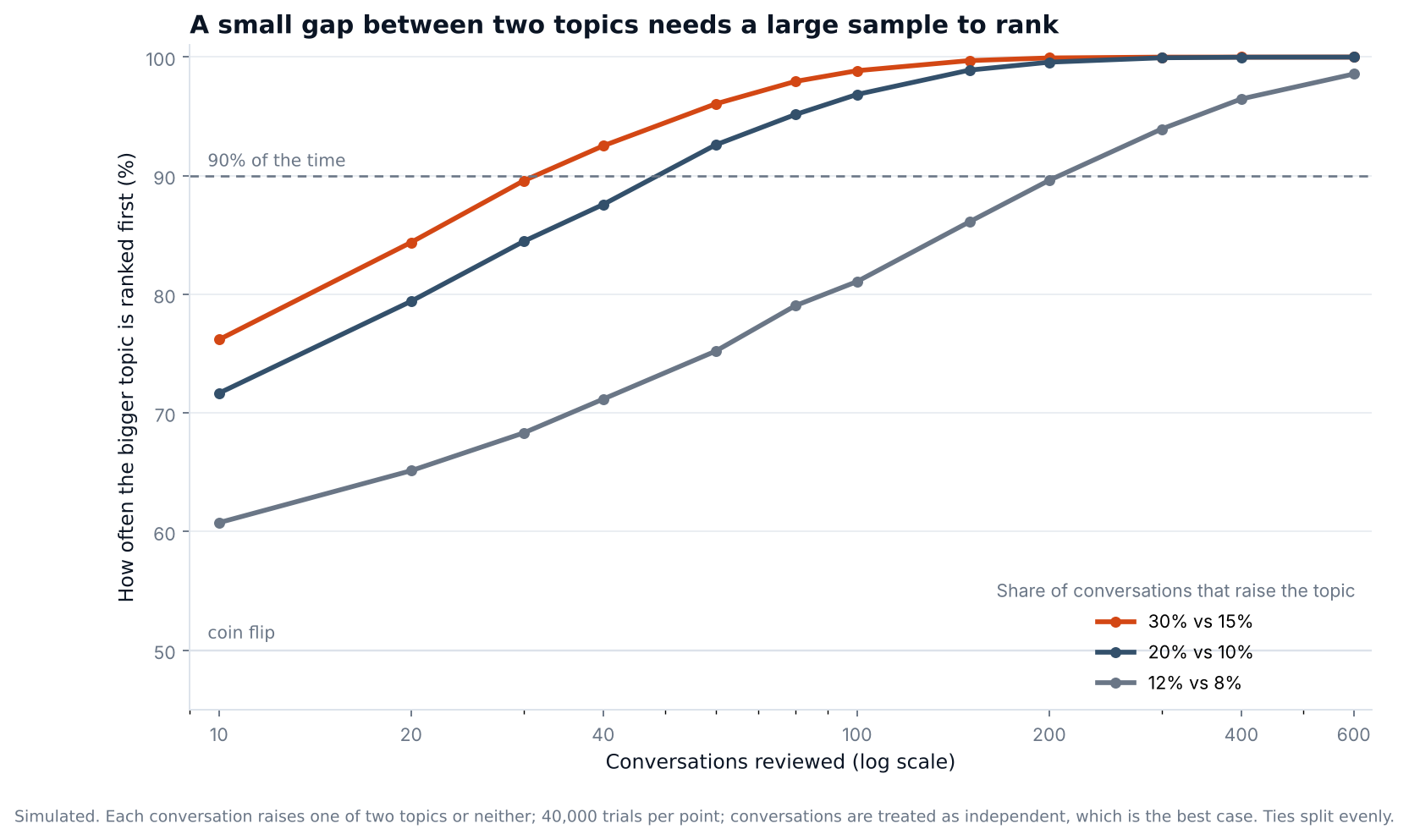
Figure 2. How often the bigger topic is ranked first. Simulated, treating conversations as independent, which is the best case
With 30 percent against 15 percent, the right topic comes first about 92 percent of the time at 40 conversations. For 20 percent against 10 percent it takes about 60. For 12 percent against 8 percent it takes about 200 to reach the same level. Being right most of the time is different from being clearly beyond chance. At a 5 percent significance level with 80 percent power, the gaps of 30 against 15, 20 against 10 and 12 against 8 need about 150, 228 and 974 conversations. The worksheet's Rank check tab calculates this for any two shares.
Once a topic earns a slot, writing it as a tracked prompt is a separate job. Our guide to designing prompts for AI visibility tracking covers it, and the B2B buyer prompt library gives you starting wording.
If you do have a prompt volume figure
Three habits keep a figure from doing more than it can. These are our judgment. Label it in reports as modeled, with the provider's name for the method and the date. Use it to order topics inside a funnel stage, next to your own counts, not to forecast visits. And do not multiply it by a rate to produce a traffic or revenue number: nothing we found shows how a prompt count translates into people who see a brand or visit a site. For a wider view of which metrics hold up, see our piece on the north star metric for B2B AI search.
Frequently asked questions
Does prompt volume exist the way keyword volume does?
Not in the same sense. Keyword volume is an average count of searches that a search engine holds and tools estimate. The AI platforms hold the prompt logs, and what they publish is topic shares for a product, not counts by prompt. A prompt volume figure from a tool is therefore an estimate, and its quality depends on the method behind it.
Can I use keyword volume to choose which prompts to track?
As one signal for how large a topic is in search, yes. As a prompt count, no. Prompts are much longer than searches, and engines shorten them behind the scenes. Combine keyword demand for the topic with how often buyers raise it in your own conversations.
Where can I see how many people ask AI about my topic?
You cannot see a count. You can see impressions of your pages in Google's AI features in Search Console, visits from AI assistants in Analytics, and what buyers raise in your own calls and forms. Together they approximate interest in a topic, and none shows a prompt.
Should I track a prompt that has no volume figure?
Yes, if buyers raise the topic in conversations and decisions turn on it. A volume figure is not required, and many real buyer questions will have none. If a topic has no signal at all, park it and revisit when you have more conversations.
How should I explain a volume figure to leadership?
Say which kind it is, measured or modeled, and who produced it. Report shares and ranges, not single counts, and say what it was checked against. If it was not checked, say so.
Tag one month of calls before you buy a number
Take the last month or two of sales calls, support chats and onboarding notes. Aim for 100 or more conversations. Tag each with the buyer questions that came up, then enter the counts in the worksheet, add a decision value, and see which topics land in Track first. If you are weighing a prompt volume figure from any provider, run the three-topic test against your tags before it shapes the list.
When the list has an order, the AI Search Visibility Checker gives you a quick first reading on a top-ranked topic before you commit a tracking slot to it. AI Search Intelligence tracks each prompt individually, so a topic you ranked high can be followed on its own history.