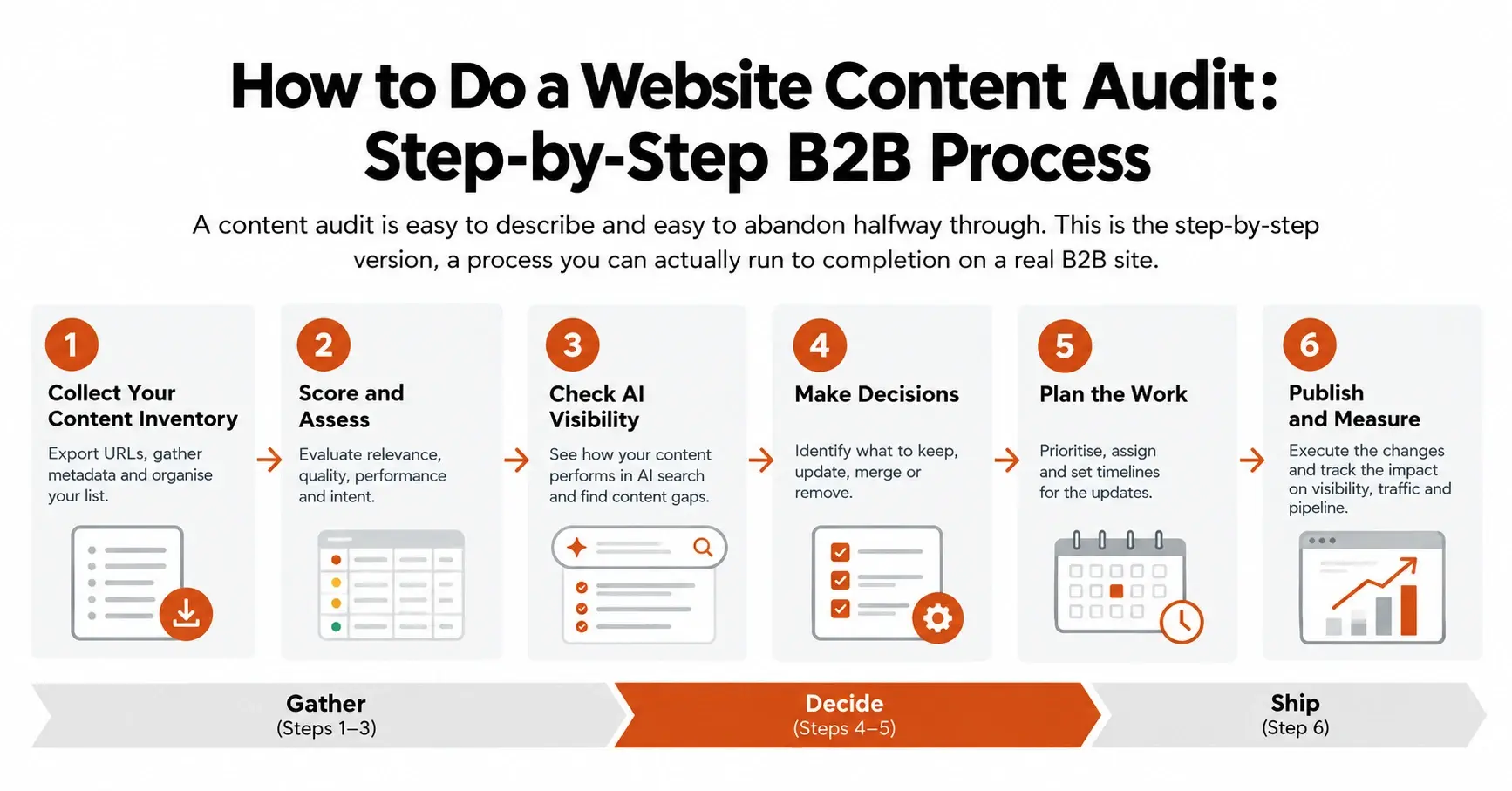


A content audit is easy to describe and easy to abandon halfway through. Teams start a spreadsheet, export a few hundred URLs, lose momentum around the scoring, and never reach the part that matters: deciding and acting. This is the step-by-step version, a process you can actually run to completion on a real B2B site, with the AI-search checks built into the steps rather than bolted on at the end. If you want the concepts behind it first, the scoring dimensions and the decision framework, start with what a content audit is and why the criteria changed for AI search; this piece is the runbook that puts that into practice.
There are six steps. The first three gather what you need, the next two turn it into decisions, and the last one ships the work. A free spreadsheet you can copy is included near the end.
Before you start: set the scope and the goal
A website content audit goes sideways when it tries to score everything at once. Decide the scope first. A full audit covers the whole site; a focused one covers a segment, the blog, the product and comparison pages, or one cluster. For a first pass, or a stretched team, start with the pages that touch a buying decision and expand later. A finished audit of your fifty most important pages beats an abandoned audit of five hundred.
Set one goal too, because it shapes what you weight. "Recover pages that rank but are not cited," "clear out thin content before it drags the site," and "find the clusters we have no page for" lead to different priorities. Write the goal at the top of the sheet so every decision ladders back to it.
Step 1: Build the inventory
Start with a complete list of URLs. A crawler like Screaming Frog or your CMS export gives you every page; pull the list and drop it into your spreadsheet. For each URL, capture the basics you will sort and filter on later: title, content type (blog, comparison, product, use-case), publish or last-updated date, and the buyer or funnel stage the page serves. Add the topic cluster each page belongs to if you have one mapped, because that is how you will spot duplicates and gaps later.
Do not skip the metadata to save time. The date and content-type columns are what let you filter the audit into manageable batches, and the cluster column is what turns a flat list into a coverage map.
Step 2: Pull performance data
Now add how each page performs. From your analytics, pull organic traffic and its trend over a consistent window, long enough to be meaningful, usually the last six to twelve months. From Search Console, add the queries each page earns and its rankings for them. Add conversions or pipeline influence where you can attribute them, and backlinks if you track them. Pull every metric over the same date range so pages are comparable.
This is the data a traditional audit runs on, and on its own it tells you what ranks and what gets visited. It does not tell you what gets cited, which is the next step and the one that changes the decisions.
Step 3: Add the AI-visibility check
This is the step a classic audit does not have, and it matters because analytics will never show it: a citation in an AI answer is not a click you can see in a traffic report. So you check it directly. For each important page, or at least each cluster, look at whether you are cited in AI answers for the questions that page targets, whether the page is citable as it stands, meaning accurate, specific, and structured so a model can lift a self-contained answer, and which buyer prompts it should be answering.
You do not have to do this by hand for every URL on a large site. Do it for the pages that shape buying decisions and for a sample of each cluster, enough to see the pattern. The output is three new columns on your sheet: cited in AI (yes or no), citability (strong or weak), and the target prompts. Those columns are what separate an AI-era audit from a traffic report, and they are usually where the surprises are, the page that ranks on page one and is cited nowhere.
Step 4: Score each page
With the data in place, score each page. This is where the audit scorecard does the work: the classic columns (traffic, rankings, conversions, freshness) plus the AI-era ones (cited in AI, citability, cluster and duplication, decay, and differentiation). You are not writing an essay per page; you are marking each column so a decision becomes obvious at a glance. Color-coding or a simple high or low flag per column is enough.
The point of scoring is speed later. Once every page has its marks, the decision for most of them is clear without re-reading the page, which is what keeps the audit from stalling.
Step 5: Decide one action per page
Every scored page gets exactly one action. Run each through the same short set of questions, the audit decision flow: does it still serve a live buyer question; is it a near-duplicate of a stronger page; is it accurate, specific, and citable now. The answers route it to keep, improve, consolidate, refresh, or prune-and-redirect. Record the action in a decision column, and add a priority and an owner while you are there, so the sheet becomes a work plan rather than a diagnosis.
Weight the priority by role, not just traffic. A comparison or product page that shapes a deal earns a high priority even on modest traffic; a years-old post with no traffic, no citations, and no strategic role is a low-effort prune. The decision column is where the audit stops being analysis and becomes a list of things to do.
Step 6: Execute in sprints, then re-measure
A list of per-page actions is hard to work through one page at a time, so batch it. Group the decisions by action and run each as a work stream: clear the prunes and redirects in one pass, do the consolidations with their 301s together, then work the improve-and-refresh batch by priority, and leave the keeps with a note to monitor them.
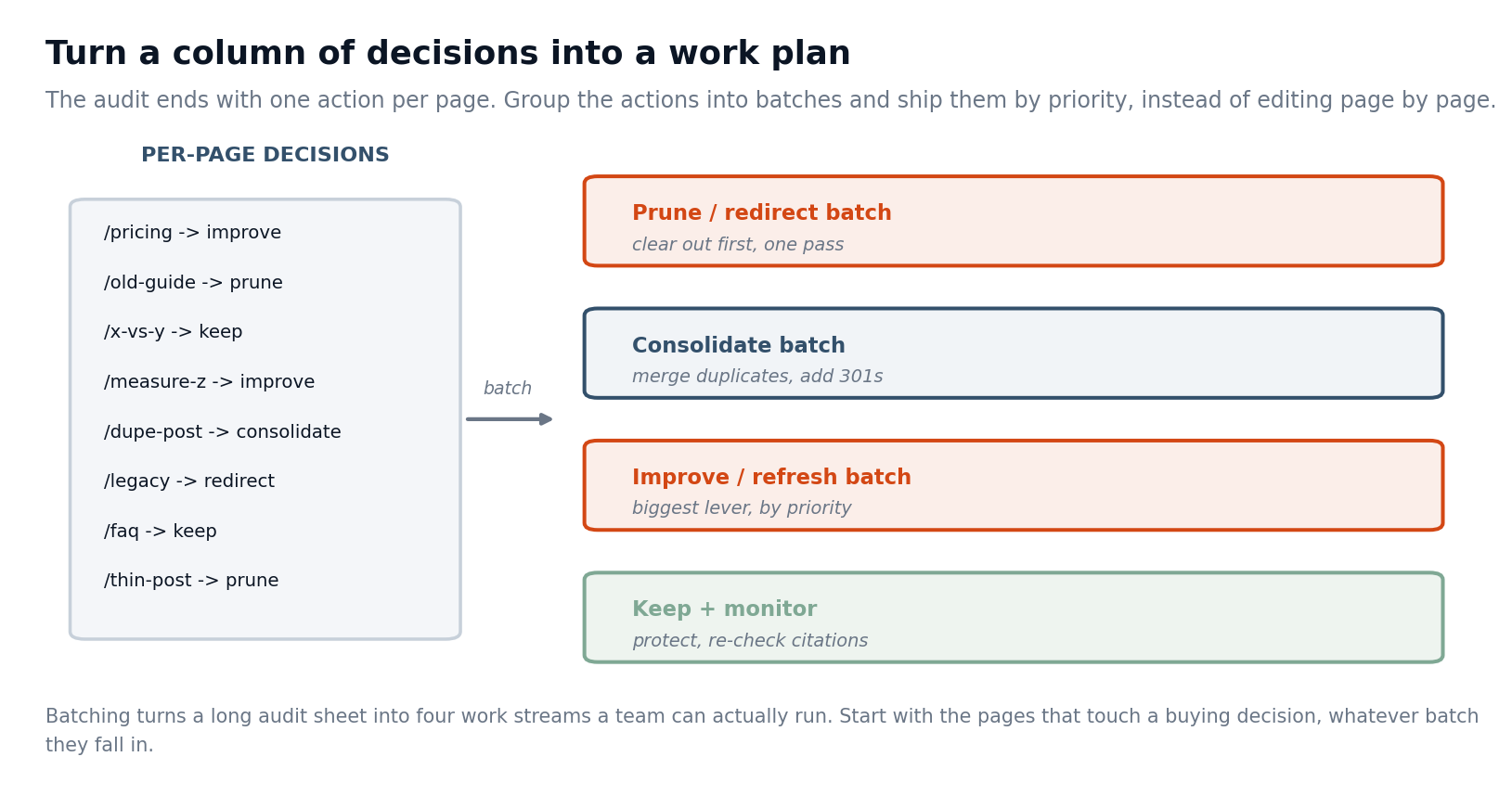
Group the per-page decisions into batches and ship them by priority. Batching turns a long audit sheet into a few work streams a team can actually run.
Start with the pages that touch a buying decision, whatever batch they fall in, because that is where the return is. The consolidations and refreshes each have a deeper method: the editing and pruning pass for merging and cleanup, and the refresh decision for pages whose facts have aged. Then set a date to re-measure, because the audit is only worth the effort if outcomes change.
One page through the six steps
To see how the row fills in, follow a single URL. Take a pricing page. Step one, inventory: URL captured, type "product," last updated eighteen months ago, stage "buyer," cluster "tools." Step two, performance: traffic is high and flat, it ranks around position eight, conversions are decent. On the classic data alone you would leave it alone. Step three, the AI-visibility check: it is not cited in AI answers for "which tool does X" or "is X worth it," its answer is buried rather than self-contained, and a check shows a second, weaker page covers the same comparison.
Step four, score: strong on the classic columns, weak on cited-in-AI and citability, flagged as a duplicate. Step five, decide: it serves a live question and is the stronger of the two pages, so the weaker one consolidates into it, and because the facts are stale and the answer is buried, the action is improve-and-consolidate at high priority. Step six, execute: it goes in the consolidate batch and the refresh batch, scheduled first because it touches a deal.
One row, six steps, one clear set of actions, all traceable to what the columns said. Multiply that across the sheet and the audit becomes a work plan.
The spreadsheet: columns to use
You can run all of this in one sheet. Set up these columns, grouped so the sheet stays readable: identity (URL, title, content type, last updated, buyer or funnel stage, cluster), performance (organic traffic and trend, top keyword rank, conversions or pipeline, backlinks), AI visibility (cited in AI, target prompts, citability, decayed), and decision (action, priority, owner, due, notes). A downloadable version with these columns and a few sample rows is attached, so you can copy it and start filling in your own URLs.
The identity and performance columns you likely already gather. The AI-visibility group is the addition that makes this an AI-era audit, and the decision group is what turns the sheet from a report into a plan. Keep it to one row per URL and resist adding columns you will not act on.
Keep the audit from stalling
Most audits fail in execution, not in theory, so a few habits keep this one moving. Timebox the scoring: give each page a quick high or low per column and move on, because a perfect rubric you never finish is worth less than a rough one you complete. Automate the gathering: pull traffic, rankings, and the URL list in bulk rather than page by page, and reserve your attention for the AI-visibility check and the decisions, which is where judgment actually adds something.
Enforce the one-action rule: every page gets exactly one decision, so nothing sits in limbo. Assign an owner and a due date in the sheet the moment you decide, because an action with no owner does not happen. And batch the work rather than editing page by page, so the team runs a few clear work streams instead of a hundred disconnected tasks. The difference between an audit that changes outcomes and one that dies in a tab is almost always execution discipline, not analysis.
How long it takes, and how often
The gathering is the slow part; the deciding is fast. For a focused audit of your most important pages, the inventory and data-pull are a day or two of work, much of it automatable, and the scoring and decisions are an afternoon once the data is in. A full-site audit scales with the number of URLs, which is another reason to start focused.
On cadence, a full pass once or twice a year with lighter continuous monitoring of your highest-value pages in between is the pattern most B2B teams can sustain. Watch the comparison and product pages and the pillars continuously, so a page that loses citations or goes stale gets caught in weeks rather than at the next annual review.
Measure what the audit changed
Finish by measuring the outcome, not the activity. After you execute, check whether the pages you improved start getting cited for their target prompts, whether consolidations lifted the surviving page, and whether the gaps you filled earned new citations. You can track citations across engines over time and read the results against the decisions the audit made, which gives you the baseline for the next audit. Traffic still counts, but the number that tells you an AI-era audit worked is whether more of your library is cited than before.
Run the six steps in order, keep the sheet to one action per page, and ship the work in batches, and a website content audit stops being the project that stalls in the spreadsheet and becomes the routine that keeps your content earning its place.
If you want a quick read on which pages are already cited before you start, the AI Search Visibility Checker gives you that picture. And for the citation data that makes step three precise, page by page and across engines, AI Search Intelligence tracks it over time, so each audit is scored on what actually gets picked up.