


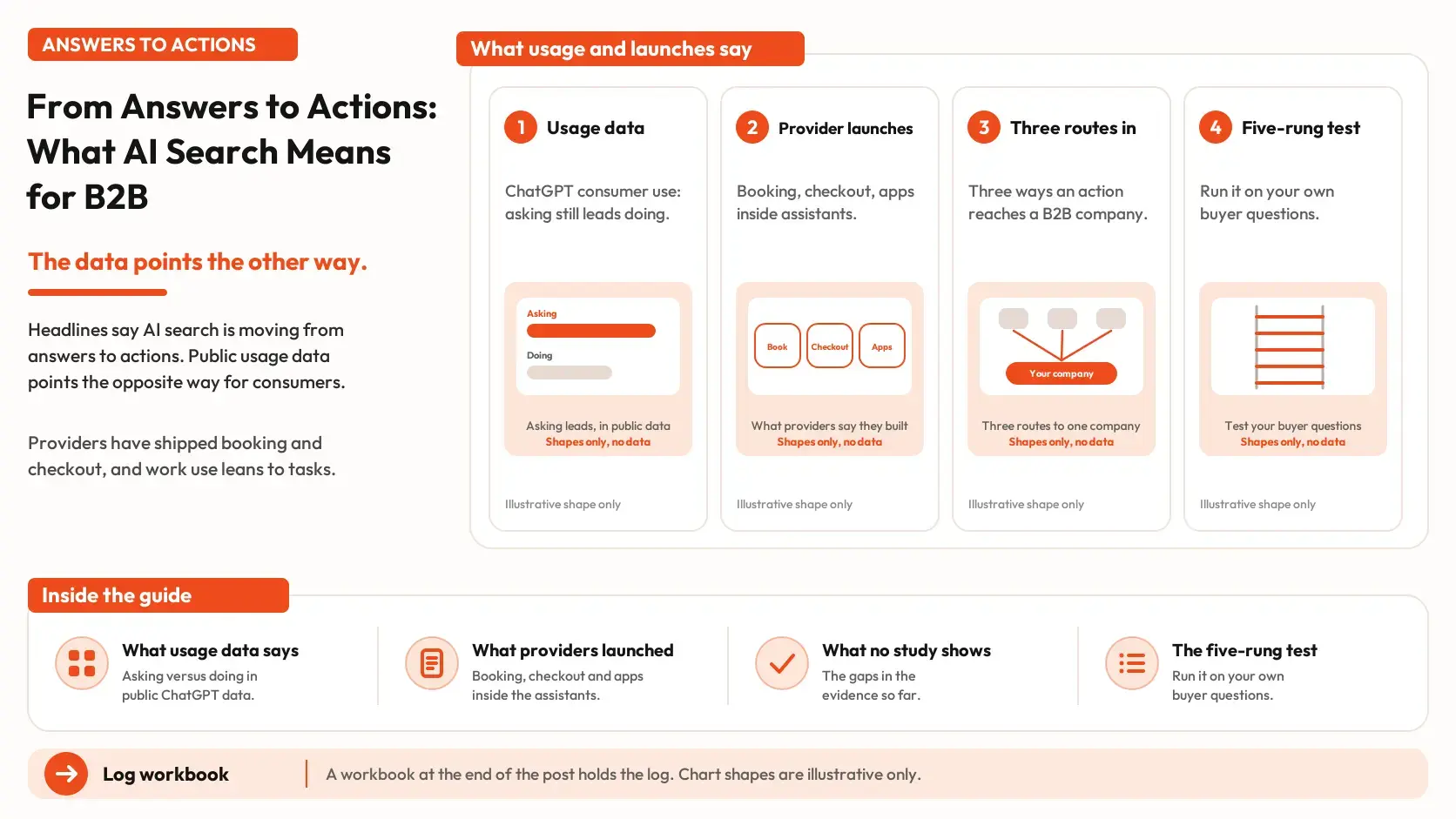


AI assistants can now book, check out and use apps. But does that mean people are using AI to take action more often than they use it to ask questions? OpenAI’s usage data suggests otherwise. By late June 2025, ChatGPT consumer use was roughly 52% asking and 35% doing, despite the growing range of actions assistants can perform. Work-related use, however, leans more toward tasks.
This post examines what the data and product launches tell us, how AI-driven actions can reach B2B companies, and what remains unproven. It ends with a five-step test for your own buyer questions and a workbook to record the results. For how agents navigate B2B websites, see designing B2B sites for AI agents. For how they evaluate vendors, see agentic buying and machine customers.
What usage data shows so far
The paper is How People Use ChatGPT, an NBER working paper from September 2025 by researchers at OpenAI and Harvard. It classifies a random sample of about 1.1 million consumer-plan conversations, one message each, as Asking, Doing or Expressing. Asking is seeking information or advice. Doing is a request that the chatbot perform a task for the user. Across May 2024 to June 2025 the split was about 49 percent Asking, 40 percent Doing and 11 percent Expressing. The authors write that Asking and Expressing grew much faster than Doing over the year. Among work-related messages in July 2025, about 56 percent were Doing, 35 percent Asking and 9 percent Expressing.
Two cautions apply. Doing covers any request to produce an output, and the abstract says writing dominates work-related tasks, so Doing is not the same as completing a purchase or a booking. And the sample is consumer plans only. OpenAI's later asking-to-doing report, dated August 6, 2026, says people are more than twice as likely to use ChatGPT to complete a task or create something at work than outside it, and that asking remains the largest category outside work. Its data page says the data likely underrepresents business and technical use cases.
Anthropic's Economic Index looks at a different slice. In its November 2025 report, directive conversations on Claude.ai, where the user hands over a task, rose from 27 percent in late 2024 to 39 percent in August 2025. In a random sample of first-party API transcripts from August 2025, 77 percent showed automation patterns and 12 percent showed augmentation. Anthropic is a model provider, and the report measures automation of tasks, not buying.
Figure 1 puts these numbers side by side. The studies use different definitions and samples, so the bars are not comparable across the two panels.
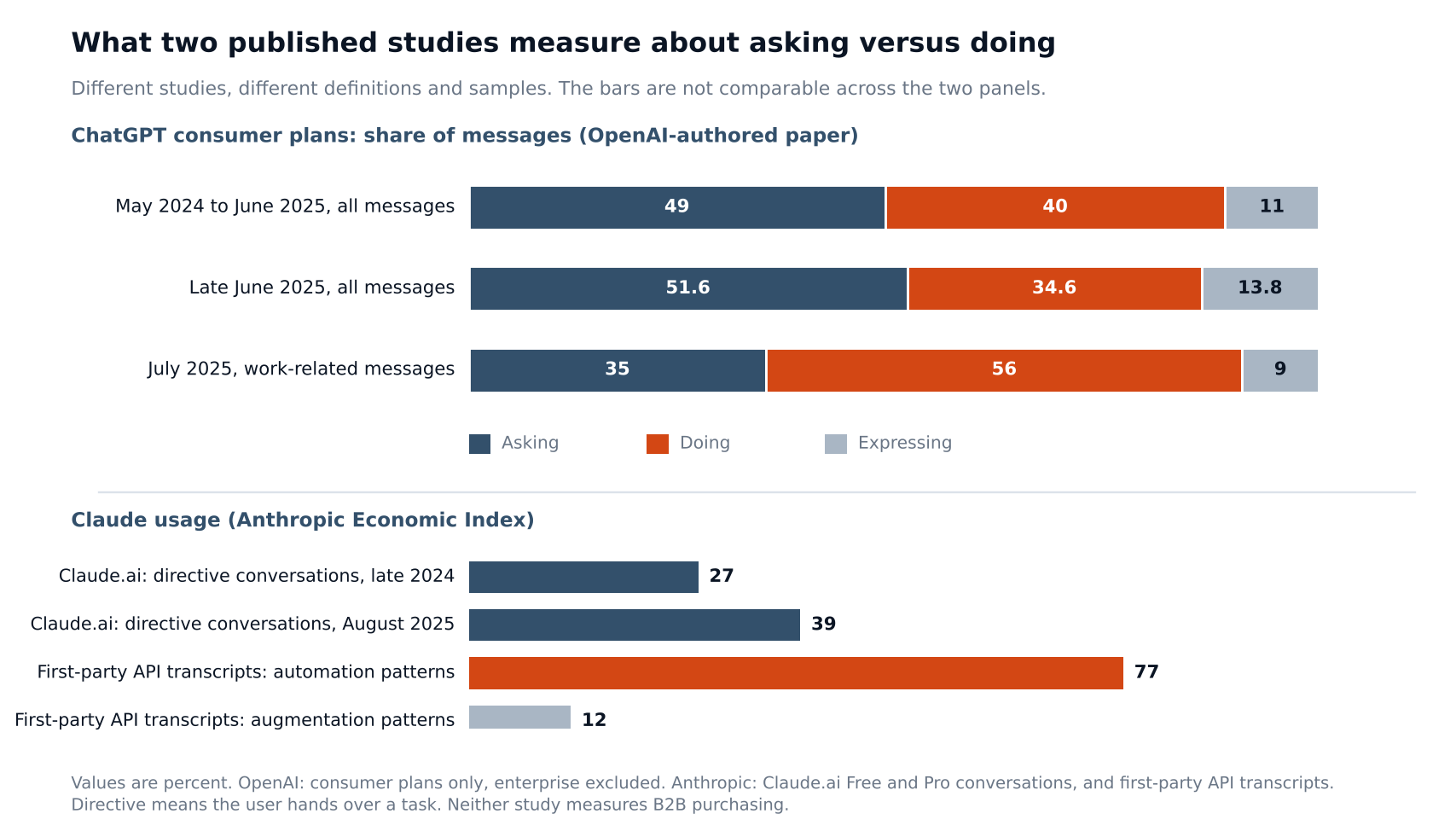
Figure 1. Two published measures of asking versus doing. Values are percent. Neither study measures B2B purchasing.
For B2B buying specifically, the closest measure we found is a Gartner release from March 9, 2026. It describes a survey of 646 B2B buyers fielded in August and September 2025. Of those buyers, 67 percent prefer a rep-free experience and 45 percent reported using AI during a recent purchase. The release does not say which tasks the AI performed.
What providers have shipped
Table 1 lists five launches from provider pages. Each page is the provider describing its own product, dated at publication, and products change, so check the current state before relying on any row.
| Surface | What the page says it does | Page date | Limits the page states |
|---|---|---|---|
| ChatGPT agent | Browses with a visual and a text browser, runs code, uses connectors; requests permission before actions of consequence such as a purchase; refuses high-risk tasks such as bank transfers | Jul 17, 2025 | Can still make mistakes; the page now carries an "outdated" banner pointing to newer products |
| Instant Checkout | Lets U.S. users buy from U.S. Etsy sellers in chat; merchants stay merchant of record and accept or decline the order | Sep 29, 2025 | Shopify merchants listed as coming soon; merchants pay a small fee on completed purchases; product results described as organic and unsponsored |
| Apps in ChatGPT | Apps built with the Apps SDK, which is based on the Model Context Protocol, respond inside the chat; examples include Zillow, Spotify, Canva and Coursera | Oct 6, 2025; updated Nov 13, 2025 | Preview; the update extended it to Business, Enterprise and Edu; directory and monetization listed as coming later |
| Google AI Mode booking | Searches reservation sites for availability and sends users to partners such as OpenTable, Resy and Tock to finish; covers restaurant reservations, event tickets and beauty and wellness appointments | Nov 17, 2025 | U.S.; some features for Labs users; flight and hotel booking described as future |
| Perplexity Instant Buy | Lets U.S. users buy from compatible merchants in Perplexity; orders and payment go to the merchant | Undated help page | Not offered to Enterprise Pro or Enterprise Max plan users; only some categories |
Table 1. Five action surfaces as described on provider pages.
Our reading, not any provider's claim: nearly all of this is retail or local booking. The B2B-relevant pieces are the agent, which works in a browser, and apps, which reached business plans in preview. We found no provider page that describes completing a B2B contract purchase inside an assistant.
Three ways an action can reach a B2B company
Table 2 is our framing. It sorts the surfaces above by where the action finishes, because that decides what a company controls and what it can see.
| Path | Where the action finishes | Example from Table 1 | What the company controls | What it may not see |
|---|---|---|---|---|
| Works on your site | An agent clicks through your pages in a browser | ChatGPT agent | Whether the page can be read and completed | The run, unless it leaves a visit |
| Finishes inside the surface | The assistant completes the step through an app or a protocol | Instant Checkout, apps | Whether the company is connected, and the order accept or decline | The question that led to it |
| Hands off with a link | The assistant names you and sends the buyer to a page | Google booking partners | The destination page and what it says | Whether the buyer arrived because of the answer |
Table 2. Three paths from answer to action.
The first path is a site question, and the agents post covers it. The second depends on connections the provider has opened, and for B2B that currently means apps and the protocols described in the machine-customer post. The third is available to every company today, because an answer can name you and point to a page whether or not any provider has built an action surface. It is also the path where a wrong or stale link costs the most, since the buyer sees only the answer.
An action that finishes inside the surface may leave no visit to count. The post on dark AI search funnels covers that gap, and the GA4 referral post covers the visits you can see.
Climb the ladder: a test for the path to your company
A buyer's path through an assistant can be broken into five rungs. Inform is a plain question about the problem. Compare asks how options differ. Shortlist asks which vendors fit a described company. Request asks how to get a quote, demo or trial. Act asks the assistant to take the buyer to the page where they do it. Write four prompts per rung in a buyer's wording, with a placeholder where your company's name goes.
For each run, log three results in order. Named: your company appears in the answer. Route given: the answer offers a link or clear step that leads to you. Route correct: following it lands on the page you intended. Each result is only logged when the one before it is yes, so the log shows where the path leaks. Run each prompt on at least two assistants, in the same words each time, and stop before any form is submitted.
Figure 2 shows an invented log for an invented accounts-payable software company. It is a model, not a measurement. Round 1 has eight runs per rung. The weakest step moves along the ladder: the answers name the company often at the low rungs, but the route to it breaks at Request and Act, where Round 1 produced no correct routes. Round 2, after invented fixes, reached 11 of 40 runs end to end against 6 of 40 in Round 1. The ranges overlap, so the log does not support a claim of change.
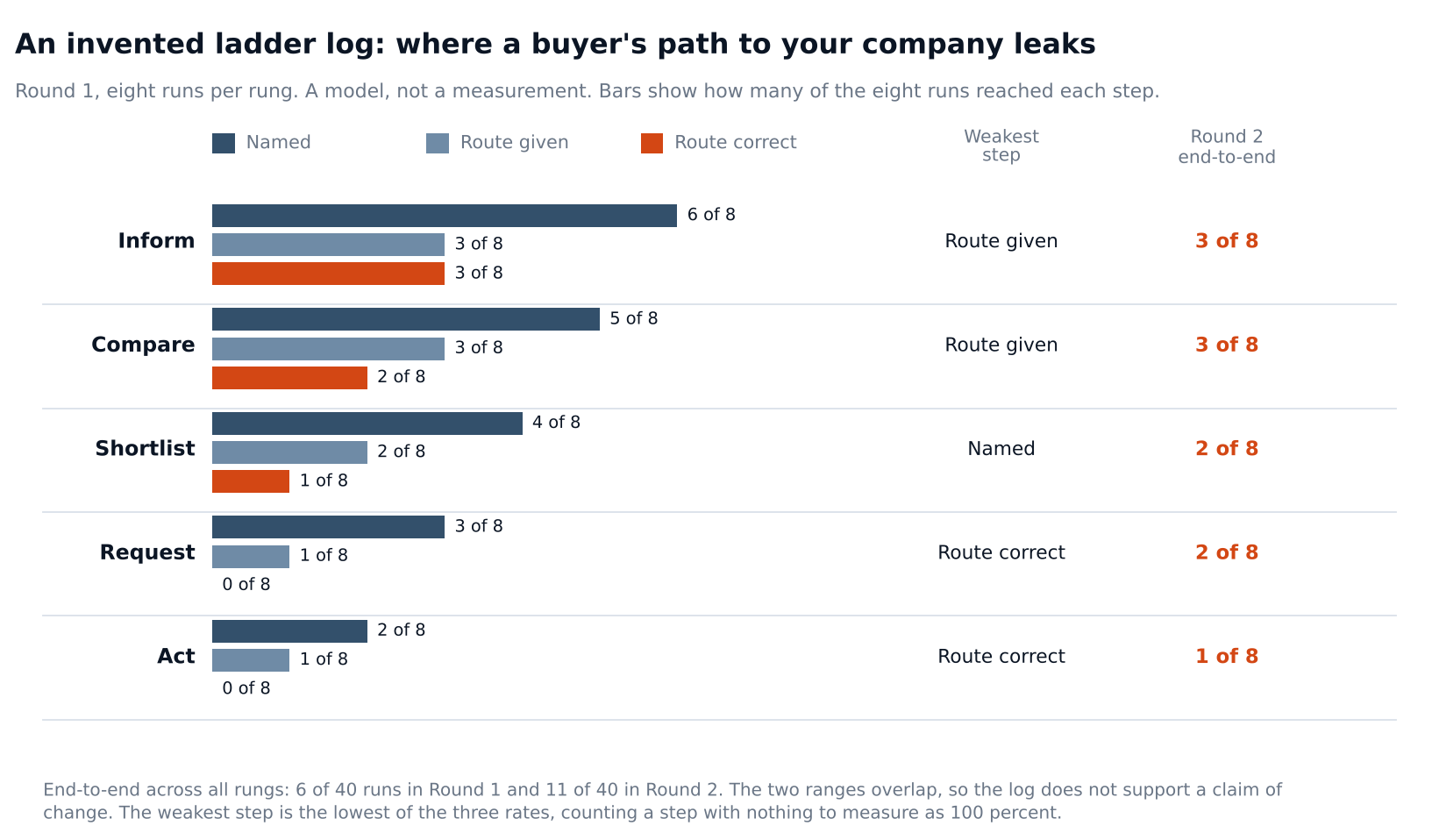
Figure 2. An invented ladder log. A model, not a measurement.
Answers vary from run to run, so read a single run as one draw. The post on model variability explains why, and the range in the workbook is a rough guide because repeated runs of one prompt are not independent.
Prepare the rung you control
Start with the rungs you can influence today, which are naming and the route.
- Write buyer prompts for each rung from the questions sales hears most. The B2B buyer prompt library is a source of wording.
- For the Request and Act rungs, decide the one page where each action should land, and make sure that page states what it is for in text, with the form or booking control visible.
- Run each prompt on at least two assistants, more than once, with no customer or personal information in any prompt.
- Log the three results, then find the weakest step for each rung.
- If Named is weakest, the answer leaves you out, and the fix is not on your destination page. If Route given is weakest, the answer names you but does not point anywhere, so check that the destination page is the obvious one for that question. If Route correct is weakest, the page the answer points to is wrong, moved or unclear, so fix that page first.
- Ask sales how recent buyers arrived and which assistants they mention before you decide which action surfaces to prepare for.
None of these steps depends on providers extending checkout to B2B. They are the same facts and pages a person comparing vendors would use.
Keep the prompts, runs and results in one workbook
The Answer-to-Action Ladder Log holds the prompts, the runs and a summary. The summary shows each rung's results for the round you pick, the weakest step, an end-to-end rate with a range, and results by assistant and by round, with checks for rows that are missing or inconsistent. Every grey row is invented. Replace them with your own prompts and results.
Frequently asked questions
Is AI search really moving from answers to actions?
Providers are shipping action features, and work use leans toward tasks. The one broad usage measurement we found shows asking still larger than doing across consumer messages. Both statements hold, and neither measures B2B buying.
What is agentic search?
We found no single accepted definition. In this post, an action is anything beyond a text answer: a booking, a purchase, an app, a form or a click-through on the buyer's behalf. Agentic search, as the term is commonly used, means an assistant that carries out steps like these.
Can buyers complete a B2B purchase inside an AI assistant today?
We found no provider page that describes it. The checkout pages describe retail merchants, and apps reached business plans in preview. A buyer can still be named and pointed to your site, which is the path every company controls.
Should we build a ChatGPT app?
OpenAI's launch page describes the Apps SDK, built on the Model Context Protocol, as a preview, and we found no outcome evidence for B2B companies. Run the ladder first. If the log shows buyers reaching the Request rung and stalling, an app is one way to shorten that path, and the decision depends on what action it would finish.
How is this different from the agents post and the machine-customer post?
The agents post covers whether an agent can read your pages and finish a task on them. The machine-customer post covers what a buyer's agent compares and who may say yes. This post covers what an assistant does with your company along the path, and how to log it.
Walk one buyer question up five rungs this week
Pick the question buyers raise most on sales calls. Write five prompts from it, one for each rung from a plain question to taking the buyer to the page where they act. Run each on two assistants in the same words, stop before any form is submitted, and log whether you were named, whether the answer gave a route and whether the route landed on the page you meant. Do not put customer or personal information in any prompt. Fix the weakest step for the rung that matters most first.
The ladder begins with a plain question. For a first reading of how an answer treats your company on one of them, the AI Search Visibility Checker gives you one. To follow the same prompts over time, AI Search Intelligence tracks individual prompts.