




In its strategic predictions for 2026, Gartner wrote that by 2028, 90 percent of B2B buying will be AI agent intermediated, pushing over $15 trillion of B2B spend through AI agent exchanges. Gartner labels it a prediction. It is not a measurement, and we found no independent measurement of how much B2B buying software agents handle today.
This post separates what is forecast from what is measured, summarizes two simulations of how agents choose between sellers, and covers the layer that decides who may say yes to an agent's purchase request. It then lists the offer facts a seller can prepare. A workbook at the end holds a register of those facts and an invented model of how two selection rules treat the same six offers. It does not repeat how agents read a web page, which the post on designing B2B sites for AI agents covers.
A forecast, two abstracts and two research releases
The prediction sits in Gartner's Strategic Predictions for 2026, published November 14, 2025. The same page says procurement is being reshaped by autonomous agents, that SEO and pay-per-click will give way to what Gartner calls agent engine optimization, and that products will need to be machine-readable.
Gartner's research abstracts add direction but no figures. A January 2024 abstract, Machine Customers Are Coming to Disrupt B2B Sales, says nonhuman agents are automating simple transactional B2B purchases and handling specific buying tasks inside complex journeys. It says sellers will have less influence as access to human buying-group stakeholders declines, and that a machine customer buying experience will be critical. An August 2026 abstract says B2B procurement teams are adopting AI buying agents for buying and replenishment tasks. The reports behind these abstracts are for Gartner clients, so we read the abstracts only.
What buyers say they want from AI is a separate question. A Gartner press release dated May 20, 2026 describes a survey of 645 B2B buyers fielded from August to September 2025. Of those buyers, 69 percent prefer to validate AI-generated insights with sales reps, and 70 percent prefer a completely digital, self-service experience. They used an average of seven information sources, and 45 percent used generative AI, mainly to gather vendor and product information. The survey asks about generative AI, not agents. It shows how buyers treat AI output today, not how much buying agents do.
Forrester's January 21, 2026 release on The State of Business Buying puts each buying decision at 13 internal stakeholders and nine external influencers, with procurement a decision-maker in 53 percent of cycles. It calls generative AI searches the starting point for B2B buyers and says answer engines often deliver incomplete or unreliable information. The release does not mention agents and gives no sample size.
Our reading, not any source's conclusion: with groups that large, the near-term role of an agent looks more like a participant that takes on tasks than a replacement for the group. Gartner's 2024 abstract describes tasks in the same way.
Three kinds of buying work an agent might take
Table 1 is our framing, built to show where a seller's records matter. It is not a Gartner taxonomy.
| Kind of work | Example | Who decides | What the seller controls |
|---|---|---|---|
| Replenishment | Reorder a known item at agreed terms | A rule the buyer set in advance | Price and stock facts, and a channel that accepts the order |
| Research and shortlisting | List the suppliers that meet a specification | A person reviews the list | Facts stated in a form a machine can read, and matching across places |
| Quote comparison | Ask several sellers for the same quote and rank the replies | The agent ranks, then a person or a rule approves | Complete quote fields, reply time and who may commit |
Table 1. Three kinds of buying work and what a seller can prepare for each.
The first row maps to Gartner's simple transactional purchases. The other two sit inside the complex journeys that Gartner's abstract describes as having specific tasks handled by agents.
How agents choose between sellers in two simulations
Two preprints simulate markets where software agents buy and sell. Neither is B2B, and both use models from 2025, so read them as evidence of what agents can do, not of what B2B agents do.
The first is Magentic Marketplace, from Microsoft and Arizona State University, posted October 31, 2025. Assistant agents represent customers and service agents represent businesses, in restaurant and contractor markets. The smallest scenario had 33 customers and 99 businesses, the medium one 100 customers and 300 businesses, and each condition ran five times. The authors report a strong first-proposal bias: in some settings the first proposal an agent received was chosen 60 to 100 percent of the time, while the third was chosen almost never. They also report that giving agents more options often lowered the quality of their choices, with large differences between models. Some models were vulnerable to manipulation tactics such as claims of authority, social proof and prompt injection.
The second is What Is Your AI Agent Buying?, a preprint from authors at Columbia Business School, Yale and a company called MyCustomAI, last revised December 15, 2025. It tests agents on 64 consumer products across eight categories. Position effects were large and differed by model and version. Agents penalized a sponsored tag and rewarded a platform "Overall Pick" label. They favored lower prices and higher ratings and review counts, but the weights varied by model. One product's market share was about 45 percent with one model and 6 percent with another. A seller-side agent that rewrote product descriptions raised its product's share.
Three things hold across both. Choices depend on the model and its version, so a result you see with one agent may not repeat with another. Speed and position can matter as much as merit. And what the seller publishes, including the way a listing is worded, changed outcomes in a simulated market. None of that has been measured in B2B.
Same offers, two rules, two different picks
To make the first-proposal finding concrete, Figure 1 runs one invented request through two simple rules. Six invented sellers quote for 500 units. The first rule scores every seller on weighted price, lead time, minimum order and buyer rating, and picks the top score. The second takes the first seller to reply whose price, lead time and minimum order are all present and inside the buyer's limits.
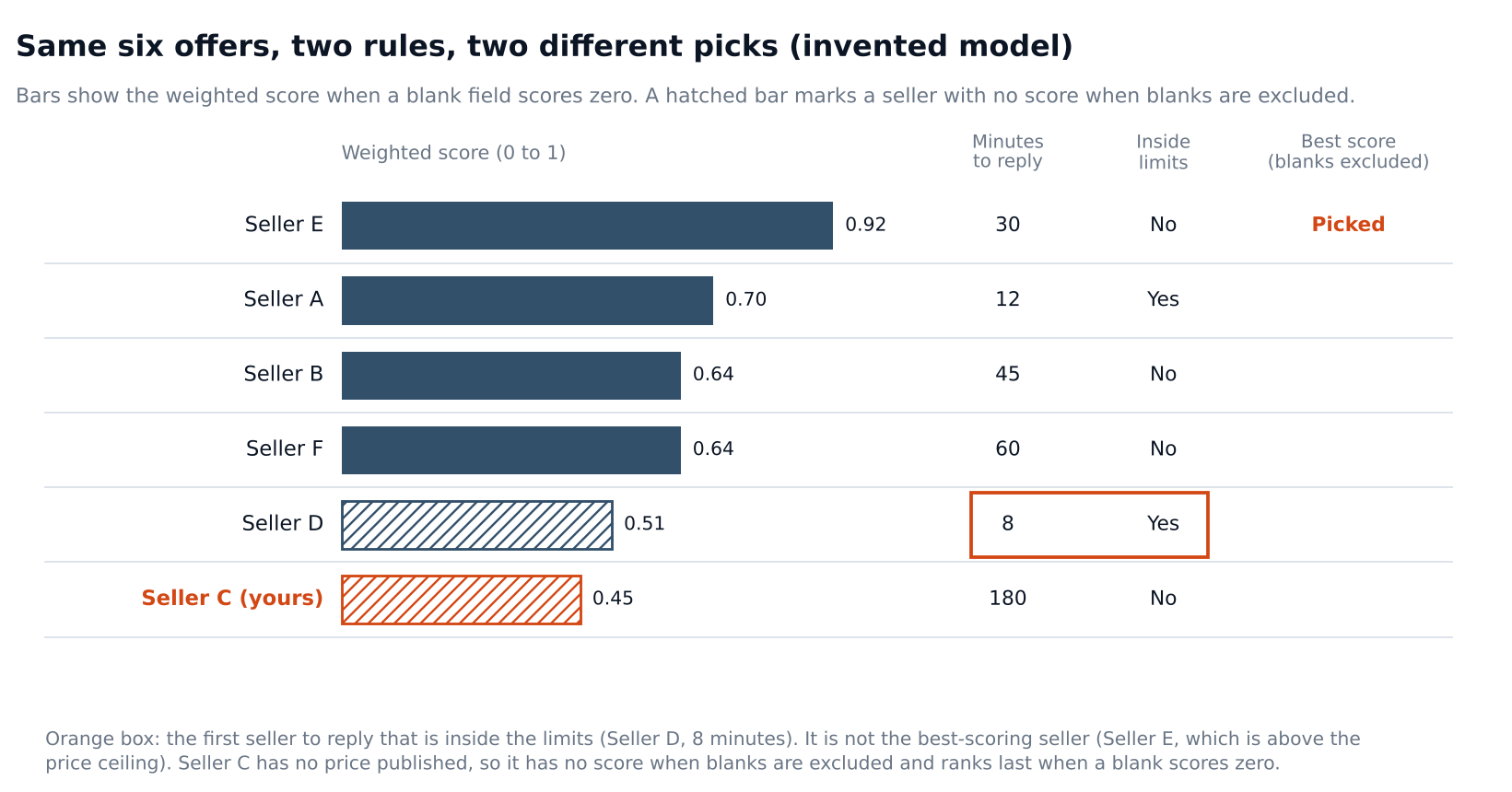
Figure 1. An invented model with six sellers. It is a model, not a measurement. Hatched bars are sellers with a blank field, which have no score when blanks are excluded.
The two rules disagree. Seller E has the best score, 0.92, but its price of 4.60 is above the buyer's ceiling of 4.50, so the second rule skips it. Seller D replies in 8 minutes, is inside every limit and wins the second rule, even though it publishes no rating and scores only 0.51 when a blank counts as zero.
Seller C is the one to watch. It has the best rating and a short lead time, but it publishes no price, only a contact line. If a comparison drops sellers with a blank field, Seller C is not scored at all. If a blank counts as zero, it ranks sixth of six at 0.45. In the model, publishing a price of 4.10 lifts it to second place with a score of 0.82. It still does not win the second rule, because it replies in 180 minutes. Cut that to 5 minutes and it becomes the first acceptable reply. The weights, limits and reply times are all placeholders. The point is only that a missing field and a slow reply can each remove a seller, and that the two rules can name different winners.
Who may say yes: mandates and merchants
Once an agent has picked, someone must authorize the purchase and someone on the seller's side must accept it. Two providers have published how they handle this for payments, and both pages describe the provider's own protocol, not an independent evaluation.
Google Cloud's announcement of the Agent Payments Protocol, dated September 16, 2025, says AP2 was built with more than 60 organizations and addresses authorization, authenticity and accountability. It describes mandates as tamper-proof, cryptographically signed digital contracts. An Intent Mandate captures the user's rules, such as price limits and timing. A Cart Mandate records the exact items and price. OpenAI's commerce key concepts page says that "OpenAI is not the merchant of record in the Agentic Commerce Protocol," that checkout state and payment processing happen on the merchant's systems, and that "the merchant accepts or declines the order."
Both pages read as retail checkout, and neither says it covers B2B. We still draw one point for sellers. In AP2 the buyer's rules are captured in advance as a signed record, and in OpenAI's design the merchant keeps the decision to accept or decline. For a seller, the practical question is who inside the company may accept a request from an agent, for which prices, discounts and terms, and where that is written down. If the answer lives only in a manager's head, a fast and correct reply is not possible. Which decisions should be central and which local is the subject of the governance post.
What a seller can prepare
Start with the facts, because every kind of work in Table 1 depends on them. For each fact a buyer's software would need to quote, compare or commit, record where it is stated, whether a machine can read it, whether it matches everywhere it appears, who owns it and when it was last checked. A fact counts as machine-readable when it is a labeled field, table or structured data on a page, not only an image, a PDF or a line that says to contact sales. Table 2 shows five rows from the invented register in the workbook.
| Fact | Where stated | Machine-readable | Same everywhere | Status |
|---|---|---|---|---|
| List price per unit | Pricing page and product pages | Yes | No | Conflicting |
| Volume price tiers | Pricing page, as an image of a table | No | Unchecked | Unchecked |
| Minimum order quantity | Product pages | Yes | Yes | Stale |
| Quote validity period | Quote PDF only | No | Unchecked | Unchecked |
| Who may approve a discount | Internal wiki only | No | Unchecked | Unchecked |
Table 2. Five rows from an invented register. Statuses are calculated from the other columns and the as-of date.
Work through the register in this order.
- List every fact a quote request would touch, from price and tiers through minimum order, lead time, payment terms, cancellation terms, certificates and availability.
- Record where each is stated today, including quote documents and internal price lists, not only the website.
- Mark whether a machine can read it. Move the facts stated only as images, PDFs or contact lines into text a machine can read first, because a blank field is the cheapest way to drop out of a comparison.
- Check whether the value matches everywhere it appears. Where two places disagree, pick one source of truth and fix the other. The post on where inaccurate AI claims come from shows how mismatched facts spread.
- Write down who may approve a discount, a non-standard term or a commitment, and the limit for each.
- Decide the route a buyer's software can use to request a quote, and how fast a reply should arrive.
- Set an owner and a re-check date for every row.
None of this depends on the 2028 forecast being right. Forrester describes generative AI searches as the starting point for B2B buyers, and the same facts are what a person comparing vendors will look for. For how buyers use those answers early in a decision, see the post on influencing early-stage buyers.
Keep the register and the model in one workbook
The Machine-Buyer Offer Workbook holds the register and the model on separate tabs, with a Summary that totals what is machine-readable, conflicting, unchecked or stale and shows where your offer lands under each rule. Every grey row is invented. Replace them with your own facts and, if you want to test the model, your own guess at what competitors would quote, and change the weights and limits to match your market.
Frequently asked questions
What is a machine customer?
Gartner uses the term for nonhuman agents that buy on behalf of a person or company. Its January 2024 abstract says they are automating simple transactional B2B purchases and handling specific tasks in complex buying journeys. It does not give a measure of how common they are.
Is agentic B2B buying happening now?
Gartner's abstracts say agents are already used for some tasks, and its prediction says most buying will be agent intermediated by 2028. We found no independent measurement of today's share, so treat the 2028 figure as a forecast and plan for tasks, not for the whole decision.
Will agents replace sales reps?
We found no source that predicts it directly. Gartner's survey found 69 percent of buyers prefer to validate AI-generated insights with sales reps, and Forrester describes large buying groups. Gartner's 2024 abstract says sellers will have less influence as access to human stakeholders declines. That is a different claim from replacement.
Should we publish different prices for agents?
We found no evidence for that, and the simulations suggest agents respond to many things that vary by model. Publish one price in text a machine can read, keep it the same everywhere, and record who may change it.
How is this different from making the site work for agents?
The site post covers whether an agent can read a page and complete a task on it. This post covers what the agent then compares and who may say yes. A seller needs both, and the facts in the register should match the pages the site test covers.
Name who can say yes to a machine's quote this week
Open a blank copy of the register and list the facts a quote request would touch, then write next to each one where it is stated and who may change it. Start with the three that decide a comparison, which are price, lead time and minimum order. If any is stated only as an image, a PDF or a contact line, put it in text first. Then write one line on who may approve a discount or a non-standard term and for how much. Do not put customer or personal information anywhere in the register.
The register covers your own records. It does not show what an AI answer says about you before a buyer arrives. For a first reading on a question you choose, the AI Search Visibility Checker gives you one. To follow the same questions over time, AI Search Intelligence tracks individual prompts.