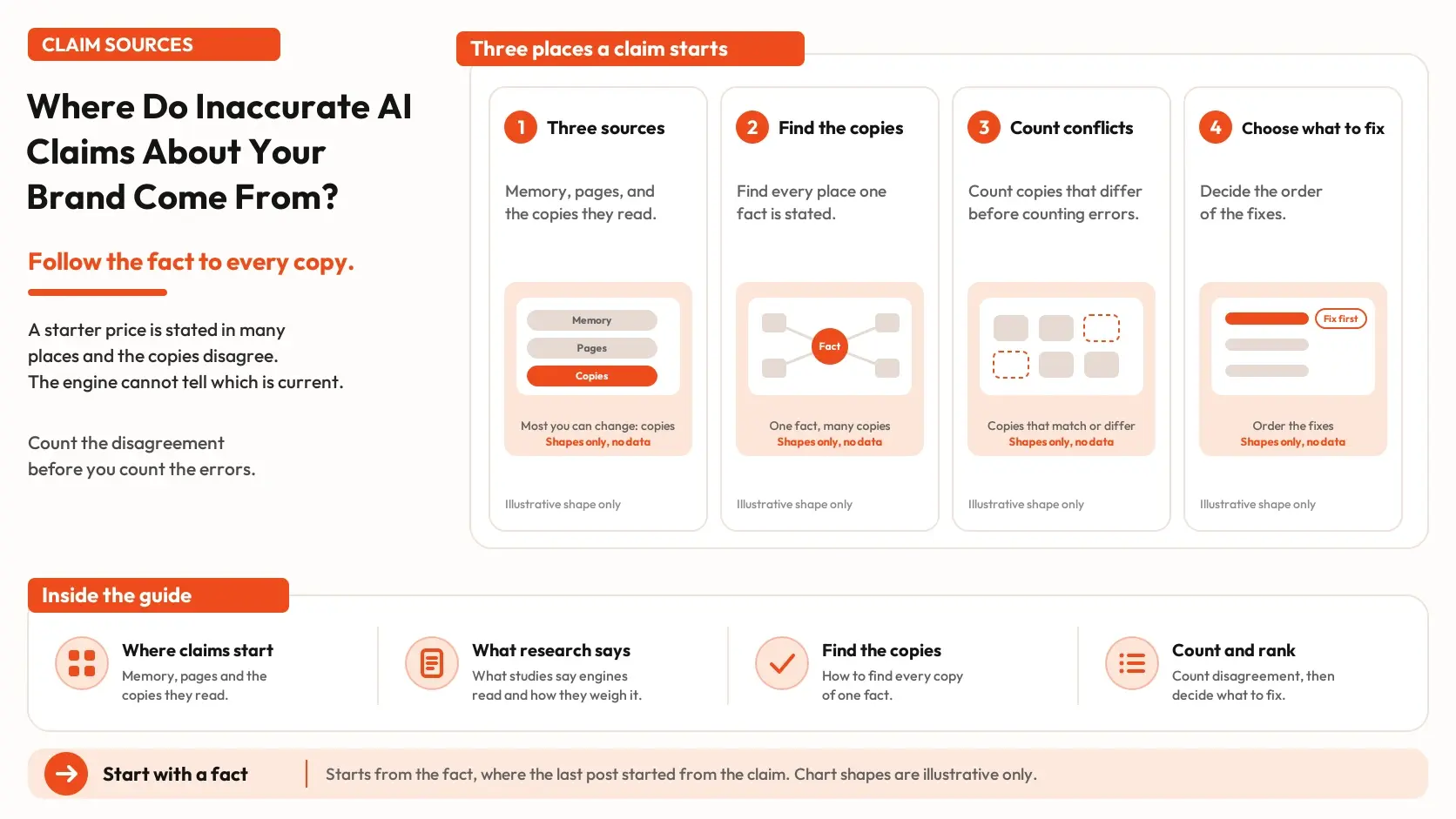


Brand A states its starter price in nine places. The pricing page says $45 per user per month. A 2024 PDF says $39. An archived page says $49. A partner page says $39, and an AI-written summary page says $29. Four of the nine copies disagree with the pricing page, and an answer engine has no way to tell which copy is current. This is an invented example, but most B2B brands would find something like it if they looked.
The previous post started from a wrong claim and traced it back to a cause. This one starts at the other end: a fact, and every place it is stated. It covers where claims can come from, what independent research says about what answer engines read, how to find the copies of one fact, how to count disagreement before you count errors, and how to decide what to fix first.
A claim can come from three places
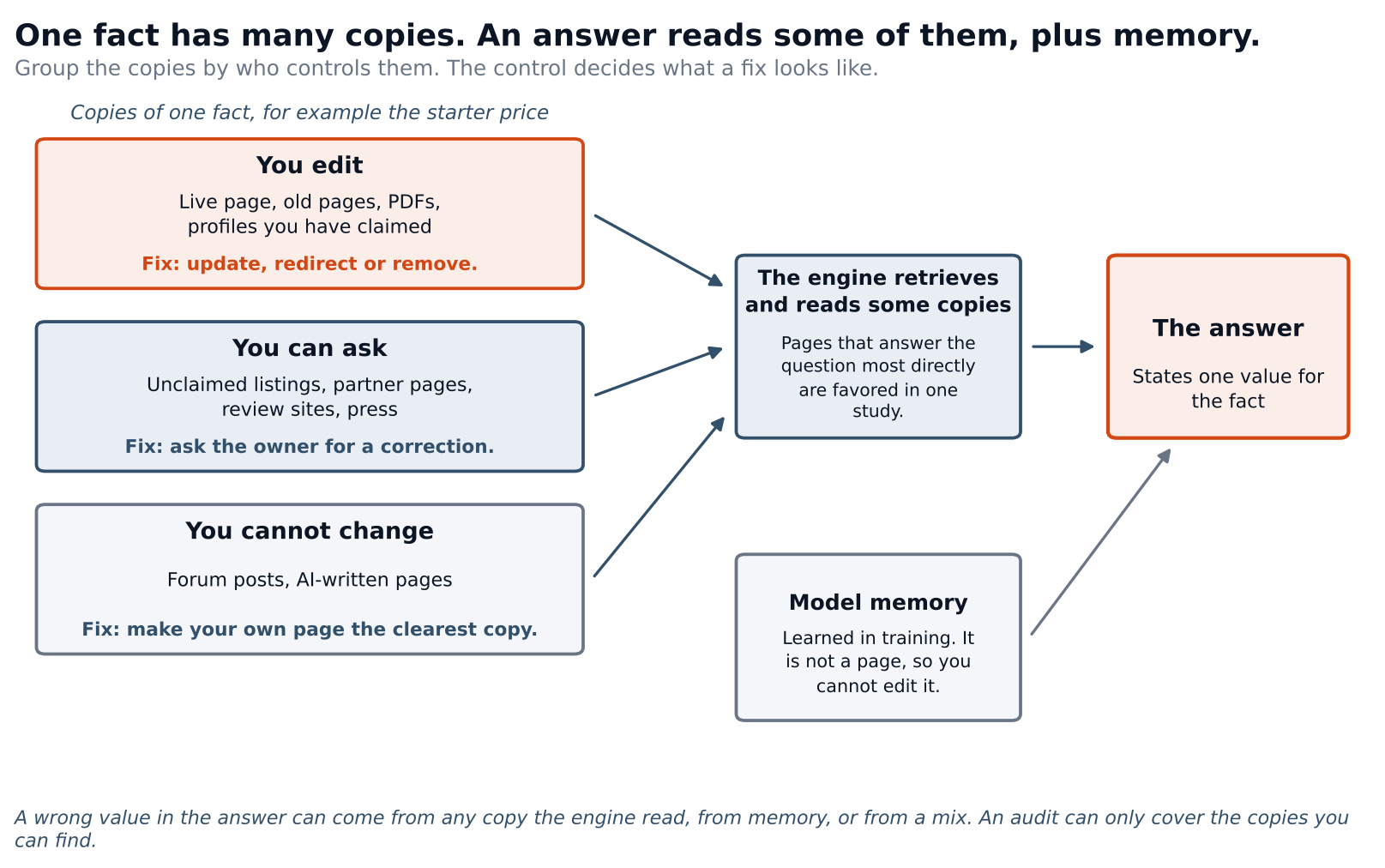
When an answer states something about your brand, the claim comes from one of three places, or a mix. The first is the model's memory, learned in training. You cannot edit memory, and it can be out of date. The second is the pages the engine retrieves while answering: the engine runs a search, reads some of what comes back and writes from it. The third is not a separate source but the thing the second one reads: the many copies of your facts that exist across the web.
Most of what you can change sits in the third place. You cannot see which of the three produced a given claim, but you can see the copies, and a fact that has copies in disagreement gives a retrieving engine something wrong to read. That is why the useful question is not only "why did the answer say that?" but also "where else does that value appear?"
What research says about where answers draw from
A University of Toronto paper, published at an EDBT/ICDT 2026 workshop, compared the sources behind rankings from Google Search, GPT-4o, Claude 4.5 Sonnet, Gemini 2.5 Flash and Perplexity Sonar Pro on 1,000 consumer ranking queries. The overlap between each AI engine's sources and Google's top ten was low: on average 4.0 percent for GPT-4o, 11.1 for Gemini, 12.6 for Claude and 15.2 for Perplexity.
On consideration queries, between 59 and 86 percent of the sources the AI engines used were third-party "earned" sources such as reviews and articles, and on transactional queries between 52 and 68 percent were brand sites. In a GPT-4o case study, rankings of niche entities moved more when the retrieved snippets were shuffled than rankings of popular ones, and about 16 percent of the entities in generated rankings did not appear in any retrieved snippet. The queries are consumer topics such as electronics and cars, many are templated, the source labels came from GPT-4o with a spot check, and the memory analysis covers one model (Chen, Wang, Chen and Koudas, University of Toronto).
A UC Berkeley paper tested what makes a model prefer one passage over a conflicting one. It used 238 controversial yes or no questions and 2,208 web paragraphs. Relevance to the question mattered most. Style mattered little: adding scientific references or a confident tone had neutral to negative effects in its edits. The paper also found that a model's rating of a passage's credibility on its own did not track which passage it chose when two competed. The study compared only two passages at a time, covers text only with no URLs or dates, and uses controversial questions, not company facts (Wan, Wallace and Klein, UC Berkeley).
A paper at ICLR 2024 tested what happens when retrieved evidence contradicts what a model already holds in memory. It reports that models can be highly receptive to evidence that conflicts with memory when the evidence is coherent and convincing, and that they show a strong confirmation bias when the evidence mixes content that agrees with memory and content that does not. The pages we read gave no numeric results (Xie et al., ICLR 2024).
A Northwestern University audit checked the pages that four engines cited for 712 queries on politics, health and the environment. One detector flagged about 16 percent of the pages it could read as likely AI-generated, ranging from 7.3 percent of ChatGPT's citations to 27.8 percent of Copilot's. The authors describe their figures as a lower bound. The queries were English and U.S.-focused, one detector did the flagging, and more than 7,000 cited sources could not be read (Allaham and Diakopoulos, arXiv 2605.23684).
Our reading, not the studies' conclusions: a brand's own site is one source among many, and engines lean on third-party pages for the comparison questions buyers ask early. A smaller brand has less memory to fall back on, so what the engine retrieves counts for more. When two copies disagree, how directly a page answers the question may count for more than how authoritative it sounds. And AI-written pages are now a source that can repeat a stale value without any person ever checking it.
Your fact has more copies than you think
A fact leaves your site the day you publish it. It spreads into documents, listings, partner pages, reviews, articles and forum posts, and each copy ages on its own schedule. The table groups the places to look by how much control you have over them.
| Where the copy lives | Control | Typical way it drifts |
|---|---|---|
| Your live page | You edit | Rarely wrong, but not always the clearest statement |
| Old pages still live on your site | You edit | Never updated or redirected after a change |
| PDFs, decks and datasheets | You edit | Frozen at the date of export and still downloadable |
| Directory profiles you have claimed | You edit | Updated once and forgotten |
| Directory listings you have not claimed | You can ask | Copied from an old source |
| Partner and reseller pages | You can ask | Written once from your launch material |
| Review sites and press | You can ask | Reflect the facts on the day they were written |
| Forum and community posts | You cannot change | Quote what the poster remembered |
| AI-written summary pages | You cannot change | Repeat whichever copy the writer used |
The control column is our suggestion. A claimed directory profile is yours to edit. An unclaimed one may only be fixable by asking. The worksheet lets you change the assignment.
Find every copy of one fact
Start with one fact that changes often and matters to buyers, such as a price, a plan name or an integration. Then search for it where copies hide.
- Write the approved value and the own page that states it. This is your master record entry. The PR and comms post covers the fact sheet that holds these.
- Search your own site for the old value and for old names, including archived pages, help articles, PDFs and downloads.
- Search for the fact in directories, partner and reseller pages, review sites and press, using both your current and former wording.
- Search forums and community posts, and look for AI-written summary pages that mention you.
- Log each copy with where it appears, its source type, the value it states, the date it was last updated, and a rating from 1 to 3 for how directly it answers a buyer question.
Count the disagreement before you count errors
An audit gives you a different number from an error count. Instead of "the answer got the price wrong," it gives you the share of copies that agree with your record. For each fact, divide the copies that match by the copies that match or differ, and leave out any you cannot judge.
In the worksheet's invented example, 60 copies of 10 facts were logged. 23 of them, 38 percent, differ from the record, and every one of the 10 facts has at least one differing copy. The example is built to be messy, so do not read the rates as typical. The pattern by source type is the useful part of it.
| Where the copy lives | Copies | Copies that differ |
|---|---|---|
| Your live page | 10 | 0 |
| Old pages on your site | 7 | 5 |
| PDFs and documents | 5 | 4 |
| Directory profiles you claimed | 4 | 1 |
| Directory listings you did not claim | 9 | 3 |
| Partner and reseller pages | 5 | 3 |
| Review sites | 6 | 1 |
| News and analyst pages | 5 | 1 |
| Forum and community posts | 4 | 2 |
| AI-written pages | 5 | 3 |
In the example, 10 of the 23 differing copies are on pages the brand edits, 8 are on pages it could ask someone to change and 5 are on pages it cannot change. Old pages and PDFs account for 9 of the 10. If your own audit looks like this, the first work is housekeeping on your own site, and it is the part you fully control. If your audit looks different, believe the audit.
Stale copies deserve a second look even when they match. In the example, 15 matching copies are older than the 365-day threshold on the Settings tab. They are not errors, but they are the copies that will be wrong the next time the fact changes.
Why one stale copy matters
It is tempting to treat a single outdated copy as noise. Figure 2 shows why that is risky. It is a model, not a measurement, and it assumes an engine reads copies at random from the set, which real engines do not.
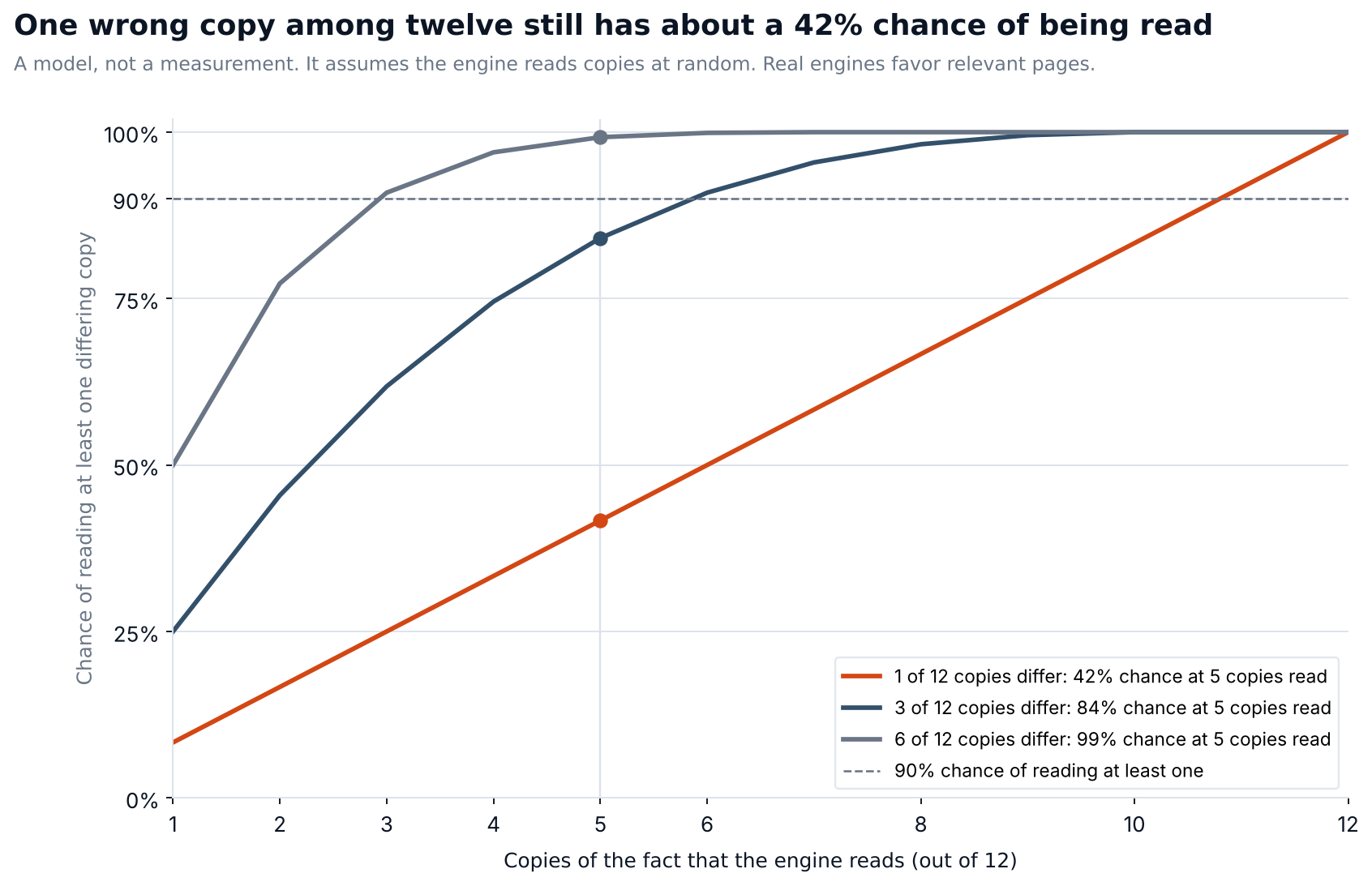
Figure 2. A model, not a measurement. It assumes the engine reads copies at random. Real engines may favor relevant pages.
With one differing copy among twelve and five copies read, the chance of reading it is 42 percent. With three differing copies it is 84 percent, and with six it is 99 percent. A fact like the starter price in the example, with 9 copies and 4 that differ, comes out at 99 percent when an engine reads five. A fact with 7 copies and 1 that differs comes out at 71 percent.
Real engines are not random. The Berkeley result suggests that a differing copy which answers the question directly, such as a page titled "Pricing," is more likely to be read than the model implies, and a buried one less likely. That is why the worksheet asks for a retrievability rating and multiplies it by the fact's harm rating to rank the copies.
Decide the order of fixes
You will find more differing copies than you can fix this month. Rate each fact's harm from 1 to 3: 1 for a minor detail, 2 for something that changes a buying decision such as price or an integration, and 3 for legal, safety, compliance or reputational exposure. Multiply it by the copy's retrievability rating. The score runs from 1 to 9, and the tier cut-offs are yours to set. A score is a sorting aid. Anything involving legal, safety, compliance or privacy exposure goes to the right owner whatever its number, and the earlier post on regulated industries covers who that owner usually is.
Then act according to control. These are our recommendations, and none has a measured effect on later answers.
For copies you edit, correct the live page first, then update or redirect old pages and replace PDFs with current versions, or take them down. Keep one current page per fact and make it the clearest statement, in plain text near the top, so that a page which answers the buyer's question directly is also the page that is right.
For copies you can ask someone to change, send a specific request that gives the page address, the wrong value, the right value and the source of truth, and keep a log of the request and the date. Claim any profile you can.
For copies you cannot change, such as forum posts and AI-written pages, do not chase them. Make your own page the clearest and most direct copy, keep tracking the prompt, and record these as known unfixable copies so nobody spends a week on them. The same goes for mentions versus citations: an engine can cite your page and still state a value from somewhere else.
After a round of fixes, ask the same prompt again with the same wording, as the post on query phrasing explains, and check whether the answer changed. A change is encouraging. No change means you have not yet found the copy the engine is reading.
Audit the footprint in a worksheet
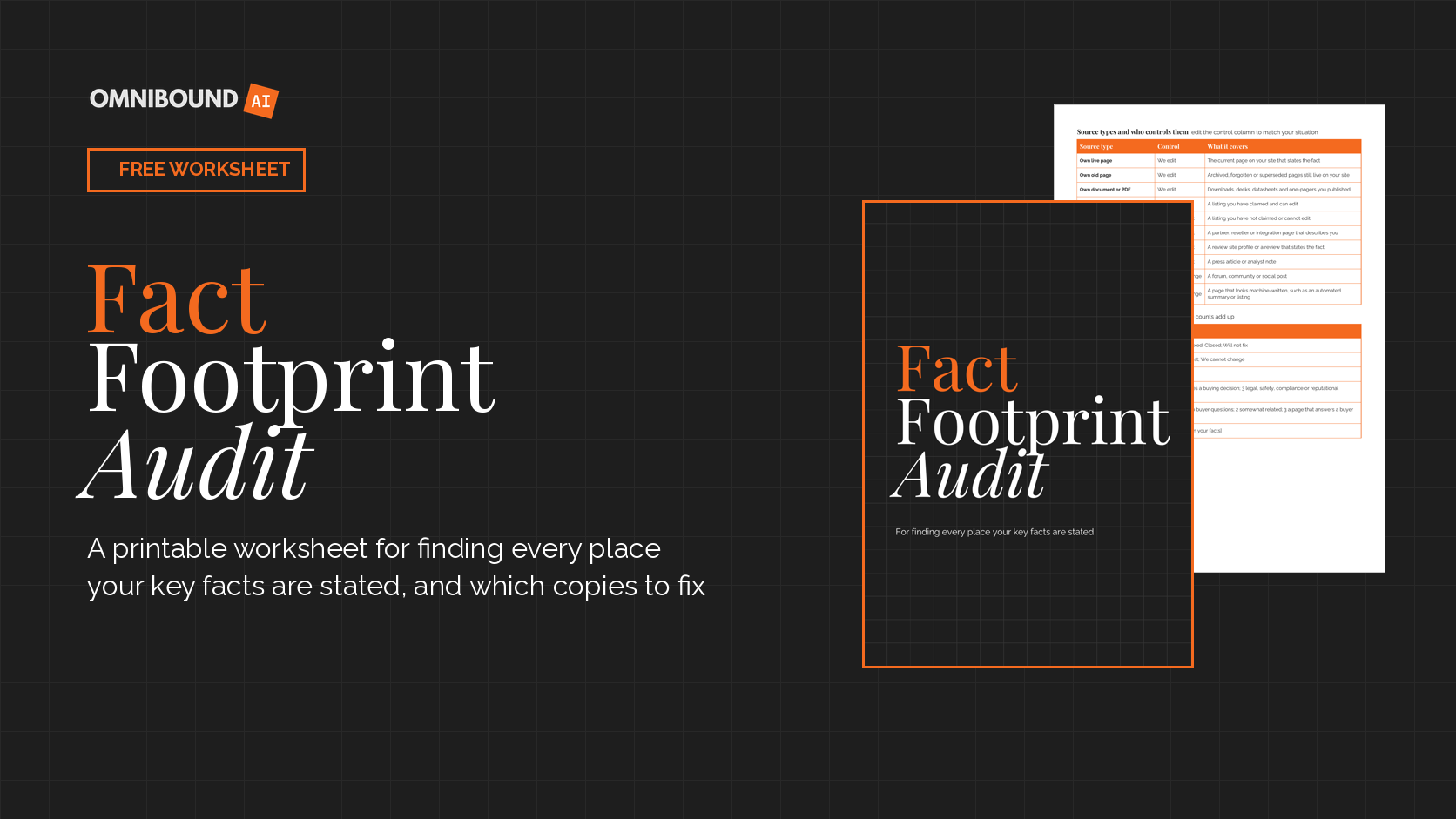
The worksheet has a settings tab, a master facts tab, a copies log and a summary. Grey rows are invented examples for an invented brand, so replace them before you read any output. Do not enter customer or personal information anywhere in it.
- On the Settings tab, set the stale threshold, the number of copies you assume an engine reads and the tier cut-offs, and check the control assigned to each source type.
- On the Master facts tab, enter each fact with its approved value, own page, owner, harm rating and the date you last verified it.
- On the Copies tab, log each copy with its source type, the value it states, whether that matches your record, the date it was last updated and its retrievability rating.
- For each differing copy, set a status and an owner, and record the date you fixed it or asked for a fix.
- On the Summary tab, read agreement by source type and by control, the facts with the most disagreement, the retrieval model and the top ten copies to fix.
Frequently asked questions
Where does ChatGPT get its information about my company?
From two places, and you cannot see which one produced a given claim. One is what the model learned in training. The other is pages it retrieves when it searches. The Toronto study found that engines' sources overlapped little with Google's top results, so do not assume the pages you rank for are the pages an engine reads.
Does fixing my website fix the answer?
Fixing your own pages removes the copies you control. It does not remove copies on other sites or anything from memory. We found no study showing how much a page fix changes later answers, so fix it, ask the same prompt again and record what happens.
How many copies of a fact is normal?
We found no benchmark. In the invented example, the price had nine copies and the headquarters six. Count your own, and treat the number as a measure of how much checking the fact needs.
Are AI-written pages a problem?
They can be, because one can repeat a stale value without anyone having checked it. The Northwestern audit found that a share of cited pages looked AI-generated, but it did not test whether they carried more errors. You cannot edit them, so make your own page the clearest copy.
How often should we re-run the audit?
Match it to how fast each fact changes. Prices and plan names might be audited monthly, integrations and security status quarterly, and founding year or headquarters twice a year. Run it again after any product, pricing or naming change.
List every place your price is stated this week
Pick one fact that buyers ask about, such as your starter price or one integration. Write down the approved value and the page that states it. Then search your own site, your PDFs, your claimed and unclaimed listings, your partner pages and a few review and forum sites for that fact, using the current and the former wording. Log each copy and mark whether it matches. Count how many differ and who controls them. Do not put customer or personal information in the log.
If you want to see what one engine says about that fact before you start searching, the AI Search Visibility Checker gives you a first reading on a prompt. If you want to ask the same question again after each fix, AI Search Intelligence tracks individual prompts.